

With maximum penalties for material omissions in CFIUS submissions reaching 5 million dollars per occurrence in 2026, the margin for error in international capital deployment has effectively vanished. You likely recognize that information asymmetry in foreign markets remains the primary catalyst for sophisticated financial instrument fraud; a reality that standard data room reviews often fail to address. To protect capital in an era of heightened scrutiny, a robust strategy for cross-border regulatory due diligence must move beyond passive checklists toward a model of active, on-ground verification.
This article provides a comprehensive framework for managing the complexities of multi-jurisdictional deployment with the precision and discretion expected by institutional entities. We’ll examine how to reconcile regulatory divergence between major hubs, specifically addressing the implications of the new EU Foreign Investment Screening Regulation 2026/1386. By integrating audit-grade validation of financial instruments with a measured, logical approach to risk mitigation, you can ensure that your strategic growth is anchored in absolute technical accuracy and long-term preservation.
Key Takeaways
- Identify the critical friction points within the 2026 global landscape by analyzing the widening regulatory divergence between Western financial hubs and emerging markets.
- Implement a sophisticated framework for cross-border regulatory due diligence that transcends standard checklists to address the specific nuances of multi-jurisdictional capital deployment.
- Understand why digital documentation is an insufficient basis for high-stakes transactions and how on-ground physical verification provides the necessary audit-grade certainty.
- Establish a structured institutional KYC and AML screening process that aligns strategic mandates with the rigorous technical requirements of global regulatory bodies.
- Secure the long-term integrity of complex projects through the strategic oversight of independent advisors who possess the Tier-1 banking experience required for meticulous risk mitigation.
The Evolving Landscape of Multi-Jurisdictional Capital Deployment
The global investment paradigm of 2026 has transitioned into a fragmented, multi-polar reality where capital no longer flows through a singular, Western-centric funnel. As financial hubs in Hong Kong, Singapore, and Geneva establish increasingly distinct regulatory identities, the necessity for robust cross-border regulatory due diligence has evolved from a secondary administrative task into a primary strategic imperative. We’re seeing a significant rise in regulatory divergence, where the technical requirements of the Swiss FINMA and the Hong Kong SFC often demand entirely different levels of disclosure and verification. Traditional models often falter because they treat compliance as a static data gathering exercise, ignoring the profound information asymmetry that exists within opaque foreign markets. In this environment, where sophisticated actors exploit the friction between jurisdictions, the Swiss Alpha Matrix standard provides a necessary layer of institutional-grade protection, ensuring that capital deployment is rooted in verified physical reality rather than mere digital representations.
Regulatory Uncertainty and Market Fragmentation
The modern due diligence process must now account for a widening chasm between the regulatory expectations of different financial centers. While Western jurisdictions emphasize rigid transparency through mechanisms like the 2026 EU Foreign Investment Screening Regulation, emerging markets often present a volatile mix of strict local mandates and fluctuating enforcement. Geopolitical shifts have rendered many historical international agreements fragile, making it essential to maintain a dynamic risk management framework. Such a framework doesn’t just observe local laws; it actively anticipates how regional instability might compromise the validity of cross-border contracts or the enforceability of security interests. It’s not enough to rely on centralized data management; one must understand the local political climate that dictates how those regulations are actually applied on the ground.
The Institutional Mandate for Precision
True security requires moving past “check-box” compliance to embrace high-level executive intelligence. Senior experts, particularly those with Tier-1 banking backgrounds, possess the seasoned intuition required to identify the subtle transactional anomalies that automated systems inevitably miss. This level of scrutiny establishes a definitive baseline for cross-border investment due diligence, ensuring that every instrument and counterparty is subjected to the same rigorous standards of verification. By prioritizing intellectual depth over simple data processing, investors can navigate the complexities of 2026 with the quiet confidence that their interests are shielded by professional excellence and regional precision. This approach transforms due diligence from a hurdle into a competitive advantage, allowing for decisive action in markets where others see only opacity and risk.
Navigating Regulatory Divergence and Geopolitical Risk
Regulatory divergence has crystallized as the preeminent obstacle for sophisticated capital deployment in 2026. It’s no longer sufficient to view compliance as a monolithic global standard; instead, institutional investors face a landscape defined by jurisdictional friction. This friction is most evident when contrasting the rigid oversight of European bodies with the unpredictable volatility often found in emerging markets. While statutory texts may appear uniform on the surface, the reality of local enforcement mechanisms often tells a different story. Effective cross-border regulatory due diligence requires an intimate understanding of these nuances, specifically how a jurisdiction’s underlying political climate dictates the actual application of law. Structuring a deal today means preparing for multi-layered compliance hurdles and rapidly shifting sanctions regimes that can render a transaction non-compliant overnight if not proactively managed.
The Swiss Standard of Compliance
Maintaining the highest standards of integrity requires a seamless integration of international financial regulations into every phase of the investigative process. This isn’t merely about meeting minimum requirements; it’s about producing audit-grade documentation that satisfies the most rigorous global stakeholders and regulatory bodies. In the context of private wealth management, we navigate the delicate intersection of traditional Swiss discretion and modern global transparency mandates. This balance ensures that while privacy is respected, every movement of capital is backed by an unassailable record of legitimacy. For those managing complex portfolios, establishing an institutional risk management framework is the only way to ensure long-term stability and strategic growth.
Counterparty Risk in Emerging Jurisdictions
In emerging markets, the institutional reliability of local financial entities can’t be taken for granted. We utilize sophisticated metrics, including the Geopolitical Risk Index, to assign a precise risk score to every mandate or geographic region. For instance, while Switzerland maintains a stable score of 2.45, other major hubs like China at 4.43 or the USA at 4.17 present higher levels of inherent complexity that require a more granular approach. Mitigating this exposure involves:
- Conducting deep-dive institutional KYC to verify the moral character and professional track record of counterparties.
- Assessing the distinct gap between a nation’s written statutory text and its historical enforcement trends.
- Implementing independent oversight and sophisticated frameworks to monitor counterparty reliability throughout the project lifecycle.
By prioritizing these strategic pillars, investors can navigate the friction of 2026 with the calm, unwavering pace that defines seasoned expertise. This methodology ensures that interests are in the hands of unemotional experts who prioritize preservation over short-term speculation.
Beyond the Data Room: The Criticality of On-Ground Verification
Digital documentation, while ostensibly efficient, often serves as a sophisticated veil for operational inadequacies or deliberate misrepresentation. Relying solely on virtual data rooms during cross-border regulatory due diligence invites a level of risk that no institutional-grade framework should tolerate, particularly as fraudulent actors become more adept at mimicking the aesthetics of legitimacy. It’s here that the Swiss Alpha Matrix methodology distinguishes itself, moving beyond the screen to bridge the gap between digital claims and physical reality through rigorous on-ground verification. We’ve observed that high-stakes capital deployment requires a forensic approach that treats every digital file as a hypothesis rather than a fact. When audit-grade paperwork masks operational voids or ghost entities, only a physical presence can reveal the truth, ensuring that your strategic growth isn’t built on a foundation of clandestine paper-only structures.
Physical Asset and Entity Validation
The process of site visits and face-to-face counterparty interviews remains the most reliable defense against sophisticated fraud. We don’t merely tour facilities; we conduct exhaustive inspections to verify the operational capacity and infrastructure of foreign subsidiaries. This level of scrutiny is essential for identifying structures designed solely to facilitate capital flight or obscure the true nature of a counterparty’s moral character. By assessing the tangible reality of an entity’s presence, we ensure that the institutional mandate for precision is upheld, protecting global stakeholders from the fallout of jurisdictional friction or regulatory flux. It’s a measured, logical progression from broad principles to specific, physical proof.
Instrument Validation and Financial Discipline
In the context of multi-jurisdictional transactions, the integrity of financial instruments is paramount. We apply specialized bank instrument validation services to every cross-border deal, verifying SBLCs, LCs, and Guarantees directly at the source bank. This direct communication bypasses intermediaries and potential points of failure, ensuring that all financial instruments used in the transaction maintain their audit-grade status. Don’t assume that a digital copy of a guarantee reflects its current standing; instead, rely on a framework that demands technical accuracy and regional precision. This disciplined approach to validation provides the quiet authority and professional calm necessary to navigate the complexities of 2026 with confidence, ensuring that your interests remain in the hands of seasoned, unemotional experts.
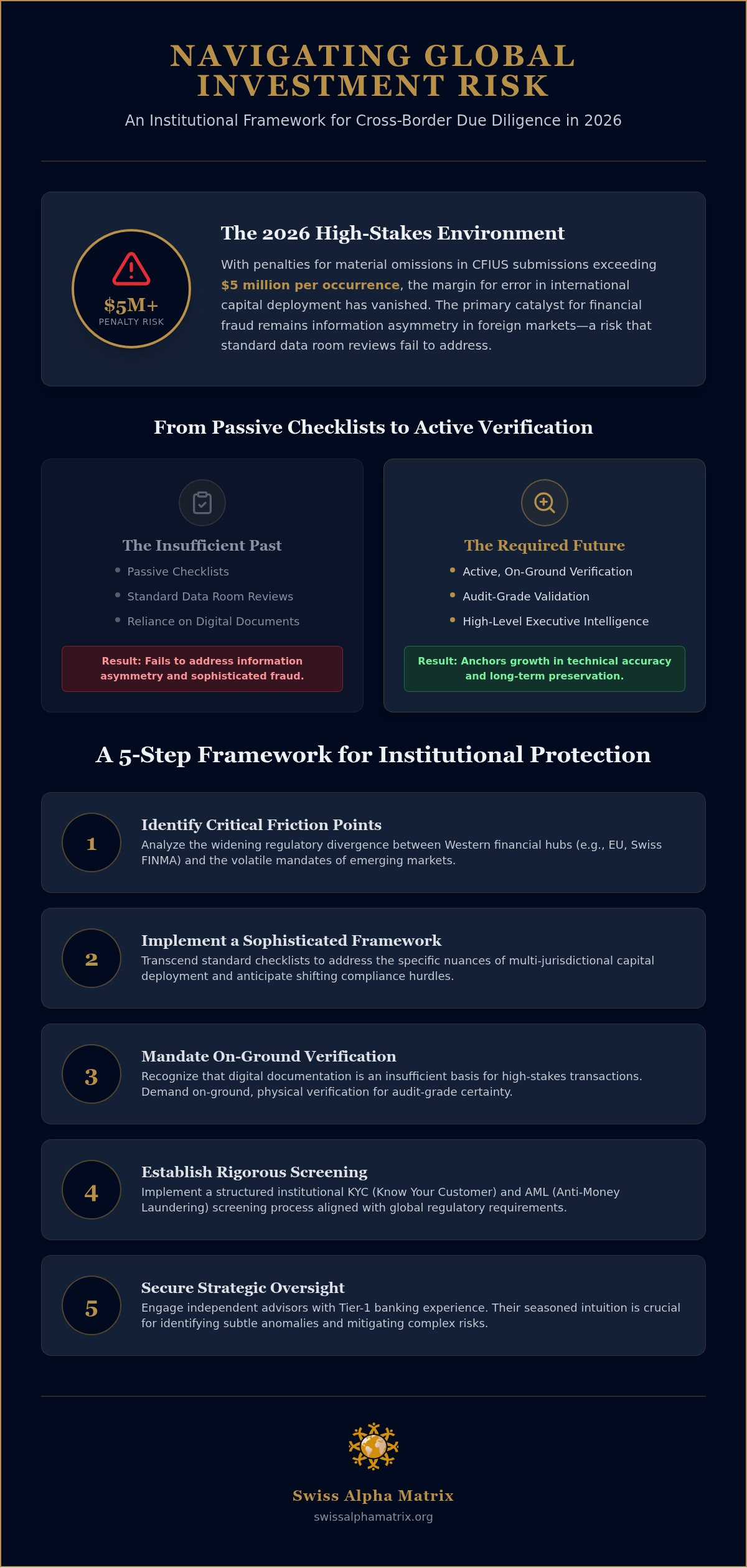
Operational and Regulatory Due Diligence: A 2026 Framework
The contemporary investment environment demands a methodology that rejects the superficiality of automated checklists, opting instead for a measured, logical sequence of investigative pillars. A robust cross-border regulatory due diligence framework must be designed to withstand the scrutiny of institutional boards while addressing the inherent opacity of fragmented markets. In an era where speed often compromises intellectual depth, we prioritize a structured approach that moves from broad philosophical alignment down to specific, technical verification. This five-step architecture ensures that every facet of a transaction is scrutinized by seasoned experts who prioritize long-term preservation over short-term speculation.
- Step 1: Strategic Alignment and Mandate Definition. We begin by establishing clear parameters with executive stakeholders to ensure the investigative scope mirrors the entity’s specific risk appetite and long-term growth objectives.
- Step 2: Deep-Dive Institutional KYC/AML Screening. Utilizing former Tier-1 banking expertise, we conduct exhaustive screenings across multiple jurisdictions to identify subtle anomalies in counterparty moral character and historical reliability.
- Step 3: Multi-Jurisdictional Regulatory Analysis. We align the transaction with the latest statutory requirements, ensuring absolute compliance with evolving standards from bodies such as the Swiss FINMA and the Hong Kong SFC.
- Step 4: Physical On-Ground Verification. As previously established, we bridge the gap between digital data rooms and physical reality through site visits and operational audits of key assets.
- Step 5: Final Risk Synthesis and Executive Reporting. The process concludes with a comprehensive consolidation of findings into a high-level intelligence report designed for definitive board-level review.
Building the Institutional Risk Matrix
Effective deal structuring requires a sophisticated weighting of jurisdictional, operational, and financial risks within a centralized reporting matrix. By applying institutional-grade financial advisory methodologies, we move beyond binary outcomes to establish precise Go/No-Go thresholds based on precision-grade intelligence. This intellectual depth ensures that capital is only deployed when the risk profile aligns perfectly with the stakeholder’s mandate for preservation. It’s a refusal to oversimplify complex dynamics, catering instead to a sophisticated audience that values nuance and technical accuracy.
Stakeholder Reporting and Transparency
The final stage of the framework involves translating complex regulatory findings into clear, executive-level intelligence that facilitates decisive action. Every report must meet audit-grade standards, providing the board with the calm confidence required to make high-stakes decisions in volatile markets. Throughout this investigative lifecycle, we maintain absolute confidentiality and Swiss discretion, treating your interests with the same reverence as a traditional private wealth mandate. To secure your next global deployment against the friction of regulatory divergence, we invite you to implement a bespoke risk management framework tailored to your specific jurisdictional needs.
Strategic Oversight: The Role of Independent Advisory
The successful deployment of multi-billion dollar capital doesn’t conclude with the final signature on a contract. It requires a sustained, high-level oversight that only seasoned professionals with Tier-1 banking experience can provide. While many software-driven competitors offer automation, they lack the intellectual depth and master planner persona required to navigate the subtle shifts in jurisdictional friction that emerge throughout a project’s lifecycle. At Swiss Alpha Matrix, we serve as a protective authority, bridging the gap between the initial cross-border regulatory due diligence and the long-term execution of complex mandates. Our approach merges the technical accuracy of institutional finance with the traditional discretion of a boutique Swiss entity, ensuring that interests remain shielded from both market volatility and regulatory flux.
Implementing the independent financial project management model allows stakeholders to maintain a measured, logical pace throughout the deal’s duration. This specialized oversight ensures that the original strategic alignment isn’t lost in the administrative complexities of post-closing operations. It’s a commitment to stability that prioritizes long-term preservation over the frantic energy of short-term speculation.
Managing the Deal Lifecycle Post-Diligence
The transition from due diligence to operational oversight is a critical phase where many institutional projects falter. Ongoing regulatory monitoring is essential, particularly in jurisdictions where enforcement trends can shift rapidly alongside the political climate. By maintaining a constant tether to regional precision, an independent advisor identifies emerging risks before they compromise the transaction’s integrity. This protective stance transforms the advisory role into a master planner, overseeing everything from counterparty reliability to the continued validity of bank instruments. It’s a professional calm that recognizes the fluidity of the 2026 global financial landscape and prepares for it with unwavering logic.
Engagement and Mandate Precision
Every engagement we undertake is rooted in hyper-personalization and a refusal to prioritize deal volume over technical precision. We structure bespoke mandates that reflect the unique requirements of each institutional client, ensuring that cross-border regulatory due diligence remains a dynamic, rather than static, component of the project. Our persona is elite yet accessible to those who value moral character and high-level standards. We invite you to experience a standard of service that is broad in reach yet meticulous in its attention to detail. To initiate a confidential review of your current deployment strategy and secure your interests, Consult with our senior advisors.
Securing the Future of Global Capital Deployment
The complexities of the 2026 financial landscape demand a departure from passive compliance models that rely solely on digital representations. As we’ve established throughout this framework, navigating the widening chasm between global financial hubs necessitates a sophisticated approach to cross-border regulatory due diligence that prioritizes technical accuracy over administrative speed. By merging physical on-ground verification with audit-grade instrument validation, institutional investors can navigate the nuances of multi-jurisdictional friction with the quiet confidence that their capital is anchored in reality. This methodology, led by former senior executives from Tier-1 global banks, ensures that your interests are managed by seasoned experts who prioritize long-term preservation and strategic growth over short-term speculation. As a dedicated partner to the world’s most sophisticated institutional stakeholders, we provide the regional precision and Swiss discretion required to protect your global interests. To ensure your next deployment is fortified by institutional-grade intelligence and master planning, we invite you to engage Swiss Alpha Matrix for your next cross-border mandate. It’s a standard of service that transforms risk management into a definitive competitive advantage.
Frequently Asked Questions
What are the most common red flags in cross-border investment due diligence?
Red flags often manifest as significant gaps in a counterparty’s institutional history or an inability to produce audit-grade documentation for high-value assets. We specifically look for “ghost entities” that exist only within digital data rooms but lack a physical infrastructure. These operational voids often indicate a high risk of capital flight or sophisticated financial instrument fraud that standard checklists frequently miss.
How does on-ground verification differ from standard operational due diligence?
While standard operational due diligence focuses on administrative review and data management, on-ground verification involves the physical inspection of assets and facilities. This higher standard of cross-border regulatory due diligence ensures that the entities and infrastructures reported in legal filings actually exist. It’s the difference between reviewing a balance sheet and physically validating the tangible inventory it represents.
Why is bank instrument validation critical for international transactions?
Bank instrument validation is the only way to ensure the legitimacy of SBLCs, LCs, and Guarantees in a multi-jurisdictional environment. We verify these instruments directly at the source bank to bypass intermediaries who might present forged or expired documents. This technical accuracy is vital for protecting capital from the surge in sophisticated instrument fraud observed in the 2026 landscape.
How do you navigate differing data privacy laws during cross-border DD?
Navigating data privacy requires a hyper-personalized framework that aligns with the strictest local regulations, such as those governed by the Swiss FINMA or the EU’s evolving 2026 standards. We utilize secure, discreet channels to manage information flow, ensuring that transparency requirements are met without compromising the privacy of institutional stakeholders. This measured approach maintains the balance between global disclosure and regional precision.
What is the role of independent advisory in complex financial project management?
An independent advisor acts as a protective authority, overseeing the entire project lifecycle from initial mandate definition to post-closing monitoring. This role is critical for managing the friction of regulatory divergence, as it provides an unemotional, expert perspective that prioritizes long-term stability. It ensures that complex project management remains logically structured and aligned with the executive stakeholder’s original vision.
How long does a comprehensive cross-border due diligence process typically take?
The timeline for a comprehensive cross-border regulatory due diligence process is dictated by the complexity of the jurisdictions involved and the depth of verification required. While some administrative reviews conclude quickly, a forensic investigation involving on-ground site visits typically spans four to eight weeks. We prioritize technical accuracy and thoroughness over artificial deadlines to ensure that no detail is overlooked.
Can AI replace the need for physical due diligence in 2026?
AI cannot replace the necessity for physical due diligence because it lacks the ability to verify the material reality of a counterparty’s facilities or the moral character of their leadership. While digital tools improve data processing, they often fail to detect the subtle anomalies that a seasoned expert identifies during a face-to-face interview. True security in 2026 relies on a hybrid model that merges digital validation with physical proof.
How does Swiss Alpha Matrix ensure discretion during high-stakes investigations?
Discretion is maintained through a combination of rigorous internal security protocols and a historical commitment to regional precision. We treat every mandate as a high-stakes investigation, utilizing secure communication channels and limiting information access to a select group of former Tier-1 bank executives. This approach mirrors the traditional discretion of Swiss private wealth management, ensuring your interests remain private and secure.