

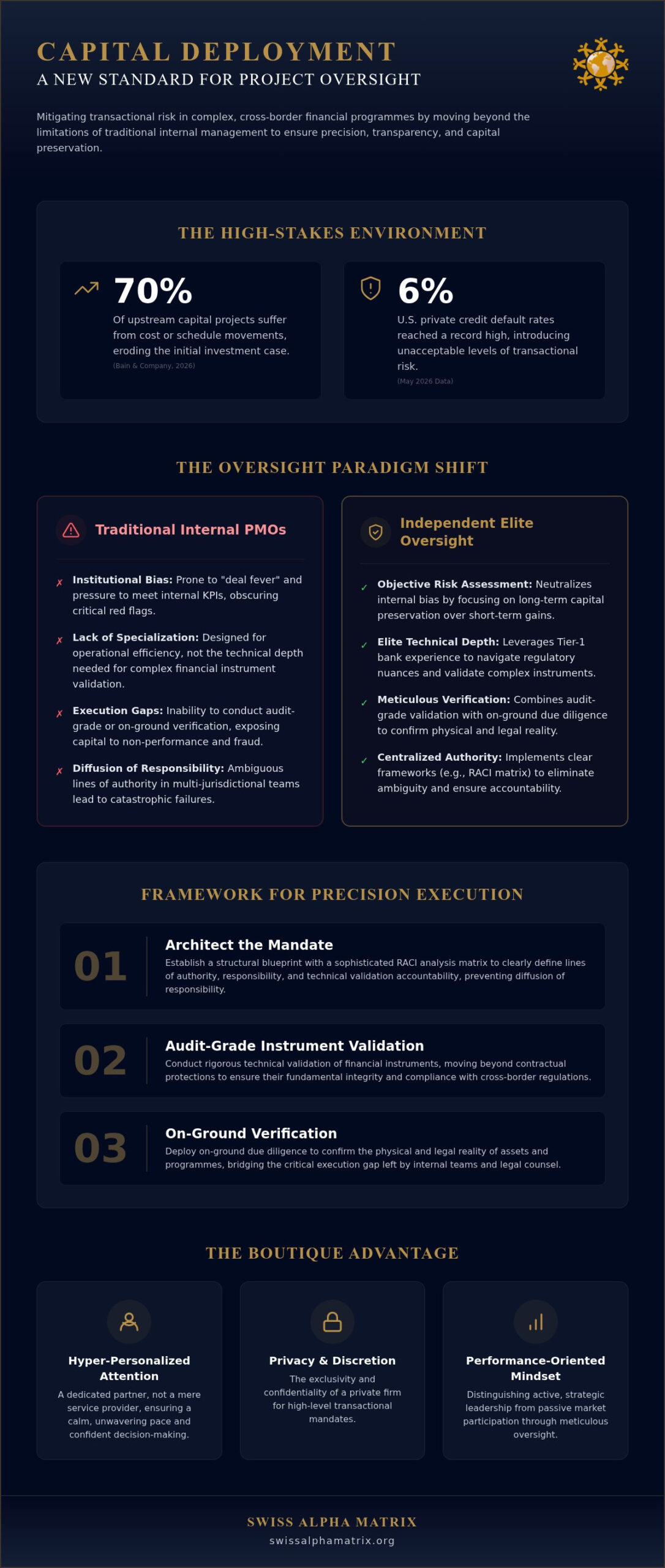
A July 2026 report from Bain & Company reveals that seventy percent of upstream capital projects suffer from cost or schedule movements that fundamentally erode the initial investment case. In an environment where U.S. private credit default rates reached a record six percent in May 2026, the reliance on internal project management offices, which often lack the specialized technical depth to validate complex financial instruments, introduces unacceptable levels of transactional risk. You likely recognize that the traditional approach to capital deployment project management requires a more sophisticated, independent layer of oversight to navigate the intricacies of cross-border regulatory frameworks and information asymmetry.
This article explores how elite, independent oversight mitigates transactional risk and ensures the precise execution of complex cross-border financial programmes. We’ll examine the strategic architecture required to achieve total transparency and audit-grade verification, moving beyond the inherent limitations of internal teams to secure the long-term preservation of capital through meticulous on-ground validation and sophisticated risk management frameworks. By the conclusion, you’ll understand how these modern strategies, tethered to concepts of regional excellence, distinguish a performance-oriented mindset from that of passive participants in the global market.
Key Takeaways
- Recognize why internal project management offices frequently lack the specialized technical depth required for 2026 cross-border deals and how independent oversight addresses these systemic vulnerabilities.
- Learn to architect a robust mandate by establishing precise lines of authority and integrating international financial regulations into a sophisticated project timeline.
- Identify how to neutralize institutional bias and “Deal Fever” through professional capital deployment project management that prioritizes objective risk assessment over internal corporate performance indicators.
- Gain insights into a rigorous execution framework that combines audit-grade instrument validation with on-ground verification to ensure the physical and legal reality of complex financial programmes.
- Understand the strategic advantage of a boutique approach that provides hyper-personalized attention and the discretion of a private firm for high-level transactional mandates.
The Evolution of Capital Deployment Project Management in High-Stakes Transactions
The landscape of institutional finance has undergone a profound metamorphosis, moving away from the era of straightforward asset acquisition into a period defined by intricate, multi-jurisdictional complexity. In 2026, the successful deployment of capital is no longer a singular event but a continuous exercise in high-stakes coordination. This shift necessitates a transition from traditional investment models to a more rigorous discipline of capital deployment project management. While many organizations rely on the foundational concepts of Project Portfolio Management to align their broader objectives, the specific execution of non-standard financial transactions requires a level of technical precision that standard corporate frameworks often fail to provide. It’s no longer enough to manage a timeline; one must manage the technical integrity of the financial instruments themselves.
The Limitations of Internal PMO Frameworks
Traditional internal Project Management Offices (PMOs) are frequently designed for operational efficiency rather than the specialized rigour required for cross-border financial instrument validation. These internal structures often suffer from institutional bias, where the pressure to meet quarterly KPIs can lead to “deal fever,” obscuring critical red flags that an external eye would catch. While legal counsel provides necessary contractual protections, they rarely possess the operational expertise to conduct the audit-grade verification of financial instruments or the on-ground due diligence necessary to confirm physical reality. This execution gap is where momentum is lost. It’s where capital is exposed to non-performance or fraudulent activity because the internal team lacks the technical depth to challenge the counterparty’s claims.
The Protective Authority of Independent Mandates
To bridge this gap, sophisticated investors are increasingly turning toward independent financial project management as a dedicated risk-mitigation discipline. This approach removes the emotional and institutional weights that often cloud internal decision-making. By engaging experts with former Tier-1 bank experience, a mandate gains an insider’s perspective on the technical hurdles and regulatory nuances of global finance. The independent advisor serves as a master planner, ensuring that capital deployment project management remains focused on long-term preservation and strategic growth rather than short-term speculative gains. This elite level of oversight provides a reassuringly formal structure, prioritizing technical accuracy and moral character in every transaction phase. It’s a boutique approach that values privacy and exclusivity, positioning the advisor as a dedicated partner rather than a mere service provider. Through this lens, complex financial programmes are executed with a calm, unwavering pace that encourages confidence in the most intricate decision-making processes.
Architecting the Mandate: Core Pillars of Professional Project Oversight
The architecture of a high-level mandate requires more than a cursory schedule; it demands a structural blueprint that defines the boundaries of authority and the depth of verification. Central to this is a sophisticated RACI analysis matrix, which serves to eliminate the ambiguity that frequently plagues cross-border transactions by clearly delineating who is accountable for the technical validation of assets and who is responsible for regulatory alignment. Such a framework prevents the catastrophic diffusion of responsibility that often occurs when multi-jurisdictional teams operate without a centralized, independent authority. This level of precision is particularly critical when addressing the Infrastructure Imperative facing modern society, where the scale of investment requires a seamless, technical coordination between private capital and institutional oversight.
Effective capital deployment project management also necessitates the seamless integration of international financial regulations into the project timeline from the very first day of the mandate. This isn’t a peripheral compliance check but a foundational pillar that dictates the tempo of execution and the validity of every milestone. We move beyond the rudimentary metrics of “on-time” and “on-budget,” which, while necessary, are insufficient for the long-term preservation of capital. In 2026, the primary success metrics are “verified” and “validated,” ensuring that every financial instrument is subject to audit-grade scrutiny before a single dollar is deployed into the transaction stream.
Strategic Stakeholder Management in Global Deals
Navigating the complex interests of global banking entities, ultimate beneficial owners, and transactional intermediaries requires a nuanced touch that prioritizes the principal’s security above all else. It’s a delicate balance of maintaining the traditional Swiss discretion that high-net-worth individuals expect while providing the total transparency required for informed, unemotional decision-making. Stakeholder management in the context of capital preservation is the disciplined alignment of disparate institutional interests to ensure that every participant’s actions remain subservient to the principal’s risk-mitigation requirements and strategic objectives. This alignment ensures that the interests of the master planner and the investor are perfectly synchronized, creating a protective shield against counterparty volatility.
The Deliverable Review Matrix: Ensuring Precision
A project milestone is merely a marker in time, but a validated financial deliverable is a verified reality that has survived rigorous institutional interrogation. To achieve this, we employ a deliverable review matrix that structures an audit-grade reporting cycle specifically designed for the discerning needs of C-suite stakeholders and family offices who value technical accuracy over simplified summaries. This matrix utilizes precise institutional terminology to ensure absolute clarity in regulatory documentation, leaving no room for the misinterpretation of performance metrics or asset probity. To ensure your next mandate is built upon this level of technical rigour, consider how operational due diligence can transform your execution framework from a passive exercise into an active safeguard. Every project deliverable must contain executive-level intelligence that confirms the integrity of the capital deployment project management process, providing the quiet authority needed to proceed with confidence in complex financial landscapes.
Independent Advisory vs. Internal PMOs: Navigating Institutional Bias
The inherent tension between corporate growth objectives and the necessity for rigorous due diligence often manifests in a phenomenon known as “Deal Fever.” Within internal Project Management Offices, teams are frequently subjected to subtle, yet pervasive, institutional pressures to meet specific Key Performance Indicators centered on transactional volume or deployment speed. This environment can inadvertently lead to the marginalization of critical red flags, as the desire to conclude a transaction overrides the mandate for objective scrutiny. True capital deployment project management requires an unwavering commitment to impartiality, a standard that is often compromised when the oversight body is embedded within the very organization seeking to execute the deal.
Independence isn’t merely a preference; it’s a prerequisite for the delivery of objective bank instrument validation services. When an advisory firm operates outside the internal hierarchy, it remains immune to the institutional bias that plagues generalist PMOs. The strategic investment in such elite oversight is minor when contrasted with the staggering cost of project failure, especially in the context of the record six percent private credit default rates observed in early 2026. A boutique advisory structure prioritizes the moral character and technical precision of each mandate, ensuring that the standard of service remains broad in reach yet meticulous in its attention to every technical detail.
The Ethics of Transactional Oversight
The primary role of an independent advisor is to act as an unemotional expert, providing a stabilizing influence during volatile market conditions or high-pressure negotiation phases. This approach avoids the common pitfall of “rubber-stamping,” where complex investment programmes are approved based on procedural completion rather than technical probity. By fostering a culture of rigorous operational due diligence, independent oversight ensures that every facet of the transaction is interrogated with a sense of quiet authority. It’s an ethical framework that protects the principal’s interests by ensuring that the decision-making process is rooted in inevitable logic rather than corporate momentum.
Specialised Expertise vs. Generalist Management
Generalist project managers, while competent in administrative coordination, often lack the specialized financial instrument expertise required to navigate the sophisticated hurdles of 2026 cross-border deals. Former senior executives from Tier-1 global banks bring a level of nuance and historical reliability that allows them to anticipate transactional friction before it disrupts the deployment timeline. This specialized depth is essential for building a risk management framework that survives the scrutiny of external audits. By tethering modern strategies to concepts of regional excellence and hyper-personalization, independent advisors ensure that capital deployment project management remains a protective discipline, safeguarding assets through intellectual superiority and traditional values.
A Framework for Execution: From Instrument Validation to On-Ground Verification
Precision in the execution of complex mandates is not a product of chance but the result of a structured, four-step methodology designed to bridge the gap between initial due diligence and the final movement of funds. Within the framework of capital deployment project management, this process begins with a deep-dive investigation into the institutional probity of the financial entities and the technical validity of the instruments involved. This initial scrutiny is followed by rigorous on-ground verification, ensuring that the physical reality of assets matches the documentation provided. The third step involves the comprehensive execution of the cross-border investment due diligence protocol, which provides the necessary regulatory alignment for 2026’s complex jurisdictional environments. Finally, the lifecycle concludes with continuous monitoring and dynamic risk-mitigation adjustments, a steady process that maintains the integrity of the mandate until its full realization.
Audit-Grade Instrument Validation
The technical scrutiny of SBLCs, LCs, and other non-standard bank instruments requires a level of expertise that extends far beyond simple bank-to-bank confirmations. While standard confirmations may verify the existence of a document, they often fail to interrogate the underlying liquidity or the specific conditions of encumbrance that could lead to non-performance. Audit-grade validation involves an independent, multi-layered interrogation of the instrument’s origin, its legal standing, and its real-time authenticity within the issuing institution. Paper-based verification serves as the primary failure point in 2026 capital deployment, as static documents often fail to reflect the real-time encumbrance or authenticity of the underlying instrument. For those seeking to secure their mandates against such technical vulnerabilities, our Audit-Grade Instrument Validation provides the institutional-grade certainty required for high-stakes transactions.
Physical On-Ground Verification
In an era of increasingly sophisticated financial fraud, the necessity of physical verification cannot be overstated, particularly in high-stakes M&A and international investment programmes. Paper-thin due diligence is no longer a sufficient safeguard against the erosion of investment cases, as evidenced by the seventy percent of upstream projects that suffer from cost or schedule movements. On-ground verification moves beyond the digital trail to confirm the existence of physical assets and the operational capacities of entities in even the most remote jurisdictions. This boutique approach to global intelligence ensures that every executive-level verification is conducted with Swiss precision and discretion, providing a factual anchor that protects the principal from the information asymmetry inherent in cross-border deals. It’s a commitment to physical reality that distinguishes a truly defensive capital deployment project management framework from a passive administrative exercise.
Securing the Transaction: The Swiss Alpha Matrix Standard of Precision
The culmination of a sophisticated execution framework lies in the standard of precision applied to the final stages of a mandate. While larger entities may offer breadth, a boutique structure provides the hyper-personalization necessary for every capital deployment project management mandate, ensuring that no technical nuance is overlooked in the pursuit of institutional-grade security. This specialized approach combines the rigorous standards expected of global financial centers with the traditional discretion of a private firm. It’s a commitment that transcends mere project oversight, evolving into a long-term strategic partnership dedicated to the permanent preservation of capital. By prioritizing quality and moral character over the high-volume metrics of larger consultancies, we ensure that your interests are managed with the same technical accuracy and technical depth that defined the traditional era of private wealth management.
The Boutique Advantage in Complex Project Management
Our methodology provides direct access to former senior executives from Tier-1 global banks, ensuring that every strategic decision is informed by decades of high-level transactional experience rather than the theoretical knowledge of junior associates. This distinction is vital in 2026, where the complexity of cross-border financial programmes demands a level of technical depth that generalist certifications cannot replicate. We maintain a measured, steady, and highly logical execution rhythm, moving through strategic pillars at an unwavering pace that avoids the frantic energy of less experienced teams. A retrospective look at our mandates reveals a consistent pattern; capital is protected not through aggressive speculation, but through a meticulous attention to technical detail and the refusal to oversimplify the intricate dynamics of the global market. This intellectual depth allows us to navigate the most challenging transactional hurdles with a sense of quiet authority, positioning ourselves as a master planner for your most exclusive mandates.
Engaging Swiss Alpha Matrix for Strategic Oversight
Transitioning an existing investment programme to an independent management framework, even mid-lifecycle, is a structured process designed to restore technical integrity and strategic calm. The initial discovery phase focuses on identifying hidden risks and information asymmetries before they manifest as liabilities, providing a clear path toward audit-grade verification. This process allows for the implementation of capital deployment project management standards that survive the most rigorous external scrutiny, ensuring that your deployment remains aligned with long-term strategic growth. To secure your 2026 investment programme against the systemic vulnerabilities of the modern landscape, we invite a confidential dialogue regarding your specific requirements. You can secure your capital with the Swiss Alpha Matrix standard of precision, ensuring that your high-level mandates are executed with the technical rigour and regional excellence they deserve. This partnership offers the high-level access and meticulous attention to detail that only a boutique entity, rooted in historical reliability and regional precision, can provide.
The Path Toward Transactional Integrity in 2026
The landscape of global finance in 2026 demands a departure from the administrative limitations of generalist management. By prioritizing independent oversight, you effectively insulate your mandates from the institutional bias that often leads to transactional friction or instrument non-performance. We’ve established that the integration of audit-grade validation and on-ground verification creates a defensive shield, ensuring that physical reality always aligns with the documentation provided. This transition toward a more rigorous discipline of capital deployment project management isn’t merely a choice for efficiency; it’s a strategic necessity for the long-term preservation of capital in an increasingly complex regulatory environment.
Led by former senior executives from Tier-1 global banks, our firm delivers the audit-grade reports required by executive stakeholders who value technical depth and Swiss discretion. We invite you to consult with our senior executives on your complex capital deployment mandate to identify hidden risks before they manifest as liabilities. By adopting a boutique standard of precision, you ensure that every transaction is executed with the unwavering calm and intellectual superiority your interests deserve. We look forward to securing your strategic growth with the meticulous attention to detail that defines our partner-led approach.
Frequently Asked Questions
What is the primary difference between a traditional PMO and independent financial project management?
Traditional PMOs focus on internal administrative alignment, whereas independent financial project management provides an objective layer of technical scrutiny. This independent oversight, led by former Tier-1 bank executives, eliminates the institutional bias often found in corporate structures. By prioritizing long-term preservation over short-term speculative gains, independent advisors ensure that complex mandates are executed with a level of technical accuracy that generalist teams simply cannot replicate.
Why is independent instrument validation necessary if the bank has already issued the document?
Independent validation is essential because a bank’s issuance only confirms a document’s existence at a specific moment in time. It doesn’t account for real-time encumbrances, underlying liquidity, or potential non-performance issues that may have developed post-issuance. Audit-grade instrument validation interrogates the legal standing and authenticity of the instrument through an independent lens, providing a factual anchor that paper-based bank confirmations often lack in today’s sophisticated market.
How does Swiss Alpha Matrix handle cross-border regulatory compliance in multiple jurisdictions?
We manage multi-jurisdictional compliance by integrating a dedicated Regulatory Compliance Advisory into the project’s foundational architecture. This ensures that every phase of the mandate is synchronized with the evolving legal requirements of 2026. By tethering modern strategies to concepts of regional excellence, we navigate complex regulatory landscapes with a measured, steady pace, providing executive stakeholders with the assurance that their capital deployment remains fully compliant and strategically sound.
What industries benefit most from independent capital deployment project management?
Industries characterized by high capital intensity and jurisdictional complexity, such as global infrastructure, energy, and private credit, derive the most value from capital deployment project management. These sectors frequently utilize non-standard financial instruments like SBLCs or LCs, which require audit-grade validation to mitigate transactional risk. Independent oversight ensures that these multi-jurisdictional programmes are managed with the technical rigour and regional precision necessary to protect the principal’s interests.
Can independent project management be integrated into an existing M&A process already underway?
Independent oversight is frequently integrated into mandates that are already underway, particularly when transactional friction begins to erode the initial investment case. This transition involves a structured discovery process to identify hidden liabilities and restore technical integrity to the execution framework. By engaging an independent advisor mid-lifecycle, organizations can pivot from a passive administrative approach to an active, defensive strategy that prioritizes capital preservation and audit-grade verification.
How do you ensure discretion and privacy during a high-stakes on-ground verification?
Discretion is maintained through a disciplined, partner-led approach that mirrors the traditional values of private wealth management. During on-ground verification services, our seasoned experts utilize quiet authority and regional precision to interrogate physical assets without alerting secondary market participants. This hyper-personalized methodology ensures that the physical reality of a mandate is confirmed while preserving the absolute privacy and exclusivity that high-net-worth individuals and institutional entities demand.
What are the red flags that suggest a project requires immediate independent intervention?
Red flags include persistent information asymmetry, resistance to on-ground verification, or a lack of transparency regarding the origin of financial instruments. When internal teams exhibit “deal fever” or prioritize corporate KPIs over rigorous due diligence, immediate independent intervention is required. These signals suggest that the project’s risk-mitigation framework is failing, necessitating a more sophisticated, unemotional layer of oversight to protect the long-term interests of the principal investor.
How does the RACI matrix function in a multi-stakeholder financial transaction?
In complex financial programmes, the RACI matrix serves as a strategic blueprint that defines the boundaries of technical accountability. It ensures that every stakeholder, including banks, beneficiaries, and intermediaries, understands their specific role in the risk-mitigation process. By utilizing this framework within capital deployment project management, we prevent the diffusion of responsibility that often occurs in cross-border deals, ensuring that every deliverable meets audit-grade standards.