

The traditional reliance on automated screening algorithms has reached its logical conclusion, often leaving institutional leaders exposed to the very risks these tools were designed to mitigate. You’ve likely experienced the frustration of digital systems that, while efficient in processing vast datasets, remain fundamentally incapable of discerning the nuanced fraud prevalent in increasingly opaque jurisdictions. Establishing a robust standard for financial crime compliance due diligence requires more than a software subscription; it demands an institutional framework rooted in the discretion and precision of seasoned experts who prioritize long-term stability over mere procedural speed.
We understand the weight of responsibility that accompanies cross-border transactions, where the threat of multi-million dollar fines is matched only by the necessity for absolute counterparty legitimacy. This guide provides a definitive roadmap for 2026, navigating the complexities of regulatory risk through an approach that transcends the limitations of automated oversight. You’ll gain insight into constructing a bulletproof framework that prioritizes audit-grade documentation and on-ground verification, ensuring your interests are protected by the same standards of excellence found in elite private wealth management.
Key Takeaways
- Understand the shifting regulatory landscape of 2026, which necessitates a transition from basic checklists to a more sophisticated, institutional-grade methodology for counterparty validation.
- Adopt a multi-pillared framework for financial crime compliance due diligence that emphasizes source of wealth verification and deep-dive risk assessments to withstand rigorous stakeholder scrutiny.
- Identify the inherent vulnerabilities of automated screening tools when they’re applied to complex, high-stakes mandates that require human discretion and regional precision.
- Learn how to embed compliance oversight within a dedicated project management office to ensure continuous risk mitigation throughout the entire investment lifecycle.
- Gain insight into the value of independent advisory and on-ground verification services that provide an unbiased alternative to software-only or legal-centric solutions.
The Evolution of Financial Crime Compliance Due Diligence in 2026
The landscape of global finance in 2026 is defined by an unprecedented level of regulatory scrutiny, where the mere appearance of compliance is no longer a sufficient defense against the expansive reach of international authorities. This environment has rendered the traditional, automated approach to risk mitigation obsolete, as sophisticated actors exploit the blind spots inherent in digital-only screening processes. Consequently, the execution of financial crime compliance due diligence has evolved from a back-office administrative function into a primary pillar of institutional risk management. It’s no longer enough to rely on the foundational Know Your Customer principles that satisfied regulators in previous decades; instead, the modern mandate requires a proactive, investigative posture that prioritizes the veracity of information over the volume of data collected.
While traditional banking compliance frameworks are designed for high-volume, retail-level monitoring, they frequently lack the granular precision required to protect bespoke private investment mandates from the nuances of modern financial crime. These institutional systems, though robust in their own right, often fail to account for the intricate geopolitical dynamics that influence capital flow in opaque jurisdictions. The intersection of shifting political alliances and sophisticated money laundering techniques means that a counterparty’s legitimacy can change overnight, necessitating a framework that is as dynamic as the risks it seeks to mitigate.
Modern Regulatory Pressures on Global Capital
The impact of extraterritoriality has expanded significantly, meaning that a transaction occurring in one jurisdiction can trigger severe legal and financial repercussions in another, regardless of where the entities are headquartered. The sanctions regimes of 2026 have introduced a layer of complexity that makes simple instrument validation nearly impossible without expert intervention, as the lines between legitimate commerce and restricted activities become increasingly blurred. Financial crime compliance due diligence is the rigorous, multi-layered verification of counterparty integrity and capital legitimacy designed to shield institutional assets from the cascading risks of regulatory and criminal exposure.
The Role of Independent Advisory in Compliance
Internal compliance teams, while proficient in maintaining standard operational protocols, often find themselves under-resourced when a mandate requires immediate, on-ground verification in a foreign territory. This is where the value of an independent advisor becomes apparent, offering a level of Swiss discretion and technical depth that internal departments cannot replicate. By adopting a methodology that emphasizes Mastering Cross-Border Investment Due Diligence, institutions can ensure that their investigations are shielded from the internal biases and operational pressures that often compromise the objectivity of in-house reviews. This independent approach provides the audit-grade validation necessary to satisfy both internal stakeholders and external regulators, establishing a standard of precision that defines the modern era of capital protection.
The Core Pillars of Audit-Grade FCC Due Diligence
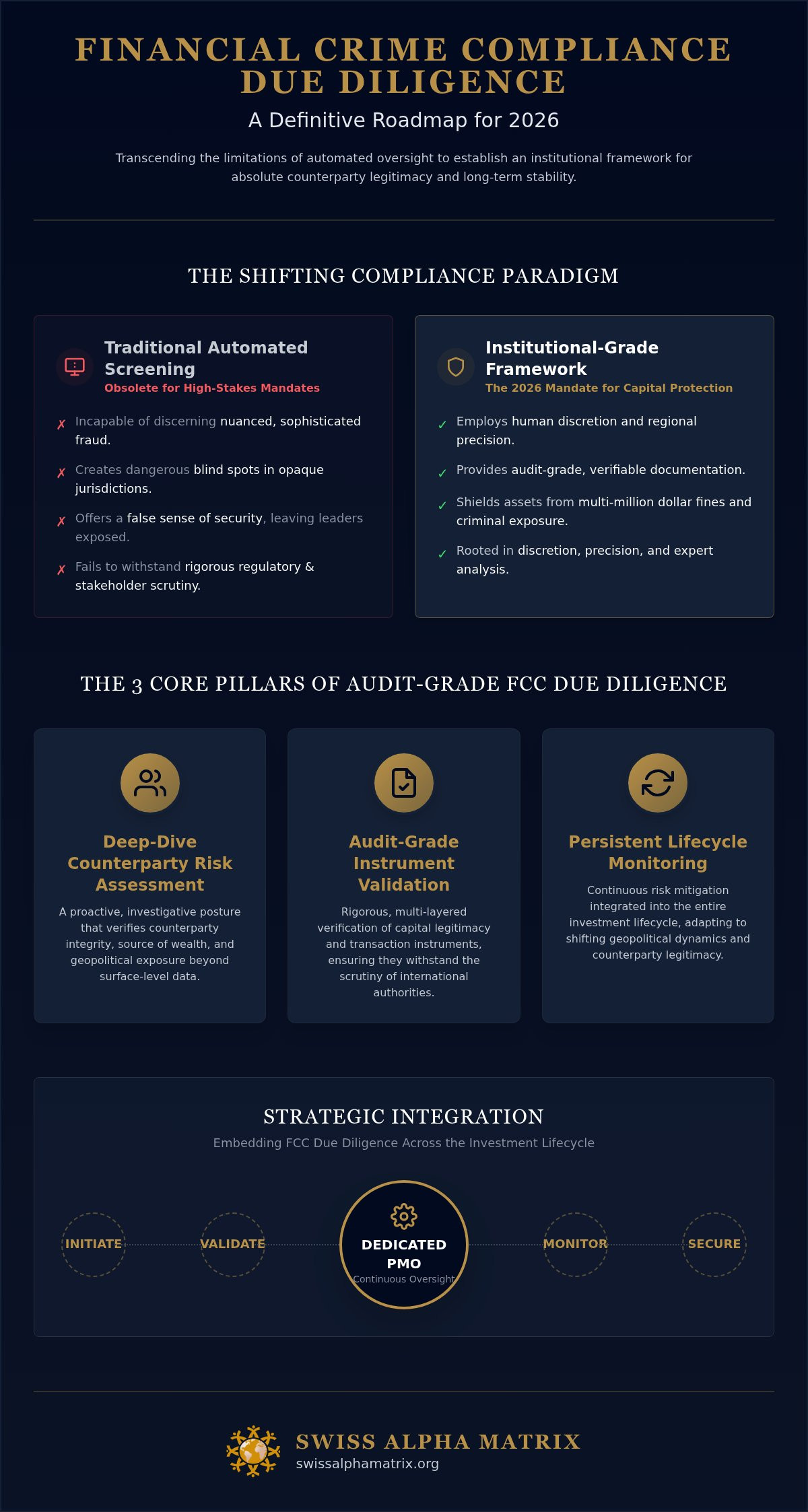
Constructing an institutional-grade framework for financial crime compliance due diligence requires a fundamental shift from passive data collection to active, multi-dimensional verification. This methodology adheres to the global standards for due diligence while simultaneously exceeding them through the application of regional precision and on-ground intelligence. A robust framework isn’t a singular event but a continuous process structured around three primary pillars: deep-dive counterparty risk assessment, audit-grade instrument validation, and persistent lifecycle monitoring. By prioritizing these elements, institutions don’t just meet regulatory minimums; they establish a defensive perimeter that protects long-term interests from the volatility of modern financial crime.
Source of Wealth vs. Source of Funds
In the sophisticated environment of 2026, simply identifying the ultimate beneficial owner (UBO) represents a baseline requirement that often fails to satisfy the demands of high-level regulatory scrutiny. True audit-grade financial crime compliance due diligence necessitates a rigorous distinction between the source of funds, which merely identifies where capital is currently held, and the source of wealth, which traces the historical accumulation of assets across decades and jurisdictions. This is particularly vital when operating within territories where transparency is obscured by complex corporate layering or opaque local regulations. To address these vulnerabilities, seasoned experts utilize Bank Instrument Validation Services to ensure that the underlying assets supporting a transaction are both legitimate and verifiable through independent channels.
Instrument Validation as a Compliance Safeguard
The classification of risk within modern portfolios must extend to the instruments themselves, particularly as non-standardized assets like Standby Letters of Credit (SBLCs) or complex liquidity guarantees become more prevalent in cross-border mandates. These instruments are often the highest risk category in 2026, as their complex structures can be used to mask illicit capital origins. Verification protocols must go beyond digital screening, confirming that the instrument’s provenance aligns perfectly with the stated transaction purpose and that the issuing entity possesses the requisite capital adequacy. This level of scrutiny acts as a primary safeguard, preventing the infiltration of fraudulent assets into legitimate investment cycles. Establishing a comprehensive Risk Management Framework ensures that this validation is not a pre-deal hurdle but a persistent standard of excellence that remains in place throughout the entire project lifecycle, providing the audit-grade documentation required to maintain institutional reputation and stakeholder trust.
Beyond the Screen: Why Automated FCC Solutions Often Fail Complex Mandates
The prevailing trend toward full automation in regulatory technology has created a dangerous sense of complacency among institutional stakeholders who mistakenly equate data volume with security. While automated systems excel at processing millions of records against static watchlists, they’re inherently ill-equipped to identify the sophisticated obfuscation techniques employed by high-level actors in opaque jurisdictions. In the context of high-value, low-volume transactions, the reliance on Big Data is often a fundamental category error; these deals require a level of scrutiny that software, optimized for retail efficiency, simply cannot provide. Consequently, a robust financial crime compliance due diligence process must look past the digital interface to uncover the nuanced risks that remain invisible to even the most advanced algorithms.
Automated solutions are frequently prone to false negatives in sanctions screening, particularly when dealing with complex corporate nesting or slight variations in name transliteration across different languages. For high-net-worth individuals and institutional entities, a single missed connection to a sanctioned party can result in catastrophic legal and reputational damage. Expert-led advisory acts as the necessary layer of intelligence above the software, providing the critical analysis required to interpret data points that a machine would otherwise dismiss as irrelevant noise. It’s this synthesis of technical data and human intuition that distinguishes an elite compliance framework from a standard procedural check.
The Human-in-the-Loop Requirement
Algorithms lack the capacity for contextual intelligence, which is the cornerstone of effective cross-border deal-making. Senior-level experts, possessing decades of experience in Tier-1 global banking, are trained to recognize subtle red flags that don’t fit into a binary code. For instance, while a digital check might clear a counterparty based on public records, on-ground verification can reveal that a supposed multi-national headquarters is merely a residential flat in a tax haven. This physical verification of reality has, in numerous instances, saved transactions from sophisticated fraud schemes that had already passed through multiple layers of automated screening.
Operational Due Diligence (ODD) as an FCC Tool
Effective compliance extends beyond the entity’s identity to an evaluation of their internal controls and organizational culture. By assessing the moral character of a counterparty through physical verification and direct engagement, advisors can determine whether a partner’s compliance standards align with institutional requirements. Integrating ODD into established Financial Advisory Methodologies ensures that financial crime compliance due diligence is treated as a physical verification of operational reality rather than a theoretical data exercise. This approach provides the audit-grade assurance necessary to proceed with confidence in the most complex global markets.
Strategic Integration: FCC Due Diligence in the Investment Lifecycle
Transitioning financial crime compliance due diligence from a mere pre-deal gateway to a persistent risk mitigation strategy represents a fundamental advancement in institutional capital protection. In the intricate financial landscape of 2026, the risk profile of a transaction doesn’t remain static once the initial contracts are executed; rather, it fluctuates as capital is deployed and counterparties interact within various regulatory environments. By embedding sophisticated compliance oversight into every phase of the investment lifecycle, from initial engagement through to final divestment, institutions maintain a continuous defensive posture that proactively addresses emerging threats. This strategic integration ensures that regulatory integrity is viewed not as a solitary procedural snapshot but as a dynamic, ongoing commitment that satisfies the most rigorous demands of global stakeholders and Tier-1 banking entities.
The Compliance-Driven PMO
Establishing a dedicated Project Management Office (PMO) with embedded compliance oversight provides the structural discipline necessary for managing high-stakes, cross-border transactions with absolute precision. This specialized model utilizes Independent Financial Project Management to ensure that every operational milestone is verified against the overarching risk management framework by seasoned experts. Within this sophisticated structure, a RACI matrix serves as a vital instrument to define specific compliance responsibilities among diverse international partners, effectively eliminating the operational ambiguity that frequently precipitates regulatory breaches. While a compliance milestone represents a critical point of regulatory validation that must be successfully cleared before a project can advance, a deliverable is the tangible output or comprehensive documentation that serves as the evidentiary proof that the required standard has been met.
Managing Regulatory Reporting and Documentation
The production of audit-grade documentation is a non-negotiable requirement for institutional entities interacting with Tier-1 global banks, where the expected standard of proof is exceptionally high and unforgiving. These reports must be meticulously constructed to be robust enough to withstand not only immediate scrutiny but also retrospective regulatory inquiries that may occur several years after the transaction’s conclusion. Maintaining this level of readiness requires an intimate, expert-led understanding of evolving International Financial Regulations, which allows the PMO to adapt its reporting methodologies in real-time as global standards shift. This proactive documentation strategy ensures that your interests are consistently supported by a clear, verifiable trail of due diligence that leaves no room for speculative interpretation. To secure this level of institutional-grade operational security for your next complex mandate, you should seek a partner capable of delivering Regulatory Compliance Advisory that prioritizes long-term stability and strategic precision.
Swiss Alpha Matrix: Independent Advisory for High-Stakes Compliance
The efficacy of an institutional framework depends entirely on the caliber of the experts executing it, which is why our firm is led by former senior executives from Tier-1 global banks who bring a level of institutional-grade precision to every mandate. By operating as an independent advisory entity, we ensure that our financial crime compliance due diligence remains entirely unbiased, free from the inherent conflicts of interest that often arise when due diligence is bundled with direct asset management or legal representation. This independence allows us to prioritize the absolute preservation of your capital and reputation above all else, providing a neutral yet rigorous assessment of even the most complex global programmes. We don’t view compliance as a peripheral administrative task but as a central pillar of strategic risk management that requires the highest level of professional competence.
Our methodology is defined by a unique synthesis of traditional financial discipline and the quiet authority of Swiss discretion, ensuring that sensitive investigations are handled with the utmost technical accuracy and moral character. We don’t merely process data; we conduct investigative mandates that merge technical validation with a profound understanding of regional nuance and counterparty legitimacy. This approach ensures that every verification is grounded in reality, moving beyond the digital screen to provide on-ground intelligence that satisfies both internal risk committees and external regulators. It’s this commitment to regional precision that distinguishes our performance-oriented mindset from passive participants in the compliance industry.
The Swiss Alpha Matrix Advantage
Engaging with our firm provides direct, unfiltered access to senior partners who possess decades of transactional experience in the world’s most demanding financial markets. This high-level access ensures that your mandate receives the meticulous attention to detail it deserves, with a global reach that is tempered by a focus on hyper-personalization and technical depth. We maintain an implicit promise of exclusivity, positioning ourselves as a dedicated partner for institutional entities and high-net-worth individuals who value privacy and excellence as the primary markers of quality. Our role as a master planner allows us to oversee the most intricate details of a project while maintaining a steady, logical focus on the long-term preservation of interests.
Securing Your Next Cross-Border Mandate
Initiating a project-based advisory engagement begins with a logical, structured assessment of your specific risk profile and project requirements, moving from broad philosophical principles down to specific strategic pillars. Our team works to implement a comprehensive risk management framework that serves as a protective barrier around your capital, ensuring that every counterparty and instrument is validated to an audit-grade standard. By choosing an expert-led approach to financial crime compliance due diligence, you mitigate exposure to fraud while establishing a foundation for sustainable, strategic growth. We invite you to consult with Swiss Alpha Matrix for your FCC due diligence needs and secure the institutional-grade precision your next mandate requires.
Establishing a Standard of Institutional Excellence for 2026
The complexities of the 2026 regulatory landscape demand a definitive transition from passive, automated screening to active, expert-led verification. Successful mandates now require a continuous oversight model where compliance is integrated throughout the investment lifecycle, ensuring deal integrity from inception through divestment. By prioritizing on-ground intelligence over static digital datasets, institutions can effectively navigate the nuanced risks prevalent in opaque jurisdictions and identify sophisticated fraud that algorithms frequently overlook. It’s this commitment to technical accuracy and regional precision that defines a truly robust and defensive risk management framework.
As an independent advisory firm led by former Tier-1 global bank executives, we provide the technical depth and Swiss discretion required for sophisticated financial crime compliance due diligence. Our methodology focuses on audit-grade instrument validation and the absolute protection of capital, offering a standard of service that is both broad in reach and meticulous in its attention to detail. We invite you to secure your capital with Swiss Alpha Matrix’s audit-grade due diligence. Your interests deserve the protection of seasoned experts who prioritize long-term stability and strategic growth above all else.
Frequently Asked Questions
What is the difference between standard KYC and institutional FCC due diligence?
Standard KYC typically focuses on the baseline verification of identity and basic sanctions screening required for retail-level onboarding. Institutional financial crime compliance due diligence represents a more profound investigative mandate that scrutinizes the historical accumulation of wealth and the intricate corporate structures used to obscure capital origins. It prioritizes contextual intelligence over procedural checklists, providing a level of counterparty validation that satisfies the most rigorous international regulatory standards.
Why is on-ground verification necessary if we have digital screening tools?
Digital screening tools are inherently limited by the quality of the public datasets they aggregate, often failing to detect sophisticated obfuscation in opaque jurisdictions. On-ground verification serves as a critical physical audit, confirming that a counterparty’s operational reality matches their documented claims. This human-led approach identifies red flags, such as shell entities operating out of residential addresses, that remain invisible to even the most advanced algorithmic screening processes.
How does financial crime compliance impact cross-border investment timelines?
While rigorous compliance protocols may introduce additional phases to the initial onboarding period, they ultimately protect the project from the catastrophic delays associated with regulatory freezes or legal inquiries. A structured approach to financial crime compliance due diligence allows for the proactive identification of risks, preventing the need for retrospective remediation that often derails complex transactions. By embedding these checks into the project lifecycle, institutions maintain a steady, predictable pace toward successful capital deployment.
What are the common red flags in complex financial instrument validation?
Common red flags include non-standardized terminology within Standby Letters of Credit (SBLCs), capital inadequacy of the issuing entity, and an opaque provenance of the underlying assets. When an instrument’s stated purpose doesn’t align with the counterparty’s known business activities, it necessitates an immediate, audit-grade validation process. These discrepancies often signal an attempt to integrate illicit capital into legitimate investment cycles, requiring expert-led scrutiny to ensure the instrument’s authenticity and regulatory integrity.
How can an independent advisory firm help with regulatory compliance better than a law firm?
Independent advisory firms provide a dedicated focus on operational reality and technical validation that is often distinct from the purely legalistic or procedural reviews conducted by traditional law firms. This independence ensures an unbiased assessment of risk, free from the institutional pressures of ongoing legal representation or asset management. By prioritizing on-ground verification and institutional-grade precision, independent advisors deliver a standard of due diligence that focuses on the practical preservation of capital.
What does ‘audit-grade’ mean in the context of due diligence reports?
An audit-grade report is a comprehensive dossier constructed to withstand the most intense scrutiny from Tier-1 global banks and international regulatory bodies. This standard of documentation provides an evidentiary trail that is sufficiently robust to support future inquiries, ensuring that every data point and verification step is verifiable. It represents a level of technical depth and professional competence that transcends the superficial summaries found in standard compliance software outputs.
How does Swiss Alpha Matrix handle data privacy and discretion during investigations?
Our firm utilizes elite privacy protocols and the traditional principles of Swiss discretion to ensure that sensitive investigations remain entirely confidential. We operate with a boutique focus that prioritizes the interests of a specific caliber of audience, ensuring that data is handled with the highest level of professional care. This approach fosters a sense of stability and trust, allowing institutional entities to conduct deep-dive verifications without compromising their reputational standing or operational privacy.
Can FCC due diligence be integrated into existing project management frameworks?
Sophisticated compliance oversight is most effective when it’s embedded directly into a dedicated Project Management Office (PMO) rather than treated as a separate administrative hurdle. This strategic integration allows for continuous monitoring and the use of RACI matrices to define compliance responsibilities across international borders. By aligning due diligence milestones with operational deliverables, institutions ensure that risk mitigation remains a constant priority throughout the entire investment lifecycle.