

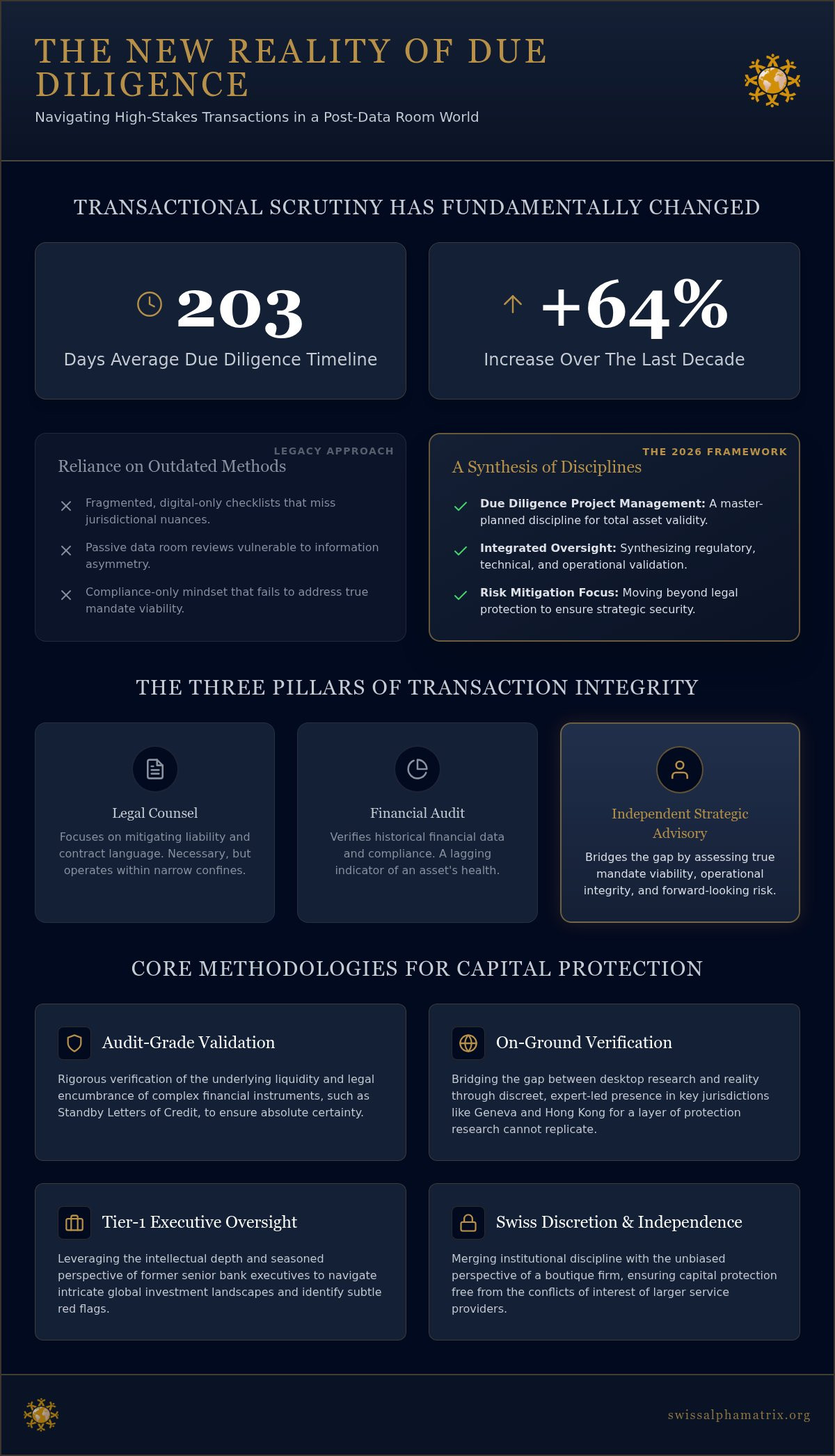
If the average timeline for transactional scrutiny has expanded to 203 days, representing a 64 percent increase over the last decade, one must ask why so many institutional investors still rely on fragmented, digital-only checklists that fail to address the nuances of local jurisdictional risk. You likely recognize that the era of the standard data room review has vanished, replaced by an environment where information asymmetry and shifting regulatory landscapes, such as the 2026 updates to AML and CFT requirements, demand more than just passive observation. In this climate, sophisticated due diligence project management is no longer a peripheral administrative task; it’s become the essential, master-planned discipline for ensuring the absolute validity of assets and the preservation of capital across complex, international borders.
We understand the inherent risks when communication between legal, audit, and advisory teams becomes fragmented, often leaving significant capital exposed to undetected operational flaws. This article presents a 2026 framework designed to synthesize audit-grade validation with the quiet authority of institutional oversight, providing a blueprint for navigating high-stakes transactions with total certainty. You’ll discover a methodology that prioritizes on-ground verification and discreet, expert-led discipline to bridge the gap between desktop research and reality. We’ll explore the strategic pillars of capital protection, moving from the necessity of rigorous instrument validation to the implementation of accountability structures that reflect the traditional discretion of elite wealth management.
Key Takeaways
- Learn to synthesize regulatory scrutiny with operational oversight through a structured approach to due diligence project management, moving beyond the limitations of digital-only data room reviews.
- Establish a clear distinction between legal liability and mandate viability by adopting a three-pillar framework that merges PMO discipline with independent strategic advisory.
- Discover the institutional methodologies required for the audit-grade validation of complex financial instruments, including Standby Letters of Credit, to ensure absolute certainty in cross-border mandates.
- Understand the critical role of on-ground verification in jurisdictions such as Geneva and Hong Kong, where local precision and Swiss discretion provide a layer of capital protection that desktop research cannot replicate.
- Identify how the oversight of former Tier-1 bank executives provides the intellectual depth and seasoned perspective necessary to navigate the most intricate global investment landscapes.
The Evolution of Due Diligence Project Management in 2026
The landscape of cross-border capital deployment has undergone a fundamental transformation, rendering the static, digital-only data room an insufficient relic of a less complex era. In 2026, the convergence of heightened regulatory scrutiny and the proliferation of sophisticated financial structures requires a more robust, multi-layered investigative approach. We define due diligence project management as a synthesis of rigorous regulatory compliance, technical validation, and proactive operational oversight. This discipline ensures that every facet of a mandate is examined through the lens of institutional-grade precision, mitigating the information asymmetry that so often precedes catastrophic capital deployment failures.
Effective oversight in this new environment demands more than just a passive review of uploaded documents. With the average due diligence process now extending to 203 days, representing a 64 percent increase over the last decade according to Peony Data Room, the need for a structured, project-led methodology is undeniable. Tier-1 banking expertise has become the non-negotiable prerequisite for validating these sophisticated financial structures. Without the seasoned perspective of former senior executives who’ve managed global risk at the highest levels, the subtle red flags of structural instability or misaligned incentives often remain obscured by the sheer volume of data.
The Limitations of Conventional Legal Checklists
While legal reviews are a necessary component of any transaction, they frequently operate within the narrow confines of liability and contract language, often failing to detect deep-seated operational discrepancies or the actual validity of underlying instruments. Standard legal reviews aren’t designed to interrogate the practical mechanics of a counterparty’s liquidity or the authenticity of their stated assets. Relying on self-reported counterparty data in cross-border investment mandates presents an unacceptable level of risk, as these documents rarely reveal the following vulnerabilities:
- Hidden legal encumbrances that aren’t disclosed in standard filings.
- Operational inefficiencies that compromise the long-term viability of the investment.
- Misrepresented financial instruments that lack the necessary audit-grade backing.
By transitioning from a compliance-only mindset toward a comprehensive, risk-mitigation focused advisory, one can achieve a more profound understanding of the transaction’s true viability. This shift ensures that capital is not merely legally protected but strategically secure against the nuances of international markets.
Synthesising Technical Precision with Swiss Discretion
The Swiss Alpha Matrix methodology represents a departure from traditional consulting, merging the institutional discipline of global banking with the agility and hyper-personalization of a boutique firm. Independent oversight provides the unbiased perspective necessary to protect capital without the conflicts of interest inherent in larger, integrated service providers. Audit-Grade Validation is the rigorous process of verifying the underlying liquidity and legal encumbrance of a financial instrument. It’s this commitment to regional excellence and meticulous detail that distinguishes a performance-oriented mindset from passive participation in the market.
Strategic Frameworks: Merging PMO Discipline with Financial Advisory
The integrity of a cross-border transaction rests upon three distinct pillars: legal counsel, financial audit, and independent strategic advisory. While these disciplines often overlap in the shared space of a digital data room, their fundamental objectives diverge significantly. Legal teams focus primarily on the mitigation of liability, ensuring that the contractual architecture is sound and that the entity is insulated from foreseeable litigation. In contrast, the role of an independent advisor is to scrutinize the actual viability of the mandate. This involves assessing whether the underlying economic logic holds up under pressure, a task that requires the advisor to act as an unemotional, expert sparring partner for the institutional C-suite.
Navigating these complexities requires a deep understanding of the evolving regulatory environment. For a detailed perspective on the current compliance landscape, one should consult the International Financial Regulations: A Comprehensive Guide for 2026. By integrating this intelligence into a broader due diligence project management framework, organizations can move beyond mere checklist compliance. This synthesis of institutional discipline and strategic foresight ensures that the decision-making process remains rooted in intellectual depth rather than short-term speculation.
Integrating Advisory into the Project Management Office (PMO)
Effective oversight isn’t a static event. It’s a dynamic process where findings must inform and reshape the wider project management framework in real-time. We utilize a RACI analysis (Responsible, Accountable, Consulted, Informed) to define clear accountability in complex, multi-stakeholder transactions. This level of institutional project management discipline prevents scope creep and unmonitored capital leakage, ensuring that every dollar deployed is accounted for within a rigorous risk management framework. For those seeking to fortify their cross-border interests, engaging with a specialized risk management partner ensures that your capital deployment remains under discreet, expert-led oversight.
The Advisor vs. The Auditor: A Forward-Looking Distinction
There’s a critical distinction between the historical financial review performed by an auditor and the forward-looking strategic risk assessment provided by an advisor. While an auditor verifies what has already occurred, the advisor bridges the gap between regulatory compliance and successful strategic execution. This forward-looking perspective is vital for identifying emerging risks that haven’t yet manifested in historical ledgers. Even in non-audit advisory mandates, the necessity of delivering institutional-grade reporting remains paramount to provide the C-suite with the clarity required for complex capital protection.
Audit-Grade Instrument Validation within the Project Lifecycle
In high-stakes cross-border mandates, the primary point of failure often resides not in the absence of documentation, but in the superficial acceptance of it. Paperwork validation, while a necessary administrative step, frequently fails to uncover the sophisticated anatomy of financial instrument fraud. These fraudulent schemes often rely on the assumption that institutional parties will prioritize speed over technical depth. Detecting red flags early requires a transition from passive review to an active due diligence project management methodology that prioritizes the verification of Standby Letters of Credit (SBLCs) and other complex guarantees at the source.
For an exhaustive analysis of these technical protocols and the protection of institutional interests, please refer to our Bank Instrument Validation Services: An Executive Guide to Protecting Capital in 2026. This resource details the institutional methodologies required to move beyond surface-level compliance toward absolute certainty.
Technical Verification and SWIFT Protocols
Executing SWIFT validation, particularly the meticulous interrogation of MT760 or MT799 message protocols, remains an essential prerequisite for confirming the actual liquidity sources supporting complex instruments. It’s critical to distinguish between the mere existence of an asset and its legal encumbrance. An asset may appear on a balance sheet yet be pledged as collateral in a separate jurisdiction, rendering it unavailable for the current mandate. On-Ground Verification serves as the final arbiter of truth in cross-border jurisdictional risk, ensuring that the digital representation of an asset aligns with its physical and legal reality.
Mitigating Counterparty and Jurisdictional Exposure
Beyond the instruments themselves, one must assess the moral character and regulatory standing of the financial intermediaries involved. In emerging markets, where regulatory oversight may be less stringent, physical verification becomes the only reliable method for confirming the tangible reality of assets behind the digital documentation. A robust due diligence project management framework must account for geopolitical volatility and regional legal nuances, ensuring that the risk management strategies are as dynamic as the markets they oversee. This level of oversight, led by seasoned experts, provides the stability required for long-term capital preservation in an increasingly unpredictable global economy. Our approach prioritizes quality and moral character, reinforcing the exclusive nature of the service provided to our institutional partners.
Executing On-Ground Verification in Cross-Border Jurisdictions
The transition from technical instrument validation to operational verification represents the critical shift from verifying the “what” to interrogating the “how.” Within a comprehensive due diligence project management mandate, assessing the internal mechanics of a target entity is paramount for identifying vulnerabilities that digital audits simply cannot reach. Whether managing transactions in the established financial hubs of London and Geneva or navigating the complex dynamics of Hong Kong, the application of local expertise is the defining factor in capital preservation. This process ensures that the operational reality of a project aligns perfectly with its documented claims, mitigating the risks inherent in information asymmetry.
Developing a bespoke international due diligence checklist, tailored to the specific risks of the mandate, allows for a hyper-personalized approach to risk mitigation. For those seeking to deepen their understanding of these protocols, our guide on Mastering Cross-Border Investment Due Diligence: An Institutional Framework for 2026 provides the necessary strategic pillars. This level of intellectual depth ensures that every transaction is viewed through the lens of regional excellence and precision, catering to a sophisticated audience that values thoroughness above all else.
The Non-Negotiable Nature of Physical Site Visits
Physical site visits remain the non-negotiable gold standard in 2026. While digital collaboration tools offer a baseline for project tracking, they are inherently limited by the quality of the data provided by the counterparty. Physical presence allows for the verification of local regulatory compliance and the authenticity of operational licenses, which is particularly critical in jurisdictions where transparency may be compromised. Relying solely on remote reviews in emerging markets creates an unacceptable exposure to sophisticated operational fraud, as digital documentation can be manipulated in ways that physical infrastructure cannot.
Navigating Multi-Jurisdictional Regulatory Complexity
Managing multi-jurisdictional regulatory complexity, including AML, KYC, and Form PF requirements, demands a steady and highly logical rhythm throughout the entire lifecycle of a deal. Meticulous documentation ensures that every stage of the transaction remains in perfect alignment with international financial regulations. Independent advisory acts as a protective authority, facilitating smoother regulatory approvals by delivering institutional-grade reporting that anticipates the needs of global regulators. To fortify your cross-border capital deployment with discreet, expert-led oversight, engage our on-ground verification specialists to ensure your interests are protected by seasoned professionals who prioritize long-term stability.
The Independent Mandate: Swiss Discretion and Tier-1 Execution
The distinction of Swiss Alpha Matrix lies in the caliber of its leadership, where former Tier-1 global bank executives deliver a level of senior-level intelligence and oversight that is often absent in larger, more commoditized advisory firms. Discretion remains the ultimate currency in high-net-worth and institutional mandates, serving as the bedrock upon which institutional trust is built. By utilizing a fixed-fee, project-based advisory model, we ensure that our reporting remains completely unbiased, as our interests are never tied to the volume of transactions but rather to the absolute validity of the mandate. This approach to due diligence project management provides a level of intellectual depth that mirrors the traditional values of private wealth management while addressing the complexities of the 2026 financial environment.
Preserving Deal Integrity through Absolute Neutrality
Large-scale, multi-service investment banking firms frequently operate under inherent conflicts of interest, where the pressure to close a deal may inadvertently compromise the rigor of the investigative process. Positioning the advisor as a fiduciary for the client’s capital, rather than a facilitator for the deal closure, is essential for preserving deal integrity. This commitment to professional excellence and regional precision ensures that the client’s interests are prioritized above all else, fostering long-term institutional trust through absolute neutrality. It is a persona rooted in historical reliability, where the advisor acts as a protective authority over the deployment of sophisticated capital.
Structuring the Mandate for Capital Protection
Defining the scope of a due diligence mandate requires a meticulous understanding of the specific risks associated with the cross-border programme, ensuring that every strategic pillar is designed for maximum risk mitigation. For a deeper exploration of these frameworks, one may review The Strategic Architecture of Independent Financial Project Management. The transition from initial instrument verification to ongoing, long-term project oversight should be seamless, providing a steady and highly logical rhythm of protection throughout the asset’s lifecycle. For those prepared to move beyond passive observation, the next step involves engaging a strategic partner who understands that due diligence project management is not merely a checklist, but a dedicated discipline of capital preservation. Actionable steps for your next mandate include:
- Defining the specific technical and jurisdictional risks of the programme during the initial strategic consultation.
- Formalizing accountability through institutional-grade frameworks to ensure meticulous oversight across all advisory stakeholders.
- Integrating audit-grade validation into the earliest stages of the project lifecycle to prevent unmonitored capital leakage.
Fortifying the Future of Institutional Capital Protection
The transition from passive observation to active capital preservation requires a fundamental shift in how institutional entities approach the verification of international assets. As we’ve explored, the synthesis of technical instrument validation and on-ground operational oversight forms the bedrock of a robust due diligence project management framework. By prioritizing intellectual depth over mere compliance checklists, the modern C-suite can bridge the gap between digital representations and the physical reality of global mandates. This methodology ensures that capital remains protected through a measured, steady, and highly logical approach to risk mitigation, moving from broad philosophical principles down to specific strategic pillars.
Our advisory, led by former senior executives from Tier-1 global financial institutions, delivers the audit-grade reporting standards necessary for sophisticated executive stakeholders who value nuance and thoroughness. We provide the specialized expertise required for complex financial instrument validation, ensuring your interests are managed with the traditional discretion of a boutique Swiss entity. To maintain the integrity of your strategic growth in an increasingly volatile landscape, secure your next cross-border mandate with Swiss Alpha Matrix advisory. We look forward to serving as your dedicated partner in long-term capital preservation and regional excellence.
Frequently Asked Questions
What is the difference between due diligence advisory and a standard financial audit?
The primary distinction lies in the temporal focus and strategic objective of the engagement. While a standard financial audit provides a historical verification of past performance and ledger accuracy, due diligence advisory focuses on the forward-looking viability of the mandate. It interrogates the structural integrity of the deal, ensuring that current operational realities align with long-term capital protection goals through a proactive, project-led methodology that anticipates potential risks before they manifest.
Why is on-ground verification critical for cross-border investment mandates?
On-ground verification serves as the definitive arbiter of truth in environments characterized by significant information asymmetry. Digital-only reviews are inherently limited by the quality of counterparty-provided data, whereas physical site visits allow for the interrogation of operational mechanics and regulatory compliance that cannot be verified remotely. This is particularly vital in emerging markets where transparency may be compromised by local jurisdictional nuances that digital documentation often fails to capture.
How do you verify the validity of a Standby Letter of Credit (SBLC) in 2026?
Verification in 2026 requires a multi-layered approach involving the interrogation of SWIFT protocols, specifically MT760 or MT799 message structures, to confirm the underlying liquidity at the source. It’s essential to move beyond surface-level paperwork to verify both the existence and the legal encumbrance of the asset. This process ensures that the instrument is not only authentic but also unencumbered by prior liens or jurisdictional restrictions that would compromise its utility in a cross-border transaction.
What role does a RACI matrix play in complex financial project management?
A RACI matrix is a fundamental tool within due diligence project management that establishes clear accountability across complex, multi-stakeholder transactions. By defining who is Responsible, Accountable, Consulted, and Informed, the framework prevents scope creep and unmonitored capital leakage. This institutional discipline ensures that every advisory stakeholder understands their specific role in the risk mitigation lifecycle, maintaining the steady and logical rhythm required for successful mandate execution.
Can independent advisory services assist with regulatory compliance in multiple jurisdictions?
Independent advisory services are specifically designed to navigate the intricate web of global regulations, including the April 2026 updates to AML and CFT requirements issued by FinCEN and the FDIC. By facilitating a centralized oversight structure, these services ensure that every stage of a cross-border transaction remains in perfect alignment with international standards. This meticulous documentation and proactive regulatory posture help facilitate smoother approvals from global oversight bodies by anticipating their specific informational requirements.
How does Swiss Alpha Matrix ensure absolute discretion during sensitive mandates?
Swiss Alpha Matrix maintains the traditional discretion of high-end private wealth management by operating as a specialized boutique entity led by former Tier-1 bank executives. We prioritize the privacy of our institutional partners through a fixed-fee model that avoids the transparency risks associated with commission-based facilitators. This quiet authority and commitment to moral character ensure that sensitive mandates are handled with the unemotional precision required for long-term strategic growth and capital preservation.
What are the common red flags to look for in financial instrument validation?
Common red flags include requests for non-standard communication channels outside of verified SWIFT protocols or the presence of opaque fee structures that deviate from institutional norms. Additionally, a counterparty’s reluctance to permit on-ground verification or a lack of clarity regarding the asset’s legal encumbrance should be viewed with extreme caution. These discrepancies often indicate a misaligned incentive structure that could lead to significant capital exposure if not addressed through rigorous, audit-grade technical validation.
How long does a typical institutional cross-border due diligence engagement last?
While the duration of an engagement varies based on the complexity of the cross-border jurisdiction, data from March 2026 indicates that the average due diligence process now takes approximately 203 days. This timeline reflects the increased regulatory scrutiny and the necessity for more in-depth investigative methods in the current landscape. A well-structured due diligence project management framework ensures that this period is utilized efficiently to achieve total certainty on asset validity and operational resilience.