

The assumption that a standard legal checklist can sufficiently insulate a high-value cross-border mandate from the sophisticated financial stratagems of 2026 is a precarious one. As the Swiss regulatory environment undergoes its most significant transformation in decades, the necessity for rigorous financial instrument due diligence switzerland has transitioned from a prudent best practice to an absolute operational imperative. You likely recognize that traditional reliance on superficial paperwork is no longer adequate when faced with the revised Anti-Money Laundering Act and the newly established federal Transparency Register, which now mandates the rigorous verification of ultimate beneficial owners for most legal entities.
This executive analysis serves as a master blueprint for navigating these complexities, offering a sophisticated framework designed to ensure both regulatory compliance and the preservation of capital through audit-grade validation. We’ll explore the critical shift toward on-ground verification and the strategic mitigation of risks inherent in multi-layered holding structures and complex financial arrangements. By moving beyond mere procedural adherence, we provide the technical precision required to verify complex instruments and secure your interests within this new era of Swiss financial discipline.
Key Takeaways
- Identify the strategic divergence between routine compliance and the rigorous scrutiny required to navigate 2026 Swiss regulatory shifts and evolving transparency mandates.
- Master the technical process of financial instrument due diligence switzerland to ensure audit-grade validation of SBLCs and other complex instruments beyond mere documentation.
- Evaluate the inherent limitations of digital data rooms and the imperative for on-ground verification to confirm the operational reality of high-stakes cross-border mandates.
- Establish a robust risk mitigation framework through independent financial project management, ensuring absolute precision in the oversight of complex capital structures.
- Leverage the technical depth of Tier-1 banking expertise to navigate the Swiss landscape with the discretion and authoritative precision required for sovereign-grade mandates.
The 2026 Landscape: Mandatory vs. Strategic Due Diligence in Switzerland
Switzerland’s reputation for financial stability is not merely a product of historical tradition but a result of a continuous evolution in oversight and professional discipline. In 2026, the introduction of the revised Anti-Money Laundering Act (AMLA) and the Federal Act on the Transparency of Legal Entities (LETA) represents a definitive conclusion to the era of opacity. These legislative shifts align the Swiss regulatory framework with the EU’s Corporate Sustainability Due Diligence Directive (CSDDD) standards, establishing a high-water mark for transparency that impacts every facet of cross-border commerce. For institutional entities, this means that Due diligence has transitioned from a peripheral legal exercise into the very cornerstone of institutional survival and capital preservation.
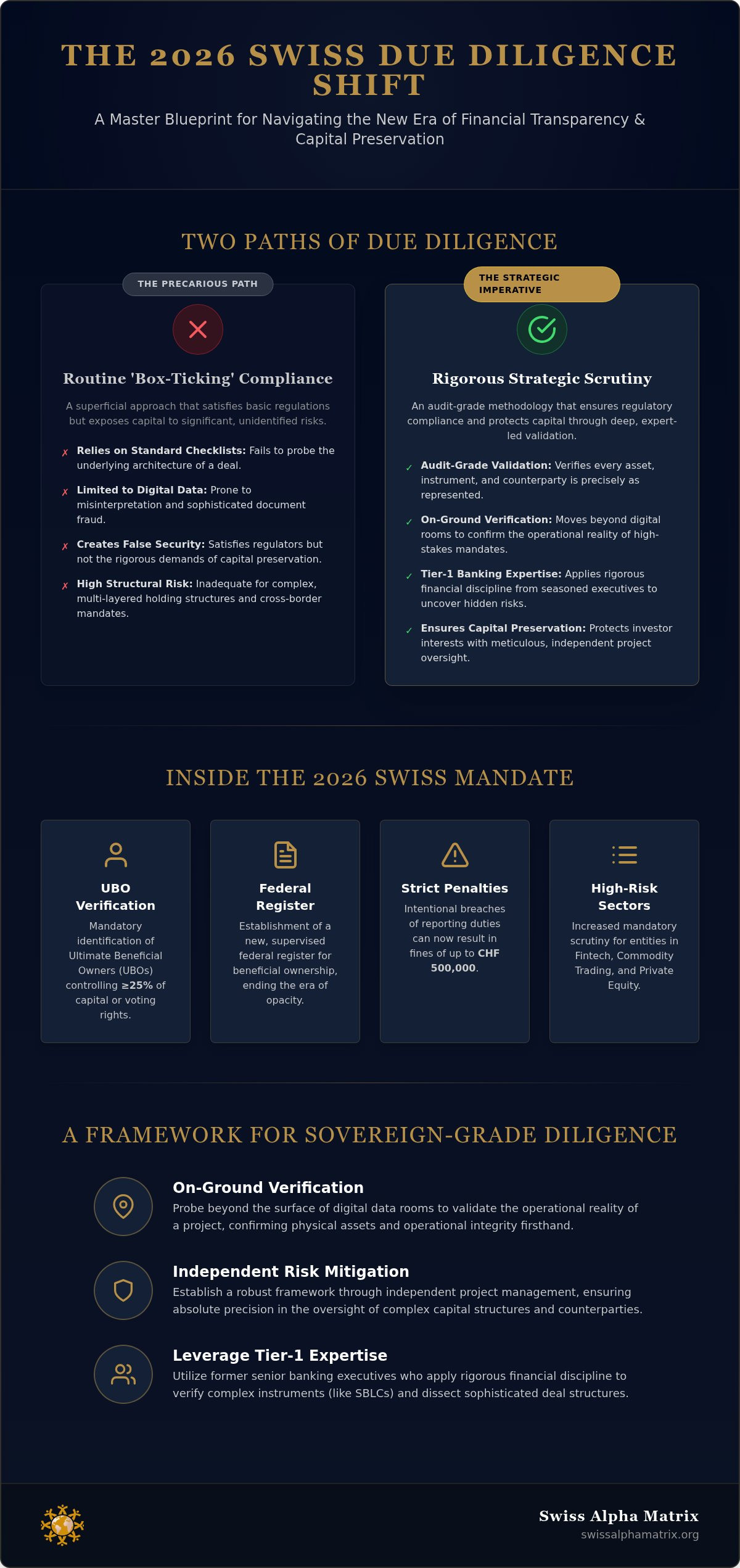
While many providers focus exclusively on basic regulatory adherence, the sophisticated mandate requires a more nuanced approach that distinguishes between “box-ticking” compliance and strategic scrutiny. Routine compliance may satisfy a regulator, but it rarely protects an investor from the structural risks inherent in complex, multi-layered transactions. This is where financial instrument due diligence switzerland becomes an indispensable tool for the master planner. It’s a methodology that prioritizes the validation of the underlying architecture of a deal, ensuring that every asset, instrument, and counterparty is precisely as represented, regardless of the complexity of the jurisdiction involved.
The Impact of New Swiss Corporate Due Diligence Laws
The 2026 legislative landscape introduces a supervised federal register for beneficial ownership, requiring most Swiss legal entities to identify and verify ultimate beneficial owners (UBOs) who control at least 25% of capital or voting rights. These requirements place a significant burden on fintechs, commodity traders, and private equity funds, which must now navigate a landscape where intentional breaches of reporting duties can result in fines of up to CHF 500,000. The 2026 Swiss due diligence mandate marks a definitive shift from voluntary reporting frameworks to a regime of mandatory, supervised disclosure. This new reality demands a level of technical precision that exceeds the capabilities of standard administrative checklists, particularly for entities operating within the high-risk sectors of virtual assets and complex holding structures.
Beyond Compliance: The Institutional Need for Scrutiny
Legal compliance serves as a baseline, but it’s rarely sufficient to mitigate the risk of sophisticated cross-border fraud or operational failure in high-value mandates. Protecting capital requires an independent advisory that probes beyond the surface of digital data rooms to validate the operational reality of a project. By Mastering Cross-Border Investment Due Diligence, institutional partners can ensure their financial instrument due diligence switzerland protocols are robust enough to withstand both regulatory audits and market volatility. This strategic scrutiny involves the use of former Tier-1 banking executives who apply rigorous financial discipline to verify complex deal structures, ensuring that interests are protected by seasoned experts who prioritize long-term stability over short-term speculation.
Switzerland remains a preeminent global hub for this level of sophisticated advisory because it harmonizes these new transparency requirements with a traditional culture of meticulous discretion. This “discretion-based precision” is a hallmark of the Swiss approach, offering a standard of service that is both broad in reach and microscopic in its attention to detail. It’s a persona of quiet authority that provides a reassuring sense of stability in an increasingly uncertain global market.
Audit-Grade Instrument Validation: The Core of Financial Integrity
The assumption that a digital data room constitutes a complete security barrier is a common, yet often fatal, misconception in high-stakes capital allocation. While the OECD’s Responsible Business Conduct Guidelines establish a foundational expectation for institutional integrity, they don’t provide the forensic tools necessary to detect sophisticated financial forgery or structural weakness in complex cross-border instruments. Within the specific context of financial instrument due diligence switzerland, the focus must shift from administrative organization to technical, audit-grade validation that proves the existence and liquidity of the assets in question.
Many institutional mandates falter because they rely on “paper-only” assets that lack verifiable banking origins or authentic liquidity profiles. Utilizing specialized bank instrument validation services ensures that Standby Letters of Credit (SBLCs), Bank Guarantees, and documentary credits are not merely present in the file, but are technically sound and fully enforceable under both Swiss law and international banking protocols. This level of financial instrument due diligence switzerland is the only mechanism capable of protecting capital from the increasingly sophisticated fraud seen in the lead-up to the 2026 regulatory shifts.
Verifying Complex Financial Instruments
Forensic instrument validation requires a profound understanding of SWIFT messaging protocols and the specific linguistic nuances inherent in Tier-1 banking documents. Red flags often hide in plain sight, appearing as non-standard phrasing in a Standby Letter of Credit or subtle inconsistencies in the issuing bank’s routing instructions that a standard legal review would likely overlook. By applying the rigorous standards developed within the world’s most elite financial institutions, the validation process confirms that every instrument is a legitimate reflection of capital, rather than a sophisticated facade designed to circumvent traditional oversight.
The Executive Intelligence Report
The culmination of this forensic process is an executive intelligence report that translates technical data into a clear, authoritative narrative for C-suite decision-makers. These reports, which are meticulously crafted to withstand the scrutiny of both internal risk committees and external regulators, provide a technical narrative that confirms the validity of the underlying assets while maintaining the executive-level readability required for rapid, informed decision-making. These validation reports serve as a defensive shield during regulatory audits, proving that the entity has met the highest standards of professional discipline. For mandates of this caliber, engaging a specialized partner with a background in Tier-1 banking is the only way to ensure absolute precision.
Operational Due Diligence and the Necessity of On-Ground Verification
Digital data rooms, while efficient for the initial collation of administrative records, often create a dangerous illusion of transparency that sophisticated counterparties can exploit. Relying solely on remote documentation ignores the physical reality where most cross-border risks actually reside. On-ground verification represents the transition from theoretical risk mapping to empirical confirmation, involving a meticulous physical audit of facilities, leadership dynamics, and the operational infrastructure that underpins a mandate. This level of scrutiny is particularly vital for financial instrument due diligence switzerland, where the technical validity of an instrument is inextricably linked to the operational integrity of the issuing or managing entity.
Unlike standard remote due diligence providers who remain confined to their desks, the Swiss Alpha Matrix approach leverages a physical presence to uncover institutional inconsistencies that digital files simply cannot capture. There’s a distinct psychological advantage to being present in the room during negotiations and site visits; it signals a level of professional discipline and quiet authority that often compels a higher degree of transparency from counterparties. This physical presence acts as a deterrent to obfuscation, positioning the investor as a master planner who demands absolute precision, distinguishing them from a merely passive participant in a complex transaction.
The Paperwork vs. Reality Gap
History is replete with examples where document-only due diligence failed to detect sophisticated fraud, specifically in cases where high-quality forgeries of bank guarantees were supported by legitimate-looking but entirely hollow corporate shells. Swiss precision requires more than just a review of the balance sheet; it demands on-site confirmation of operational claims to ensure that the assets presented aren’t merely paper-thin constructs. Former Tier-1 bank executives are uniquely equipped for this task, possessing the seasoned intuition required to identify subtle institutional inconsistencies that would bypass a standard compliance officer or a software-based screening tool.
Structuring an Operational Audit
A robust operational audit focuses on three critical pillars: leadership character, technological resilience, and supply chain integrity. By physically verifying these elements, we mitigate the counterparty risk that often escalates in volatile cross-border markets where jurisdictional boundaries can blur accountability. This process involves interviewing key personnel and inspecting the technical infrastructure to ensure it meets the sovereign standards expected in high-end wealth management. On-ground verification serves as the final gate in a capital protection strategy, providing the definitive validation required before any significant allocation of capital.
A Strategic Framework for Swiss Cross-Border Mandates
The execution of cross-border mandates requires more than technical skill; it demands a structured architecture that can synchronize disparate workstreams with unwavering precision. When conducting financial instrument due diligence switzerland, the process shouldn’t be treated as a static event or a simple checklist. It’s a dynamic evolution that must be governed by a rigorous oversight mechanism to account for shifting regulatory sands. By integrating independent financial project management, institutional entities ensure that legal, financial, and operational facets, which are often siloed in less sophisticated environments, aren’t merely parallel efforts. They’re fully synthesized into a cohesive risk mitigation strategy that protects long-term interests over short-term speculation.
High-stakes transaction management relies on the absolute clarity provided by a RACI (Responsible, Accountable, Consulted, and Informed) matrix. This tool eliminates ambiguity, ensuring that every critical decision point is owned by a qualified expert with the requisite institutional background. It’s the operational backbone of our methodology. It defines who’s responsible for the forensic validation of assets and who’s accountable for the final risk assessment, creating a sense of inevitable logic in the decision-making process. This level of organizational clarity is paramount when you’re navigating the complexities of 2026 Swiss mandates, where even a minor technical inconsistency, if overlooked, can have profound legal and financial consequences for the mandate’s stakeholders.
The Project Management Office (PMO) in Due Diligence
Complex deals require a dedicated PMO to maintain the delicate balance between deal momentum and the necessary depth of forensic scrutiny. This office ensures workstreams remain aligned with overarching milestones, which are often aggressive in cross-border deals, while allowing the technical experts the time required for audit-grade validation. It’s the PMO’s duty to ensure that traditional Swiss discretion, while respected, doesn’t hinder the flow of critical intelligence. We prioritize the seamless transmission of high-level data between validation teams and executive stakeholders to maintain a steady, logical rhythm throughout the transaction lifecycle.
Stakeholder Management and Reporting
Synthesizing disparate findings into a single, comprehensive risk profile is the lead advisor’s ultimate objective. We tailor technical data for different organizational levels, providing the strategic clarity needed for robust capital protection. By employing Institutional-Grade Financial Advisory Methodologies, we translate forensic findings into actionable intelligence. This ensures that financial instrument due diligence switzerland results are presented with both the technical accuracy and the executive-level readability required for sovereign-grade decision making.
Secure your next complex mandate with the oversight of our seasoned master planners.
Swiss Alpha Matrix: Elevating Due Diligence to Sovereign Standards
The selection of an advisory partner represents the final and perhaps most critical decision in the architecture of a complex mandate. In an era where the technicalities of financial instrument due diligence switzerland dictate the boundary between institutional success and catastrophic capital loss, Swiss Alpha Matrix stands as a boutique entity of singular focus. We don’t merely offer a directory of experts; we provide a unified, senior-led methodology that harmonizes the traditional discretion of Swiss wealth management with the rigorous financial discipline of global institutional banking. Our approach is anchored in the evolving landscape of international financial regulations, serving as the guiding framework for mandates that require a standard of service both broad in reach and microscopic in its attention to detail.
Our commitment to capital protection is absolute, rooted in a belief that high-value transactions shouldn’t be left to the vagaries of remote checklists or superficial legal reviews. By positioning ourselves as a dedicated partner rather than a passive service provider, we ensure that every mandate is governed by a sense of inevitable logic and professional calm. This intellectual depth allows us to navigate the most intricate cross-border arrangements, providing our clients with the reassurance that their interests are in the hands of seasoned experts who prioritize long-term preservation over short-term speculation.
The Value of Senior Institutional Experience
The inherent advantage of our firm lies in the specialized perspective of former senior executives from Tier-1 global banks, individuals who’ve spent decades navigating the internal mechanisms of institutional risk. This institutional memory is vital when performing financial instrument due diligence switzerland, as it allows for the detection of subtle anomalies that would remain invisible to those without a background in forensic financial discipline. Our persona is that of the unemotional expert, a master planner who maintains professional detachment to ensure that findings are governed by technical reality rather than the momentum of the transaction. Through a Swiss central point of contact, we provide seamless access to a global network of on-ground specialists, ensuring that local intelligence is filtered through a lens of regional excellence and technical precision.
Engaging for Precision: The Mandate Process
Every engagement is structured as a bespoke mandate, meticulously tailored to the specific risk profile and operational requirements of the project. We don’t offer generic solutions; instead, we design a dedicated partnership that evolves from the initial risk assessment into a phase of ongoing project oversight. This transition ensures that the integrity of the deal is maintained from the point of validation through to the final execution of the mandate. The process begins with a structured intake to define the technical parameters of the instrument and the operational scope of the counterparty, leading to the creation of a robust framework for capital protection. By choosing an independent advisory led by seasoned practitioners, you’re opting for a standard of service that prioritizes the long-term preservation of interests above all else. Securing capital through rigorous, independent validation is the only sustainable strategy for institutional entities operating in the complex cross-border landscape of 2026.
Securing Institutional Interests in an Era of Transparent Precision
The transition toward the 2026 regulatory landscape necessitates a fundamental shift in how institutional entities evaluate risk within the Swiss jurisdiction. It’s no longer sufficient to rely on passive data rooms. Instead, the sophisticated mandate demands a proactive integration of audit-grade validation and on-ground verification. By moving beyond the baseline of legal compliance, you ensure that every asset and counterparty is scrutinized with the technical precision required for long-term capital preservation.
Our firm, led by former Tier-1 global banking executives with decades of transactional experience, provides the authoritative oversight necessary to navigate these complexities. Through rigorous financial instrument due diligence switzerland, we transform technical data into a defensive shield for your interests, ensuring that every mandate meets sovereign standards of excellence. We invite you to contact Swiss Alpha Matrix to secure your cross-border mandate with audit-grade precision. Entrusting your strategic growth to seasoned master planners ensures that your capital remains protected in a volatile global market.
Frequently Asked Questions
How does the 2026 Swiss Corporate Due Diligence Law differ from the EU CSDDD?
The 2026 Swiss Corporate Due Diligence Act aligns with the EU CSDDD but features specific thresholds, applying full obligations to companies with over 5,000 employees or a turnover of CHF 1.5 billion. While the EU directive is broader in scope, the Swiss legislation is a targeted counterproposal designed to reduce compliance burdens for internationally active firms. It emphasizes mandatory reporting on specific environmental and human rights risks within global supply chains.
What is the role of on-ground verification in cross-border due diligence?
On-ground verification acts as the definitive empirical bridge between theoretical risk mapping and operational reality. It involves the physical audit of facilities and direct leadership assessments to uncover institutional inconsistencies that digital data rooms often mask. This process is essential for confirming the physical existence of assets and the legitimacy of counterparty operations in complex, high-stakes mandates where digital documentation is insufficient for capital protection.
Why should I use an independent advisor instead of just legal counsel for due diligence in Switzerland?
An independent advisor provides forensic financial validation and operational scrutiny that falls outside the traditional scope of legal representation. While legal counsel ensures contractual validity, an advisor with Tier-1 banking experience verifies the technical integrity of the underlying assets. This distinction is critical for robust financial instrument due diligence switzerland, as it ensures that financial discipline and technical validation complement formal legal compliance.
Can Swiss Alpha Matrix validate bank instruments like SBLCs and LCs?
Yes, our firm specializes in audit-grade validation of Standby Letters of Credit (SBLCs), Letters of Credit (LCs), and bank guarantees. Our process utilizes forensic analysis of SWIFT messaging and institutional routing to ensure instruments are liquid and technically sound. This level of technical scrutiny is designed to protect capital from the risks associated with sophisticated financial forgery in complex cross-border mandates.
What are the most common red flags in Swiss financial due diligence?
Frequent red flags include non-standard phrasing in SWIFT MT760 messages, inconsistent routing instructions, or multi-layered holding structures with opaque beneficial ownership. Discrepancies between reported financial performance and physical operational capacity also signal significant risk. Identifying these anomalies requires a seasoned intuition developed through decades of transactional experience within global financial institutions, allowing for the detection of risks that standard compliance checklists overlook.
How long does a comprehensive institutional-grade due diligence process typically take in Switzerland?
A comprehensive institutional-grade due diligence process typically requires four to eight weeks, depending on the complexity of the mandate. This timeline allows for forensic instrument validation, on-ground site visits, and the synthesis of disparate data points into an executive intelligence report. We prioritize the depth of scrutiny over aggressive speed to ensure absolute technical accuracy and the long-term preservation of your interests.
How does Swiss Alpha Matrix ensure discretion while conducting deep-dive investigations?
Discretion is maintained through a centralized Swiss point of contact and the use of seasoned, unemotional experts who prioritize institutional privacy. We utilize secure, institutional-grade communication protocols and restrict the flow of sensitive intelligence to a strictly defined stakeholder group. This “discretion-based precision” ensures that deep-dive investigations are conducted without compromising the transactional confidentiality required in high-end private wealth management and sovereign-grade mandates.
What industries are most impacted by the 2026 Swiss regulatory shifts?
The 2026 regulatory shifts most profoundly impact the fintech sector, commodity traders, and private equity funds managing complex holding structures. Additionally, non-financial intermediaries, including real estate brokers for cash transactions over CHF 100,000, now face expanded reporting duties. These sectors must adapt to mandatory reporting regimes to satisfy the rigorous requirements of financial instrument due diligence switzerland and maintain compliance with the revised Anti-Money Laundering Act.