

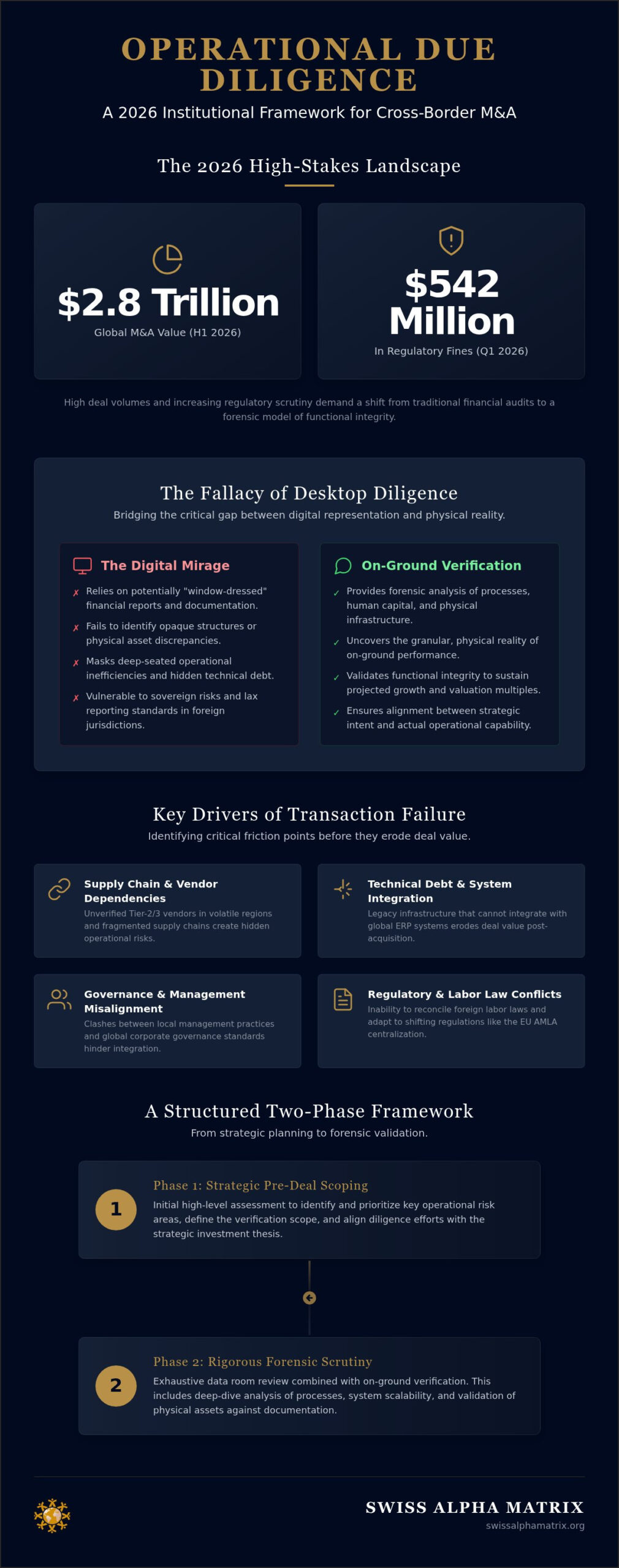
With global M&A values reaching a staggering USD 2.8 trillion in the first half of 2026, the margin for error in cross-border capital deployment has reached a critical threshold. While the sheer volume of activity suggests a period of robust institutional growth, the $542 million in regulatory fines issued during the first quarter alone highlights a systemic vulnerability in traditional oversight. This underscores the absolute necessity for rigorous operational due diligence in cross-border m&a, a process that must move beyond superficial, desktop-level audits which, as many seasoned executives have discovered, frequently fail to identify opaque structures or physical asset discrepancies in foreign jurisdictions. You’ve likely observed that even the most meticulously structured deals can falter when the physical reality of an asset doesn’t align with its digital representation.
This analysis delivers a sophisticated institutional framework designed to safeguard your capital by bridging the gap between strategic intent and on-ground operational capability, ensuring that every deployment is met with absolute certainty. We’ll explore senior-led verification strategies and the critical regulatory shifts, such as the centralization of supervision under the EU Anti-Money Laundering Authority as of January 2026, that define the current landscape. You’ll gain a robust methodology for verifying the physical reality of a deal, allowing for a standard of service that’s both broad in reach and meticulous in its attention to detail.
Key Takeaways
- Understand the critical evolution from traditional financial audits toward a forensic model of functional integrity, essential for navigating the heightened regulatory landscape of 2026.
- Identify systemic vulnerabilities within multi-tiered supply chains and evaluate the technological scalability required for seamless global system integration.
- Bridge the “digital mirage” by prioritizing on-ground verification over desktop-only analysis to ensure that physical operational reality aligns with institutional documentation.
- Master a structured two-phase framework for operational due diligence in cross-border m&a that transitions from strategic pre-deal scoping to rigorous forensic data room scrutiny.
- Leverage senior-led, Tier-1 global banking expertise to secure institutional capital and maintain alignment between strategic intent and operational capability.
The Strategic Imperative of Operational Due Diligence in Cross-Border M&A
In the high-stakes environment of 2026, where global M&A values have ascended to USD 2.8 trillion, the traditional reliance on financial metrics has proven insufficient for protecting institutional capital. While balance sheets provide a historical record of fiscal performance, they often fail to capture the underlying functional integrity of a target entity. This gap has necessitated a shift toward a more forensic approach. What is Operational Due Diligence? At its core, it’s the exhaustive analysis of a target company’s internal processes, human capital, and physical infrastructure to ensure they can sustain the projected growth that justifies the purchase multiple. In 2026, average EBITDA multiples of 6.8x, and premiums reaching 9.8x, leave no room for operational friction that hasn’t been accounted for in the valuation.
The transition from financial-only audits to holistic operational validation is no longer optional. Cross-border transactions introduce unique layers of sovereign and systemic risk that desktop-level reviews cannot penetrate. Whether it’s the shifting 2026 FATF grey-list status of emerging markets or the centralization of oversight under the EU Anti-Money Laundering Authority, the regulatory landscape is increasingly unforgiving. Engaging in operational due diligence in cross-border m&a ensures that your cross-border investment due diligence remains robust, providing the clarity needed to deploy capital into jurisdictions where transparency is often a secondary concern.
Beyond the Balance Sheet: Why Financials Lie
EBITDA is a lagging indicator that can easily mask deep-seated operational inefficiencies, particularly in international subsidiaries where reporting standards may be lax. Institutional investors often encounter “window-dressed” assets, where physical facilities or inventory counts are manipulated to satisfy remote auditors. These discrepancies are rarely caught by teams who don’t set foot on the ground. Operational due diligence serves as the indispensable bridge between abstract financial theory and the granular, physical reality of on-ground performance. Without this verification, a firm risks acquiring a digital mirage rather than a functional enterprise.
Drivers of Transaction Failure in International Markets
Transaction failure in 2026 is frequently driven by fragmented supply chains and the sudden impact of regional regulatory shifts. The hidden costs of technical debt, such as legacy infrastructure that can’t integrate with global ERP systems, can erode deal value within months of closing. It’s vital to align deal velocity with the precision of international financial regulations, ensuring that every operational component is compliant and scalable. Common failure points include:
- Misalignment between local management practices and global corporate governance.
- Unverified Tier-2 and Tier-3 vendor dependencies in volatile regions.
- Inability to reconcile foreign labor laws with post-merger integration goals.
By identifying these friction points early, operational due diligence in cross-border m&a transforms from a simple checklist into a strategic tool for capital preservation.
Deconstructing the Pillars of Institutional-Grade Operational Risk
Institutional-grade risk management requires a refusal to accept documentation at face value. When executing operational due diligence in cross-border m&a, the objective is to uncover the friction points that remain invisible to standard accounting. The strategic imperative of effective operational due diligence is found in the meticulous deconstruction of a target’s functional pillars, ensuring that the strategic vision is supported by a resilient operational reality. This forensic scrutiny is the only way to safeguard interests in a global market where complexity often masks systemic vulnerability.
Supply Chain and Logistics Forensics
Supply chain resilience has evolved from a logistical concern into a primary risk factor for capital preservation. We often find that while a target’s primary suppliers appear stable, the Tier-2 and Tier-3 vendors in emerging markets represent significant single-source dependencies that aren’t immediately apparent. In 2026, the introduction of stringent ESG mandates across global jurisdictions means that a target’s operational viability is inextricably linked to the ethical standards of its entire network. Verifying these hubs requires on-ground verification services to ensure that physical logistics capacities aren’t merely theoretical projections in a data room. It’s about confirming that the assets you’re acquiring actually exist and function as described.
Corporate Governance and Entity Integrity
Deconstructing complex corporate webs is essential to identifying the Ultimate Beneficial Owner (UBO), particularly in jurisdictions where ownership remains intentionally opaque. Evaluating the maturity of internal control frameworks involves more than checking boxes; it requires assessing the target’s ability to integrate with global technological systems without accruing debilitating technical debt. Utilizing bank instrument validation services provides the necessary certainty regarding counterparty creditworthiness, protecting the acquiring entity from sophisticated institutional fraud. This level of scrutiny defines the institutional standard for operational due diligence in cross-border m&a in 2026.
Soft risks, such as cultural misalignment and human capital retention, often manifest as hard losses post-integration. If the target’s internal culture resists the acquiring firm’s governance, the resulting friction can erode the very synergies that justified the deal. This is why our approach emphasizes a holistic view of aml compliance requirements and regulatory infrastructure. It’s about ensuring the target’s operational DNA is compatible with your long-term strategic growth. For those seeking absolute precision in these assessments, leveraging an independent oversight layer remains the most prudent path to capital preservation.
The Fallacy of Desktop Diligence: Why On-Ground Verification is Non-Negotiable
The digital data room, while a staple of modern deal-making, often creates what we term a “Digital Mirage,” where polished PDFs and automated reports obscure the true state of a target’s operations. Relying solely on desktop-level analysis for operational due diligence in cross-border m&a is a gamble that institutional capital cannot afford. While AI-driven tools have become more prevalent in 2026, helping to shorten timelines and deepen the scope of investigations, they remain fundamentally limited. These algorithms can process vast amounts of data, but they lack the contextual intelligence to detect sophisticated institutional fraud or the subtle signs of operational decay that only a seasoned eye can discern. Strategic growth requires more than just high-speed data processing; it demands the intellectual depth to see beyond the screen.
The Swiss Alpha Matrix philosophy rejects the oversimplification of complex dynamics, favoring a methodology where financial discipline is tethered to a physical on-ground presence. This is where the strategic architecture of independent financial project management becomes indispensable. It provides the necessary oversight layer to coordinate international site visits, ensuring that the “physical reality” of a deal is verified by experts who prioritize long-term preservation over short-term speculation. Without this layer of regional precision, the strategic intent of a merger is often lost in the gap between paperwork and practice.
The Role of Senior Human Oversight
Algorithms don’t understand the nuances of a factory floor or the unspoken tensions in a local boardroom. Former Tier-1 global bank executives bring a level of unemotional expertise that junior analysts and automated systems simply can’t replicate. This senior oversight moves the process from a “check-the-box” exercise to a strategic validation of the target’s core capabilities. It’s about seeing what isn’t there, questioning the assumptions that others take for granted, and maintaining the traditional discretion required for high-stakes international mandates. This elite level of scrutiny ensures that interests are in the hands of masters who value thoroughness over deal velocity.
Physical Asset and Inventory Validation
In one notable cross-border mandate, a target entity’s digital records showed a robust inventory of high-value components, yet on-ground inspection revealed that the warehouses were largely empty, with the “stock” consisting of empty crates. This discrepancy, which would have been invisible to a desktop audit, highlights the non-negotiable nature of physical verification in operational due diligence in cross-border m&a. On-ground verification serves as the ultimate antidote to documentation fraud, providing the certainty required for deployment in remote or opaque jurisdictions where regional precision is the only standard that matters. It’s the final, logical step in lead-generation for certainty.
Strategic Implementation: A 2026 Framework for Operational Assessment
Implementing a robust framework for operational due diligence in cross-border m&a requires a departure from the superficial checklists of the past. For 2026, we’ve developed a four-phase methodology that prioritizes technical precision and physical reality over mere documentation. This approach begins with Phase 1: Pre-Deal Scoping, where we identify critical operational friction points that could impede value creation. By utilizing institutional-grade financial advisory methodologies, we ensure that the initial assessment is rooted in capital protection and strategic alignment from the outset.
Phase 2 involves Forensic Data Room Analysis, a process that challenges every assumption with technical rigor, moving beyond the surface-level summaries provided by target entities. However, the definitive shift in our framework occurs in Phase 3: On-Ground Execution. This phase addresses the prevailing industry gap by deploying senior experts to physically verify assets, inventory, and facility integrity in the target jurisdiction. Finally, Phase 4 focuses on Post-Closing Integration Mapping, ensuring that the operational gap between the target and the acquirer is bridged before friction can erode synergies. This structured progression creates a sense of inevitable logic and professional calm throughout the transaction lifecycle.
Jurisdictional Risk Mapping
Successful mandates depend on a granular understanding of local environments. In 2026, evaluating jurisdictional risk involves more than just a legal review; it requires assessing the stability of regional infrastructure and the impact of local labor laws on post-merger efficiency. With certain emerging markets maintaining their FATF grey-list status throughout 2026, the necessity for local regulatory alignment is paramount for long-term capital protection. We analyze these variables to ensure your deployment remains secure against sovereign or systemic shifts that digital audits simply cannot predict.
Audit-Grade Reporting for the C-Suite
The final output of our assessment is a report designed for board-level scrutiny. We translate complex operational data into executive-level intelligence, providing the clarity required for high-stakes decision-making. These audit-grade reports don’t just list findings; they offer a structured analysis of risks and mitigation strategies that align with your strategic intent. Precision in capital deployment is achieved through detailed deliverable reviews that leave no room for ambiguity. For executives who demand absolute certainty in their international expansions, our on-ground verification services provide the definitive layer of oversight needed to protect institutional interests.
Swiss Alpha Matrix: Precision-Led Operational Due Diligence for Global Mandates
The efficacy of a cross-border transaction is frequently determined by the depth of the independent oversight applied during the pre-acquisition phase. At Swiss Alpha Matrix, we leverage decades of Tier-1 global banking experience to provide the forensic scrutiny necessary for operational due diligence in cross-border m&a, ensuring that institutional capital is protected from the systemic vulnerabilities inherent in international expansions. Our primary function is to bridge the often-perilous gap between polished corporate documentation and the unvarnished on-ground reality of a target’s operations. As an independent advisory, we serve as the essential third-party layer, offering the unemotional expertise required to challenge assumptions and verify physical assets without the conflict of interest inherent in larger, multi-service firms.
Our commitment to Swiss discretion mirrors the traditional standards of high-end private wealth management, applying a level of meticulous attention to detail that is required for the most complex global mandates. This deliberate complexity in our methodology reflects our refusal to oversimplify the intricate nature of verifying functional integrity across diverse regulatory environments. We position ourselves as a dedicated partner, providing a standard of service that is both broad in reach and meticulous in its execution, ensuring that your interests are in the hands of seasoned masters who prioritize long-term preservation over deal velocity.
Our Mandate-Specific Approach
We don’t believe in templated solutions for institutional-grade risk. Our frameworks are meticulously tailored to the specific risk profile of your industry and the unique geopolitical nuances of the region in question. By utilizing milestone-based engagements, we provide long-term project oversight that maintains historical reliability throughout the deal lifecycle. This hyper-personalized approach allows you to access senior-level expertise for multi-jurisdictional deal management, ensuring that every operational component is validated against the highest global standards. Our methodology moves from broad philosophical principles of capital protection down to specific strategic pillars with a calm, unwavering pace.
Securing Your Next Institutional Acquisition
Proactive operational validation isn’t merely a defensive measure; it’s the foundation of long-term capital preservation and strategic growth. By mitigating exposure in volatile international markets, particularly those facing the complexities of 2026 FATF grey-list status, we ensure that your strategic intent is supported by genuine operational capability. This level of certainty in capital deployment decisions distinguishes a performance-oriented mindset from passive market participants. To ensure your next acquisition is rooted in physical reality and institutional discipline, Consult with Swiss Alpha Matrix for your cross-border operational due diligence mandate and secure the independent oversight your capital deserves.
Safeguarding Institutional Capital Through Forensic Operational Validation
The transition from theoretical value to physical reality requires more than just high-speed data processing; it demands the intellectual depth and seasoned intuition that only senior human oversight can provide. We’ve established that a multi-layered framework, rooted in forensic data analysis and physical on-ground verification, serves as the definitive barrier against the systemic risks and opaque structures often encountered in foreign jurisdictions. By prioritizing functional integrity over superficial financial metrics, institutional investors ensure that their strategic intent remains perfectly aligned with the target’s actual operational capacity.
Mastering operational due diligence in cross-border m&a is no longer a matter of simple checklists, but a strategic imperative for long-term capital preservation in an increasingly volatile global landscape. Swiss Alpha Matrix, led by former senior executives from Tier-1 global financial institutions, provides the independent oversight layer required to navigate these complexities with Swiss discretion and regional precision. Our specialized approach to complex, high-stakes international project management ensures that your interests remain in the hands of experts who value thoroughness over deal velocity. Secure your cross-border M&A transaction with institutional-grade operational due diligence from Swiss Alpha Matrix and deploy your capital with absolute certainty.
Frequently Asked Questions
What is the primary objective of operational due diligence in cross-border M&A?
The primary objective of operational due diligence in cross-border m&a is to verify the functional integrity and scalability of a target’s internal processes to ensure they can support the strategic value projected in the deal valuation. This forensic analysis aims to identify hidden operational friction that could erode capital post-acquisition. By scrutinizing the target’s physical and technical infrastructure, investors gain the certainty required for high-stakes capital deployment.
How does ODD differ from standard financial and legal due diligence?
While financial and legal audits focus on historical fiscal records and contractual obligations, operational due diligence examines the target’s ability to execute its business model under new ownership. Financial audits might confirm that revenues exist, but this process assesses whether the supply chain, technology, and human capital are capable of sustaining those revenues. It serves as the bridge between theoretical balance sheet value and the practical reality of daily operations.
Why is on-ground verification essential for international acquisitions in 2026?
On-ground verification is essential in 2026 because digital data rooms often present a polished mirage that fails to reflect the physical state of assets or inventory. With the rise of sophisticated institutional fraud and opaque reporting standards in certain regions, physical site visits provide the only definitive proof of functional existence. This meticulous approach ensures that what’s documented in a data room aligns precisely with the on-ground operational reality.
What are the biggest operational risks when acquiring a target in an emerging market?
The most significant risks include single-source supply chain dependencies, opaque corporate ownership structures, and the potential for a target to be located in a jurisdiction with a 2026 FATF grey-list status. These markets often lack the transparency of Western economies, making it difficult to identify the Ultimate Beneficial Owner or assess the maturity of internal control frameworks. Regional regulatory shifts can also introduce sudden, unforeseen compliance costs that threaten post-merger synergy.
How can senior human oversight prevent institutional-grade fraud in M&A?
Senior human oversight, particularly when led by former Tier-1 bankers, identifies subtle anomalies that automated algorithms and junior analysts frequently overlook. These seasoned experts possess the unemotional discipline to question inconsistencies in facility throughput or inventory turnover that appear normal on paper. By applying a master planner’s perspective, they can detect sophisticated fraud patterns that rely on the assumption that due diligence will be a simple, check-the-box exercise.
What role does cultural integration play in operational due diligence?
Cultural integration is a soft risk that often leads to hard financial losses if not addressed during the due diligence phase. Misalignment between the target’s local management practices and the acquirer’s global corporate governance can result in post-merger integration failure and the loss of key talent. Operational due diligence evaluates these cultural nuances to ensure that the target’s organizational DNA is compatible with the long-term strategic intent of the merger.
How does Swiss Alpha Matrix handle multi-jurisdictional regulatory compliance?
Swiss Alpha Matrix utilizes a milestone-based framework to navigate the intricate regulatory requirements of multiple jurisdictions simultaneously. Our approach emphasizes regional precision, ensuring that a target meets specific local mandates, such as the centralized AML supervision under the EU Anti-Money Laundering Authority. We provide an independent oversight layer that coordinates complex project management across borders, maintaining Swiss discretion while delivering audit-grade reports for executive stakeholders.
Can automated software replace the need for senior-led operational advisory?
Automated software cannot replace senior-led advisory because it lacks the contextual intelligence and qualitative judgment required for high-stakes operational due diligence in cross-border m&a. While AI tools can shorten timelines for data processing, they cannot conduct physical site inspections or navigate the nuanced negotiations typical of international deals. The intellectual superiority and traditional values provided by seasoned experts remain the only standard for ensuring absolute precision in capital deployment decisions.