

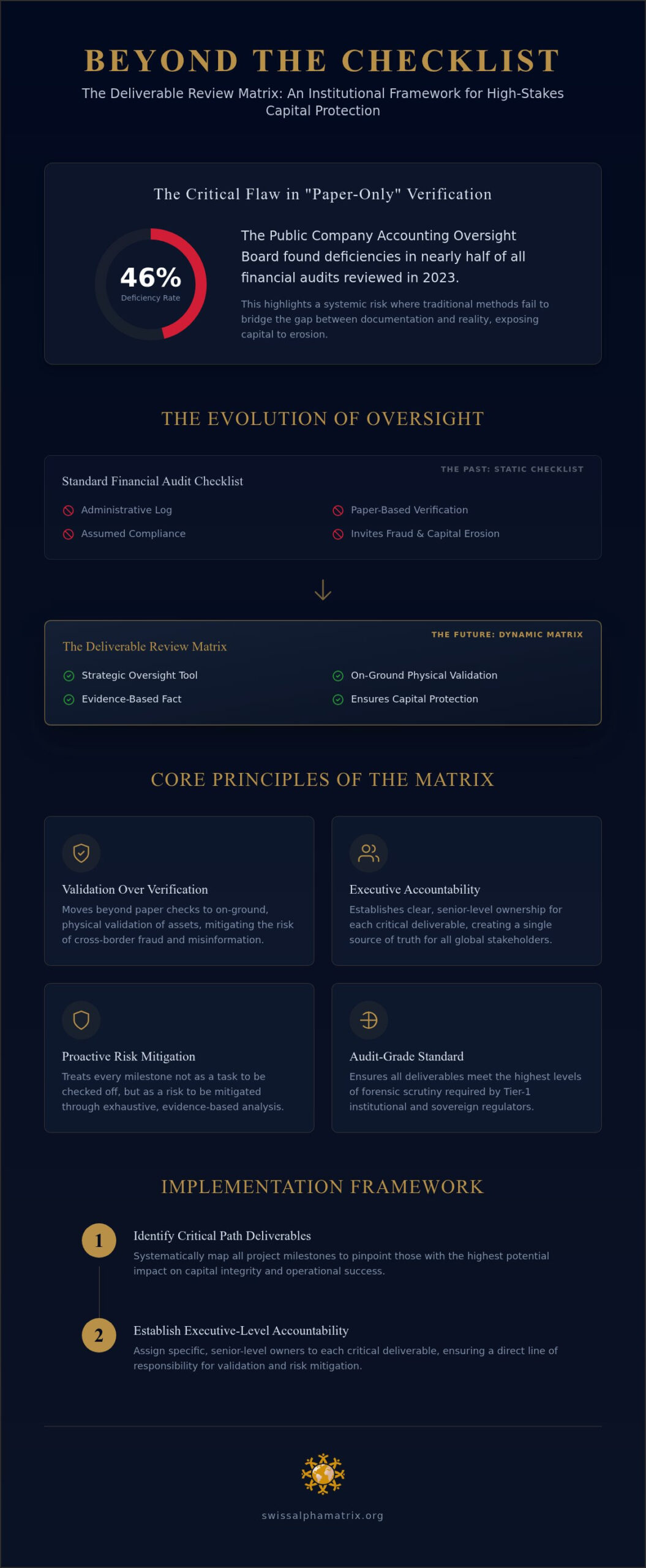
In high-stakes cross-border finance, the reliance on mere “paper-only” verification is not just a procedural oversight; it’s a profound systemic risk that invites capital erosion. You likely understand that as global mandates grow in complexity, the traditional financial project audit checklist often fails to bridge the gap between perceived compliance and actual, on-ground instrument validation. With the Public Company Accounting Oversight Board finding deficiencies in 46% of financial audits as recently as 2023, the margin for error has narrowed significantly, requiring a more rigorous approach to oversight that favors precision over speed.
This article explores the Deliverable Review Matrix, a sophisticated institutional framework designed by former Tier-1 bank executives to enforce accountability and ensure every financial instrument meets an audit-grade standard. We’ll examine how this methodology eliminates information asymmetry among global stakeholders, providing a logical, structured path toward absolute deal integrity and long-term capital protection. By transitioning from static documentation to a dynamic system of continuous validation, you can secure the intellectual depth and technical accuracy required to protect interests in an increasingly volatile regulatory environment.
Key Takeaways
- Understand how to transform a standard administrative log into a robust strategic oversight tool that enforces institutional-grade discipline across complex financial mandates.
- Move beyond the inherent limitations of a basic financial project audit checklist by implementing a multi-layered matrix that prioritizes capital protection over simple documentation.
- Discover the critical distinction between paper-based verification and physical validation, including how to integrate on-ground triggers to mitigate the risk of cross-border fraud.
- Learn a structured, two-step implementation process for identifying critical path deliverables and establishing clear executive-level accountability among global stakeholders.
- Explore the advantages of senior-level oversight and bespoke review frameworks in providing the precision required for sovereign and institutional-grade project management.
Defining the Deliverable Review Matrix within Institutional Frameworks
The Deliverable Review Matrix serves as a sophisticated sentinel, transcending the utility of a conventional administrative log to function as a primary instrument of capital protection. While foundational project management principles provide a necessary baseline for operational coordination, they often lack the specialized fiduciary depth required for high-value cross-border mandates. This is where independent financial project management distinguishes itself; it integrates a technical layer of scrutiny that transforms a standard financial project audit checklist into a rigorous validation protocol. Within this framework, every milestone is treated not as a task to be completed, but as a risk to be mitigated through exhaustive evidence based analysis.
Establishing an audit-grade standard is essential in an era where institutional oversight has never been more critical. With the Public Company Accounting Oversight Board reporting deficiencies in 46% of financial audits in 2023, a 6% increase from the prior year, it’s clear that traditional documentation often masks underlying structural weaknesses. To meet the expectations of Tier-1 institutional regulators, deliverables must be prepared with the understanding that they’ll be subjected to the highest levels of forensic scrutiny. The matrix acts as the operational backbone for this effort, systematically addressing the information asymmetry that frequently plagues multi-billion dollar deals where global stakeholders may lack direct visibility into local operational realities.
The Distinction Between Tracking and Validation
In the context of complex financial instrument analysis, the designation of “completed” is often dangerously premature. A deliverable is only truly valid when it’s been mapped against specific risk mitigation objectives and verified against on-ground realities. The Deliverable Review Matrix stands as the ultimate guardian of capital integrity, ensuring that every institutional commitment rests upon a foundation of verified fact rather than assumed compliance. This process requires a financial project audit checklist that prioritizes technical validation over mere procedural adherence.
Stakeholder Alignment in Complex Mandates
For C-suite executives, the matrix functions as the definitive “single source of truth,” aligning legal, financial, and operational teams under a unified methodology. It replaces fragmented reporting with a logical, structured argument for deal integrity, fostering a sense of professional calm among partners. The Swiss Alpha Matrix philosophy dictates that discretion must always be paired with technical precision, ensuring that the most sensitive institutional mandates are managed by experts who value long-term preservation over short-term expediency.
The Strategic Architecture of a High-Stakes Review Matrix
Constructing a matrix for high-stakes mandates requires a deliberate departure from the simplistic tracking models often found in generic business software. While a basic financial project audit checklist might satisfy administrative needs, it lacks the technical depth to safeguard capital in multi-jurisdictional deals. The architecture of a truly institutional matrix must integrate financial advisory methodologies that prioritize validation over mere observation. This structure ensures that every entry is tethered to a verifiable reality, moving beyond the “checked box” mentality that often precedes institutional failure. It’s a system designed for master planners who recognize that precision is the only defense against information asymmetry.
Modern project audit frameworks emphasize the necessity of governance, yet in the specialized world of sovereign finance and private wealth, this governance must be hyper-personalized. The matrix must include a “Validation Tier” column, which serves to categorize deliverables based on their potential for capital exposure. By assigning a risk-weighted value to each document, the oversight team can allocate forensic resources where they’re most needed. This evidence-based approach defines what it means to produce audit-grade proof, requiring original source verification and independent confirmation rather than accepting secondary summaries at face value.
The Validation Hierarchy
A logical hierarchy is required to manage the overwhelming volume of data inherent in cross-border mandates. The matrix should categorize deliverables into three distinct tiers of scrutiny to ensure no critical detail is overlooked:
- Tier 1: Critical Financial Instruments. This involves the forensic validation of SBLCs, Bank Guarantees, and SWIFT messages, where any discrepancy represents a direct threat to capital integrity.
- Tier 2: Operational Due Diligence and Regulatory Compliance Reports. These documents provide the structural context for the deal, including AML/KYC certifications and regional regulatory filings that must withstand institutional scrutiny.
- Tier 3: Administrative and Procedural Documentation. While necessary for a complete financial project audit checklist, these items carry lower immediate risk but remain essential for maintaining a clear audit trail.
Mapping Roles via RACI Integration
Accountability is the cornerstone of a successful review matrix. It’s vital to distinguish between a “Reviewer,” who checks for procedural completeness, and a “Validator,” who confirms the technical authenticity of the instrument through independent channels. In high-stakes transactions, a “blind approval,” where a document is signed off without counter-party verification, can be catastrophic for all involved parties. The final executive sign-off must be more than a formality; it’s a personal attestation of the deal’s integrity by a seasoned expert. To ensure your mandates are handled with this level of technical accuracy, consider how specialized complex project management services can bridge the gap between oversight and execution.
Beyond Documentation: Validation vs. Verification in Cross-Border Deals
The pervasive fallacy in modern due diligence is the belief that digital documentation provides a sufficient foundation for capital deployment without a corresponding physical anchor. In complex cross-border deals, where jurisdictional boundaries often obscure transparency, a standard financial project audit checklist must evolve from a passive record into an active validation engine. This evolution necessitates the inclusion of specific physical verification triggers that challenge the authenticity of every submitted document, regardless of the perceived reputation of the counterparty. Institutional discipline doesn’t view partner trust as a substitute for forensic scrutiny; rather, it recognizes that even the most reputable entities can be compromised by systemic internal errors or sophisticated external fraud.
A review matrix that relies solely on “paper-only” evidence is fundamentally incomplete, as it fails to address the risk of document fabrication which has become increasingly common in international investment. By integrating specialized bank instrument validation services directly into the oversight workflow, a master planner can ensure that every asset is tethered to a verifiable reality. This methodology moves the project beyond “compliance theater” and into a state of absolute deal integrity, where capital protection is enforced through unwavering technical precision and logical deduction.
The Role of On-Ground Verification
High-value asset validation is logically incomplete without a direct presence in the physical jurisdiction where the collateral resides. The review matrix must incorporate non-negotiable site visits and face-to-face interviews with key counterparties to verify the actual existence and current encumbrance status of physical assets. In the context of transactions exceeding $100M, digital footprints and scanned certificates are insufficient proof of value because they lack the immutable assurance that only on-ground inspection can provide. This level of rigor replaces subjective assumptions with empirical data, ensuring that the project’s foundation is built on verified fact rather than optimistic projection.
Instrument Validation Protocols
Preventing cross-border malfeasance requires a systematic mapping of bank-to-bank communications, specifically the independent verification of SWIFT messages through secure, multi-layered channels. Every instrument, from Standby Letters of Credit to sovereign guarantees, must be meticulously cross-referenced against the strictures of international financial regulations to ensure both compliance and operational viability. Within this framework, the financial project audit checklist acts as a formidable deterrent to sophisticated financial malfeasance, signaling to all stakeholders that the mandate is under the protection of seasoned, unemotional experts who prioritize long-term stability.
Implementing a Deliverable Review Matrix for Executive Oversight
The transition from a conceptual framework to an active operational protocol requires a disciplined implementation strategy that prioritizes the systematic reduction of risk over the mere completion of tasks. This process begins with Step 1, the identification of critical path deliverables that possess the inherent potential to impact capital deployment decisions directly, ensuring that executive attention remains focused on high-exposure milestones. Step 2 involves the assignment of multi-layered review responsibilities to independent advisors, which establishes a series of checks and balances designed to eliminate the possibility of single-point failure within the oversight chain. In Step 3, the master planner defines the unambiguous “Stop/Go” criteria for each validation milestone, ensuring that the financial project audit checklist serves as an absolute barrier to progress whenever a technical discrepancy is identified. Step 4 necessitates the execution of the on-ground verification protocols previously established, while Step 5 ensures the meticulous archiving of the audit trail to provide lasting regulatory and fiduciary protection for all involved parties.
Execution of this matrix is not a static event but an iterative cycle that demands constant technical accuracy and logical consistency. For instance, when a financial instrument moves through the validation tier, the matrix tracks its progression from initial submission to final attestation, providing a transparent record of the scrutiny applied at each stage. This level of detail is essential for maintaining deal integrity, as it allows stakeholders to see exactly how and when a deliverable was verified against the project’s core objectives. To ensure your next mandate is governed by these rigorous standards, you may wish to explore our Operational Due Diligence services.
Establishing Critical Success Factors
Defining what “Review Complete” looks like for a complex financial model requires a granular approach that includes the forensic stress-testing of every underlying assumption. It’s vital to set a precise threshold for acceptable variance in due diligence findings, as even a minor discrepancy can signal deeper systemic issues that require immediate attention. This methodology is a core component of mastering cross-border investment due diligence, where the goal is to create a seamless alignment between institutional standards and regional execution.
Managing Revision and Rejection
Rejection is a vital feature of a robust matrix, providing a structured protocol for deliverables that fail to meet audit-grade standards. If a document is flagged, the matrix tracks the remediation process to ensure that red flags are resolved with technical precision rather than bypassed for the sake of deal momentum. This disciplined approach ensures that the project remains on a secure footing, protecting the interests of all stakeholders by refusing to compromise on the quality of the underlying evidence. By maintaining this unwavering standard, you don’t just manage a project; you protect the capital and the reputation of the institution you serve.
Swiss Alpha Matrix: Precision in Mandate-Specific Deliverable Validation
At Swiss Alpha Matrix, we recognize that sovereign-level and institutional mandates require a level of forensic scrutiny that transcends standard market offerings. We deploy bespoke review matrices that are meticulously calibrated to the specific risk profile of each engagement, ensuring that no detail is left to chance. Our approach is defined by the expertise of our leadership team, comprised of former senior executives from Tier-1 global banks who bring a master planner’s perspective to every transaction. By merging traditional Swiss discretion with the rigorous discipline of international banking standards, we provide a layer of oversight that is as logically unassailable as it is technically precise. This technical accuracy ensures that the financial project audit checklist isn’t just a static document but a living instrument of capital protection designed to withstand the most demanding regulatory inquiries.
The defining advantage of our methodology lies in the commitment of our partners to personally validate critical path deliverables. In an industry where “blind approval” is a recurring systemic failure, our experts don’t rely on secondary summaries; they engage in the primary validation of instruments and on-ground realities. This hands-on involvement transforms raw data into executive-level intelligence, empowering stakeholders to make capital deployment decisions with absolute confidence. The final deliverable we provide is not merely a report, but a verified foundation for strategic growth, ensuring that your interests are protected by seasoned professionals who value long-term stability over short-term speculation.
Boutique Service, Institutional Reach
Our approach to project oversight is rooted in hyper-personalization, recognizing that every mandate possesses unique jurisdictional and structural complexities. We prevent capital loss by enforcing matrix-driven verification protocols that identify and neutralize potential threats before they can impact the deal’s integrity. The promise of permanence serves as our primary metric for success, as we prioritize the long-term preservation of capital through a standard of service that is both broad in reach and meticulous in its attention to detail. This elite level of care ensures that every financial project audit checklist reflects the high moral character and technical standards of our institutional partners.
Engaging Swiss Alpha Matrix for Project Oversight
Our independent advisory services are designed to integrate seamlessly with your existing deal team, providing a dedicated partner to strengthen your operational due diligence. The engagement process begins with a strategic audit of your current deliverable expectations, where we identify potential gaps in your validation framework and propose a logical, structured path forward. This initial assessment creates a sense of professional calm, allowing your team to focus on strategic pillars while we manage the intricate details of risk mitigation. To secure the intellectual depth and technical precision your mandate requires, Contact Swiss Alpha Matrix for a confidential consultation.
Securing Institutional Integrity Through Technical Precision
The transition from a rudimentary financial project audit checklist to a sophisticated deliverable review matrix represents a fundamental shift from passive observation to active capital protection. By prioritizing on-ground verification over digital documentation, master planners ensure that every financial instrument is anchored in a verifiable reality that withstands the most rigorous forensic scrutiny. This methodology, rooted in the disciplined traditions of private wealth management, provides the intellectual depth necessary to navigate the information asymmetries inherent in complex cross-border mandates. It’s a system designed for those who recognize that long-term preservation and strategic growth are only possible when deal integrity is enforced with technical accuracy and logical consistency.
As you move forward with high-value global initiatives, the support of a dedicated partner can provide the necessary layer of institutional-grade discipline. Led by former Tier-1 global bank executives, Swiss Alpha Matrix combines global reach with the regional precision and discretion required for sovereign and institutional mandates. We remain committed to ensuring that your interests are protected through audit-grade validation standards and a standard of service that is both broad in scope and meticulous in its execution. We invite you to Secure Your Capital with Institutional-Grade Oversight and establish a foundation of permanence for your most critical financial projects.
Frequently Asked Questions
What is the primary purpose of a deliverable review matrix in high-stakes finance?
The primary purpose is to function as a strategic sentinel for capital protection, ensuring that every project milestone is subjected to a forensic level of scrutiny. It transcends simple administrative tracking by enforcing a rigorous financial project audit checklist that maps each deliverable to a specific risk-mitigation objective. This logical framework eliminates information asymmetry and ensures that institutional interests remain in the hands of seasoned experts who prioritize long-term stability.
How does a deliverable review matrix differ from a standard project schedule?
A standard project schedule focuses on the chronological progression of tasks, whereas a review matrix prioritizes the technical validation and authenticity of those outcomes. While a schedule might indicate that a document has been submitted, the matrix requires audit-grade proof that the document is both accurate and legitimate. It shifts the focus from the timing of a submission to the quality of the evidence provided against institutional standards.
Why is independent validation necessary if we already have legal counsel?
Legal counsel is essential for defining contractual obligations, but independent validation confirms the physical and technical reality behind those legal instruments. Attorneys focus on the language of the agreement; however, they rarely possess the institutional banking background required to conduct on-ground verification or forensic bank instrument validation. Our methodology complements legal oversight by providing the empirical data needed to ensure that the assets described in a contract actually exist and are unencumbered.
Can a deliverable review matrix help in identifying financial instrument fraud?
The matrix is specifically designed to act as a deterrent to sophisticated financial malfeasance by requiring original source verification for every instrument. By integrating financial project audit checklist protocols with bank-to-bank communication triggers, the system exposes discrepancies that digital documentation often masks. This rigorous approach identifies red flags such as unverified SWIFT messages or inconsistent collateral claims, providing a logical barrier against the risk of document fabrication in cross-border deals.
How do you integrate on-ground verification into a digital matrix?
Integration is achieved by establishing non-negotiable physical triggers that must be satisfied before any digital milestone is marked as validated. The matrix defines specific criteria for site visits, face-to-face counterparty interviews, and physical asset inspections that correspond to the technical stages of the transaction. This ensures that the digital record is always anchored to an empirical, on-ground reality, preventing the deal from proceeding based on unverified digital footprints alone.
What are the common red flags that a review matrix should be designed to catch?
A robust matrix targets indicators of systemic risk, such as inconsistencies in the chain of custody for financial instruments or a lack of direct bank-to-bank confirmation. Other critical red flags include resistance from counterparties regarding on-ground inspections, vague accountability among global stakeholders, and deliverables that rely solely on scanned documentation without original source access. Identifying these variances early allows for remediation before capital is deployed into compromised structures.
How does this methodology support regulatory compliance for institutional investors?
This methodology provides a comprehensive, archived audit trail that meets the exacting standards of Tier-1 institutional regulators and internal compliance committees. By systematically documenting every validation step, the matrix serves as a primary defense in regulatory inquiries, demonstrating a high level of fiduciary care and adherence to international financial standards. It ensures that the project oversight framework is as logically unassailable as it is technically precise.
Is the deliverable review matrix suitable for smaller cross-border deals?
The logic of capital protection is universal, making this framework equally essential for smaller mandates where the margin for error is often narrower. While the scale of the deliverables may vary, the fundamental requirement for technical accuracy and on-ground verification remains the same to prevent capital erosion. Implementing these institutional-grade standards early in a smaller transaction fosters a sense of professional calm and establishes a foundation of stability for future strategic growth.