

The realization that a standard checklist is insufficient often arrives at the most inopportune moment, typically when a cross-border transaction encounters the friction of fragmented regulatory jurisdictions or the sophisticated misrepresentation of a financial instrument. You likely recognize that in a landscape where the EU Anti-Money Laundering Authority is currently implementing its latest measures and the UK has recently tightened oversight through the 2026 Amendment Regulations, a passive approach to verification is a significant institutional liability. To ensure the long-term preservation of capital and the integrity of your most sensitive deals, a robust due diligence project plan must transcend simple procedural tasks to become a masterfully architected roadmap for risk mitigation.
This article demonstrates how to structure a sophisticated framework that provides audit-grade certainty and clear accountability across global teams. We’ll explore the strategic pillars required to validate complex assets, moving beyond superficial reviews to establish a standard of precision that satisfies both internal stakeholders and international regulators. By the conclusion, you’ll understand how to transform your verification process into a tool of quiet authority that ensures every instrument is both authentic and enforceable.
Key Takeaways
- Understand how to elevate your due diligence project plan from a simple checklist to a sophisticated risk-management framework that prioritizes the long-term preservation of institutional capital.
- Learn to identify the ‘desktop gap’ by implementing on-ground verification protocols that validate the authenticity of complex financial instruments beyond digital documentation.
- Explore the integration of Operational Due Diligence and multi-jurisdictional compliance to ensure target entities maintain rigorous internal controls.
- Discover how a RACI matrix and milestone-based scheduling provide clarity and accountability across global teams during high-stakes cross-border transactions.
- See how professional oversight from seasoned experts transforms fragmented information into a logical, audit-grade roadmap for certain decision-making.
The Strategic Architecture of a Due Diligence Project Plan
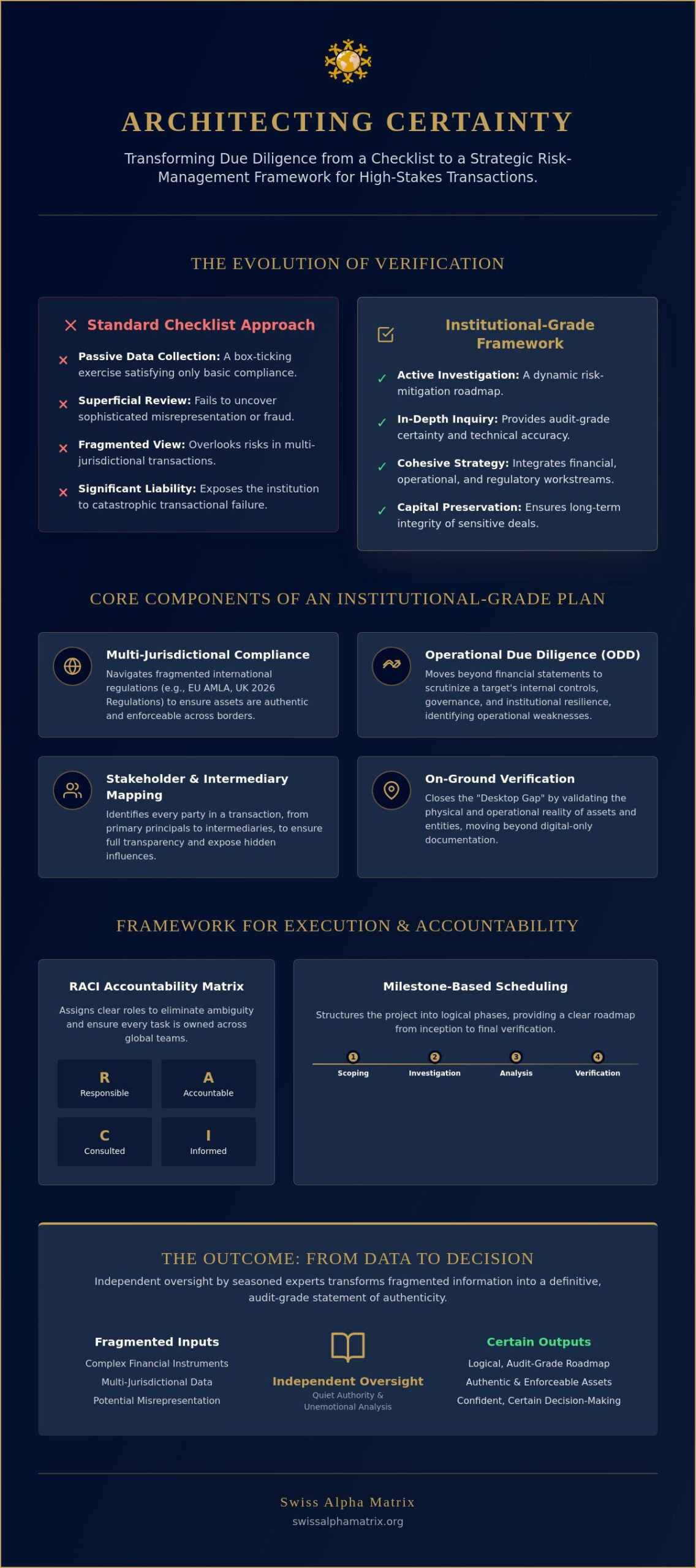
In the rarefied sphere of high-value cross-border transactions, the traditional concept of due diligence often suffers from a reductive interpretation that equates verification with a simple box-ticking exercise. A sophisticated due diligence project plan, however, functions as a dynamic strategic architecture that prioritizes the long-term preservation of capital over the mere fulfillment of procedural requirements. It’s a comprehensive risk-management framework designed to withstand the scrutiny of global regulators and the complexities of multi-jurisdictional financial instruments. For the C-suite and board members, this plan isn’t merely a tactical tool; it’s the primary instrument through which they discharge their fiduciary duties, ensuring that every deployment of capital is underpinned by an unwavering commitment to technical accuracy and moral character.
The distinction between standard procedural checks and institutional-grade validation lies in the depth of the investigative inquiry and the logical flow of the methodology. While standard checks might satisfy basic compliance, they often fail to address the fragmentation of information across multiple regulatory jurisdictions, leaving the organization exposed to misrepresentation or fraud. A structured plan serves as the primary defense against such failures, moving from broad philosophical principles of risk mitigation down to the specific strategic pillars required for transaction verification. It’s an elite approach that values privacy and exclusivity, positioning the verification process as a dedicated partnership between the organization and its seasoned advisors.
Beyond the Checklist: A Multi-Layered Approach
Transitioning from a passive stance of data collection to a posture of active, investigative oversight requires a methodology that integrates disparate workstreams into a single, cohesive roadmap. An institutional-grade due diligence project plan accounts for the intricate interplay between financial health, operational resilience, and regulatory compliance, ensuring no single variable is viewed in isolation. This multi-layered strategy reflects the discretion and precision inherent in elite Swiss advisory. It’s about identifying the subtle discrepancies that standard audits often overlook, particularly in deals involving complex financial instruments where the lack of a structured plan frequently leads to catastrophic transactional failure.
The Role of Independent Advisory in Plan Formulation
Internal teams, while competent in their specific domains, frequently struggle with systemic blindness when confronted with the sophisticated misrepresentations found in high-stakes cross-border deals. The perspective of former Tier-1 bank executives provides a layer of protective authority that internal departments cannot replicate. By establishing a sense of quiet authority, these seasoned experts apply a rigorous, unemotional lens to the project’s structure. This independent oversight is essential for identifying red flags within complex instruments, ensuring that the final verification isn’t just a report, but a definitive statement of authenticity. It’s this commitment to institutional excellence that distinguishes a performance-oriented mindset from the passive participation seen in less structured environments.
Core Components of an Institutional-Grade Plan
Constructing a high-stakes due diligence project plan requires a meticulous synthesis of several critical workstreams, each designed to mitigate specific vectors of risk in multi-jurisdictional environments. At the core of this architecture lies Operational Due Diligence, which extends beyond financial statements to scrutinize the internal controls and governance frameworks of the target entity. This is not merely an assessment of current performance but an evaluation of institutional resilience. Concurrently, a robust due diligence project plan must account for the intricate web of stakeholders involved in cross-border transactions, identifying every party from primary principals to the intermediaries whose presence can often obscure the true nature of a deal. For those seeking to fortify their transaction frameworks, engaging with specialized risk management advisors ensures that every strategic pillar is anchored in historical reliability and technical precision.
Audit-Grade Instrument Validation
The validation of financial instruments, such as Standby Letters of Credit (SBLCs) and Documentary Letters of Credit (LCs), represents a pivotal milestone in any sophisticated verification roadmap. It’s insufficient to rely on digital copies provided within a data room; instead, rigorous protocols must be implemented to facilitate direct, bank-to-bank verification procedures. This level of scrutiny ensures that assets are not only authentic but also legally enforceable under the prevailing jurisdiction. Professionals who prioritize the long-term preservation of capital should consult our bank instrument validation services to understand the investigative depth required to identify sophisticated misrepresentation in 2026.
Operational and Regulatory Workstreams
Navigating the intricacies of international financial regulations demands a performance-oriented mindset that anticipates the divergence in global standards. With the EU’s Anti-Money Laundering Authority publishing its latest Level 2 and Level 3 measures in July 2026, the compliance timeline must be agile yet meticulously structured. Integrating international financial regulations into the project plan ensures that the target’s operational resilience is mapped against global institutional standards. This process requires a quiet authority, moving logically from broad regulatory principles to the hyper-personalized oversight necessary for complex, cross-border alignment. It’s this commitment to regional excellence and precise execution that distinguishes elite fiduciary stewardship from passive compliance participation.
Addressing the ‘Desktop Gap’ with On-Ground Verification
The digital data room, while providing an efficient interface for initial document review, often creates a deceptive sense of security that masks the underlying operational reality of a transaction. Relying solely on electronic submissions and scanned certificates represents a significant institutional vulnerability, particularly in complex cross-border environments where the sophistication of financial misrepresentation has reached unprecedented levels. A truly robust due diligence project plan must therefore bridge this ‘desktop gap’ by mandating physical, on-ground verification as a non-negotiable pillar of the risk management framework. This investigative approach ensures that the representations made in a digital environment align perfectly with the physical and legal existence of the assets in question. For those architecting a high-stakes due diligence project plan, the transition from passive data consumption to active, site-based inquiry is what distinguishes institutional-grade stewardship from standard procedural compliance.
History is replete with examples where desktop-only reviews failed to identify sophisticated fraud, often because the documentation provided was visually perfect but lacked any tether to a functioning entity. Discrepancies that remain invisible on a high-resolution scan frequently become glaringly obvious during a face-to-face interview with key personnel or a physical inspection of corporate records. By deploying seasoned experts with a background in Tier-1 global banking, an organization can uncover the subtle red flags that automated systems and remote analysts inevitably miss. This level of oversight provides the quiet authority necessary to protect capital in jurisdictions where the rule of law and documentation standards may diverge from Western expectations.
The Necessity of Physical Presence
Conducting on-site audits of facilities, records, and key personnel is the only definitive method for verifying the existence and custody of physical assets or collateral. In the context of cross-border investment due diligence, local context is everything. A physical presence allows for the assessment of operational resilience that no digital questionnaire can capture, such as the actual state of infrastructure or the genuine authority of local signatories. It’s about ensuring that the ‘moral character’ and quality of the target entity are as robust as the financial metrics suggest on paper.
Verifying Financial Entities and Instruments
On-ground validation is particularly critical when dealing with financial institutions in emerging markets, where the distinction between ‘paper’ assets and enforceable, liquid instruments can be intentionally blurred. Our methodology prioritizes direct, bank-to-bank confirmation and physical ledger verification to ensure that bank-issued instruments are not merely fabrications designed to facilitate a deal. Audit-grade validation is a meticulous process that necessitates direct, unmediated counterparty confirmation to ensure the absolute authenticity and legal enforceability of a financial instrument. This standard of service is both broad in reach and meticulous in its attention to detail, providing the certainty required for high-level capital deployment.
Implementing the RACI Matrix and Milestone Scheduling
The transition from theoretical risk mitigation to operational execution requires a framework that eliminates ambiguity at every transactional touchpoint. Within a sophisticated due diligence project plan, the RACI matrix serves as the definitive architecture for accountability, ensuring that global teams don’t operate in silos or succumb to the friction of fragmented communication. By clearly defining who is Responsible, Accountable, Consulted, and Informed, a master planner can maintain a measured, steady, and highly logical flow of intelligence. This structured approach is particularly vital when navigating the 2026 regulatory environment, where the divergence between EU AMLA standards and UK reporting requirements necessitates absolute precision in task allocation.
Fragmentation is often the precursor to transactional failure in cross-border deals. When responsibilities are loosely defined, critical verification steps; such as the validation of an SBLC or the on-ground audit of a local subsidiary; can easily fall through the cracks. A project plan anchored in a RACI framework ensures that every strategic pillar is owned by a seasoned expert, providing the quiet authority required to manage complex, multi-jurisdictional workstreams. This methodology moves beyond the frantic energy of typical deal-making, opting instead for a professional calm that encourages confidence among institutional stakeholders and board members.
The RACI Framework in Financial Advisory
Assigning accountability for high-stakes regulatory filings and instrument checks is a matter of fiduciary stewardship. In this context, independent financial project management clarifies complex reporting lines, ensuring that the C-suite remains properly Informed without being overwhelmed by technical minutiae. This hyper-personalized oversight allows executives to focus on capital deployment decisions while trusting that the master plan is being executed with meticulous attention to detail. It’s a standard of service that reflects the traditional discretion of high-end private wealth management, where precision and moral character are paramount.
Milestone-Based Execution and Reporting
Arbitrary dates are the enemies of precision in a high-stakes due diligence project plan. Instead, the timeline must be structured around critical transaction milestones that serve as natural ‘Go/No-Go’ points in the lifecycle. Each phase concludes with an executive-level intelligence report, providing a logical and unwavering pace that leads the organization toward a final decision. Maintaining Swiss discretion throughout this process is essential, as it protects the privacy of all parties while ensuring that every finding is audit-grade and enforceable. For entities seeking to fortify their internal frameworks, engaging with experts to develop bespoke risk management frameworks is the most effective way to ensure long-term preservation and strategic growth.
The Swiss Alpha Matrix Methodology: Beyond Standard Oversight
The finalization of a comprehensive due diligence project plan represents more than a procedural conclusion; it is the commencement of capital deployment executed with institutional-grade precision. Our methodology transcends the standard oversight protocols typically found in mid-market advisory, opting instead for a synthesis of Tier-1 banking discipline and regional excellence. By integrating the perspectives of former senior executives from global financial institutions, we ensure that every strategic pillar of the plan is anchored in a performance-oriented mindset. This approach moves beyond the mere identification of risks, focusing instead on the long-term preservation of capital through a standard of service that is both broad in reach and meticulous in its attention to detail.
Transitioning from the investigative phase to ongoing strategic project oversight is a critical evolution in the lifecycle of any high-stakes transaction. While many entities view verification as a one-time event, our framework treats it as a dynamic architecture that continues to provide certainty long after the initial contracts are signed. This continuity ensures that the operational resilience and regulatory compliance established during the initial review remain intact, protecting the organization from the latent discrepancies that often emerge in complex cross-border environments. It’s a methodology rooted in historical reliability, designed for sophisticated stakeholders who value a partner capable of navigating the intricate nature of the industry with quiet authority.
Our Approach to Complex Project Management
We leverage institutional-grade financial advisory methodologies to provide the unemotional expert perspective required for objective risk assessment in mandate-specific engagements. This level of oversight is essential for maintaining technical accuracy when validating complex financial instruments or assessing the internal controls of a target entity. By prioritizing intellectual depth over short-term speculation, we ensure that every due diligence project plan we architect serves as a robust, audit-grade roadmap. Our focus remains steadfast on strategic growth and the meticulous planning required to satisfy the most demanding institutional standards.
Engaging a Partner for Strategic Precision
Moving from a generic verification checklist to a bespoke, mandate-specific architecture requires a dedicated partner that understands the nuances of privacy and exclusivity. As a boutique entity, we provide high-level access to seasoned experts who prioritize the moral character and quality of every deal. Finalizing the roadmap for executive approval involves a logical progression from broad principles to specific strategic pillars, ensuring that the C-suite can make deployment decisions with absolute certainty. This standard of excellence distinguishes our methodology, providing the standard of service and regional precision necessary to secure interests in an increasingly fragmented global regulatory landscape.
Orchestrating Precision in Global Transactions
The complexity of the 2026 regulatory landscape requires a definitive shift from procedural compliance to strategic architecture. We’ve explored how bridging the ‘desktop gap’ through on-ground verification and utilizing a milestone-based RACI framework ensures that no variable is left to chance during a cross-border deal. A sophisticated due diligence project plan isn’t merely a document; it’s a commitment to the long-term preservation of capital and the meticulous validation of every financial instrument involved. By aligning your verification workstreams with the logic of seasoned experts, you establish a standard of quiet authority that satisfies both internal stakeholders and international regulators.
Swiss Alpha Matrix offers a standard of service rooted in historical reliability and regional precision. Led by former senior executives from Tier-1 global banks, our boutique entity specializes in audit-grade financial instrument validation and maintains a proven track record in cross-border project management and capital protection. We invite you to secure your capital with an institutional-grade due diligence project plan from Swiss Alpha Matrix. Entrusting your most sensitive mandates to master planners ensures that your strategic growth remains anchored in technical accuracy and elite professional standards.
Frequently Asked Questions
What are the essential phases of a professional due diligence project plan?
The essential phases of a professional due diligence project plan include strategic scoping, multi-layered data room analysis, on-ground verification, and the synthesis of audit-grade validation reports. Each phase is designed to move logically from broad risk assessment to the granular verification of specific financial instruments. This structured approach ensures that no detail is overlooked during the high-stakes transition from initial inquiry to final capital deployment.
How does a RACI matrix improve the efficiency of financial due diligence?
A RACI matrix improves efficiency by establishing definitive reporting lines and preventing the fragmentation of information across global teams. By identifying who is Responsible and Accountable for each task, the framework eliminates the ambiguity that often leads to transactional friction. This logical allocation of duties ensures that the C-suite remains Informed of critical milestones without becoming entangled in the technical minutiae of daily operations.
What is the difference between operational and financial due diligence in a project plan?
Operational due diligence assesses the internal controls and governance frameworks of a target entity, while financial due diligence focuses on the technical accuracy of balance sheets and asset valuations. Within a comprehensive due diligence project plan, these workstreams are integrated to provide a holistic view of institutional resilience. Operational reviews expose the human and procedural risks that financial audits might naturally overlook.
Why is on-ground verification considered a non-negotiable part of cross-border deals?
On-ground verification is considered non-negotiable because it bridges the desktop gap where digital misrepresentation often thrives. Physical site visits and face-to-face interviews allow seasoned experts to confirm the existence of assets and the genuine authority of local signatories. This level of investigative depth is the only way to ensure that the representations made in a digital data room align with physical and legal reality.
How long does it typically take to execute a comprehensive due diligence plan?
The execution of a comprehensive plan typically requires between four and twelve weeks, depending on the complexity of the jurisdictions and the nature of the financial instruments involved. While seed-stage reviews might conclude more quickly, mid-market and large-scale M&A investigations demand a more measured and steady pace to achieve audit-grade certainty. This timeline allows for the meticulous on-ground validation required to protect capital.
How can a due diligence plan help in the validation of complex bank instruments like SBLCs?
A due diligence plan facilitates the validation of SBLCs by mandating direct, bank-to-bank confirmation and physical ledger verification. This process moves beyond the review of digital copies to ensure that the instrument is both authentic and legally enforceable. By implementing these rigorous protocols, the plan provides the intellectual depth needed to identify sophisticated fraud that standard procedural checks would likely miss.
What role does independent advisory play in the due diligence process for institutional investors?
Independent advisory provides institutional investors with an unemotional, objective perspective that is often missing from internal reviews. Former Tier-1 bank executives bring a layer of protective authority, utilizing their experience to identify red flags in complex financial structures. This independent oversight ensures that fiduciary duties are discharged with precision, prioritizing long-term preservation over short-term speculative gains.
How do regulatory compliance requirements vary in cross-border project plans between Switzerland and Hong Kong?
Compliance requirements in Switzerland are governed by FINMA standards emphasizing discretion and rigorous AML protocols, whereas Hong Kong plans must align with HKMA and SFC regulations, particularly regarding cross-border reporting. A sophisticated plan must account for these regional nuances to ensure seamless regulatory alignment. Navigating these differences requires a master planner’s attention to detail to maintain the integrity of the transaction across divergent jurisdictions.