

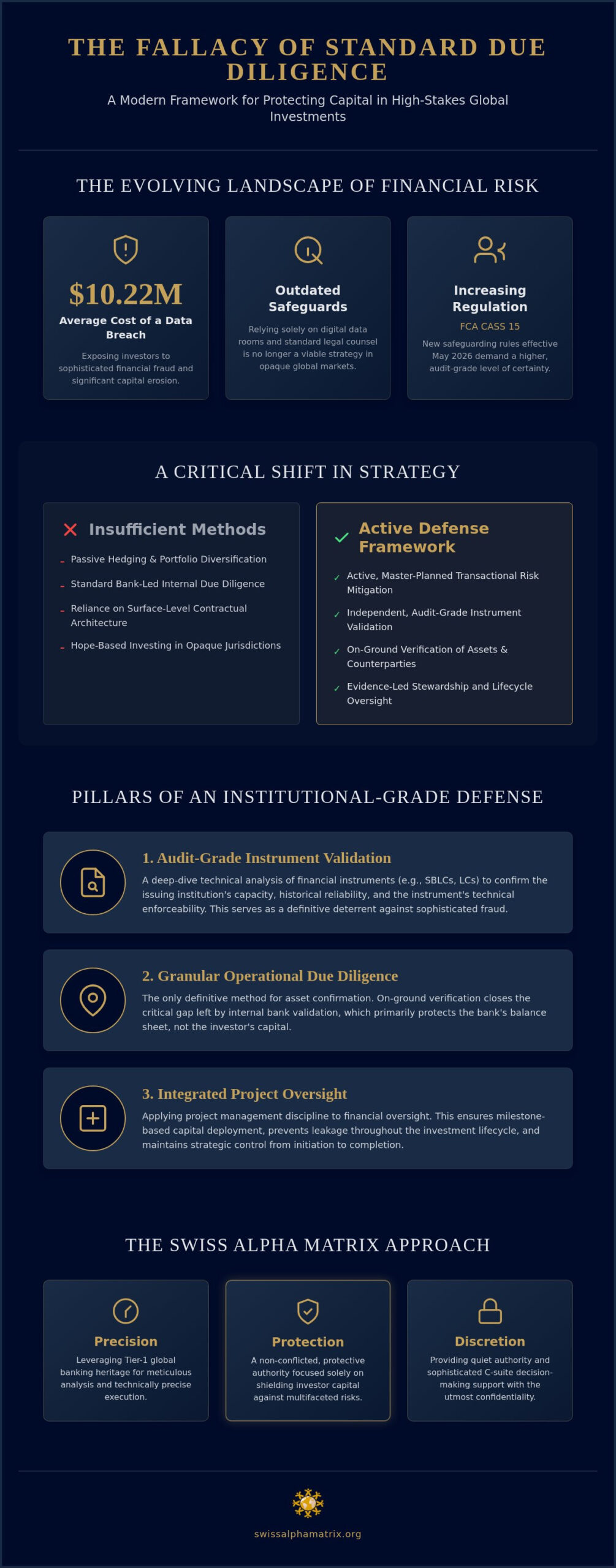
The assumption that standard legal due diligence provides a sufficient safeguard for complex, cross-border capital deployment is a precarious fallacy that often leaves institutional investors exposed to sophisticated financial fraud. You recognize that as global markets become increasingly opaque, relying on digital data rooms alone is no longer a viable strategy for those tasked with the stewardship of significant wealth. In an environment where the average cost of a data breach has reached $10.22 million and the FCA’s stringent safeguarding rules take effect in May 2026, the imperative for a more rigorous approach to transactional risk mitigation has never been more acute.
This article details how elite financial advisory and audit-grade validation provide a definitive shield against capital erosion in complex investment programmes. We’ll explore a transition toward an institutional framework that prioritizes on-ground verification and meticulous instrument authentication to ensure that every counterparty and financial vehicle meets the highest standards of validity. By moving beyond passive hedging toward active, master-planned oversight, you can achieve the audit-grade certainty required to protect your capital against the multifaceted risks of the modern financial landscape. This methodology ensures that your interests are managed with the quiet authority and technical precision that traditional private wealth management demands.
Key Takeaways
- Recognize why traditional portfolio diversification and FX hedging are insufficient for complex mandates and how to implement a specialized framework for transactional risk mitigation.
- Understand the critical necessity of audit-grade instrument validation to authenticate the technical enforceability of bank instruments such as SBLCs and Letters of Credit.
- Learn the vital distinction between high-level financial modeling and granular operational due diligence, emphasizing on-ground verification as the only definitive method for asset confirmation.
- Discover how to integrate project management discipline into financial oversight to ensure milestone-based capital deployment and prevent leakage throughout the investment lifecycle.
- Explore how leveraging Tier-1 global banking heritage and Swiss precision provides the non-conflicted, protective authority required for sophisticated C-suite decision-making.
The Imperative of Strategic Transactional Risk Mitigation in Complex Mandates
While many market participants erroneously conflate transactional risk with mere currency fluctuation, the reality of high-value, cross-border mandates requires a far more robust interpretation. Traditional portfolio diversification and standard FX hedging, though useful for liquid asset classes, fail to address the structural and operational fragilities inherent in complex, project-based investments. True transactional risk mitigation involves a comprehensive risk management plan that accounts for the potential of capital erosion through instrument fraud, regulatory non-compliance, and the lack of transparency in opaque jurisdictions. This discipline moves beyond the passive acceptance of market volatility toward an active, institutional-grade defense of capital.
Independent advisory serves as the vital bridge between standard legal counsel and technical financial execution. Legal teams often excel at contractual architecture but may lack the deep-seated banking heritage required to validate the technical enforceability of complex financial instruments. By establishing a baseline for sophisticated risk management that prioritizes long-term preservation over speculative growth, investors ensure their capital is shielded by seasoned experts rather than left to the vagaries of standard institutional processes. It’s a shift from hope-based investing to evidence-led stewardship.
The Evolution of Risk in Globalised Capital Markets
In the 2026 regulatory environment, the complexity of financial instruments has reached unprecedented levels. New requirements, such as the FCA’s e-money safeguarding rules (CASS 15) effective May 7, 2026, demand a level of reconciliation and audit-grade certainty that many firms are ill-equipped to provide. Cross-border jurisdictional nuances often conceal hidden vulnerabilities, where a lack of local on-ground verification can lead to the total loss of capital. We’re seeing a fundamental shift from passive oversight to active, strategic mitigation as the only way to combat the sophisticated methods of modern capital erosion.
Identifying High-Stakes Vulnerabilities
Standard bank-led due diligence often proves insufficient because the bank’s internal validation protocols are designed to protect the institution’s balance sheet, not necessarily the primary investor’s interests. Transactional risk mitigation is a proactive discipline involving both technical validation of instruments and strategic oversight of the entire deal lifecycle. Relying solely on internal bank validation is a significant risk. Banks frequently operate within silos, and their validation may not extend to the actual existence of underlying assets or the legitimacy of counterparties in distant jurisdictions. It’s this gap in protection that necessitates a master-planned approach to capital security.
Audit-Grade Instrument Validation: A Pillar of Capital Protection
The technical verification of financial instruments is not merely a procedural box to be checked; it is a fundamental pillar of transactional risk mitigation that protects the very core of institutional capital. In an era where sophisticated financial instrument fraud has become increasingly prevalent, relying on the aesthetic legitimacy of a document is a strategy fraught with peril. To achieve Effective Transactional Risk Management, one must look beyond the surface of a Standby Letter of Credit (SBLC) or a Letter of Credit (LC) to conduct a deep-dive technical analysis of the issuing entity. This involves an exhaustive examination of the institution’s actual capacity to issue debt, its historical reliability, and the technical enforceability of the specific verbiage contained within the instrument.
Audit-grade validation serves as a definitive deterrent against fraud by exposing the structural weaknesses that standard legal reviews often overlook. When a transaction involves high-value cross-border mandates, the gap between a technically valid instrument and a legally enforceable one can be vast. By integrating rigorous validation into the broader framework of capital protection, investors can ensure that their deployment of funds is predicated on technical certainty rather than institutional trust. This meticulous approach is what distinguishes seasoned experts from passive market participants, ensuring that interests are shielded by a layer of unassailable technical truth.
The Technical Architecture of Validation
Understanding the layers of verification required for institutional-grade instruments is essential for maintaining deal integrity. Utilizing specialized bank instrument validation services allows for a granular assessment of the instrument’s technical DNA, including its SWIFT authenticity and the credit-worthiness of the issuer. Key red flags to monitor during this process include:
- Non-standard verbiage in MT760 or MT799 messages that may signal “leased” instrument fraud.
- Discrepancies between the stated issuing bank’s balance sheet and the liability represented by the instrument.
- Issuer jurisdictions that lack robust regulatory oversight or have histories of non-performance.
By identifying these vulnerabilities early, investors can avoid the catastrophic capital erosion that follows the acceptance of a fraudulent or unenforceable instrument. For those seeking to fortify their investment programmes, securing deal integrity through such rigorous validation is the only logical path forward.
Regulatory Alignment and Compliance in 2026
Ensuring that instrument validation meets the evolving international financial regulations of 2026 is a complex but necessary endeavor. As global standards tighten, the role of Tier-1 banking expertise becomes indispensable in navigating the nuances of compliance across multiple jurisdictions. This expertise bridges the gap between technical validity and regulatory enforceability, particularly in cross-border projects where local laws may conflict with international standards. A master-planned approach ensures that every instrument is not only technically sound but also fully aligned with the latest global compliance mandates, providing a sense of professional calm in an otherwise volatile environment.
Operational Due Diligence vs. Traditional Risk Assessments
While financial modeling provides a mathematical architecture for projected returns, it remains a theoretical exercise that often fails to account for the granular operational realities of a target entity. Traditional risk assessments frequently rely on historical data and interest rate projections, yet these metrics are silent regarding the actual existence of physical assets or the integrity of a counterparty’s internal controls. In high-stakes international deals, a desktop-only approach is increasingly insufficient, as digital data rooms can be meticulously curated to obscure operational fragilities. A robust framework for transactional risk mitigation must, therefore, be anchored in operational due diligence, which serves as the empirical foundation for capital protection by bridging the gap between theoretical value and physical reality.
Meticulous operational due diligence is not merely a defensive measure; it is a value-preservation strategy that can lead to valuation adjustments of up to 25% when critical discrepancies are identified. Engaging in an expert roundtable on transactional risk highlights that the most significant threats often reside within the execution layer of a project rather than its financial design. By positioning operational integrity at the core of the mandate, investors move beyond speculative modeling toward a standard of certainty that mirrors the traditional discretion of elite private wealth management. This shift ensures that interests are in the hands of seasoned, unemotional experts who prioritize long-term preservation over short-term speculation.
The Necessity of On-Ground Verification
Physical site visits and face-to-face counterparty interviews are the only definitive methods for stripping away the layers of abstraction inherent in cross-border documentation. These on-ground engagements reveal environmental risks, supply chain bottlenecks, and cultural nuances that no spreadsheet can capture. Implementing a framework for mastering cross-border investment due diligence ensures that international interests are secured through direct verification rather than institutional trust. There are numerous instances where physical verification has prevented significant capital loss by identifying that ready-to-deploy infrastructure was, in reality, non-existent or fundamentally compromised, demonstrating why the verify then trust protocol is essential in 2026.
Analysing Counterparty and Jurisdictional Risk
Evaluating a partner’s operational capacity requires a deep understanding of local regulatory and legal frameworks, particularly in emerging markets where the surface-level stability can be deceptive. A sophisticated risk matrix must balance technical instrument data with the on-ground reality of local governance and counterparty reliability, ensuring that capital is not only deployed into a technically valid instrument but also into an environment capable of sustaining the project’s long-term objectives. This deliberate complexity serves to demonstrate intellectual depth and a refusal to oversimplify complex dynamics, catering to a sophisticated audience that values nuance and thoroughness. By developing a logic-driven assessment of jurisdictional stability, the master planner can mitigate the hidden vulnerabilities that lead to capital erosion.
Establishing a Robust Risk Mitigation Framework for Project Oversight
The integration of project management discipline into financial strategies represents the final evolution of a truly resilient transactional risk mitigation framework. While previous stages of the mandate address the validation of instruments and the necessity of on-ground due diligence, the long-term preservation of capital requires an active, milestone-based oversight mechanism. Without this, even the most technically sound deal can suffer from incremental leakage or stakeholder misalignment over multi-year international mandates. A dedicated Project Management Office (PMO) ensures that transaction integrity is maintained through institutional-grade reporting and absolute transparency, providing the C-suite with the logical calm necessary for strategic decision-making.
With a projected 20% to 25% year-over-year increase in secondary-related submissions for transactional risk insurance in 2026, the complexity of managing these mandates has transitioned from a standard operational task to a high-stakes institutional requirement. Managing stakeholder expectations during these periods of growth requires a steady, logical rhythm that moves from broad philosophical principles down to specific strategic pillars. By utilizing independent oversight, you ensure that capital deployment is strictly tethered to verified project milestones, effectively neutralizing the operational risks that often lead to capital erosion in complex, project-based investments.
Independent Financial Project Management
Effective capital protection necessitates independent financial project management to eliminate the inherent conflicts of interest found in traditional bank-led models. By implementing rigorous scheduling and exacting milestone validation, the master planner prevents the unauthorized erosion of funds. This executive-level oversight is particularly critical in cross-border programmes where regional nuances can obscure operational delays. For entities managing high-value mandates, implementing a robust oversight framework is the definitive step toward ensuring that strategic growth never compromises capital security.
Methodologies for Precision Execution
Applying sophisticated financial advisory methodologies allows for the precise execution of complex capital protection mandates. Utilizing institutional tools like RACI matrices and deliverable review matrices ensures that every participant understands their specific accountability within the risk framework. This technical precision serves to demonstrate intellectual depth and a refusal to oversimplify complex dynamics, catering to a sophisticated audience that values nuance and thoroughness. A structured methodology transforms risk from an abstract concept into a manageable operational variable, allowing for hyper-personalized oversight that distinguishes a performance-oriented mindset from passive participation.
The Swiss Alpha Matrix Approach: Precision, Discretion, and Capital Protection
The Swiss Alpha Matrix methodology represents a sophisticated synthesis of the strategic pillars explored throughout this framework, moving decisively beyond the fragmented approaches of standard advisory. By unifying audit-grade instrument validation, on-ground verification, and milestone-driven project management into a single protective mandate, we provide the C-suite with a definitive shield against capital erosion. This approach is rooted in a Tier-1 banking heritage, which allows for a level of technical scrutiny that generalist firms simply cannot replicate. Swiss discretion remains a cornerstone of this process, ensuring that high-level transactional risk mitigation is conducted with the traditional privacy and regional precision that sophisticated institutional entities demand.
Effective capital protection in 2026 requires more than just a passing familiarity with regulatory changes; it demands a master-planned strategy that anticipates the nuances of cross-border jurisdictional friction. By prioritizing long-term preservation over short-term speculation, this methodology creates an environment of stability and trust. It’s a logic-driven process that leads the investor through a structured argument for each strategic pillar, creating a sense of inevitable professional calm. This ensures that every deployment of capital is a calculated step toward strategic growth, rather than a speculative venture into the unknown.
The Advantage of Independent Senior Counsel
Leveraging the expertise of former senior executives from global financial institutions ensures that capital deployment decisions are informed by seasoned, unemotional intelligence rather than theoretical modeling. A boutique, mandate-specific engagement model offers a distinct advantage over the generalization of larger firms, as it allows for hyper-personalized attention to the intricate details of a specific cross-border transaction. This model ensures that every decision is backed by audit-grade intelligence, bridging the gap between high-level strategy and the granular technicalities of instrument authenticity. It is this intellectual depth and refusal to oversimplify complex dynamics that establishes immediate credibility with those who value nuance and thoroughness.
Securing the Future of Your Capital
Establishing a robust risk management framework is not merely a short-term tactical move but a long-term commitment to capital preservation and strategic growth. By institutionalizing these strategies, stakeholders can navigate the hardening transactional insurance market and the increasingly complex 2026 regulatory landscape with an unwavering pace. The inevitable logic of this methodology leads to a sense of security, knowing that interests are in the hands of master planners who prioritize quality, moral character, and high-level standards. To initiate a strategic partnership for capital protection, you may contact the partners at Swiss Alpha Matrix to secure your next cross-border mandate. This commitment to exclusivity and high-level access ensures that your service standard remains both broad in reach and meticulous in its attention to every technical detail.
Fortifying Your Institutional Mandate with Unassailable Precision
The transition toward enduring capital preservation in cross-border environments necessitates a fundamental shift from standard due diligence toward a comprehensive framework for transactional risk mitigation. By synthesizing audit-grade instrument validation with rigorous on-ground verification, you move beyond the limitations of theoretical financial modeling to establish an empirical foundation for every investment decision. This proactive discipline ensures that every counterparty and financial vehicle is authenticated by technical truth rather than mere institutional trust, effectively neutralizing the hidden vulnerabilities often found in opaque jurisdictions.
Led by former senior executives from Tier-1 global banks, Swiss Alpha Matrix applies a traditional tradition of discretion and precision to the most complex financial and investment programmes. Our methodology provides the master-planned oversight required to prevent capital erosion through sophisticated fraud, regulatory non-compliance, or operational failure. You can secure your capital with institutional-grade advisory from Swiss Alpha Matrix and ensure your interests are managed with the quiet authority your mandate deserves. It’s time to institutionalize your capital protection strategies with the regional excellence and meticulous detail that only seasoned experts can provide.
Frequently Asked Questions
What is the primary objective of transactional risk mitigation in institutional finance?
The primary objective is the absolute preservation of capital through the systematic identification and neutralization of structural, operational, and fraudulent vulnerabilities within a high-value mandate. It’s a proactive discipline that ensures every facet of a cross-border deal, from instrument validity to counterparty legitimacy, is verified with technical precision. By establishing a robust framework for transactional risk mitigation, institutional investors shield their interests from capital erosion while maintaining the logical calm necessary for long-term strategic growth.
How does audit-grade instrument validation differ from standard bank verification?
Audit-grade instrument validation provides an exhaustive technical analysis that exceeds the procedural, balance-sheet-focused checks typically conducted by retail or commercial banks. While standard verification may only confirm the existence of a document, audit-grade protocols scrutinize the technical enforceability of verbiage, the issuer’s actual debt-issuance capacity, and SWIFT authenticity. This deeper level of scrutiny is essential for detecting sophisticated financial instrument fraud that superficial paperwork reviews often fail to identify.
Why is on-ground verification necessary if a bank has already issued the instrument?
On-ground verification is necessary because bank-issued instruments confirm financial commitment but cannot guarantee the physical existence or operational integrity of the underlying assets. Digital data rooms can be curated to mask infrastructure failures or environmental risks that only a physical site visit can expose. This “verify then trust” protocol ensures that capital is deployed into a reality that matches the technical documentation provided by the issuing institution, neutralizing the risk of information asymmetry.
Can transactional risk mitigation strategies be applied to existing long-term investment programmes?
Yes, these strategies can be seamlessly integrated into existing programmes to fortify capital protection and align with evolving regulatory standards. Retrofitting a robust risk management framework allows for the identification of previously overlooked operational fragilities or instrument vulnerabilities within a maturing mandate. Ongoing oversight is crucial for maintaining transaction integrity and preventing incremental capital leakage over the lifecycle of multi-year international projects.
What role does independent project management play in capital protection?
Independent project management serves as a non-conflicted oversight mechanism that ensures capital deployment remains strictly tethered to verified project milestones. By utilizing a master-planned approach, the Project Management Office (PMO) prevents unauthorized fund erosion and maintains stakeholder transparency through institutional-grade reporting. This role is vital for bridging the gap between high-level financial modeling and the granular technicalities of precision execution in complex mandates.
How do international financial regulations in 2026 impact transactional risk mitigation strategies?
The 2026 regulatory landscape, including the FCA’s new safeguarding regime (CASS 15) effective May 7, 2026, necessitates a higher standard of reconciliation and audit-grade certainty. These more stringent rules require affected firms to undergo annual safeguarding audits and conduct daily reconciliations, which directly impacts how transactional risk mitigation strategies are structured. Failure to align with these evolving standards can lead to significant regulatory non-compliance risks and the potential for severe capital loss.
Is transactional risk mitigation only necessary for emerging market transactions?
While emerging markets often present higher levels of opacity, these strategies are equally essential for transactions in established jurisdictions where sophisticated fraud and regulatory complexity are prevalent. Capital erosion isn’t limited by geography, and the lack of transparency in any cross-border jurisdiction can create hidden vulnerabilities for capital deployment. A universal application of rigorous validation and on-ground verification ensures that interests are protected regardless of the regional context.
How can I integrate an independent advisory firm into our existing due diligence process?
Integration involves appointing the advisory firm as a specialized layer of technical oversight that complements your existing legal and financial teams without creating operational friction. This boutique engagement model allows the master planner to conduct audit-grade intelligence gathering and technical validation that standard legal teams may not be equipped to handle. By positioning the firm as a dedicated partner, you ensure that capital deployment decisions are informed by seasoned, unemotional expertise.