

If the standard legal checklist remains the primary barrier between your institutional capital and a cross-border default, is your portfolio truly insulated, or is it merely compliant? In a landscape where the Money Laundering and Terrorist Financing Regulations 2026 have fundamentally shifted the requirements for enhanced scrutiny, relying on passive verification is no longer a strategy commensurate with the risks of global exposure. The reality of modern finance is that sophisticated financial counterparty due diligence must transcend the superficiality of digital records, requiring instead a rigorous, on-ground methodology that addresses the inherent opacity of cross-border entities. You’ve likely observed that standard legal frameworks, while necessary, frequently fail to capture the operational nuances of complex counterparties, leaving significant capital vulnerable to sophisticated instrument fraud.
This executive analysis provides a framework for institutional-grade capital protection, focusing on the structural and operational protocols required to navigate an increasingly interconnected regulatory environment. We’ll explore how to move beyond rudimentary compliance toward a model of absolute certainty through physical and financial verification. By adopting a master-planner approach that prioritizes long-term preservation over short-term ease, you can ensure that every deployment is supported by audit-grade validation. Our discussion will detail the transition toward Perpetual KYC and the application of Swiss precision in establishing a robust defense against counterparty default in the most complex environments.
Key Takeaways
- Analyze the obsolescence of traditional credit ratings within the context of the current geopolitical landscape, necessitating a more granular approach to bespoke cross-border risk assessment.
- Implement a robust risk management framework by integrating financial counterparty due diligence with audit-grade validation for standby letters of credit and other complex instruments.
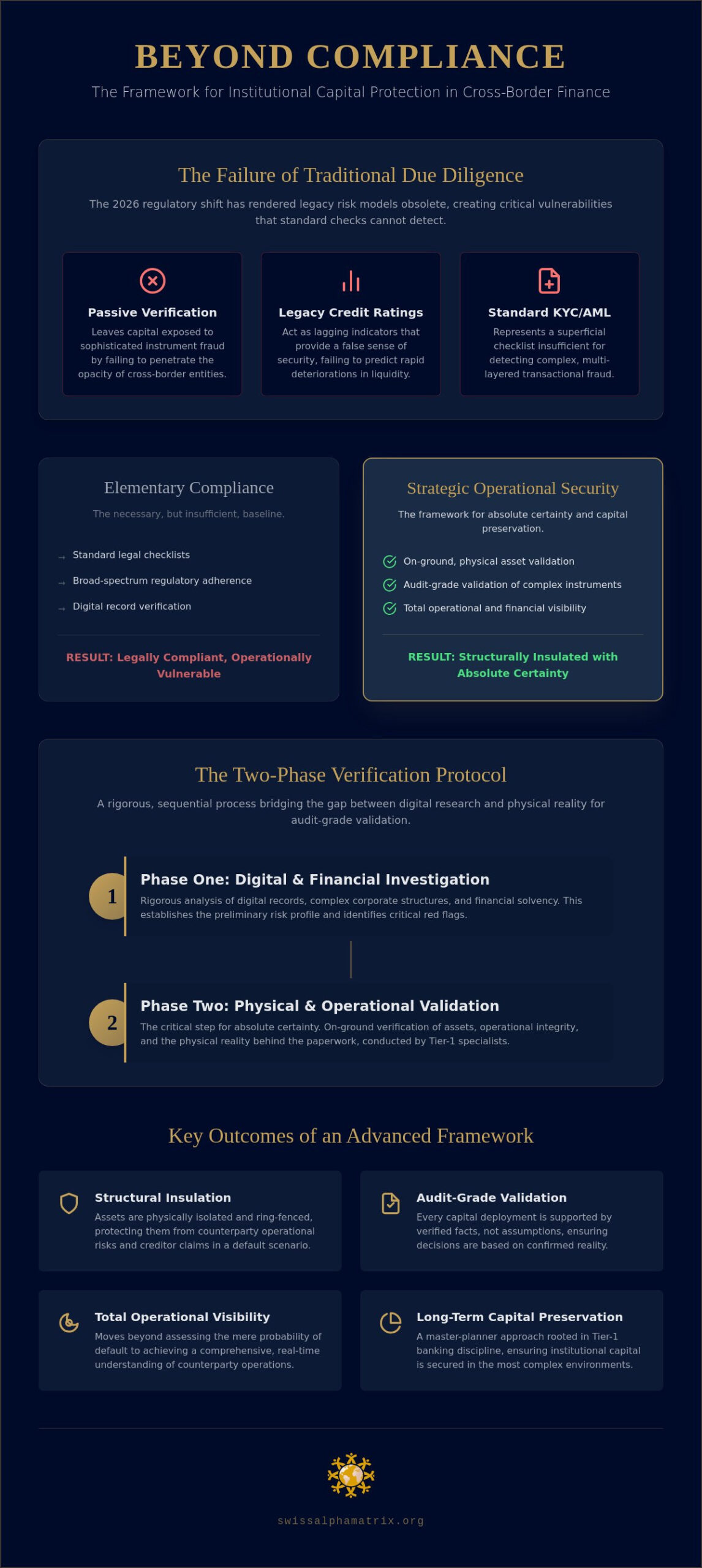
- Distinguish between elementary regulatory compliance and strategic operational security, identifying why standard KYC/AML protocols are often insufficient for detecting sophisticated transactional fraud.
- Adopt a rigorous two-phase protocol for cross-border operational verification, bridging the gap between digital investigative research and physical, on-ground asset validation.
- Leverage the precision of mandate-specific advisory, rooted in Tier-1 banking discipline, to achieve absolute certainty and structural insulation during the deployment of institutional capital.
The Evolution of Financial Counterparty Due Diligence in Global Markets
The global financial architecture has entered a period of profound transformation, where the geopolitical fractures of 2026 have rendered traditional risk assessment models increasingly precarious. In this volatile climate, the reliance on lagging indicators, such as legacy credit ratings, often provides a false sense of security that fails to account for the rapid deterioration of liquidity in bespoke, cross-border arrangements. Sophisticated financial counterparty due diligence has evolved from a static compliance requirement into a dynamic operational discipline. It’s no longer sufficient to merely confirm a partner’s historical performance; the focus has shifted toward a granular understanding of their real-time operational transparency and the structural integrity of their capital reserves.
This specialized approach to financial counterparty due diligence serves as the essential bridge between rigid, bank-led risk models and the bespoke needs of private capital. While institutional banks often prioritize broad-spectrum regulatory adherence, private entities require a more meticulous, mandate-specific level of due diligence that uncovers hidden vulnerabilities within non-standard financial instruments. This systemic shift reflects a move away from the simple probability of default toward a comprehensive requirement for total operational visibility, ensuring that capital protection is rooted in verified fact rather than assumed stability.
Defining Counterparty Credit Risk (CCR) for the C-Suite
At the executive level, understanding Exposure at Default (EAD) requires looking beyond the balance sheet to the specific mechanics of non-standard mandates. Counterparty risk is the intersection of financial solvency and operational integrity. While market risk involves the fluctuation of asset prices, counterparty failure represents a total breakdown of the contractual relationship. In complex project finance, the specific risk of a counterparty’s inability to perform is often obscured by multi-layered corporate structures, making physical and financial verification an absolute necessity for capital preservation.
Drivers of Risk in Cross-Border Project Finance
The rising complexity of multi-jurisdictional capital deployment is compounded by significant regulatory fragmentation. With the EU’s Anti-Money Laundering Authority (AMLA) becoming operational in 2026 and the UK introducing its latest 2026 amendments, the enforceability of financial instruments like standby letters of credit depends heavily on regional legal nuances. Swiss discretion remains a hallmark of high-level risk management because it prioritizes regional precision and meticulous attention to detail. This approach ensures that cross-border projects aren’t just compliant with local laws but are structurally insulated against the catastrophic potential of instrument fraud or operational collapse.
Advanced Structural Frameworks for Risk Mitigation
While legal contracts provide a foundational baseline for engagement, they rarely offer sufficient protection once a default sequence has initiated. True capital preservation requires a structural architecture that physically isolates assets from the operational risks of a partner. This necessitates the implementation of netting and collateralization protocols that extend well beyond the standard ISDA agreements, particularly when navigating jurisdictions where legal recourse is notoriously protracted. By aligning internal policies with the counterparty credit risk management guidelines established by international authorities, institutions can construct a resilient framework that anticipates friction. The goal isn’t merely to win a legal dispute after the fact but to ensure that capital remains ring-fenced and inaccessible to the counterparty’s creditors in the event of an insolvency event.
Effective financial counterparty due diligence in 2026 demands a shift toward independent project oversight. This involves the use of milestone-based fund release mechanisms, where capital deployment is tethered to verified operational achievements rather than calendar dates. Such a strategy ensures that the exposure at any given moment is strictly limited to the current phase of the mandate. Establishing these “Ring-Fenced” structures requires a level of technical precision that transcends standard compliance, positioning the investor as a master planner of their own security. For those seeking to elevate their internal standards, adopting comprehensive risk management frameworks is the only way to achieve absolute certainty in complex, non-standard financial arrangements.
Instrument Validation as a Primary Defense
Surface-level reviews of financial documents frequently fail to detect the sophisticated anomalies present in modern fraudulent instruments. Relying on a cursory glance at a PDF or a scanned document is a recipe for catastrophic loss. Instead, executives must utilize bank instrument validation services to ensure the authenticity of standby letters of credit (SBLCs) and bank guarantees. This process involves direct, institutional-grade communication protocols that bypass intermediary interference. Identifying red flags, such as non-standard terminology or inconsistent SWIFT metadata, before capital is committed is the most effective way to insulate a portfolio from instrument-based fraud.
Structural Insulation in Project Management
Deal integrity is often compromised not by a lack of intent, but by a lack of accountability. Leveraging independent financial project management allows for the creation of clear RACI matrices that define stakeholder responsibilities across multi-jurisdictional boundaries. This third-party validation ensures that every participant is held to a standard of regional excellence and precision. In high-value, non-standard mandates, this level of oversight acts as a protective authority, bridging the gap between the initial agreement and the final, successful execution of the project.
Regulatory Compliance vs. Strategic Operational Security
Adherence to international financial regulations represents the absolute minimum standard of care, yet many institutional actors mistakenly treat it as the ceiling of their risk management efforts. In the complex financial landscape of 2026, compliance is merely the floor. Standardized KYC and AML protocols are designed to satisfy regulatory bodies and protect the global financial system’s broader integrity, but they aren’t specifically calibrated to insulate your specific capital from sophisticated transactional fraud. Effective financial counterparty due diligence must therefore transcend these passive reporting requirements, moving instead toward a model of active risk intervention. While a counterparty may appear compliant on paper, their operational reality might still harbor vulnerabilities that standard regulatory filters are simply not designed to detect.
The transition from passive compliance to strategic security requires a shift in perspective. Instead of asking if a counterparty meets the legal requirements for engagement, executive stakeholders must demand audit-grade documentation that proves the counterparty’s capacity to perform under stress. This superior layer of protection ensures that decisions are based on verified operational facts rather than self-reported data. By implementing financial counterparty due diligence that prioritizes high-level standards and moral character, institutions can move beyond the “check-the-box” mentality that often precedes catastrophic capital loss. This proactive stance is essential for those who value long-term preservation over the convenience of standard legal due diligence.
The Fallacy of Paper-Only Due Diligence
Digital records and SWIFT messages, while foundational to modern commerce, are increasingly susceptible to sophisticated manipulation in 2026. Relying solely on these digital artifacts, particularly when dealing with entities in jurisdictions newly added to the EU high-risk list like Bolivia or the Russian Federation, creates a dangerous blind spot. These records require secondary, independent verification to ensure their authenticity. Legal enforceability is irrelevant if the counterparty’s assets are misrepresented. If the underlying liquidity is a digital facade, even the most ironclad contract provides no recourse. This reality necessitates a departure from digital-only verification in favor of on-ground, physical validation of entity existence and asset ownership.
Bridging the Gap with Institutional Expertise
Identifying institutional loopholes requires a level of sophistication that only comes from decades of Tier-1 banking experience. As global standards harmonize under new frameworks like the EU’s AMLR, the methods used to circumvent these rules become equally refined. Utilizing financial advisory methodologies that incorporate real-time monitoring and “Agentic Compliance” systems allows for a more nuanced understanding of risk. This approach establishes a risk management framework that doesn’t just withstand regulatory scrutiny but remains resilient against sudden market shocks and geopolitical shifts. It’s a method rooted in regional precision, ensuring that your capital deployment is protected by a standard of service that is both broad in reach and meticulous in its execution.
The Protocol for Cross-Border Operational Verification
Establishing a definitive defense against capital loss requires a transition from desk-based analytical research to a multi-phased operational protocol that prioritizes physical reality over digital assertions. While the initial stage of financial counterparty due diligence involves a comprehensive cross-border investment due diligence process to map corporate structures and beneficial ownership, this intelligence gathering is merely the first step. A robust institutional framework must integrate four distinct phases of verification to ensure that every facet of a counterparty’s profile is authenticated. This structured approach moves from the investigative to the physical, followed by direct institutional validation of financial instruments, and concludes with a rigorous system of ongoing operational oversight. By adhering to this measured rhythm, master planners can identify discrepancies before they manifest as catastrophic defaults.
The efficacy of this protocol rests on the refusal to accept self-reported data at face value. In high-value, non-standard mandates, the risk of instrument fraud is significantly mitigated when direct institutional communication replaces intermediary-led narratives. This ensures that the standby letters of credit or bank guarantees being utilized are not just legally plausible but are active, verified obligations within the issuing bank’s ledger. For entities operating in complex jurisdictions, engaging in on-ground verification services is the only method to achieve absolute certainty in the integrity of a transaction.
Execution of On-Ground Verification
Verifying the physical presence and operational capacity of international counterparties is a critical deterrent against sophisticated fraud. In global financial hubs such as London, Geneva, and Hong Kong, the presence of a corporate office does not always equate to the existence of the liquidity or assets claimed in a prospectus. Executing site visits and conducting face-to-face executive interviews allow seasoned experts to assess the moral character and technical competence of the counterparty’s leadership team. This level of local market intelligence provides a qualitative layer of security that background checks alone cannot replicate, ensuring that the entity has the actual infrastructure required to fulfill its contractual obligations.
Continuous Monitoring and Project Oversight
Deal integrity is a perpetual requirement that extends far beyond the initial onboarding phase. Establishing a Deliverable Review Matrix allows for the meticulous tracking of project milestones, ensuring that fund releases are strictly tethered to verified operational achievements. This ongoing oversight serves to prevent capital leakage and ensures that the project remains insulated from the volatility of the global news cycle or sudden shifts in the counterparty’s stability. By maintaining an independent project management role, institutional investors can exercise active risk intervention, providing a standard of service that prioritizes long-term preservation and strategic growth through every phase of the capital deployment lifecycle.
Partnering for Precision: The Swiss Alpha Matrix Approach
Swiss Alpha Matrix represents the synthesis of Tier-1 global banking discipline and the historical discretion inherent in Swiss financial traditions. While generic consulting often relies on standardized templates, our approach to financial counterparty due diligence is strictly mandate-specific, ensuring that the unique risks of complex, cross-border projects are addressed with technical precision. By leveraging the expertise of former senior executives from the world’s leading financial institutions, we provide a level of audit-grade intelligence that transcends simple compliance. This commitment to long-term capital preservation isn’t a passive goal but an active operational discipline, designed to insulate institutional interests from the volatility of non-standard financial arrangements.
The advantage of our project-based advisory lies in its focus on the master planner persona, where every strategic pillar is meticulously aligned with the client’s specific risk appetite. This methodology ensures that capital deployment decisions are supported by verified facts rather than institutional assumptions. As a protective authority, we bridge the gap between the initial transaction and the final execution, providing a standard of service that is both broad in reach and meticulous in its attention to detail. Our work focuses on creating a sense of inevitable logic and professional calm, allowing stakeholders to proceed with absolute certainty in their strategic growth initiatives.
A Methodology Rooted in Regional Excellence
The significance of Swiss-based oversight in the global landscape of 2026 can’t be overstated, as it remains a beacon of stability amidst shifting regulatory tides. We provide hyper-personalized risk frameworks for high-net-worth stakeholders, recognizing that every portfolio requires a bespoke defensive architecture. Swiss Alpha Matrix acts as a protective authority for complex programs, ensuring that regional excellence and precision are embedded in every phase of the engagement. This focus on moral character and high-level standards distinguishes our performance-oriented mindset from more passive industry participants who may overlook the subtle operational nuances of cross-border entities.
Initiating a Strategic Mandate
Engaging with our senior-level expertise marks the transition from transactional uncertainty to a state of professional calm. When you secure your cross-border interests through our institutional oversight, you’re not just hiring a service provider; you’re partnering with a dedicated entity that values privacy and exclusivity above all else. Our process begins with a deep-dive analysis of your current exposure, followed by the implementation of a robust risk management framework tailored to your specific mandate. Secure your cross-border interests with Swiss Alpha Matrix’s institutional oversight to ensure your capital remains protected by the highest standards of financial counterparty due diligence and operational integrity.
Securing Institutional Certainty in an Era of Global Complexity
The transition from passive risk acceptance to active operational stewardship represents the defining challenge for the modern institutional investor, necessitating a move beyond the baseline of regulatory compliance toward a rigorous framework of physical and financial verification. This methodology, which is rooted in regional excellence and the technical discipline of seasoned experts, transforms transactional uncertainty into a state of professional calm by ensuring that every deployment is insulated from systemic vulnerabilities. Effective financial counterparty due diligence requires more than just legal scrutiny, as it demands the specialized oversight of those who’ve navigated the highest levels of global finance. Our team, managed by former Tier-1 bank executives, provides a Swiss-based independent advisory that prioritizes your long-term preservation through audit-grade instrument validation and meticulous on-ground scrutiny. We invite you to Request an Executive Consultation on Counterparty Risk Mitigation to establish a protective architecture that prioritizes the integrity of your global interests. With the right institutional framework in place, you can navigate the most complex environments with absolute confidence in your capital protection.
Frequently Asked Questions
What is the primary difference between counterparty risk and credit risk?
Credit risk typically focuses on the unilateral failure of a borrower to fulfill a debt obligation, whereas counterparty risk specifically addresses the bilateral possibility that a partner in a derivative or non-standard transaction defaults before the final settlement of cash flows. In complex mandates, this risk is often more volatile because the exposure value fluctuates with market conditions until the contract’s conclusion. Understanding this distinction is essential for master planners who must manage the intricate dynamics of settlement and replacement cost.
How do you mitigate counterparty risk in bespoke financial arrangements?
Mitigation in bespoke arrangements requires the implementation of a structural architecture that includes robust netting agreements and the use of ring-fenced collateral. By utilizing financial counterparty due diligence to establish milestone-based fund releases, institutional investors can ensure that capital exposure is strictly limited to verified operational achievements rather than speculative timelines. This approach ensures that deal integrity is maintained through every phase of the project’s lifecycle, providing a necessary layer of operational security.
What is the Standardized Approach for Counterparty Credit Risk (SA-CCR)?
The Standardized Approach for Counterparty Credit Risk (SA-CCR) is a regulatory framework designed to provide a more risk-sensitive measure of Exposure at Default (EAD) for derivative transactions. It replaces older methodologies like the Current Exposure Method (CEM), utilizing a more granular calculation of replacement cost and potential future exposure to reflect the actual risk profile of a portfolio. For institutional entities, adhering to these guidelines is a foundational requirement for maintaining capital adequacy in a sophisticated regulatory environment.
Why is independent instrument validation necessary if we have a SWIFT message?
A SWIFT message, while foundational to international finance, is a communication protocol that doesn’t inherently verify the operational existence or the unencumbered status of the underlying assets. Independent validation is necessary to confirm that the financial instrument is an active obligation within the issuing bank’s ledger, protecting against sophisticated digital manipulation or unauthorized instrument issuance that a standard message might obscure. It’s the only way to ensure that the document represents a genuine, enforceable commitment.
Can counterparty risk be entirely eliminated in cross-border deals?
Absolute elimination of risk is a statistical impossibility in global finance, yet it can be structurally insulated to a degree that approaches certainty. Through rigorous financial counterparty due diligence and on-ground verification, the probability of catastrophic capital loss is minimized by ensuring that every transactional facet is authenticated by independent, institutional-grade oversight. This standard of service allows for strategic growth while maintaining a performance-oriented mindset that prioritizes the long-term preservation of capital.
How does on-ground verification differ from standard KYC protocols?
Standard KYC protocols are primarily digital exercises focused on regulatory compliance and beneficial ownership, whereas on-ground verification involves the physical validation of an entity’s operational capacity and asset existence. This process includes site visits and face-to-face executive interviews, providing a qualitative layer of security that digital records simply cannot replicate in opaque cross-border environments. It ensures that the counterparty possesses the actual infrastructure and moral character required to fulfill high-value, non-standard mandates.
What are the common red flags of counterparty failure in 2026?
In the current landscape of 2026, common red flags include the use of AI-generated identities for verification and a sudden shift toward jurisdictions recently added to the EU high-risk list, such as Bolivia or the Russian Federation. Inconsistencies in SWIFT metadata or a reluctance to permit independent, on-ground audits often precede a total breakdown in operational integrity. Seasoned experts monitor these signals to provide active risk intervention before a counterparty’s stability is compromised by geopolitical or financial stress.
What is the role of collateral in counterparty risk mitigation?
Collateral serves as a vital financial buffer that secures a transaction, providing a source of recovery if the counterparty fails to perform. In sophisticated frameworks, the focus is on High-Quality Liquid Assets (HQLA) that are held in bankruptcy-remote structures, ensuring that the investor has immediate access to value without the delays inherent in multi-jurisdictional legal proceedings. This strategy is a cornerstone of institutional capital protection, providing a sense of inevitable logic and professional calm during complex deployments.