

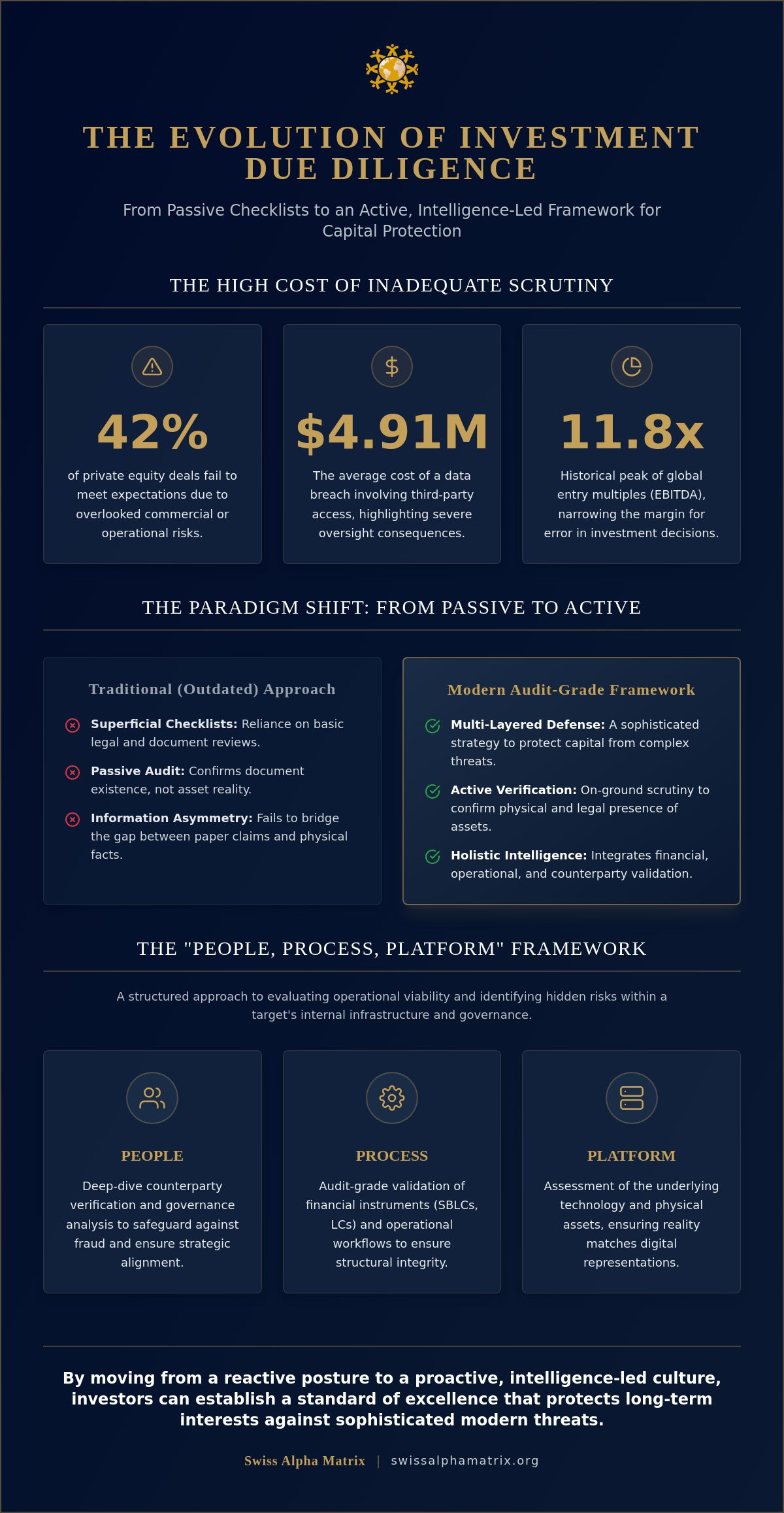
It’s a sobering reality that 42% of private equity deals fail to meet underwriting expectations because of overlooked commercial or operational risks, a statistic that underscores the inherent fragility of standard review processes. For the institutional entity or high-net-worth individual, the traditional reliance on superficial legal checklists is no longer sufficient to counter the sophisticated layers of modern financial fraud. Implementing a rigorous investment program due diligence framework is the only reliable method to bridge the profound information asymmetry that often characterizes complex, cross-border transactions. You likely recognize that the preservation of capital requires a level of scrutiny that extends far beyond the digital data room, reaching into the physical and regulatory realities of the underlying assets.
This article provides the technical depth necessary to master the methodologies required for validating complex financial instruments and ensuring absolute project integrity. We’ll explore how audit-grade validation and on-ground verification services create a robust oversight structure that eliminates unnecessary capital exposure. By moving from a reactive posture to a proactive, intelligence-led culture, you can establish a standard of excellence that protects your long-term interests against the escalating costs of third-party breaches, which reached an average of $4.91 million in 2025. Through this structured approach, you’ll gain the clarity needed to ensure that every strategic allocation is grounded in verified fact rather than mere projection.
Key Takeaways
- Recognize why traditional document reviews fail in the modern landscape and how a multi-layered investment program due diligence framework bridges the gap between paper claims and physical reality.
- Master the technical requirements for audit-grade instrument validation to ensure the authenticity of bank guarantees and standby letters of credit within institutional projects.
- Apply the “People, Process, Platform” framework to evaluate operational viability and identify hidden risks within a target’s internal infrastructure and governance.
- Develop a structured risk management protocol that prioritizes deep-dive counterparty verification and strategic alignment to safeguard capital against sophisticated fraud.
- Gain insight into how integrating former Tier-1 banking expertise with regional precision provides a protective authority for long-term capital preservation.
The Evolution of Investment Program Due Diligence in 2026
In the current financial climate, Due diligence has transitioned from a standard procedural requirement into a sophisticated, multi-layered defensive strategy designed to protect capital from increasingly complex threats. It’s no longer sufficient to conduct a cursory review of digital data rooms; true investment program due diligence requires a comprehensive validation of both the investment vehicle and its underlying assets to ensure structural integrity. With global entry multiples reaching a historical peak of 11.8x EBITDA, the margin for error has narrowed significantly, leaving little room for the oversights that frequently plague standard reviews. Institutional stakeholders now recognize that traditional, document-based assessments often fail to detect the nuanced discrepancies that precede a catastrophic capital loss.
The 2026 landscape is defined by a convergence of intense regulatory scrutiny and escalating operational costs that demand a more rigorous approach to capital deployment. For instance, the average cost of data breaches involving third-party access rose to $4.91 million in 2025, a figure that highlights the severe financial consequences of inadequate oversight and information asymmetry. As 73% of M&A executives expect the rigor of investigative processes to intensify through 2026, the industry is moving toward “Audit-Grade” validation as the baseline for institutional participation. This standard ensures that every claim is substantiated by reproducible, granular evidence that can withstand the most rigorous internal and external audits, providing a level of certainty that simple legal reviews cannot replicate.
The Shift from Passive Audit to Active Verification
Distinguishing between the mere verification of a claim and the validation of a financial programme’s underlying mechanism is critical for long-term capital preservation. While a passive audit might confirm that a document exists within a digital repository, active verification involves on-ground scrutiny to ensure that the assets described are physically and legally present, thereby mitigating the risk of sophisticated instrument forgery. This distinction is vital because international markets have seen a marked rise in counterfeit bank guarantees that appear indistinguishable from authentic ones under standard light. To navigate these complexities, stakeholders must adopt a framework for cross-border investment due diligence that prioritizes physical reality over digital representations.
Regulatory Pressures and Stakeholder Accountability
Recent regulatory shifts have increased the personal accountability of C-suite executives, making the failure of a due diligence process a matter of individual liability rather than just corporate loss. Regulations such as California’s SB 253, which carries an August 10, 2026, deadline for emissions reporting, require institutions to validate third-party integrity and non-financial misconduct standards with unprecedented precision. Similarly, the FCA’s May 2026 safeguarding requirements for e-money audits reflect a global trend toward mandated transparency. Consulting an international financial regulations guide is essential for maintaining compliance in this environment. These pressures ensure that comprehensive investment program due diligence is no longer a checkbox exercise but a fundamental pillar of institutional governance and professional ethics.
Audit-Grade Instrument Validation: Beyond the Paperwork
The validation of complex financial instruments, specifically Standby Letters of Credit (SBLC), Letters of Credit (LC), and various forms of bank guarantees, represents a critical juncture in the broader framework of investment program due diligence. While standard legal reviews focus on the surface-level wording of a contract, an institutional-grade approach requires a forensic examination of the instrument’s technical structure and the underlying bank-to-bank communication protocols. This process is essential because the global financial system is increasingly targeted by sophisticated forgery that can bypass traditional document checks. To maintain capital integrity, stakeholders must look beyond the physical paper to verify the actual liquidity and legal standing of the issuing institution through direct, verifiable channels.
Our methodology relies heavily on the expertise of former Tier-1 bank executives who possess an intimate understanding of how these instruments are structured within the world’s leading financial institutions. These experts are uniquely positioned to identify subtle red flags, such as non-standard SWIFT verbiage or inconsistencies in the issuing bank’s collateralization patterns, which frequently elude generalist auditors. Furthermore, modern due diligence processes in the areas of data privacy and information security must now account for the digital pathways through which these instruments are transmitted. Ensuring that the communication remains within secure, institutional rails is the only way to guarantee that the instrument isn’t just a digital fabrication but a legitimate obligation of the issuing bank.
Validating Complex Financial Instruments
The execution of bank instrument validation services involves a multi-step protocol that begins with the authentication of the SWIFT message and moves into a deep-dive analysis of the instrument’s specific terms and conditions. Unlike a surface-level legal review that merely checks for signatures, a technical validation confirms the actual availability of funds and the specific trigger events for drawdowns. Audit-Grade Validation is the forensic confirmation of an instrument’s liquidity and legal standing. This level of scrutiny provides the “Audit-Grade” reporting that institutional stakeholders require to authorize significant capital deployment with confidence.
On-Ground Verification: The Ultimate Safeguard
Physical presence remains the ultimate safeguard in any robust investment program due diligence strategy, as digital audits often fail to detect the physical non-existence of assets or operational capacity. There have been numerous instances where digital documentation appeared flawless, yet on-ground inspections revealed “ghost warehouses” or infrastructure projects that hadn’t even broken ground. Swiss Alpha Matrix utilizes a global network to perform these essential on-ground inspections, ensuring that the physical reality of a project matches its financial representation. Engaging with seasoned specialists to perform on-ground instrument verification ensures that your capital remains anchored in reality and protected from the vulnerabilities of purely remote assessments.
Operational Due Diligence: A Comparative Framework
Institutional-grade operational due diligence transcends the mere examination of balance sheets, opting instead for a granular dissection of the target’s internal infrastructure. While standard reviews might satisfy basic compliance, a sophisticated investment program due diligence framework prioritizes the “People, Process, Platform” triad to ensure long-term resilience. This methodology evaluates whether the human capital possesses the requisite expertise, if the operational workflows are sufficiently robust to withstand market volatility, and if the technological platforms are secure from external intrusion. In this context, Swiss discretion becomes a vital asset, allowing for deep-dive inquiries into sensitive operational areas without compromising the transaction’s confidentiality or the parties’ reputations. It’s a level of scrutiny that moves beyond startup-style valuation to address the systemic risks inherent in institutional projects.
The assessment of internal governance structures is particularly critical when dealing with non-standard investment vehicles where information asymmetry is prevalent. By examining the alignment between stated policies and actual operational behavior, advisors can identify the subtle discrepancies that often signal future instability. This comparative framework ensures that every strategic allocation is supported by an operational environment capable of sustaining the projected growth. It’s not just about verifying that a process exists, but rather validating that the process is executed with the precision required to protect significant capital interests in a complex global market.
Deconstructing Counterparty and Regulatory Risk
Assessing counterparty risk requires more than a background check; it demands an evaluation of institutional history and what we term the “moral character” of partners. Cross-border programmes are often derailed by non-financial risks, such as local political shifts or sudden regulatory pivots, which a static audit cannot anticipate. By aligning with institutional-grade financial advisory methodologies, stakeholders can navigate these intricacies with a higher degree of precision. This proactive stance ensures that the interests of the capital provider are shielded from the volatility of unverified partnerships and shifting international standards.
The RACI Model in High-Stakes Transactions
Clear accountability is paramount when managing high-stakes transactions, and the implementation of a RACI matrix provides the necessary structure during the due diligence phase. This framework distinguishes the strategic oversight of the executive stakeholder from the technical execution of the independent advisor, ensuring that no critical deliverable is overlooked. A structured review matrix allows for the systematic evaluation of project milestones, creating a logical flow that encourages confidence among institutional participants. It’s this level of meticulous planning that separates a performance-oriented mindset from passive participation, ensuring that every participant understands their specific role in the capital protection process.
Implementing a Robust Risk Management Framework
Establishing a resilient risk management framework requires a departure from the reactive, ratio-based analysis common in standard reviews, moving instead toward an intelligence-led methodology that anticipates systemic vulnerabilities. This structured approach begins with a precise definition of strategic objectives and the institution’s specific risk appetite, ensuring that every subsequent action is aligned with the overarching mandate for capital preservation. A thorough investment program due diligence process is the central pillar of this framework, providing the evidentiary basis for all deployment decisions. To achieve the level of certainty required by institutional stakeholders, a five-step protocol must be executed with meticulous attention to detail:
- Step 1: Define the strategic objectives and risk appetite for the investment programme to establish clear boundaries for capital exposure.
- Step 2: Execute deep-dive instrument validation and counterparty background checks to identify structural or reputational anomalies.
- Step 3: Conduct on-ground verification of physical assets and operational sites, ensuring that the project’s material reality matches its digital representation.
- Step 4: Integrate all findings into an audit-grade risk assessment report that stands up to the highest levels of institutional scrutiny.
- Step 5: Establish ongoing project oversight and milestone-based monitoring to prevent operational drift throughout the lifecycle of the investment.
Research indicates that the ideal duration for comprehensive due diligence is approximately 139 days, a timeframe associated with the lowest premiums and the most stable 12-month returns. Rushing this process often leads to the oversight of critical operational risks that derail 42% of private equity deals. By maintaining a measured pace, investors can ensure that every layer of the framework is properly validated, creating a sense of professional calm and inevitable logic in the decision-making process.
Milestone-Based Project Oversight
The deployment of capital should never be a singular event but rather a phased progression tied to the successful completion of verified project milestones. This transition from initial due diligence to independent financial project management ensures that funds are only released when the underlying operational capacity has been physically confirmed. By utilizing an independent project management office (PMO), institutional investors can maintain an objective distance from the project’s internal pressures while ensuring that the execution remains strictly within the pre-defined risk parameters. This oversight serves as a protective layer, shielding the capital from the inefficiencies and misrepresentations that often plague unmonitored international projects.
Continuous Regulatory Compliance Advisory
Due diligence is a continuous obligation rather than a static, one-time assessment, particularly as international standards evolve with increasing frequency. For instance, the February 13, 2026, FinCEN update to the Customer Due Diligence (CDD) rule necessitates a more nuanced approach to verifying beneficial owners, requiring immediate action if the reliability of previously obtained information is questioned. Maintaining continuous oversight of AML and KYC requirements throughout the project lifecycle is essential for mitigating the reputational risks that often accompany cross-border transactions. Establishing a robust risk management framework with our seasoned experts provides the executive-level intelligence required to navigate these shifting regulatory waters with absolute precision.
The Swiss Alpha Matrix Approach to Capital Protection
Swiss Alpha Matrix operates as a protective authority, bridging the gap between broad philosophical principles of capital preservation and the specific strategic pillars of technical execution. Unlike generic corporate entities that prioritize volume over depth, we function as a boutique advisory led by former Tier-1 bank executives who bring a sense of quiet authority to every mandate. This leadership ensures that investment program due diligence is never treated as a commoditized service, but rather as a hyper-personalized strategy designed to verify the physical and legal existence of assets with regional precision. By merging rigorous financial discipline with the traditional discretion of private wealth management, we provide a level of stability and trust that’s essential for navigating the complexities of modern capital deployment.
A defining signature of our approach is the seamless integration of investigative findings into a broader framework of complex project management. We recognize that the conclusion of a due diligence report is merely the beginning of the risk management lifecycle. Our firm positions itself as a dedicated partner, ensuring that the oversight established during the initial validation phase continues through every stage of the project. This commitment to permanence and quality allows institutional entities to feel that their interests are in the hands of seasoned, unemotional experts who prioritize long-term preservation over short-term speculation.
Why Senior-Level Expertise is Non-Negotiable
The nuance required to detect sophisticated financial fraud or subtle structural flaws in bank instruments can’t be automated or delegated to junior-level analysts. Decades of experience within the world’s most prestigious financial institutions provide our team with the intellectual depth necessary to identify red flags that others frequently overlook. While larger firms may rely on standardized checklists, our senior executives produce audit-grade intelligence specifically tailored for the C-suite. This level of professional competence ensures that every strategic decision is supported by technical accuracy and a refusal to oversimplify complex dynamics.
Engaging for Precision and Discretion
Initiating a mandate with Swiss Alpha Matrix is a deliberate process designed to ensure total alignment with the client’s strategic objectives. We operate under a mandate-specific engagement model, utilizing a fixed-fee or milestone-based advisory structure that reflects our commitment to transparency and performance. Every engagement is characterized by a high level of professional calm and a steady, logical flow from initial consultation to final oversight. Our promise is one of exclusivity and high-level access, providing a standard of service that’s both broad in reach and meticulous in its attention to detail.
Securing the Future through Institutional Strategic Oversight
The transition toward more rigorous standards in 2026 underscores a fundamental truth: the preservation of capital is not a passive outcome, but rather the result of deliberate, expert-led scrutiny. Mastering a sophisticated investment program due diligence framework ensures that every strategic allocation is anchored in verified reality, effectively shielding institutional interests from the escalating complexities of international financial fraud. By prioritizing audit-grade instrument validation and on-ground verification, stakeholders move beyond the inherent limitations of standard legal reviews to achieve a level of institutional integrity that is both reproducible and resilient. It’s this commitment to technical accuracy and regional precision that distinguishes a performance-oriented mindset from passive market participation.
Swiss Alpha Matrix, led by former senior executives from Tier-1 global banks, provides the protective authority and Swiss-level discretion required to navigate these high-stakes environments with absolute confidence. Our focus on audit-grade validation ensures that your interests remain in the hands of seasoned, unemotional experts who prioritize long-term stability over short-term speculation. We invite you to Request a Confidential Consultation for Your Investment Programme to explore how our specialized methodologies can safeguard your capital. Establishing a robust framework today ensures that your legacy is protected by the highest standards of professional excellence and historical reliability.
Frequently Asked Questions
What is the primary difference between standard and institutional-grade due diligence?
Institutional-grade due diligence differs from standard reviews by shifting the focus from passive document collection to active forensic validation of both the financial vehicle and its underlying assets. While a standard audit might satisfy basic compliance requirements, an institutional approach addresses the profound information asymmetry inherent in global transactions. This methodology ensures that capital is only deployed after the material and legal standing of an instrument is confirmed through direct, bank-to-bank protocols.
How does audit-grade instrument validation prevent financial fraud?
Audit-grade instrument validation prevents financial fraud by employing forensic protocols that confirm the technical structure and SWIFT authenticity of bank instruments such as standby letters of credit. By moving beyond surface-level signatures, this process exposes sophisticated forgeries that often bypass traditional legal reviews. It provides a level of certainty that is essential for maintaining capital integrity in high-stakes, cross-border investment programmes.
Why is on-ground verification essential for cross-border investment programmes?
On-ground verification is essential for cross-border projects because digital data rooms cannot reliably confirm the physical existence or operational capacity of underlying assets. This physical scrutiny exposes discrepancies where digital documentation may appear flawless but the actual infrastructure or inventory is non-existent. It serves as the ultimate safeguard against misrepresentation, ensuring that the project’s material reality aligns perfectly with its financial claims.
Can Swiss Alpha Matrix validate standby letters of credit (SBLCs) and other bank instruments?
Yes, the firm specializes in the technical validation of standby letters of credit (SBLCs), letters of credit, and various forms of bank guarantees through secure, institutional channels. This service involves a deep-dive analysis of the instrument’s specific terms and conditions to ensure liquidity and legal standing. It’s a critical component of a comprehensive investment program due diligence strategy designed to protect significant capital interests.
What role does a RACI matrix play in complex investment project management?
A RACI matrix provides the necessary structural framework for complex project management by clearly defining the specific roles and accountabilities of every participant. This ensures that the strategic oversight of executive stakeholders is properly supported by the technical execution of independent advisors. By establishing who is Responsible, Accountable, Consulted, and Informed, the matrix prevents critical oversight during the high-pressure due diligence phase.
How does independent project oversight protect capital during the deployment phase?
Independent project oversight protects capital during the deployment phase by linking fund releases to the successful completion of verified, milestone-based objectives. This proactive approach prevents the premature disbursement of capital before operational capacity has been physically confirmed on the ground. It creates a robust oversight framework that shields the investor from the inefficiencies and potential misrepresentations common in unmonitored international projects.
What are the most common red flags discovered during operational due diligence?
Common red flags include non-standard SWIFT verbiage, inconsistencies in collateralization patterns, and a lack of transparency regarding internal governance or beneficial ownership. Identifying these subtle anomalies requires a performance-oriented mindset and an intimate understanding of global banking standards. When these red flags are detected early, they serve as a vital early warning system for sophisticated financial fraud or operational instability.
How do former Tier-1 bank executives improve the due diligence process?
Former Tier-1 bank executives enhance the investment program due diligence process by providing the intellectual depth and regulatory experience that only decades of high-level transactional history can offer. Their ability to identify sophisticated red flags ensures that the resulting intelligence is of an audit-grade standard suitable for C-suite decision-makers. This senior-level expertise provides the quiet authority and precision necessary to manage complex financial risks effectively.