

In the rarefied environment of Tier-1 institutional finance, a robust project governance framework for financial services represents far more than a secondary administrative layer; it functions as a sophisticated technical discipline essential for the preservation of capital across divergent jurisdictions. The traditional reliance on passive oversight has proven insufficient when confronted with the intricate realities of modern capital deployment. As we look toward the strategic horizon of 2026, the necessity for a framework that prioritizes precision and regulatory integrity over mere procedural compliance has never been more pronounced for those charged with fiduciary responsibility.
You’ve likely experienced the mounting operational risks that stem from fragmented stakeholder interests and the persistent lack of transparency in the validation of complex financial instruments. This guide details the methodology required to master these sophisticated governance structures, ensuring that every multi-jurisdictional mandate meets the most exacting audit-grade standards. We’ll examine how to bridge the gap between technical execution and strategic mandates by implementing rigorous on-ground verification and risk management protocols that effectively minimize counterparty risk while maintaining the highest levels of professional discretion.
Key Takeaways
- Understand how a sophisticated project governance framework for financial services functions as a critical technical discipline for mitigating systemic risk and ensuring alignment with institutional risk appetites.
- Identify the essential pillars of cross-border governance that establish a definitive single point of truth, moving beyond subjective consensus toward data-driven, audit-grade precision.
- Evaluate the strategic necessity of independent, third-party oversight to circumvent the inherent conflicts of interest often found within internal project management offices.
- Master the application of RACI mapping within complex financial mandates to define accountability in the specific context of capital risk and stringent regulatory reporting requirements.
- Explore how on-ground verification and expert instrument validation restore deal integrity, providing executive stakeholders with the transparency required for high-stakes mandates.
Beyond Management: The Strategic Role of a Project Governance Framework for Financial Services
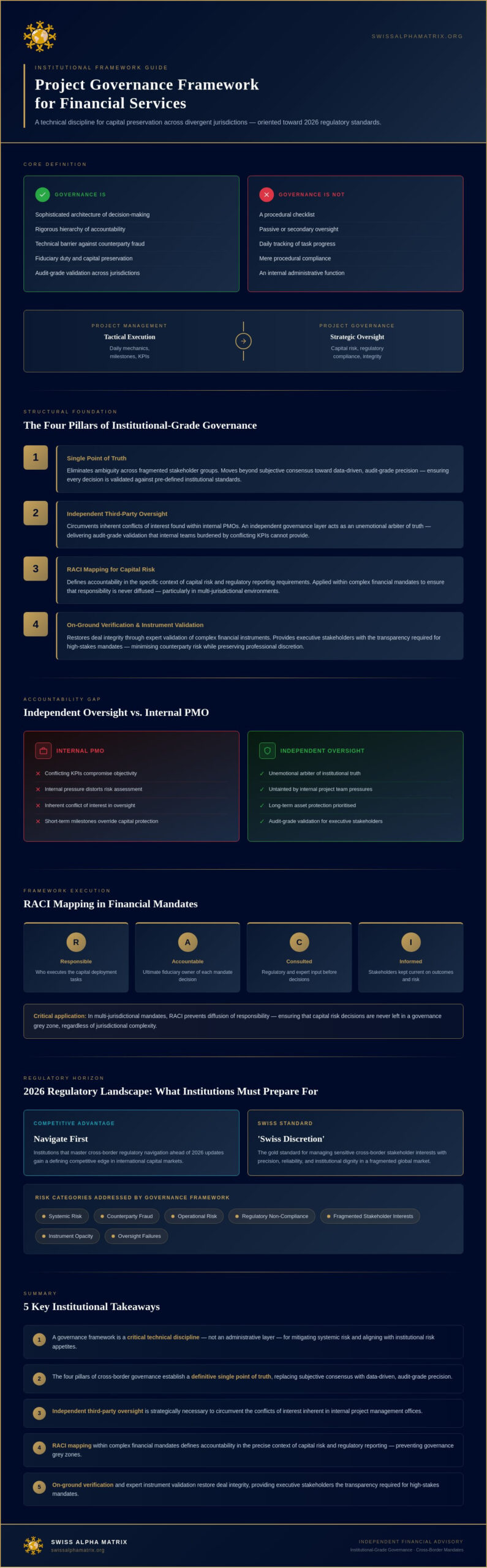
The evolution of institutional oversight has transformed the Project Governance Framework from a procedural checklist into a sophisticated architecture of decision-making. Within the context of a project governance framework for financial services, this structure serves as the primary mechanism for ensuring that high-stakes mandates remain strictly aligned with established institutional risk appetites. It isn’t merely about tracking progress. It’s about establishing a rigorous hierarchy of accountability that can withstand the unique pressures of systemic risk and the relentless scrutiny of multi-jurisdictional regulatory bodies.
Distinguishing between tactical execution and strategic oversight is critical for maintaining deal integrity. While project management focuses on the daily mechanics of execution, governance provides the overarching technical barrier required to mitigate operational and counterparty fraud. In high-stakes environments, where the complexity of financial instruments can obscure underlying risks, a robust project governance framework for financial services ensures that every decision is validated against a pre-defined set of institutional standards. This separation of powers prevents the internal biases that often lead to catastrophic oversight failures in fragmented stakeholder groups. It’s a structured refusal to oversimplify the intricate dynamics of cross-border capital deployment.
Governance as a Mechanism for Capital Preservation
Senior executives increasingly view governance as a fundamental fiduciary duty rather than a secondary project task. This perspective shift is driven by the realization that capital preservation depends on the integrity of the oversight model. By integrating independent financial project management, institutions can ensure that their governance structures are untainted by the internal pressures of the project team. This creates a transparent environment where long-term asset protection takes precedence over short-term milestones, effectively securing the moral character of the mandate. When the governance layer is independent, it acts as an unemotional arbiter of truth, providing audit-grade validation that internal teams, burdened by conflicting KPIs, simply can’t deliver.
The 2026 Regulatory Landscape and Oversight Requirements
As we approach the 2026 implementation of updated global standards, the ability to navigate international financial regulations has become a defining competitive advantage. The traditional concept of ‘Swiss discretion’ remains a gold standard in this regard, offering a dignified approach to managing sensitive cross-border stakeholder interests with precision and reliability. In a fragmented global market, this level of technical thoroughness ensures that every mandate remains compliant with the evolving demands of regulatory oversight. Project governance is the technical blueprint for institutional risk mitigation.
The Four Pillars of Institutional-Grade Governance in Cross-Border Mandates
The efficacy of a project governance framework for financial services rests upon four non-negotiable pillars that distinguish institutional-grade oversight from standard administrative management. In the complex sphere of cross-border capital deployment, these pillars provide the structural integrity required to manage multi-party transactions without compromising on precision or security. By establishing a definitive Single Point of Truth, the framework eliminates the ambiguity that often plagues fragmented stakeholder groups, ensuring that accountability is never diluted across jurisdictional lines.
- Accountability & Authority: Centralizing the decision-making hierarchy to ensure every mandate has a clear, unassailable lead.
- Decision-Making Frameworks: Moving away from the vulnerabilities of subjective consensus toward data-driven, audit-grade precision that stands up to the highest levels of institutional scrutiny.
- Transparency & Reporting: Delivering sophisticated executive intelligence that simultaneously satisfies the diverse requirements of internal boards and external regulatory bodies.
- Risk Management & Assurance: Integrating specialized bank instrument validation services to provide an empirical layer of protection for all underlying assets.
Success in these high-stakes programmes isn’t a matter of chance. It’s the result of a meticulously designed project governance framework for financial services that prioritizes technical accuracy over operational convenience. When these pillars are properly aligned, the framework functions as an elite protective shield, preserving the moral character and financial value of the mandate against the backdrop of global market volatility.
Integrating Financial Instrument Validation into Governance
In many complex programmes, the validation of financial instruments is erroneously treated as a concluding task rather than a core component of the project lifecycle. This creates significant vulnerabilities. A sophisticated framework mandates that the validation of SBLCs, LCs, and other complex instruments occurs in real-time, backed by audit-grade reporting. It requires on-ground intelligence to verify counterparty claims, ensuring that assets are authentic and unencumbered. Utilizing professional risk management frameworks is a necessary step in maintaining deal integrity.
Mapping Jurisdictional Friction in Global Deals
Aligning governance models across hubs like Geneva, London, and Hong Kong requires a nuanced understanding of localized regulatory friction. It’s not enough to satisfy primary stakeholders; one must also manage invisible participants like correspondent banks and regional regulators. Adapting the architecture for cross-border investment due diligence allows for a seamless transition between legal environments, ensuring the strategic mandate remains intact regardless of geographical complexity.
Independent Oversight vs. Internal PMO: Addressing the Accountability Gap
While many institutions traditionally rely on internal Project Management Offices (PMOs) to spearhead their strategic initiatives, this approach often introduces a fundamental conflict of interest that can compromise the integrity of a project governance framework for financial services. Internal teams, naturally influenced by institutional politics and the pressure to meet internal performance metrics, may inadvertently overlook subtle technical discrepancies or escalating operational risks. This inherent bias creates an accountability gap that, if left unaddressed, can lead to the erosion of capital and the failure of multi-jurisdictional mandates.
Tier-1 institutions are increasingly mandating independent, third-party oversight for their most complex programs to ensure that reporting remains untainted by internal organizational pressures. This transition toward external advisory isn’t merely a preference for outsourcing; it’s a strategic move to secure the specialized intelligence that only former Tier-1 bank executives can provide. These experts bring a level of technical validation and an unemotional perspective that internal departments, often siloed or under-resourced, cannot replicate. When a mandate is distressed, the introduction of an independent authority serves to stabilize the project, restoring stakeholder confidence through transparent, audit-grade communication.
The Swiss Alpha Matrix Approach to Independent Advisory
By positioning itself as an independent authority, Swiss Alpha Matrix bridges the often-perilous gap between technical execution and the strategic expectations of executive boards. This model actively counters institutional groupthink, a common phenomenon where internal teams align their findings with existing corporate narratives rather than empirical reality. In practical terms, this senior-level intervention has proven essential for stabilizing cross-border transactions, ensuring that every financial instrument is validated with the meticulous precision required by high-level stakeholders. It’s a standard of service that prioritizes the long-term preservation of interests over short-term milestones.
Protecting Fiduciary Integrity through External Oversight
For high-net-worth mandates, the presence of audit-grade, independent reporting isn’t optional; it’s a non-negotiable requirement for protecting long-term interests. The legal and reputational benefits of such oversight are profound, providing a layer of protection that internal audits frequently fail to establish due to their lack of independence. By utilizing a project governance framework for financial services that incorporates external verification, institutions demonstrate a commitment to moral character and high-level standards. Independent oversight serves as the ultimate safeguard for fiduciary responsibility in 2026.
Executing the Framework: RACI Mapping and Regulatory Alignment
The practical execution of a project governance framework for financial services requires more than a simple organizational chart; it demands a granular mapping of responsibilities that can withstand the weight of heavy regulatory scrutiny. By applying the RACI Matrix (Responsible, Accountable, Consulted, Informed) to complex financial mandates, institutions can eliminate the dangerous accountability gaps that often emerge in multi-party investment programs. In this context, ‘Accountability’ is redefined, moving beyond project milestones to encompass the ultimate ownership of capital risk and the accuracy of regulatory reporting. The ‘Consulted’ role within this matrix is particularly vital, as it integrates sophisticated financial advisory methodologies into the decision arc, ensuring that technical validation is never sacrificed for the sake of speed.
RACI as a Blueprint for Regulatory Compliance
Within a sophisticated governance structure, assigning clear ownership for AML (Anti-Money Laundering) and KYC (Know Your Customer) requirements is a fundamental prerequisite for maintaining jurisdictional standing. Maintaining an immutable audit trail, which is essential for satisfying the rigorous demands of global regulators, requires that the Project Management Office acts as the vigilant guardian of RACI integrity. By defining exactly who is responsible for each compliance hurdle, the framework ensures that no regulatory obligation is left to chance, providing a transparent record of due diligence that protects the institution’s moral character and legal standing. If your institution requires a robust project governance framework for financial services to secure a complex mandate, our team is prepared to provide the necessary oversight.
Managing Technical Integrity in Global Transactions
Successfully navigating global transactions requires a delicate balance of senior-level diplomacy and uncompromising technical validation. It’s not merely about the data; it’s about how that data is communicated across the decision-making hierarchy to align stakeholder expectations with the realities on the ground. Communication frequency must be meticulously calibrated based on the risk profile of each stakeholder, ensuring that those with the highest exposure are provided with the most detailed intelligence. This approach maintains Swiss-level precision in multi-jurisdictional reporting, preventing the dilution of technical standards that often occurs when mandates move through diverse legal and financial environments. Each report serves as a testament to the framework’s ability to provide clarity amidst complexity.
Swiss Alpha Matrix: Restoring Deal Integrity through Independent Advisory
Swiss Alpha Matrix represents a unique synthesis of institutional discipline and executive-level banking expertise, specifically engineered to address the profound vulnerabilities that often emerge during cross-border capital deployment. By positioning ourselves as the master planner within a project governance framework for financial services, we provide a layer of oversight that is both technically rigorous and strategically aligned with the long-term interests of high-net-worth entities. Our approach avoids the frantic energy of speculative markets, opting instead for a measured, logical methodology that prioritizes the moral character and financial security of each mandate. Precision is paramount in high-stakes finance. We don’t just manage projects; we safeguard the strategic intent of the institution through an unwavering commitment to regional excellence and technical thoroughness.
The core of our value proposition lies in providing audit-grade instrument validation as a specialized service to all project stakeholders, thereby eliminating the information asymmetry that frequently leads to operational friction. Unlike generic consulting firms that lack the specific Tier-1 banking background required to validate complex financial instruments, our experts bring a seasoned, unemotional perspective to the validation process. This expertise ensures that every SBLC, letter of credit, or sovereign guarantee is scrutinized with the precision necessary to prevent counterparty fraud and ensure deal integrity. It’s a standard of service that is both broad in its jurisdictional reach and meticulous in its attention to detail, reflecting a boutique entity’s dedication to privacy and exclusivity.
Our Engagement Model: From Due Diligence to Precise Execution
Our engagement model is highly personalized, offering mandate-specific engagements for project-based advisory or retainer-based consulting for continuous oversight of complex portfolios. By integrating seamlessly into existing executive structures, we provide the technical depth and independent intelligence required to secure high-value international deals without compromising the institution’s internal culture. This integration allows for a steady, unwavering pace of execution, where modern strategies are constantly tethered to established concepts of precision and reliability. It’s the most effective way to bridge the gap between technical execution and executive expectations.
Next Steps: Securing Your 2026 Financial Mandate
As the financial industry prepares for the regulatory shifts of 2026, evaluating your existing project governance framework for financial services for hidden operational risks has become a critical fiduciary priority. We invite you to contact Swiss Alpha Matrix for a confidential consultation regarding the oversight of your most complex mandates. Our team is ready to provide the stability and trust required to navigate fragmented stakeholder interests. Inquire regarding our independent advisory services to ensure your capital remains under the protection of seasoned experts who value stability and strategic growth above all else.
Advancing Institutional Integrity in a Fragmented Global Market
The strategic landscape of 2026 demands a decisive departure from traditional, internally-focused oversight models that often fail to account for the complexities of cross-border capital deployment. Implementing a comprehensive project governance framework for financial services has become a fundamental fiduciary imperative for long-term capital preservation. By prioritizing independent validation and rigorous RACI mapping, institutions can navigate jurisdictional friction with the technical precision required by sophisticated stakeholders. This structured approach ensures that deal integrity is maintained through empirical evidence rather than subjective consensus, effectively shielding mandates from operational and counterparty risks.
Swiss Alpha Matrix, led by former Tier-1 banking executives with decades of cross-border regulatory expertise, provides the audit-grade instrument validation standards necessary to protect your interests in high-stakes environments. Our methodology ensures that every mandate is executed with the moral character and technical thoroughness that exclusive mandates deserve. You’re invited to secure your financial mandate with independent Swiss oversight. We look forward to establishing the stability and trust your strategic growth requires.
Frequently Asked Questions
What is the difference between project governance and project management in financial services?
Project governance establishes the architectural framework of accountability and strategic decision-making, while project management focuses on the tactical execution of specific milestones. In a project governance framework for financial services, the governance layer acts as a technical barrier ensuring that all mandates remain strictly within institutional risk appetites. Management handles daily mechanics. Governance provides the high-level oversight required to protect capital and satisfy fiduciary duties.
How does a project governance framework improve regulatory compliance in 2026?
A robust framework ensures that every decision is backed by an immutable audit trail, which is essential for meeting the heightened transparency requirements of 2026. By integrating compliance advisory directly into the oversight layer, institutions can proactively adapt to shifting multi-jurisdictional standards. This structure prevents the regulatory friction that often occurs when compliance is treated as a secondary task rather than a core institutional pillar.
Why is independent oversight necessary for complex cross-border transactions?
Independent oversight is necessary to eliminate the inherent conflicts of interest and institutional groupthink that often plague internal project teams. External experts provide an unemotional, technical validation of progress and risks, ensuring that reports to executive stakeholders are entirely objective. This is particularly vital in cross-border mandates where navigating diverse legal environments requires senior-level intelligence that internal departments might not possess.
What are the core components of a RACI matrix in a financial mandate?
The RACI matrix defines who is Responsible for tasks, who is Accountable for capital risk, who is Consulted for technical depth, and who remains Informed of progress. In high-stakes finance, defining Accountability is paramount. It identifies the single point of truth for regulatory reporting. This clarity eliminates accountability gaps, ensuring that every AML and KYC requirement has a designated owner within the broader governance structure.
How can project governance help in the validation of financial instruments like SBLCs?
Project governance mandates that instrument validation occurs as a continuous oversight function rather than a concluding administrative step. By utilizing a project governance framework for financial services, institutions ensure that SBLCs and other complex instruments undergo audit-grade verification. This process includes on-ground intelligence to confirm counterparty claims. It provides an empirical layer of assurance that protects the deal’s integrity from its inception.
What role does Swiss discretion play in high-stakes project governance?
Swiss discretion represents a standard of dignified professionalism and technical precision that’s essential for managing sensitive cross-border stakeholder interests. It ensures that complex mandates are handled with the highest level of privacy while maintaining rigorous standards of accuracy. This approach fosters an environment of stability and trust. It allows elite institutions to pursue strategic growth without exposing sensitive operations to unnecessary public scrutiny.
How do you manage conflicting regulatory requirements in multi-jurisdictional projects?
Managing conflicting requirements involves a meticulous mapping of jurisdictional friction across hubs like Geneva, London, and Hong Kong. The framework utilizes senior-level diplomacy and technical thoroughness to align the mandate with the most stringent applicable standards. This ensures that the project remains compliant in all relevant jurisdictions. It effectively navigates the invisible pressures from correspondent banks and regional regulators through a unified oversight model.
What are the common signs of a failing project governance structure?
Failing structures are often characterized by fragmented stakeholder interests and a persistent lack of transparency regarding instrument validation. When accountability gaps emerge, or when technical execution becomes misaligned with strategic mandates, the governance layer is likely insufficient. Other indicators include inconsistent reporting frequency and an inability to provide audit-grade intelligence to executive boards. This often leads to escalating operational risks and diminished counterparty trust.