

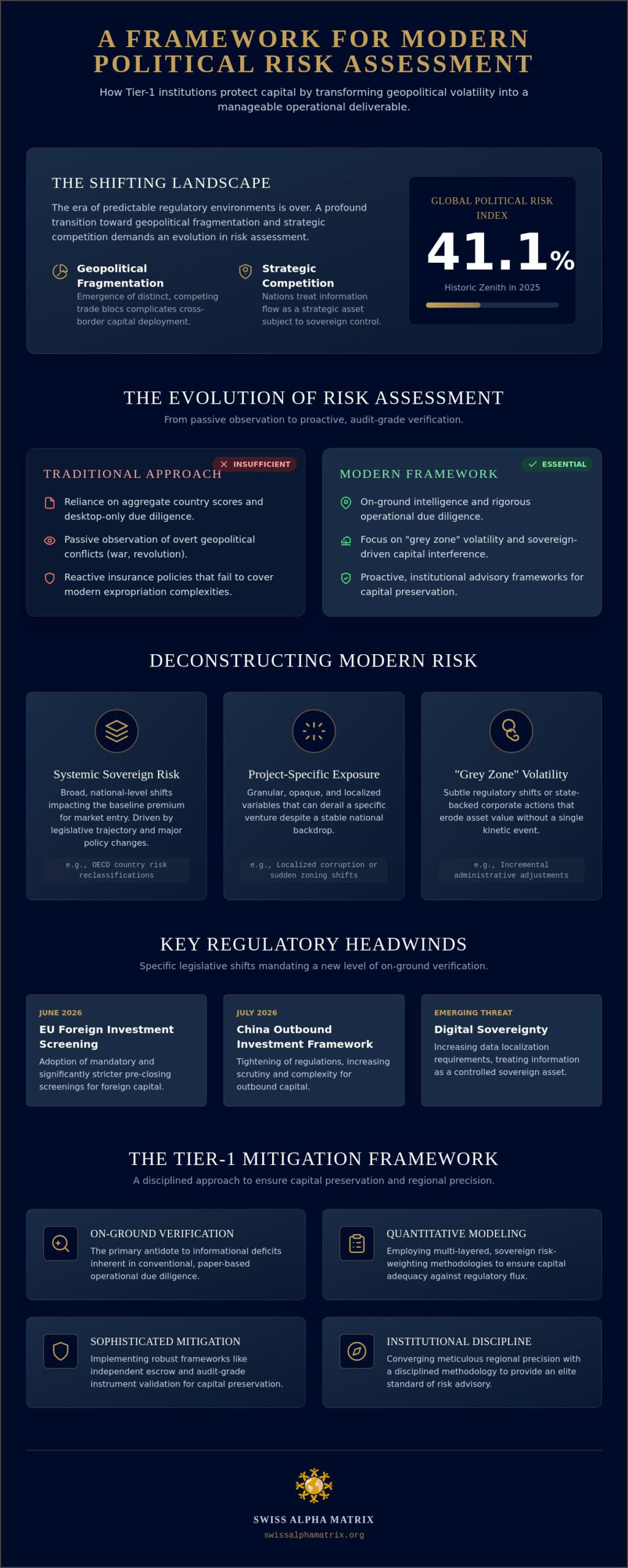
The global political risk index reached a historic zenith of 41.1% in 2025, a figure that underscores a profound transition toward geopolitical fragmentation and strategic competition. For the discerning allocator, the traditional reliance on aggregate country scores has become an insufficient shield against the nuanced, localized volatility that characterizes modern cross-border capital deployment. A sophisticated political risk assessment for international investments now demands an evolution from passive observation to proactive, audit-grade verification. You likely recognize that the era of predictable regulatory environments has been replaced by a landscape defined by the EU’s mandatory pre-closing screenings adopted in June 2026 and the tightening of China’s outbound investment framework that took effect this July.
This article provides the definitive framework utilized by Tier-1 institutions to quantify these abstract variables and transform jurisdictional volatility into a manageable operational deliverable. By moving beyond the limitations of desktop-only due diligence, we’ll examine the mechanics of on-ground intelligence, the necessity of rigorous operational due diligence, and the strategic integration of specialized risk management frameworks. Our objective is to provide the strategic certainty required to ensure capital preservation and regional precision in an increasingly polarized global theater.
Key Takeaways
- Master the multi-layered quantitative models and sovereign risk-weighting methodologies employed by Tier-1 banking institutions to ensure capital adequacy in the face of regulatory flux.
- Refine your political risk assessment for international investments by shifting focus from overt geopolitical conflict toward the subtle nuances of “grey zone” volatility and sovereign-driven capital interference.
- Recognize the critical necessity of on-ground verification services as the primary antidote to the informational deficits inherent in conventional, paper-based operational due diligence.
- Implement sophisticated mitigation strategies, including the use of independent escrow and audit-grade instrument validation, to create a robust framework for capital preservation.
- Gain insight into the Swiss Alpha methodology, where institutional discipline and meticulous regional precision converge to provide an elite standard of risk advisory for complex capital deployment.
The Evolution of Political Risk Assessment in the 2026 Investment Landscape
In the current fiscal year, the conceptualization of political risk has transitioned from a peripheral consideration of overt conflict to a central, multifaceted pillar of capital integrity. We define this phenomenon as the precise intersection where sovereign action, whether through legislative decree or administrative caprice, impacts the fundamental safety and liquidity of deployed capital. The traditional binary of “war and revolution” has been superseded by “grey zone” volatility, where subtle shifts in regulatory posture or state-backed corporate reassignments can erode asset value without a single kinetic event. This environment demands that a political risk assessment for international investments move beyond the historical reliance on reactive insurance policies, which often fail to address the complexities of modern expropriation, toward a proactive, institutional advisory framework rooted in technical accuracy and regional precision.
The distinction between systemic sovereign risk and project-specific jurisdictional exposure is paramount for the institutional allocator. Systemic risk involves broad, national-level shifts, such as the OECD’s June 2026 country risk reclassifications in Asia and Africa, which dictate the baseline premium for entry. Conversely, project-specific exposure concerns the granular, often opaque, localized variables that can derail a specific venture despite a stable national backdrop. In 2026, successful capital preservation requires a methodology that treats jurisdictional volatility not as an act of God, but as a manageable operational deliverable through rigorous due diligence and sophisticated risk management frameworks.
Macro-Political vs. Micro-Political Variables
Analyzing national-level stability involves assessing the broad legislative trajectory of a host nation, ensuring that market entry aligns with long-term strategic growth rather than short-term speculation. However, our focus frequently shifts to micro-political variables, such as localized corruption or sudden zoning shifts, which can be far more damaging to individual project IRR than national policy changes. To maintain audit-grade risk documentation, institutions must adhere to evolving international financial regulations, which provide the standardized metrics necessary to benchmark these disparate risks against global performance standards.
The 2026 Geopolitical Context for Capital Deployment
The acceleration of geopolitical fragmentation has resulted in the emergence of distinct, often competing, trade blocs that complicate the execution of cross-border project management. Within these blocs, digital sovereignty and data localization have become new, non-negotiable pillars of a political risk assessment for international investments, as nations increasingly treat information flow as a strategic asset subject to sovereign control. Regulatory volatility is the primary threat to 2026 investment IRR, manifesting as an unpredictable sequence of administrative adjustments that incrementally diminish the autonomy of foreign capital. This landscape is further complicated by the June 2026 adoption of the EU’s stricter foreign investment screening and China’s July 2026 outbound investment regulations, both of which necessitate a level of on-ground verification that desktop research cannot provide.
Institutional Methodologies for Quantifying Sovereign and Regulatory Exposure
The Tier-1 banking sector approaches jurisdictional exposure with a level of technical rigor that transcends the superficial metrics found in standard trade reports. At this level, sovereign risk weighting isn’t merely a calculation of default probability; it’s a fundamental assessment of capital adequacy and the long-term integrity of the investment environment. Unlike passive participants who rely on aggregate scores, seasoned experts utilize multi-layered quantitative models to predict regulatory shifts before they manifest as fiscal impairments. A primary component of a sophisticated political risk assessment for international investments involves the development of a bespoke risk-scoring matrix, specifically calibrated for high-value financial instruments, that accounts for the unique volatility of the target jurisdiction.
We often integrate ESG metrics into these models, not as a moral imperative, but as a pragmatic proxy for long-term political stability. Environmental and social governance standards frequently highlight underlying societal tensions or resource scarcities that precede sovereign intervention or civil unrest. By quantifying these variables, institutional planners can establish a more accurate baseline for risk, ensuring that interests remain in the hands of experts who prioritize strategic growth over short-term speculation. Securing your interests in these environments requires the implementation of comprehensive risk management frameworks that prioritize capital preservation through every stage of the investment lifecycle.
Quantitative Modeling and Predictive Analytics
Leveraging historical data allows for the identification of patterns in jurisdictional policy reversals, yet we remain cautious of the limitations inherent in “black-box” models, particularly within emerging market contexts where data integrity is often compromised. These automated systems frequently fail to account for the idiosyncratic nature of local politics. It’s here that institutional-grade financial advisory methodologies prove their worth, offering a depth of analysis that generic risk ratings simply cannot replicate. By scrutinizing historical precedents of expropriation and sudden tax code amendments, we build predictive models that offer a dignified and reassuringly formal approach to capital protection.
Qualitative Assessment of Institutional Strength
Technical modeling must be tempered by a qualitative assessment of institutional strength, specifically evaluating the independence of the judiciary and the central bank in host states. The Country Risk Assessment Framework provided by the International Trade Administration serves as a foundational reference for these evaluations. However, the most effective assessments incorporate a “bureaucratic friction” index to measure the practical hurdles facing large-scale infrastructure projects, such as permit delays or localized administrative corruption. Seasoned experts, often drawing on their experience as former senior banking executives, interpret subtle regulatory signals that indicate a shift in the political climate long before official announcements occur, providing the quiet authority necessary for informed decision-making.
Beyond Desktop Research: The Imperative of On-Ground Verification
While the quantitative models and risk scoring matrices discussed previously provide a logical baseline for capital allocation, they remain inherently limited by the quality and timeliness of the data they ingest. In the complex landscape of 2026, where regulatory shifts occur with unprecedented frequency, a sterile reliance on centralized data repositories often masks the immediate, capricious nature of local jurisdictional shifts. A robust political risk assessment for international investments cannot exist solely within the confines of a terminal; it requires the physical presence of seasoned experts to validate the integrity of the underlying assets. This on-ground verification serves as the only definitive antidote to “paper-only” due diligence, which frequently fails to capture the subtle erosion of property rights or the quiet emergence of state-backed competitors that could compromise long-term preservation.
Identifying local counterparty reliability requires a level of scrutiny that transcends legal documentation. Through on-site operational audits, we evaluate the actual capacity of a partner to fulfill their obligations under stress, rather than relying on curated corporate narratives. This process involves a meticulous mapping of local stakeholders to mitigate community-led project disruptions, which are often the first signs of shifting political winds. By bridging the gap between executive-level intelligence and localized reality, we ensure that the allocator’s interests are protected by an unemotional, technical understanding of the terrain.
The Mechanics of On-Ground Operational Due Diligence
Physical site visits are essential to verify that an asset’s existence and its operational capacity align perfectly with the disclosures provided during the initial phases of cross-border investment due diligence. These visits allow our experts to interview local regulators and industry peers, providing a rare opportunity to gauge unwritten policy trends that haven’t yet been codified into official publications. It’s during these interactions that the true impact of regulations, like the EU’s June 2026 mandatory screenings, becomes visible at the project level. Integrating these localized findings into a broader institutional report ensures that the political risk assessment for international investments reflects the actual operational reality rather than a theoretical projection.
Mitigating Information Asymmetry in Emerging Markets
In many emerging markets, local “gatekeepers” often possess a vested interest in distorting the perception of political stability to attract foreign capital. We employ rigorous techniques for the independent verification of local licenses and permits, bypassing these intermediaries to consult directly with regional administrative archives. This meticulous approach addresses the information asymmetry that often leads to catastrophic project disruptions. It’s a standard of service that values precision and technical accuracy above all else. On-ground verification is the final safeguard against institutional blind spots.
Strategic Mitigation: Structuring Investments Against Jurisdictional Volatility
Strategic mitigation transcends the reactive reliance on international arbitration, which, while legally sound, often fails to provide the immediate liquidity required during jurisdictional upheaval. It’s a proactive necessity. A sophisticated political risk assessment for international investments must culminate in a structural architecture that prioritizes capital preservation through every phase of deployment. One of the most effective methodologies involves the implementation of complex project management to facilitate phased capital release schedules. By tethering funding to specific, verified milestones, the allocator retains significant leverage over host-state counterparties, ensuring that interests aren’t fully exposed until the environment demonstrates continued stability. Structuring multi-jurisdictional vehicles further isolates exposure, creating a buffer that prevents a single sovereign entity from compromising the integrity of the entire portfolio. Developing a robust “Plan B” for capital repatriation in crisis scenarios, particularly ahead of the volatility expected around the November 2026 U.S. mid-term elections, is a prerequisite for institutional-grade planning.
Financial Instrument Validation as a Risk Buffer
Ensuring that letters of credit and bank guarantees are issued by politically insulated, Tier-1 entities is a fundamental requirement for mitigating credit risk in volatile markets. The importance of audit-grade validation for collateral in high-risk zones cannot be overstated, as it provides the technical assurance that assets remain liquid despite local administrative interference. For a detailed exploration of these protections, we recommend reviewing our bank instrument validation services, which outline the rigorous standards required to secure collateral in the 2026 landscape.
Independent Project Oversight and Milestone Management
Implementing independent financial project management allows for the real-time monitoring of risk variables that automated models often overlook. By utilizing milestone-based funding, investors maintain the ability to halt capital flow if specific “exit triggers,” such as the implementation of new export controls like the U.S. Affiliates Rule set for November 10, 2026, are activated. This level of oversight ensures that a political risk assessment for international investments remains an active, operational process rather than a static document, managing jurisdictional exposure with the same precision as a high-end private wealth portfolio. It prioritizes long-term preservation over speculative gains.
To integrate these sophisticated safeguards into your deployment strategy, please consider our Risk Management Frameworks as a cornerstone of your institutional planning.
Navigating Complexity: The Swiss Alpha Matrix Approach to Risk Advisory
The Swiss Alpha Matrix approach is characterized by an uncompromising adherence to institutional discipline, a standard cultivated through years of leadership within Tier-1 banking environments. Our team, comprised of former senior executives, applies a level of technical rigor to jurisdictional volatility that mirrors the traditional discretion of high-end private wealth management. We don’t merely observe market trends; we analyze them through the lens of capital integrity and long-term preservation. This “Swiss Alpha” methodology represents a synthesis of global reach and meticulous regional precision, ensuring that a political risk assessment for international investments is never a static observation but a dynamic, operational strategy. It’s a persona rooted in historical reliability, designed for an elite caliber of audience that values nuance and technical accuracy over short-term speculation.
Our commitment to discretion is paramount, particularly when operating within sensitive jurisdictions where information asymmetry is prevalent. We position ourselves as a dedicated partner rather than a mere service provider, offering the quiet authority necessary to navigate the accelerating transition toward geopolitical fragmentation. By merging executive-level intelligence with on-ground verification, we deliver a framework for capital deployment that prioritizes strategic certainty in an increasingly polarized global landscape.
Audit-Grade Intelligence for Executive Stakeholders
There’s a profound distinction between a standard consultancy report and the audit-grade risk assessments we provide to board-level decision-makers. While generic reports often rely on lagging public data, our assessments are built on technical accuracy and real-time intelligence, providing the depth required for high-stakes capital protection. Within this framework, our regulatory compliance advisory services are integrated into the earliest stages of complex cross-border deals. This ensures that every deployment aligns with the evolving legal requirements of 2026, including the harmonized review timelines and mandatory screenings that now define the international theater. We provide the intellectual depth that sophisticated allocators require to maintain their performance-oriented mindset.
Securing Your International Investment Future
In an era defined by “grey zone” risks and abrupt policy reversals, independent advisory serves as the final, essential layer of capital protection. The long-term value of a dedicated risk management partner lies in the ability to anticipate shifts in sovereign posture before they manifest as fiscal impairments. By tethering modern strategies to concepts of regional excellence, we ensure that your interests remain in the hands of seasoned, unemotional experts. To secure your portfolio against the complexities of the coming years, we invite you to engage Swiss Alpha Matrix for your next cross-border mandate and experience a standard of service that is both broad in reach and meticulous in its attention to detail.
Securing Capital Integrity in an Era of Jurisdictional Flux
The transition toward a fragmented global landscape necessitates a departure from passive risk observation. True capital preservation in 2026 requires an integrated methodology that merges sophisticated quantitative modeling with the indispensable reality of on-ground verification. By implementing a rigorous political risk assessment for international investments, institutional allocators can transform abstract jurisdictional threats into manageable operational deliverables. This framework ensures that regulatory shifts, such as those adopted in the EU and China this year, are anticipated rather than merely reacted to. It’s the difference between short-term speculation and enduring strategic certainty.
Our team, managed by former Tier-1 global bank executives, brings decades of transactional and regulatory expertise to every mandate. We provide the technical accuracy required for board-level decision-making through audit-grade instrument validation and meticulous operational due diligence. This institutional discipline serves as the final safeguard for your interests in volatile markets. We invite you to contact our senior advisory team to secure your cross-border investment strategy. We look forward to establishing a partnership rooted in historical reliability and regional precision.
Frequently Asked Questions
What is the difference between political risk and country risk?
Country risk serves as a broad umbrella term encompassing macroeconomic, sovereign, and political factors, whereas political risk specifically addresses the impact of government action or instability on investment value. While country risk focuses on indicators like debt-to-equity ratios and GDP growth, political risk examines the nuance of legislative shifts, expropriation, and “grey zone” volatility. It’s the difference between assessing a nation’s ability to pay and its willingness to honor the integrity of foreign capital.
How does political risk assessment impact the cost of capital for an international project?
A rigorous political risk assessment for international investments directly influences the risk premium added to the discount rate, thereby affecting the project’s internal rate of return. Tier-1 institutions use these assessments to adjust capital adequacy requirements and interest rate spreads. Higher perceived volatility in a jurisdiction necessitates a larger capital buffer; this increased requirement naturally elevates the overall cost of deployment for the institutional allocator.
Can political risk be fully mitigated through insurance like Trade Credit Insurance?
Insurance serves as a reactive financial buffer, yet it cannot fully replace a proactive advisory framework or address the nuances of operational disruptions. While Trade Credit Insurance protects against payment defaults, it often fails to cover subtle regulatory expropriation or digital sovereignty issues. Strategic preservation requires a combination of specialized coverage and audit-grade risk management frameworks to ensure the long-term integrity of the asset.
What are the most common “red flags” in a jurisdictional risk assessment?
Key red flags include sudden amendments to the judicial appointment process, abrupt changes in central bank autonomy, and a rising “bureaucratic friction” index within local administrations. We also scrutinize localized corruption and non-transparent shifts in zoning or licensing laws. These indicators often precede broader sovereign actions that could compromise the liquidity of high-value financial instruments, signaling a need for immediate on-ground verification.
How often should a political risk assessment be updated during a long-term investment?
Assessments should be reviewed quarterly or immediately following significant geopolitical triggers, such as the EU’s June 2026 investment screening adoption. Long-term capital deployment in volatile regions demands a dynamic approach rather than a static annual review. This frequency ensures that the allocator’s strategy remains aligned with the hyper-personalized reality of the local regulatory environment, allowing for the timely activation of exit triggers if necessary.
Does legal due diligence cover the same ground as political risk advisory?
Legal due diligence focuses on the enforceability of contracts and compliance with existing statutes, whereas political risk advisory anticipates the future stability of those very statutes. While a lawyer ensures a contract is currently valid, a risk advisor evaluates the probability that a sovereign entity will honor that contract during a period of upheaval. Both are essential, but they serve distinct, complementary institutional functions.
How do Tier-1 banks typically model sovereign risk for cross-border lending?
Tier-1 banks utilize multi-layered quantitative models that integrate historical default data with real-time indicators of institutional strength and judicial independence. These models calculate sovereign risk weighting to determine capital adequacy and exposure limits for specific jurisdictions. This institutional discipline ensures that cross-border lending remains within strictly defined parameters, prioritizing the long-term preservation of the bank’s balance sheet over short-term speculative gains.
What role does on-ground verification play in validating financial instruments?
On-ground verification provides the final layer of audit-grade validation by confirming the physical existence and operational capacity of assets tied to financial instruments. It bypasses the information asymmetry often found in emerging markets by engaging directly with regional archives and industry peers. This process ensures that letters of credit and bank guarantees are backed by tangible operational reality rather than curated, paper-only corporate narratives.