

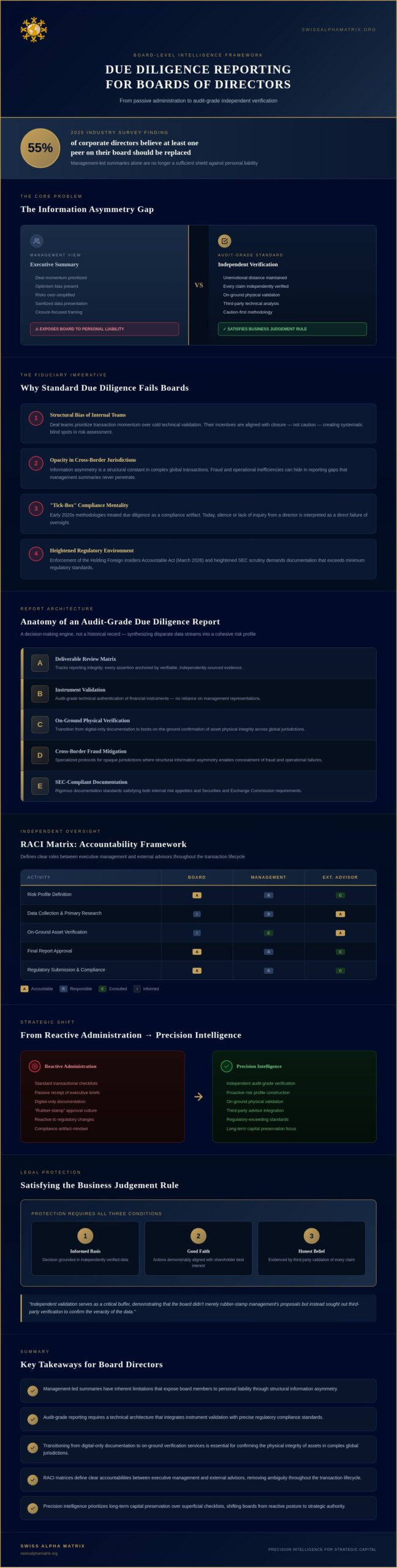
When one considers that 55% of corporate directors, according to a 2025 industry survey, believe at least one of their peers should be replaced, it becomes evident that the traditional reliance on management-led summaries is no longer a sufficient shield against personal liability. The contemporary landscape, underscored by the enforcement of the Holding Foreign Insiders Accountable Act on March 18, 2026, necessitates a fundamental transformation in due diligence reporting for board of directors from a passive administrative exercise into a sophisticated framework of independent, audit-grade verification. You likely recognize that the persistent information asymmetry between executive management and the boardroom remains the primary catalyst for catastrophic capital loss and regulatory scrutiny in high-stakes transactions.
This article serves as a definitive guide to mastering the architecture of institutional reporting, ensuring your fiduciary duties are fulfilled with the technical precision required to mitigate risk in increasingly volatile global markets. We’ll explore the strategic pillars of operational validation, the nuances of cross-border fraud mitigation, and the implementation of robust frameworks that satisfy both internal risk appetites and the stringent requirements of the Securities and Exchange Commission. By establishing a more rigorous standard for documentation, boards can move beyond the fear of personal liability toward a position of quiet authority and strategic permanence.
Key Takeaways
- Identify the inherent limitations of management-led summaries and why they often fail to bridge the information asymmetry that exposes board members to personal liability.
- Establish a technical architecture for due diligence reporting for board of directors that integrates audit-grade instrument validation with precise regulatory compliance standards.
- Recognize the necessity of transitioning from digital-only documentation to on-ground verification services to ensure the physical integrity of assets in complex global jurisdictions.
- Implement an independent oversight framework using RACI matrices to define clear accountabilities between executive management and seasoned external advisors throughout the transaction lifecycle.
- Shift from a reactive administrative posture to a strategy of precision intelligence, prioritizing long-term capital preservation over the superficiality of standard transactional checklists.
The Fiduciary Imperative: Why Standard Due Diligence Fails the Board
The Fiduciary Imperative dictates that a board’s oversight must extend far beyond the passive receipt of condensed executive briefs. In the current 2026 regulatory environment, characterized by heightened scrutiny and the stabilization of the D&O insurance market into a buyer-favorable yet cautious state, the role of due diligence reporting for board of directors has evolved into a strategic instrument for informed capital deployment. It’s no longer sufficient to treat these reports as mere compliance artifacts; they are the primary defense against the erosion of shareholder value. The gap between a high-level management summary and the granular, often obscured reality of transactional risk can be vast, particularly when dealing with complex financial instruments or opaque cross-border jurisdictions where information asymmetry is a structural constant.
As of mid-2026, the global corporate governance landscape has transitioned away from the “tick-box” methodologies that defined the early 2020s. Boards now face a mandate for a performance-oriented mindset where silence or lack of inquiry is interpreted as a failure of oversight. When a board relies solely on internal reporting for cross-border deals, it risks inheriting the inherent optimism of a deal team focused on closure rather than caution. This creates a vacuum where fraud or operational inefficiencies can hide, potentially leading to significant fiduciary breaches and personal liability for directors who failed to demand independent verification of the underlying assets.
The Limitations of Management-Led Reporting
Internal deal teams, while technically proficient, often operate under structural biases that prioritize the momentum of a transaction over its cold, technical validation. This frequently results in executive summaries that over-simplify the risks associated with complex financial instruments, presenting a sanitized version of reality to the board. To bridge this gap, sophisticated boards are increasingly adopting institutional-grade financial advisory methodologies. These frameworks provide the necessary depth and unemotional distance required to dissect management’s assumptions and reveal the underlying mechanics of a potential acquisition or investment with absolute precision.
Satisfying the Business Judgement Rule
The Business Judgement Rule offers protection only to those directors who have acted on an informed basis, in good faith, and with the honest belief that their actions were in the best interest of the corporation. Establishing a standard of care that exceeds regulatory minimums is essential for securing this protection in the 2026 market. Independent validation serves as a critical buffer, demonstrating that the board didn’t merely “rubber-stamp” management’s proposals but instead sought out third-party verification to confirm the veracity of the data. The “audit-grade” standard represents the highest benchmark for board-ready intelligence, ensuring that every claim is verified through rigorous, on-ground, and technical analysis.
Anatomy of an Audit-Grade Due Diligence Report
An institutional-grade report functions as a decision-making engine rather than a mere historical record. It must synthesize disparate data streams into a cohesive risk profile that allows for the precise allocation of capital. For the report to be effective, it requires the implementation of a deliverable review matrix, which serves to track reporting integrity and ensures that every assertion is anchored by verifiable evidence. This structural rigor is what distinguishes due diligence reporting for board of directors from the superficial summaries that often lead to oversight failures. When analyzing counterparty disclosures, directors should look for inconsistencies in beneficial ownership structures or anomalies in instrument documentation that deviate from established international protocols.
Integrating financial discipline with regulatory precision demands a methodology that scrutinizes the technical validity of every claim. Red flags often manifest as subtle discrepancies in the timing of financial filings or the lack of transparency in secondary market valuations. By maintaining an unwavering focus on these granular details, the board can protect the institution from the cascading effects of cross-border fraud. Utilizing professional Operational Due Diligence services can provide the necessary distance to identify these risks before they jeopardize the transaction’s viability.
Financial Instrument Validation Protocols
Standard reviews of Standby Letters of Credit (SBLC) and bank guarantees frequently fail because they rely on the presumed authenticity of paper-based claims. A truly robust framework utilizes specialized bank instrument validation services to confirm the existence and unencumbered status of these instruments through institutional-grade analysis. This process involves a meticulous verification of the issuing bank’s standing and the specific terms of the instrument, ensuring that the security offered is both liquid and legally enforceable in the event of a default.
Operational and Regulatory Alignment
In the context of cross-border mandates, boards must map every investment against a complex web of international financial regulations to ensure absolute compliance. This alignment extends beyond mere legal adherence; it encompasses an assessment of the target entity’s operational resilience, including its cybersecurity posture and ESG metrics. As noted in the discussion regarding due diligence for board nominees, the necessity for systematic oversight is paramount. Incorporating these modern risk factors into the primary financial framework ensures that the board’s fiduciary duty is satisfied through a holistic and technically accurate understanding of the target’s long-term viability.
Paperwork vs. Reality: The Critical Role of On-Ground Verification
Digital artifacts, despite their perceived permanence within a secure data room, are merely representations of value that lack the inherent weight of physical confirmation. In the current 2026 environment, where sophisticated actors can fabricate entire chains of custody using advanced digital tools, a board’s reliance on notarized documents alone is a precarious strategy. For a board to truly fulfill its mandate, the due diligence reporting for board of directors must reconcile these digital claims against the tangible reality of the assets in question. History is replete with instances where flawless balance sheets and notarized titles concealed empty warehouses or non-existent infrastructure, proving that deal integrity is only as robust as the physical oversight applied to the underlying project.
Independent, on-ground verification functions as the final arbiter of truth in complex capital deployments. It serves to dismantle the “paper-only” illusions that often cloud the judgment of deal teams who are incentivized by transaction volume rather than long-term asset performance. By deploying seasoned experts to verify the structural integrity of facilities, the actual presence of inventory, and the legitimacy of local operational permits, the board can transform a speculative venture into a validated investment. This transition from passive acceptance of management’s data to active, physical interrogation of the facts is the hallmark of a protective authority.
Verifying Cross-Border Investment Due Diligence
The complexities inherent in cross-border investment due diligence require a methodology that bridges the geographical and cultural gaps between global financial hubs like Geneva or London and the local site of operations. In 2026, the “Trust but Verify” model has become the standard for directors who seek to avoid the pitfalls of opaque jurisdictions. Direct verification of facilities and inventory ensures that the capital is backed by real-world substance, while a thorough review of local regulatory standing protects the organization from the sudden seizure of assets or the discovery of undisclosed environmental liabilities.
Counterparty Risk and Physical Presence
Assessing the moral character and historical track record of international partners requires more than a simple database check; it necessitates the gathering of local intelligence through established networks. Physical presence remains the only definitive counter to sophisticated financial fraud. By maintaining a physical presence during critical phases of the transaction, independent advisors can observe the nuances of a counterparty’s operations that are never captured in a digital report. These on-ground findings, when integrated into the final due diligence reporting for board of directors, provide a level of technical precision that satisfies the highest standards of fiduciary oversight and capital protection.
Implementing an Independent Oversight Framework for Board Reporting
Designing a reporting cadence that aligns with the transaction lifecycle is the cornerstone of institutional capital protection, ensuring that due diligence reporting for board of directors isn’t a static document delivered at the eleventh hour, but a dynamic flow of intelligence that evolves as the deal progresses. By establishing an independent Project Management Office (PMO) to oversee complex transaction deliverables, the board can bypass the filtered perspectives of internal deal teams. This structure provides the raw, unvarnished intelligence necessary to identify structural weaknesses in a counterparty’s financial position before they manifest as catastrophic losses. It’s essential that the flow of information remains unencumbered by the internal pressures of the deal team, allowing the board to function as a truly independent protective authority.
To maintain absolute clarity in accountability, the implementation of a RACI matrix is essential, specifically to define the boundaries between management’s operational duties and the oversight functions of independent advisors. This prevents the dangerous overlap where management inadvertently audits its own assumptions, a common precursor to fiduciary failure. When the reporting line is clearly demarcated, the board receives information that is untainted by the internal incentives that often drive deal closure at any cost. For boards seeking to institutionalize this level of precision, our Complex Project Management services provide a robust framework for managing high-stakes transaction deliverables with technical accuracy.
The Independent Financial Project Management Model
Utilizing independent financial project management secures the reporting chain by establishing clear milestones for every due diligence deliverable. It’s critical to distinguish between a standard management “update,” which often serves to maintain momentum, and a board-grade “report,” which must serve as a definitive verification of value. This model ensures that every technical assertion is backed by the audit-grade validation discussed in previous sections, creating a transparent trail of accountability that satisfies both internal risk committees and external regulators. By adhering to these strict milestones, the board ensures that no capital is deployed until every layer of verification has been satisfied.
Stakeholder Management and Precision Execution
Navigating the delicate balance between board oversight and management execution requires a level of technical accuracy that only seasoned experts can provide. Every qualifying clause and executive summary must be scrutinized for precision, ensuring that the board isn’t misled by the linguistic nuances that often mask significant risk. Maintaining Swiss-level discretion throughout the reporting process preserves the exclusivity of the mandate while reinforcing the board’s position as a protective authority. This approach transforms due diligence reporting for board of directors into a standard of regional excellence, where every strategic pillar is anchored by unwavering logic and professional calm, rather than the frantic energy of the marketplace.
The Swiss Alpha Matrix Standard: Precision Intelligence for Strategic Capital
Swiss Alpha Matrix occupies a unique position as a protective authority, offering a standard of precision intelligence that transcends the generalized offerings of traditional consulting firms. Our approach to due diligence reporting for board of directors is rooted in the traditional discretion of high-end private wealth management, ensuring that every mandate is treated with the technical rigor and regional precision it deserves. By engaging our firm, boards gain access to a methodology that prioritizes long-term capital preservation over the superficiality of standard transactional checklists. This institutional framework is designed to bridge the information gap between management and the boardroom, providing the audit-grade validation necessary to navigate the complexities of 2026 global markets with absolute confidence.
The value of our advisory resides in the caliber of our personnel, who are exclusively former Tier-1 senior executives with decades of experience in navigating the world’s most intricate financial landscapes. These unemotional experts bring a level of intellectual depth and technical accuracy that is often missing from internal deal teams. Our commitment to on-ground verification services ensures that no asset is taken at face value, as we recognize that physical presence remains the only definitive safeguard against sophisticated cross-border fraud. This uncompromising dedication to the truth allows us to provide unvarnished intelligence that empowers directors to fulfill their fiduciary duties with total clarity.
Bespoke Advisory for Global Mandates
Each board mandate requires a hyper-personalized strategy that reflects the specific risk profile of the transaction and the unique requirements of the directors involved. Our bespoke advisory services for due diligence reporting for board of directors are tailored to provide deep-dive analysis into complex project management and operational resilience. By intersecting rigorous financial discipline with regional precision, we ensure that every reporting deliverable is technically accurate and strategically relevant. This high-level access to senior expertise allows boards to evaluate potential investments through a lens of intellectual superiority and traditional values, ensuring that every decision is anchored in historical reliability.
Strategic Growth through Capital Preservation
Preservation is the prerequisite for sustainable growth. In an era where 72% of S&P 500 companies identify emerging technologies like AI as material risks, the ability to deploy capital with absolute precision is a significant competitive advantage. Our framework ensures that every deployment decision is backed by audit-grade documentation, reducing exposure in high-stakes transactions while satisfying the most stringent regulatory compliance standards. To secure the integrity of your next strategic move, Consult with Swiss Alpha Matrix for your next cross-border mandate. The firm stands as a dedicated partner, committed to the meticulous protection of your interests and the steady realization of long-term strategic growth.
Advancing Board Oversight through Institutional Precision
The evolution of global governance requires a fundamental shift from passive compliance to a standard of technical excellence. As detailed throughout this framework, the integrity of capital deployment rests upon the board’s ability to demand unvarnished intelligence and on-ground verification that transcends the inherent limitations of internal management summaries. By institutionalizing a framework for due diligence reporting for board of directors that prioritizes audit-grade validation over mere administrative checklists, directors effectively mitigate the risks of information asymmetry and potential personal liability. This transition ensures that the board functions as a true protective authority rather than a reactive participant in the transaction lifecycle.
Swiss Alpha Matrix stands as a dedicated partner in this pursuit of strategic permanence. Led by former senior executives from Tier-1 global banks, our team brings decades of transactional and regulatory expertise to every high-stakes mandate. We specialize in the validation of complex financial instruments, ensuring that your fiduciary oversight is anchored in technical reality rather than curated narratives. Secure your next cross-border transaction with Swiss Alpha Matrix’s audit-grade due diligence reporting. Establishing this level of precision ensures that your institution’s interests are protected by a standard of service that is both broad in reach and meticulous in its attention to detail.
Frequently Asked Questions Regarding Board-Level Due Diligence
What are the essential elements of a due diligence report for a board of directors?
The essential elements of a comprehensive report include a verified chain of custody for all financial instruments, a detailed analysis of beneficial ownership to identify potential sanctions risks, and a technical evaluation of operational resilience. These reports must transcend simple executive summaries by providing granular data on counterparty creditworthiness and the specific legal enforceability of transactional documents in their local jurisdictions. Every technical assertion should be supported by audit-grade evidence that allows directors to make informed capital deployment decisions.
How does audit-grade validation differ from standard financial review?
Audit-grade validation differs from standard financial reviews by prioritizing the proactive verification of underlying data rather than the passive acceptance of management’s provided documentation. While a standard review might rely on existing audited financial statements, an audit-grade approach utilizes on-ground verification and technical instrument analysis to confirm that the assets described in those statements actually exist and are unencumbered by undisclosed liabilities. This level of scrutiny provides the technical precision required for high-stakes mandates.
Is independent third-party due diligence mandatory for public company boards?
While specific statutes may not always mandate the use of third-party advisors, the Business Judgment Rule and recent 2026 regulatory updates, such as the HFIAA, effectively require boards to demonstrate an informed basis for their decisions. Utilizing independent due diligence reporting for board of directors serves as a primary defense against claims of fiduciary negligence. This is particularly true in complex or cross-border transactions where internal teams may lack the necessary specialized expertise to identify sophisticated fraud.
What is the role of the board in overseeing cross-border investment due diligence?
The board’s role in overseeing cross-border investment due diligence is to establish and enforce a robust risk management framework that accounts for the nuances of international law and local market volatility. Directors must ensure that the reporting they receive includes a technical assessment of geopolitical risks and a verification of the target entity’s compliance with both regional regulations and global standards. This oversight ensures that capital is protected from the unique risks inherent in emerging and established international markets.
How can boards verify the authenticity of complex financial instruments like SBLCs?
Boards can verify the authenticity of complex financial instruments like Standby Letters of Credit (SBLCs) by requiring direct institutional-grade validation through specialized third-party advisors. This process involves confirming the instrument’s status with the issuing bank’s treasury department and ensuring that the terms of the guarantee are not subject to hidden conditions that would render the security illiquid. Relying on paper-based claims without this direct verification exposes the institution to significant transactional risk and potential capital loss.
What happens if a board fails to exercise proper due diligence in a transaction?
A board’s failure to exercise proper due diligence can lead to significant personal liability for directors, substantial regulatory fines, and the loss of coverage under D&O insurance policies. In the event of capital loss, shareholders may initiate securities class action filings, which saw a median settlement increase of 21% in 2025. This underscores the increasing financial stakes for boards that fail to implement a technically rigorous oversight framework to protect shareholder interests in high-stakes transactions.
How does an independent project management office (PMO) assist in board reporting?
An independent project management office (PMO) assists in board reporting by maintaining a disciplined reporting cadence and managing the deliverable review matrix to ensure the integrity of the information flow. The PMO acts as a buffer between the board and management, ensuring that technical reports are delivered on schedule and that every assertion made by the deal team has been subjected to independent verification. This structure provides the board with unvarnished intelligence for strategic decision-making.
Why is on-ground verification critical in international mergers and acquisitions?
On-ground verification is critical in international mergers and acquisitions because it provides the only definitive method for reconciling digital or paper-based claims with the physical reality of the assets. This process identifies discrepancies that are often invisible in a virtual data room, such as the actual condition of manufacturing facilities or the physical existence of inventory. By deploying experts to the local site of operations, the board protects the institution from sophisticated fraud in unfamiliar jurisdictions.