

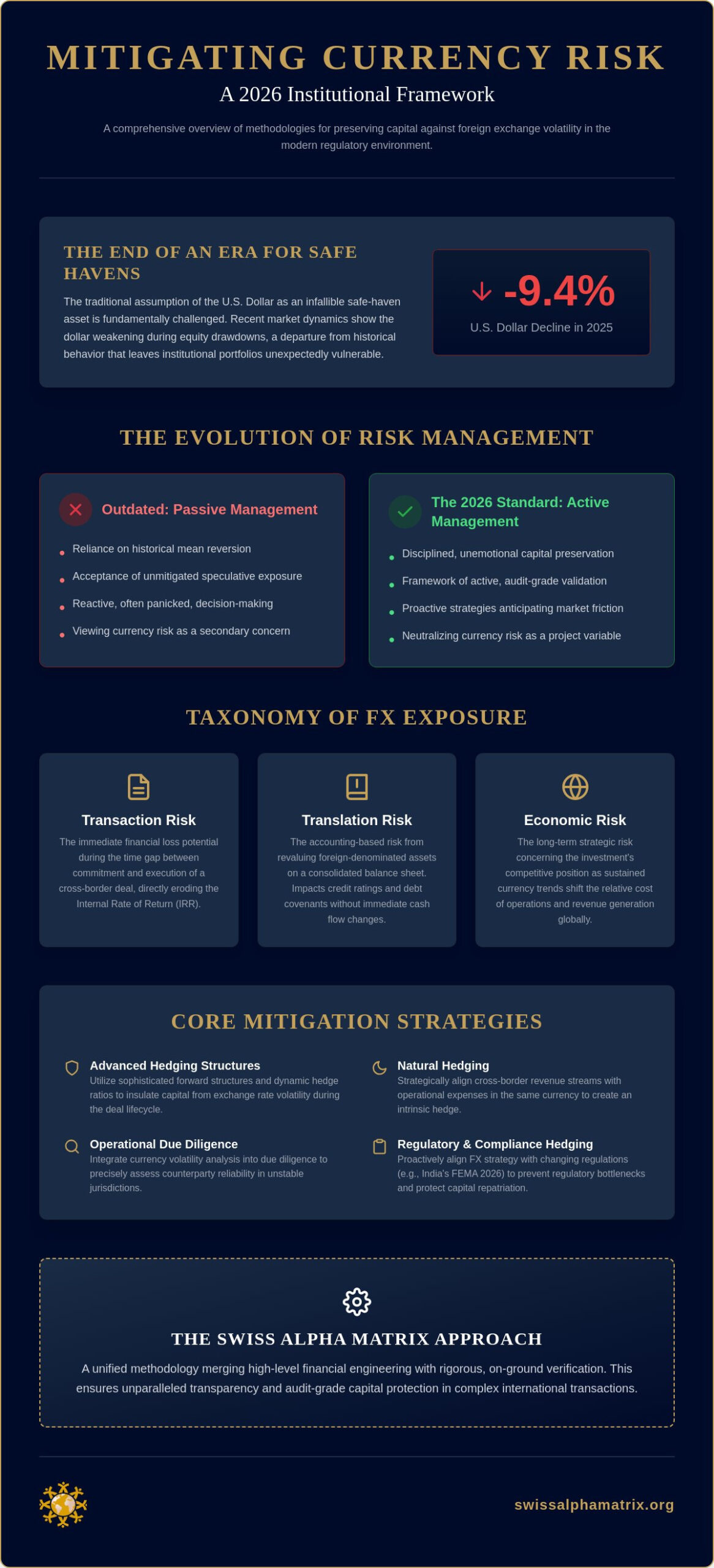
The traditional assumption that the U.S. dollar serves as an infallible safe-haven asset has been fundamentally challenged; in recent periods of equity drawdowns, the dollar has weakened simultaneously, a departure from its historical behavior that has left many institutional portfolios unexpectedly vulnerable. You likely recognize that the pursuit of international yield is increasingly fraught with the peril of capital erosion, where unforeseen macroeconomic shifts and the inherent complexity of multi-currency project management can dismantle even the most robust investment thesis. This article provides a comprehensive overview of the methodologies required for mitigating currency risk in foreign investments within the 2026 regulatory environment, specifically focusing on how sophisticated investors employ audit-grade due diligence and strategic hedging to preserve capital against foreign exchange volatility. We will examine the shift toward transparent, centrally cleared instruments and the implementation of dynamic hedge ratios, ensuring that your cross-border transactions remain anchored in a framework of intellectual depth and technical precision.
Key Takeaways
- Understand why the 2026 institutional landscape necessitates a departure from passive currency management toward a framework of active, audit-grade validation.
- Distinguish between transaction and translation risks to ensure that capital deployment remains insulated from the erosive effects of unfavorable exchange rate movements during the deal lifecycle.
- Master the nuances of mitigating currency risk in foreign investments by utilizing advanced forward structures and natural hedging strategies that align cross-border revenue with operational expenses.
- Evaluate how integrating currency volatility into operational due diligence allows for a more precise assessment of counterparty reliability in unstable jurisdictions.
- Leverage the Swiss Alpha Matrix methodology to merge high-level financial engineering with rigorous on-ground verification for unparalleled transparency in complex transactions.
The Institutional Landscape of Currency Risk in 2026
Institutional capital deployment in the current fiscal year demands a sophisticated departure from the simplistic hedging models of the previous decade. Within the context of long term mandates, foreign exchange risk has transitioned from a secondary treasury concern to a primary determinant of net internal rate of return. The evolution of market dynamics throughout 2026 has demonstrated that traditional safe havens are no longer beyond reproach; for instance, the U.S. dollar’s 9.4% decline in 2025, followed by continued softening in early 2026, has forced a re-evaluation of what constitutes a stable reserve. To maintain the integrity of a portfolio, it’s essential to distinguish between market volatility, which is an inherent condition of global trade, and currency risk, which is a manageable project variable that can be neutralized through meticulous engineering. This realization has sparked a psychological shift within the C-Suite, moving away from the acceptance of speculative exposure toward a culture of disciplined, unemotional capital preservation.
Why Passive Management is No Longer Viable
The assumption that major currency pairs like the USD, EUR, or CHF will revert to a historical mean has proven costly for those relying on passive oversight. Geopolitical shifts and the second year of the current U.S. administration have introduced layers of policy uncertainty that directly impact liquidity and valuation. Relying on “unemotional expertise” is the only way to replace the reactive, often panicked decision-making that characterizes less disciplined firms. By adhering to the most recent international financial regulations, institutional investors can ensure their strategies for mitigating currency risk in foreign investments are grounded in current legality rather than outdated market assumptions. This proactive stance allows for the anticipation of friction in major pairs before it erodes project margins.
The Interplay Between Regulatory Compliance and FX Strategy
Effective risk mitigation in 2026 is inseparable from a deep understanding of regional regulatory nuances, such as India’s Foreign Exchange Management Regulations coming into effect on October 1, 2026. These shifts in capital controls and reporting requirements can significantly alter the liquidity profile of a cross-border transaction. It is no longer sufficient to hedge for value; one must also hedge for compliance. Implementing a robust risk management framework ensures that all mitigation efforts meet audit-grade reporting standards, providing the transparency required by institutional stakeholders. By aligning FX strategy with these rigorous standards, investors protect themselves not just from market fluctuations, but from the regulatory bottlenecks that often impede the repatriation of capital in complex jurisdictions.
Taxonomy of FX Exposure in Complex Cross-Border Deals
The anatomy of foreign exchange exposure within institutional mandates is multi-faceted, requiring a granular understanding of how various risk vectors intersect during the lifecycle of a transaction. While many market participants view currency fluctuation as a singular phenomenon, a refined approach to mitigating currency risk in foreign investments necessitates the categorization of exposure into distinct, manageable pillars. Transaction risk remains the most immediate concern, representing the quantifiable delta between commitment and execution. Translation risk, conversely, involves the accounting impact of revaluing foreign-denominated assets on a consolidated balance sheet, a factor that often influences credit ratings and debt covenants without impacting immediate cash flows. Beyond these lies economic or strategic risk, which concerns the long-term competitive position of the investment as currency trends shift the relative cost of operations and revenue generation.
Transaction Risk in High-Value Mandates
In the context of high-value mandates, the temporal gap between deal signing and final capital deployment introduces a vulnerability that can significantly erode the internal rate of return (IRR). For instance, in a complex infrastructure project where capital is deployed in tranches, a mere 2% unfavorable shift in the exchange rate between commitment and settlement can effectively invalidate the project’s initial feasibility study. Such erosion isn’t merely a rounding error; it’s a fundamental degradation of capital efficiency. Protecting against these deltas requires more than standard treasury functions; it necessitates audit-grade instrument validation to ensure that every hedging vehicle is structurally sound and aligned with the project’s specific liquidity requirements.
Economic Risk and Regional Precision
Economic risk represents a profound long-term threat, as it concerns the competitive position of an investment relative to persistent currency trends. Assessing these risks requires a departure from traditional digital data feeds, which often lag behind the nuanced reality of local market stability. Genuine insight is found through cross-border investment due diligence that incorporates on-ground verification to detect regional macroeconomic shifts before they manifest in official statistics. This level of precision is critical when evaluating strategies such as The Carry Trade: Risks and Drawdowns, where the allure of interest rate differentials can be swiftly negated by a sudden liquidity crisis or counterparty default in an opaque jurisdiction. Relying solely on remote analysis leaves an investor blind to the “hidden” risks of regional contagion and settlement failure, which are the hallmarks of currency crises in developing economies. It’s this commitment to regional precision that distinguishes a performance-oriented mindset from passive participation in volatile global markets.
Strategic Mitigation Beyond Tactical Hedging
In the current macroeconomic climate, relying on tactical spot transactions is insufficient for the preservation of institutional capital. While some advisory bodies suggest a “USD-only” approach to mitigating foreign exchange risk, this strategy often proves impractical for global mandates where local currency participation is a prerequisite for competitive bidding. A sophisticated framework for mitigating currency risk in foreign investments moves beyond simple conversion, utilizing multi-layered structures that address the underlying financial architecture of the deal. This involves a cold assessment of the cost-of-carry against the cost-of-risk. With the 30-day average SOFR at 3.63379% as of July 2026, the interest rate differential between jurisdictions remains a primary driver of hedging costs, necessitating a shift toward more permanent, structural solutions like currency swaps for long-term debt servicing.
Forward Contracts vs. Currency Options
The choice between forward contracts and currency options is a choice between absolute certainty and strategic flexibility. Forward contracts are the workhorse of institutional hedging, allowing an investor to lock in a specific rate for a future date, thereby neutralizing the volatility of known cash flows. Options, however, provide an asymmetric risk profile; they protect against downside erosion while allowing the portfolio to capture gains if the currency moves favorably. This protection comes at the cost of an upfront premium, which must be weighed against the potential for volatility during the project lifecycle.
| Instrument Feature | Forward Contracts | Currency Options |
|---|---|---|
| Rate Certainty | Absolute; the rate is fixed at inception. | Conditional; provides a floor or ceiling. |
| Upfront Capital | Typically zero; costs are embedded in the rate. | Premium required at the time of purchase. |
| Strategic Flexibility | Low; creates a binding obligation to settle. | High; provides the right, but not the obligation, to execute. |
Structural Hedging and Natural Offsets
Natural hedging represents the pinnacle of strategic risk management, where an institution aligns its revenue streams with its operational expenses in the same local currency. By securing project-level debt in the target jurisdiction’s currency, the investor creates a structural offset; as the currency devalues, the real value of the debt decreases alongside the value of the assets. Implementing these multi-currency clauses and local financing arrangements requires the steady hand of independent financial project management. Such oversight ensures that these complex offsets are not merely theoretical but are operationally integrated into the project’s cash flow management system, providing a level of protection that tactical market trades cannot replicate.
Integrating FX Risk into Operational Due Diligence
The integration of foreign exchange considerations into the primary due diligence phase represents a fundamental shift from passive oversight to proactive capital protection, moving beyond the mere examination of historical financial statements. When mitigating currency risk in foreign investments, the modern institutional framework demands a rigorous assessment of a counterparty’s operational resilience against localized currency shocks, particularly in jurisdictions where liquidity can evaporate without warning. It’s no longer sufficient to rely on digital data feeds that often fail to capture the nuances of local market stress; instead, seasoned experts must conduct physical on-ground verification to validate the economic substance of foreign entities. This process ensures that the counterparty possesses the tangible assets and operational capacity to fulfill their obligations, even when their domestic currency experiences significant devaluation, thereby protecting the investor from the sudden insolvency that often follows a currency crisis. To maintain this oversight, we utilize a Deliverable Review Matrix, which serves as a structured mechanism for monitoring currency-sensitive milestones, ensuring that every phase of capital deployment is matched against the current reality of the foreign exchange market.
The Audit-Grade Approach to FX Assessment
Transitioning from standard bank reports to independent, executive-level intelligence is a hallmark of a sophisticated investment strategy. This audit-grade approach involves verifying the structural validity of the underlying bank instruments that are frequently utilized for hedging purposes in complex transactions. By ensuring that these strategies are meticulously documented and aligned with bank instrument validation services, investors can satisfy both internal audit requirements and the stringent expectations of external regulators. Our firm provides the Operational Due Diligence necessary to confirm that every financial vehicle involved in the mandate is not only legitimate but also optimized for the specific risk profile of the project, providing a level of security that traditional treasury functions cannot match.
Stakeholder Management in Multi-Currency Projects
Managing the expectations of the Board and the C-Suite requires a transparent yet dignified communication strategy that clearly articulates the costs and benefits of currency mitigation. We establish clear RACI matrices to define accountability for FX decision-making throughout the project lifecycle, ensuring that no strategic shift occurs without the proper level of executive oversight. This structured approach maintains the traditional discretion associated with high-end wealth management while providing the absolute transparency required for logical, unemotional decision-making. By leading stakeholders through a measured argument for the chosen methodology, we foster a sense of professional calm that is essential when navigating the inherent complexities of multi-currency capital deployment. This steady, logical flow of information encourages confidence in the decision-making process, ensuring that long-term preservation remains the primary objective.
The Swiss Alpha Matrix Approach to Capital Protection
The efficacy of a risk management strategy is fundamentally determined by the caliber of the experts who architect it. At Swiss Alpha Matrix, our methodology is defined by the institutional discipline of former Tier-1 bank executives who recognize that generic hedging tools consistently fail the unique demands of complex, high-value investments. We don’t view currency management as a secondary treasury function but as a primary pillar of project integrity. Our approach involves a sophisticated synthesis of advanced financial engineering and rigorous on-ground verification, ensuring total risk transparency across the entire lifecycle of a mandate. By moving beyond the sterile environment of digital data feeds, we provide a layer of protection that accounts for the physical and operational realities of foreign jurisdictions, securing your cross-border interests through meticulous instrument validation and unwavering regulatory oversight.
When mitigating currency risk in foreign investments, the distinction between a passive participant and a performance-oriented investor lies in the depth of their due diligence. We operate as a master planner, meticulously validating the economic substance of every counterparty and the structural integrity of every financial vehicle. This level of scrutiny is essential in a 2026 environment where capital controls and shifts in traditional safe-haven statuses can rapidly erode portfolio value. Our firm prioritizes long term preservation over short term speculation, positioning ourselves as a dedicated partner for those who value privacy, exclusivity, and a standard of service that is both broad in reach and meticulous in its attention to detail.
Precision in Capital Deployment
The value of independent advisory becomes most apparent when navigating the intricate nuances of the current global financial environment. We provide the intellectual depth required for high-stakes transactional decisions, ensuring that every strategic move is backed by logical, unemotional analysis. Swiss Alpha Matrix delivers the audit-grade validation necessary to ensure that currency volatility remains a calculated variable rather than a catastrophic risk. This precision allows institutional entities to deploy capital with confidence, knowing that their interests are protected by a framework of regional excellence and technical accuracy.
Engaging Senior-Level Expertise
Choosing to work with a boutique firm offers the advantage of direct access to senior-level expertise, a level of service characterized by prestige and a commitment to permanence. We invite you to initiate a project-based advisory mandate for your next cross-border deal to experience the difference that institutional discipline can make in capital preservation. Our partners are prepared to lead you through a structured argument for our methodology, creating a sense of professional calm that encourages confidence in every decision. Consult with our senior partners on your capital protection strategy to ensure your international investments are anchored in stability and strategic growth.
Securing Institutional Longevity through Rigorous Risk Architecture
The 2026 financial landscape requires a transition from the simplistic acceptance of market volatility toward a sophisticated, structural approach to capital preservation. By prioritizing audit-grade instrument validation and moving beyond the limitations of digital data through on-ground verification, institutional investors can transform currency exposure from an unpredictable threat into a manageable variable. The methodologies discussed, from natural hedging to the implementation of complex forward structures, serve as the technical foundation for mitigating currency risk in foreign investments within high-stakes environments. It’s the synthesis of financial engineering and regional precision that ensures a portfolio’s resilience against the erosive effects of macroeconomic shifts. Swiss Alpha Matrix provides a dedicated partnership for those who demand the intellectual depth and traditional discretion of a boutique advisory firm. Led by former Tier-1 global bank executives, our firm specializes in audit-grade instrument validation and provides global reach with Swiss discretion to ensure your interests are protected by seasoned experts. Secure your cross-border investment with Swiss-grade precision. We look forward to establishing a framework of stability that allows your long term mandates to flourish in an increasingly complex global economy.
Frequently Asked Questions
What is the most effective way for institutional investors to mitigate currency risk?
The most effective method involves a multi-layered approach that combines audit-grade instrument validation with structural offsets like natural hedging. By moving beyond tactical market trades, investors ensure that currency management is integrated into the project’s financial architecture rather than treated as a secondary treasury concern. This holistic strategy prioritizes long-term capital preservation over short-term speculation, ensuring that every hedging vehicle is structurally sound and aligned with the mandate’s liquidity requirements.
How does economic risk differ from transaction risk in long-term foreign investments?
Transaction risk concerns the quantifiable delta in exchange rates between the commitment and execution of a specific deal, whereas economic risk addresses how persistent currency trends affect the competitive position and future cash flows of an investment. While transaction risk is often managed through forwards or options, economic risk requires deeper strategic alignment. This might include localizing debt or adjusting pricing structures to reflect the target jurisdiction’s macroeconomic health and competitive landscape.
Is it always necessary to hedge 100% of foreign currency exposure?
It isn’t always necessary or even advisable to hedge 100% of exposure; instead, sophisticated investors utilize dynamic hedge ratios that respond to valuation, carry, and specific risk budgets. A “one-size-fits-all” approach often ignores the cost-of-carry, which can be significant in high-interest environments. A more nuanced methodology involves identifying the core capital that requires absolute protection while allowing for calculated, monitored exposure in non-critical tranches of the project.
How do 2026 international financial regulations affect cross-border currency hedging?
The 2026 regulatory environment, including India’s Foreign Exchange Management Regulations effective October 1, 2026, places a higher premium on transparency and audit-grade reporting standards. These mandates require that strategies for mitigating currency risk in foreign investments are meticulously documented and aligned with regional compliance frameworks. Failure to adhere to these evolving standards can lead to liquidity bottlenecks and significant complications during the eventual repatriation of capital from foreign jurisdictions.
What role does on-ground verification play in assessing currency stability?
On-ground verification provides the essential economic substance that digital data feeds often fail to capture during periods of regional instability. By physically validating the operational resilience of foreign entities and local market conditions, investors gain a more accurate assessment of counterparty reliability. This localized precision is critical for detecting early signs of currency contagion or settlement failure that aren’t yet reflected in official macroeconomic statistics or traditional bank reports.
Can natural hedging replace the need for financial instruments like forwards or options?
Natural hedging, which involves aligning local revenue with local expenses, can significantly reduce exposure but rarely eliminates the need for financial instruments in complex mandates. While it provides a structural offset, it doesn’t account for the temporal gaps or liquidity constraints that characterize high-value cross-border transactions. Most institutional frameworks utilize natural offsets as a primary layer of protection, which is then supplemented by forwards or swaps to ensure absolute certainty.
Why should an independent advisory firm oversee FX risk instead of a traditional bank?
An independent advisory firm provides an unbiased, executive-level perspective that prioritizes the investor’s long-term interests over a bank’s transactional volume. Unlike traditional institutions that may favor their own proprietary hedging products, independent experts offer bespoke project oversight and audit-grade instrument validation. This boutique approach ensures that the risk management framework is hyper-personalized to the project’s specific requirements rather than being limited by a bank’s standard product suite.
How does currency risk impact the due diligence process for international M&A?
Currency risk transforms the due diligence process from a static review of historical balance sheets into a dynamic assessment of operational resilience against foreign exchange volatility. It requires a deep dive into the counterparty’s ability to fulfill obligations in a devalued currency environment and the structural validity of their existing hedges. Integrating FX analysis into the initial due diligence phase allows for a more precise calculation of the project’s feasibility and long-term internal rate of return.