

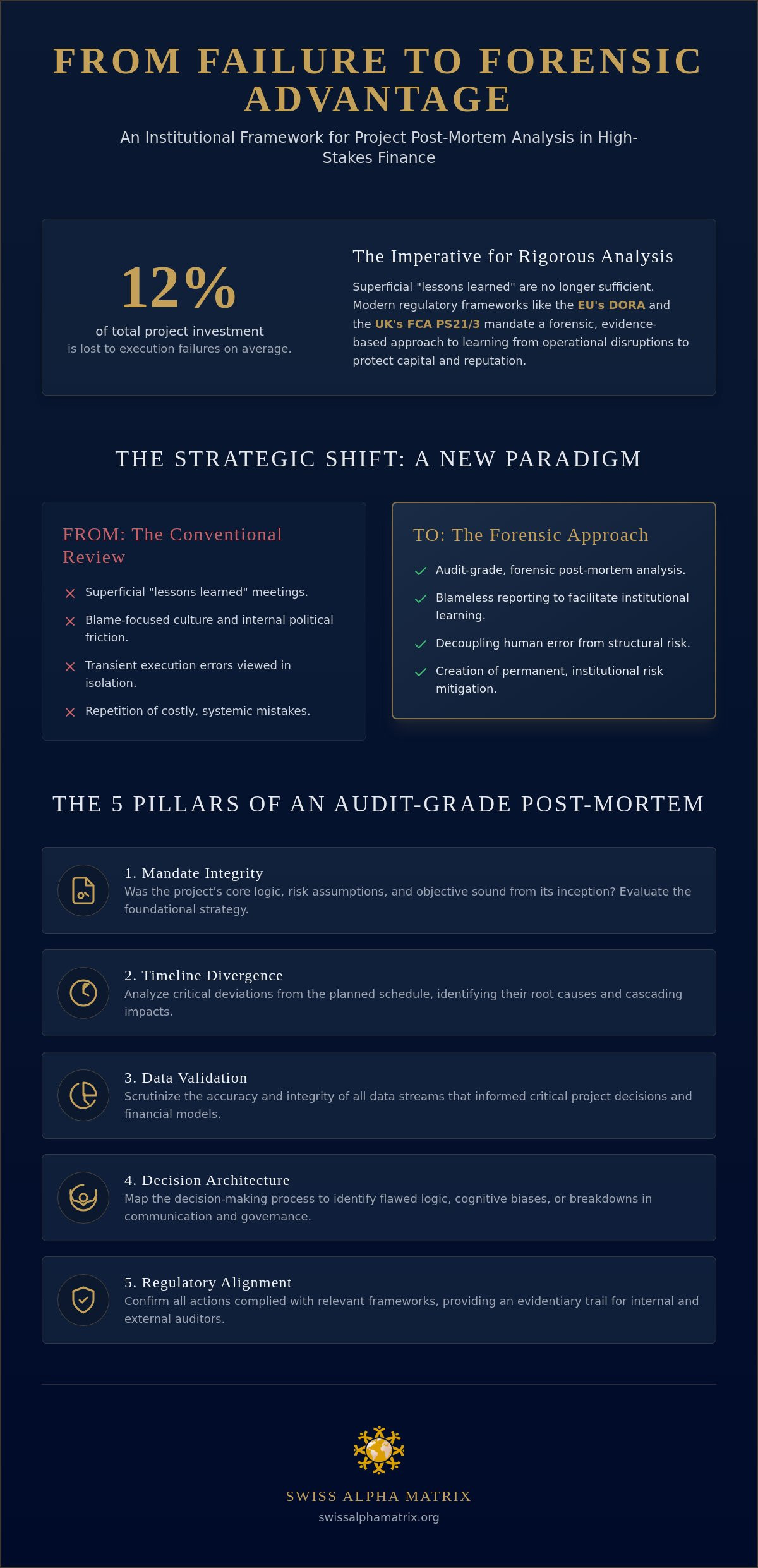
When one considers that the average financial services entity loses approximately 12% of its total project investment to execution failures, the necessity of a rigorous, forensic approach to retrospective analysis becomes an undeniable institutional imperative. You likely understand that in the current regulatory environment, where the EU Digital Operational Resilience Act (DORA) and the UK’s FCA PS21/3 framework mandate evidence-based learning from operational disruptions, a simple “lessons learned” meeting is insufficient to protect your firm’s reputation or capital. It’s often the case that internal political friction and a lack of structured memory lead to the repetition of costly errors; however, these vulnerabilities can be systematically neutralized through a more disciplined methodology.
By utilizing a comprehensive project failure post-mortem template designed for high-stakes environments, you’ll master the art of the forensic audit to transform complex project failures into institutional-grade risk mitigation strategies. This article provides a repeatable, audit-grade framework for failure analysis, offering a structured path toward improved stakeholder confidence and the implementation of actionable risk mitigation for all future mandates.
Key Takeaways
- Reframe project failures as strategic institutional assets by shifting from superficial reviews toward a forensic evaluation of decision-making logic.
- Deploy an audit-grade project failure post-mortem template that satisfies the rigorous documentation requirements of modern regulatory frameworks like DORA.
- Distinguish between transient execution errors and deep-seated strategic miscalculations through the application of forensic root cause analysis techniques.
- Cultivate a blameless reporting environment that facilitates the seamless conversion of retrospective findings into permanent, institutional-grade risk management frameworks.
- Recognize how independent project oversight and third-party validation serve to eliminate the internal biases that frequently lead to recurrent project failure.
Beyond the Autopsy: The Strategic Value of Post-Mortem Analysis in Finance
The traditional view of a post-mortem often conjures images of a clinical autopsy, a reactive examination performed only after a project has reached its definitive end. In the context of high-stakes finance, this definition is insufficient. An institutional post-mortem is a forensic review of both project logic and execution, designed to dissect the decision-making architecture that led to a specific outcome. While a software developer might conduct a post-mortem to identify a specific line of code responsible for a system crash, a financial professional must look deeper. You aren’t merely looking for technical glitches; you’re evaluating the validity of the risk assumptions and the integrity of the due diligence process that preceded the capital allocation.
Capital preservation in volatile markets requires an unwavering commitment to understanding assumption-based failures. Utilizing a rigorous project failure post-mortem template allows your firm to move beyond the superficial symptoms of a failed mandate to address the underlying structural vulnerabilities. This level of scrutiny is particularly vital in cross-border deals where cultural nuances and local regulatory shifts can quietly undermine even the most robust financial models. Standardized post-mortem documentation provides the necessary evidentiary trail to prevent the erosion of institutional memory, ensuring that the hard-won lessons from one transaction become the competitive advantage for the next.
The High Cost of Ignored Failures
Unaddressed operational gaps in global transactions don’t simply vanish; they compound. When a firm fails to analyze why a specific trade or infrastructure project missed its performance benchmarks, it effectively invites that risk to reappear in future mandates. This neglect erodes stakeholder trust and complicates future capital raising efforts, as institutional investors increasingly demand proof of operational resilience. Sophisticated bank instrument validation services often serve as the first line of defense, identifying discrepancies in collateral or counterparty standing before they manifest as systemic project failures. Without a structured project failure post-mortem template, these early warning signs are often dismissed as anomalies rather than recognized as critical data points for risk mitigation.
Post-Mortem vs. Project Audit
It’s vital to distinguish between a compliance-driven audit and a performance-driven post-mortem. An audit typically confirms whether specific rules were followed, focusing on historical accuracy and regulatory adherence. In contrast, a post-mortem is a forward-looking exercise that evaluates the efficacy of the strategy itself. It requires an unemotional expert perspective, often provided by third-party specialists who aren’t tethered to the internal politics of the deal team. Senior leadership plays a pivotal role here, as they must authorize these reviews with the explicit understanding that the goal isn’t to assign blame, but to refine the firm’s strategic pillars. This dignified approach ensures that the analysis remains logical, measured, and focused on long-term preservation.
The Institutional Post-Mortem Template: A Structural Framework for 2026
While many organizations rely on generic retrospective models, the unique complexities of high-stakes finance demand a more rigorous, audit-grade approach. A sophisticated project failure post-mortem template must transcend simple incident summaries to address the intricate interplay of market dynamics, counterparty reliability, and internal decision logic. To maintain the standard of excellence expected in private wealth management and institutional mandates, the framework should be built upon five core pillars: Mandate Integrity, Timeline Divergence, Data Validation, Decision Architecture, and Regulatory Alignment. This structure ensures that every analysis survives the scrutiny of both internal risk committees and external regulators.
Capturing “Decision Logic” at each project milestone is perhaps the most critical component of this framework. It isn’t enough to document what occurred; one must reconstruct the qualitative and quantitative rationale that existed at the moment of commitment. As highlighted in A Better Approach to After-Action Reviews, moving beyond organizational myths requires a disciplined look at the gap between intent and outcome. By integrating regulatory compliance checkpoints directly into the template, firms can ensure that the review process itself serves as evidence of robust Risk Management Frameworks, satisfying the increasingly stringent demands of global oversight bodies.
Section 1: The Mandate and Objective Review
This initial phase focuses on documenting the original project scope and the specific financial outcomes intended at the outset. It requires a clinical analysis of the delta between planned milestones and actual deliverables, identifying where the fundamental thesis of the project may have been flawed. Central to this review is an evaluation of the financial advisory methodologies employed during the planning phase. If the initial methodology failed to account for specific tail risks or liquidity constraints, the post-mortem must articulate these omissions with absolute precision.
Section 2: The Timeline of Divergence
Identifying the exact moment when project reality deviated from the pro-forma is essential for accurate forensic analysis. In this section of the project failure post-mortem template, triggers are categorized into market volatility, counterparty failure, or sudden regulatory shifts. Mapping the internal response time to these external triggers reveals much about a firm’s operational agility. A delayed response often indicates a failure in internal reporting lines or an over-reliance on lagging indicators, both of which represent significant institutional risks.
Section 3: Data and Instrument Validation Gaps
Failures in high-stakes finance are frequently rooted in inadequate information. This section assesses whether the cross-border investment due diligence was sufficiently robust to identify counterparty red flags. It evaluates the quality of physical on-ground verification and identifies any failures in instrument authentication or direct bank communication. By pinpointing these gaps, the institution can refine its requirements for future mandates, ensuring that capital is never deployed based on unverified or superficial data points.
Forensic Root Cause Analysis: Decoupling Human Error from Structural Risk
To achieve a truly institutional-grade resolution, one must move beyond the superficial assignment of blame to conduct a forensic root cause analysis. The application of the “Five Whys” technique within a high-stakes financial transaction serves as a primary tool for peeling back layers of operational complexity. If a settlement fails, the immediate catalyst might be a liquidity shortfall at the counterparty level. However, a disciplined inquiry asks why that shortfall wasn’t predicted, eventually revealing a lack of on-ground verification or a failure in the initial due diligence architecture. Integrating these findings into your project failure post-mortem template ensures that structural vulnerabilities are addressed before they can compromise future capital.
It’s essential to distinguish between “Execution Error” and “Strategic Miscalculation.” Execution errors involve the incorrect implementation of a sound plan, such as a missed filing deadline or a technical data entry mistake. Conversely, a strategic miscalculation occurs when the fundamental project logic is flawed, perhaps due to an over-reliance on historical volatility metrics that no longer reflect current market realities. This distinction is particularly relevant when considering how international financial regulations may have evolved during the project lifecycle. Regulatory shifts, such as the full application of the EU’s DORA in early 2025, can transform a compliant strategy into a non-compliant liability mid-mandate, requiring a post-mortem that accounts for legislative fluidity.
Addressing the “Objection of Complexity” is a requirement for any analysis intended for the C-Suite. While the underlying data may be dense, the final reporting must offer a logical synthesis that prioritizes actionable risk mitigation over technical minutiae. This ensures that executive leadership can authorize strategic pivots with confidence, knowing the analysis is rooted in logical precision rather than reactive speculation.
Evaluating Counterparty and Jurisdictional Risk
Determining whether a failure was inherent to a counterparty’s operational capacity requires a clinical review of their performance history and internal controls. In many cross-border mandates, jurisdictional hurdles that weren’t properly scoped in the pre-deal phase emerge as insurmountable barriers to execution. Jurisdictional risk is defined as the potential for capital loss or operational paralysis arising from the legal, regulatory, or political instability of the specific territory in which a transaction is executed.
Assessing the Project Management Office (PMO) Performance
A rigorous review of the independent financial project management structure reveals whether the PMO functioned as a strategic partner or merely a passive observer. This assessment evaluates the flow of intelligence from ground-level operators to the executive board, identifying where bottlenecks in the decision-approval hierarchy may have delayed critical interventions. When intelligence is siloed, the window for effective risk mitigation closes, turning manageable deviations into terminal project failures.
Implementing Post-Mortem Findings: From Retrospective to Risk Mitigation
The true value of a forensic inquiry lies not in the documentation of past errors, but in the systematic conversion of those insights into institutional-grade resilience. When utilizing a project failure post-mortem template, the primary objective is to bridge the gap between retrospective awareness and proactive risk mitigation. This transition requires a “Blameless Culture,” a prerequisite often overlooked in high-stakes corporate environments where individual accountability can inadvertently suppress the honest reporting of systemic flaws. In a sophisticated financial setting, the pursuit of truth must supersede the assignment of fault, as the ultimate goal is the preservation of capital and the refinement of the firm’s strategic architecture.
To ensure these findings don’t remain static, a dedicated “Post-Mortem Review Board” should be established to oversee the implementation of corrective actions. This body acts as a guardian of institutional memory, ensuring that “Lessons Learned” are rigorously translated into “Standard Operating Procedures.” When communicating these findings to external stakeholders or regulators, transparency serves as a powerful indicator of robust governance. Providing evidence that a failure has been analyzed through a structured project failure post-mortem template demonstrates a level of professional competence that can actually enhance stakeholder confidence despite the initial setback.
Updating the Risk Management Framework
Post-mortem data must be fed back into the firm’s transactional risk models to ensure that the parameters of future mandates reflect current operational realities. This involves adjusting due diligence intensity based on the failure’s root causes, whether they were found in counterparty standing or jurisdictional instability. Ensuring the “Audit-Grade” nature of these new protocols is essential for maintaining regulatory alignment, particularly when undergoing Operational Due Diligence to validate the integrity of internal controls.
The Executive Debrief: Precision and Discretion
Crafting the executive summary requires a focus on capital impact and specific corrective action, delivered with the precision expected by senior leadership. It’s vital to maintain Swiss-style discretion when discussing internal operational failures, ensuring that the analysis remains a private tool for institutional growth rather than a source of external exposure. Using these results to justify future investments in independent oversight reinforces the firm’s commitment to long-term stability and strategic precision, positioning the post-mortem not as a sign of weakness, but as a pillar of sophisticated master planning.
The Role of Independent Oversight in Preventing Recurrent Project Failure
While the implementation of a rigorous project failure post-mortem template serves as a vital retrospective tool, the ultimate institutional objective remains the preemptive identification of risk before it manifests as capital loss. Independent project management functions as the definitive preventative measure, providing a layer of scrutiny that internal teams, often constrained by organizational politics or operational silos, may struggle to maintain. By engaging third-party validation, a firm effectively removes the internal biases that frequently obscure emerging red flags, ensuring that every project milestone is evaluated through a lens of absolute objectivity and logic. This professional distance isn’t merely a preference; it’s a strategic necessity for those who prioritize long-term preservation over reactive crisis management.
The value of integrating “Former Tier-1 Bank Executive” expertise into this oversight process cannot be overstated. Such individuals possess a seasoned understanding of complex instrument validation and the subtle nuances of cross-border regulatory compliance, allowing them to anticipate structural failures that less experienced observers might overlook. Swiss Alpha Matrix bridges the critical gap between execution and oversight, transforming the insights gained from a project failure post-mortem template into a living framework for continuous risk mitigation. This approach ensures that interests are in the hands of seasoned, unemotional experts who view failure not as an inevitability, but as a data point to be systematically neutralized.
Why Internal Teams Often Miss Red Flags
Internal teams frequently succumb to the “Sunk Cost Fallacy,” a psychological trap where the desire to justify previous investments leads to the continued funding of fundamentally flawed programs. Professional distance is required to ensure an objective risk assessment, providing the master planner with the clarity needed to pivot or terminate a mandate when the data diverges from the original thesis. Central to this approach is the requirement for audit-grade instrument validation before any significant capital deployment occurs, as this serves as the foundational barrier against counterparty fraud and operational negligence. Without this external verification, the risk of recurrent failure remains unacceptably high, as internal reporting lines often filter out the very warnings that senior leadership needs most.
Securing the Next Mandate with Swiss Alpha Matrix
Our specialized due diligence and project oversight services are designed to provide the intellectual depth and technical precision required for the preservation of high-value assets. By merging traditional financial discipline with meticulous on-ground verification, we ensure that your interests are protected by a partner rooted in historical reliability and regional precision. This standard of service is both broad in reach and meticulous in its attention to detail, offering the exclusive access and historical reliability that sophisticated institutional entities demand. We don’t just analyze what went wrong; we build the frameworks that ensure it doesn’t happen again.
Engage Swiss Alpha Matrix for Independent Project Oversight
Transitioning from Retrospective Insight to Institutional Resilience
The transition from reactive retrospective to proactive institutional resilience requires a fundamental shift in how your firm perceives project deviations. By adopting a disciplined project failure post-mortem template, you ensure that every forensic inquiry serves as a catalyst for long-term capital preservation rather than a mere catalog of historical errors. We’ve established that decoupling individual performance from structural risk and mandating independent oversight are the hallmarks of a sophisticated, master-planned organization. These methodologies don’t just satisfy regulatory requirements; they build the logical foundation for future mandates.
At Swiss Alpha Matrix, our team is led by former Tier-1 global bank executives who bring a standard of regional excellence and audit-grade instrument validation expertise to every engagement. We provide the global reach and Swiss precision necessary to identify red flags before they manifest as systemic failures, positioning ourselves as your dedicated partner in strategic growth. Secure your next transaction with Swiss Alpha Matrix project management and transform your risk management into a definitive competitive advantage. Your path toward institutional-grade operational resilience is an inevitable logic when supported by seasoned experts.
Frequently Asked Questions
What is a project failure post-mortem in a financial context?
In a financial context, a post-mortem is a forensic evaluation of the decision-making logic and risk assumptions that preceded a failed capital allocation or operational mandate. It moves beyond simple event logging to analyze the integrity of the initial due diligence and the validity of the financial models employed. This disciplined inquiry serves to protect future capital by identifying exactly where the institutional strategy diverged from market reality.
How does a post-mortem differ from a standard project audit?
A standard project audit is primarily a compliance-driven exercise that verifies adherence to established rules and historical accuracy. Conversely, a post-mortem is a performance-oriented inquiry that examines the efficacy of the strategy itself. It requires an unemotional perspective to determine whether a failure was the result of a flawed thesis or an execution error, providing the master planner with actionable insights for future mandates.
Why is a “blameless” approach critical for financial post-mortems?
A blameless approach is essential to ensure that internal reporting remains honest and transparent, facilitating the identification of systemic flaws rather than individual scapegoating. In high-stakes environments, the fear of professional reprisal often leads to the suppression of critical data. By removing blame, the institution encourages a logical synthesis of facts that prioritizes long-term capital preservation over the assignment of fault.
Can a post-mortem template be used for successful projects?
Applying a post-mortem framework to successful projects is a sophisticated practice that helps determine if an outcome resulted from a sound strategy or merely favorable market conditions. This proactive analysis reinforces institutional memory by documenting the specific variables that contributed to success. It ensures that excellence is repeatable and that the firm’s strategic pillars are grounded in verified performance metrics rather than fortunate anomalies.
Who should lead the post-mortem session for a cross-border deal?
An independent advisor or a third-party specialist with seasoned experience in jurisdictional risk and international compliance should ideally lead the session. This external leadership ensures that the review remains free from internal political bias and accounts for the intricate complexities of global transactions. Their professional distance allows for a more rigorous evaluation of the counterparty standing and the quality of the on-ground verification performed.
How long after project failure should the post-mortem be conducted?
The review should ideally commence within two to four weeks after the project’s termination or the identification of a terminal failure. This timeframe is narrow enough to ensure that the decision logic and qualitative data remain fresh in the minds of the participants. It also provides a sufficient buffer for emotions to settle, allowing the team to approach the analysis with the necessary logical precision.
What are the most common root causes of failure in complex financial projects?
Root causes frequently include inadequate on-ground verification, flawed risk assumptions, and a failure to account for shifting regulatory landscapes mid-mandate. Utilizing a structured project failure post-mortem template helps isolate these structural variables from simple human error. This distinction is vital for refining the firm’s risk management framework and ensuring that future mandates are built upon a foundation of verified data points.
How do we ensure post-mortem findings actually lead to change?
Ensuring change requires the establishment of a formal review board that oversees the integration of findings into the firm’s standard operating procedures. This body acts as a guardian of institutional memory, ensuring that the outputs of the project failure post-mortem template are converted into audit-grade risk mitigation protocols. Without this structural oversight, the lessons learned often remain static documents rather than evolving into permanent strategic improvements.