

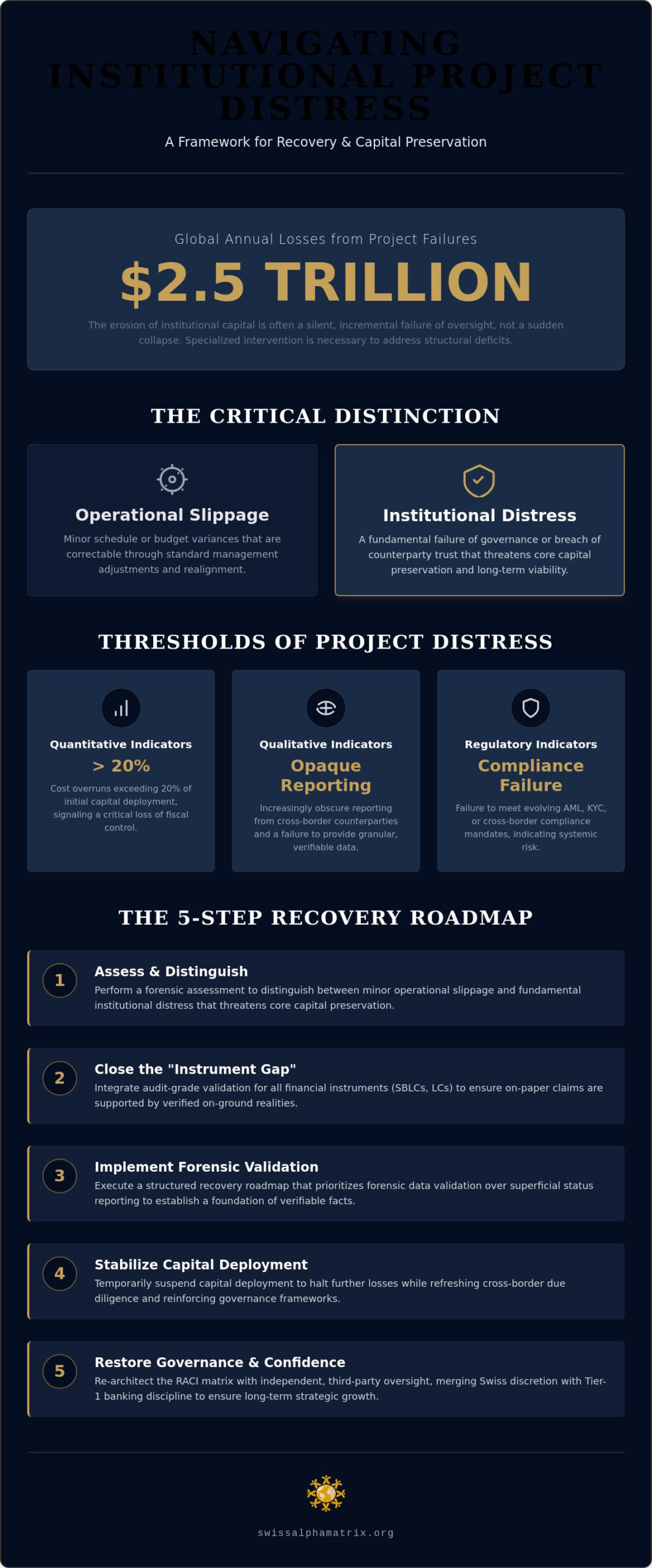
With global losses from project failures estimated at $2.5 trillion annually, the erosion of institutional capital is often not a sudden collapse but a silent, incremental failure of oversight. You’ve likely observed how opaque counterparty reporting and shifting regulatory requirements in foreign jurisdictions can quickly compromise even the most robust cross-border investments. When stakeholder confidence begins to fracture, the traditional response of simple management realignment is rarely sufficient to stem the tide of capital depletion. Engaging specialized troubled project turnaround services becomes a necessity to move beyond surface-level fixes and address the underlying structural deficits that threaten long-term viability.
It’s understandable to feel that a distressed programme has reached a point of no return, yet professional intervention can provide the clarity needed to distinguish between recoverable assets and irrecoverable loss. This article explores how elite financial project recovery and audit-grade validation can salvage complex investments while protecting your remaining capital deployment. We’ll examine the methodology for restoring institutional governance, implementing rigorous risk management frameworks, and delivering a definitive assessment of project viability that satisfies both internal boards and external regulators through technical precision and seasoned expertise.
Key Takeaways
- Distinguish between minor operational slippage and fundamental institutional distress where a deviation from the risk-reward matrix threatens core capital preservation.
- Address the “Instrument Gap” by integrating audit-grade validation for SBLCs and LCs, ensuring that on-paper claims are supported by verified on-ground realities.
- Implement a structured recovery roadmap using specialized troubled project turnaround services that prioritize forensic data validation over superficial status reporting.
- Establish immediate project stabilization through the temporary suspension of capital deployment while refreshing cross-border investment due diligence and governance frameworks.
- Restore stakeholder confidence by re-architecting the RACI matrix with independent oversight, merging Swiss discretion with Tier-1 banking discipline to ensure long-term strategic growth.
Defining the Troubled State in High-Value Financial Programmes
In the sophisticated environment of institutional finance, the distinction between a project experiencing minor operational friction and one in a state of fundamental collapse is often obscured by institutional hope. A troubled project is defined as an engagement where the deviation from the original risk-reward matrix threatens capital preservation, moving beyond simple delays into the territory of systemic failure. While “slippage” involves minor schedule variances that can be corrected through standard adjustments, “distress” signifies a profound failure of governance or a terminal breach of counterparty trust. The discipline of turnaround management necessitates an unemotional, forensic assessment of these dynamics to determine if a programme remains viable or if capital is being deployed into a vacuum.
Institutional inertia often serves as a primary catalyst for project failure, as internal stakeholders may be reluctant to acknowledge that a prestigious investment has deviated from its intended path. This hesitation frequently masks early warning signs, allowing minor issues to metastasize into significant liabilities. Under the rigorous regulatory standards of 2026, the definition of project viability has transitioned from a subjective internal metric to an audit-grade requirement. Modern compliance mandates now demand that institutions provide documented evidence of active risk management and technical validation, making the engagement of troubled project turnaround services a critical component of fiduciary responsibility.
The Thresholds of Project Distress
Identifying the exact moment a programme enters a distressed state requires monitoring both hard data and subtle shifts in counterparty behavior. Quantitative indicators typically include cost overruns that exceed 20% of the initial capital deployment, signaling a loss of fiscal control. Qualitative indicators are equally telling, often manifesting as increasingly opaque reporting from cross-border counterparties or lead managers who fail to provide granular data. Regulatory indicators, such as a failure to meet evolving AML or cross-border compliance mandates, often serve as the final precursor to institutional exposure.
The Opportunity Cost of Delayed Intervention
The “sunk cost fallacy” remains a significant barrier to effective recovery, as executive stakeholders often feel compelled to continue funding failing initiatives to justify previous expenditures. This psychological trap prevents the timely initiation of troubled project turnaround services, ultimately leading to a more severe depletion of institutional capital. Beyond the direct loss of funds, distressed projects exert a negative drag on a firm’s wider portfolio performance, consuming resources that could be allocated to high-yield opportunities. Project distress is fundamentally a failure of institutional oversight rather than just a failure of execution.
Root Cause Analysis: Why Complex Financial Projects Fail
The failure of high-value financial programmes is rarely the result of a single catastrophic event; it’s typically the culmination of incremental erosions in oversight and the gradual abandonment of institutional discipline. One of the most pervasive factors in these declines is the “Instrument Gap,” which occurs when underlying financial instruments, such as Standby Letters of Credit (SBLCs) or traditional Letters of Credit (LCs), haven’t been subjected to rigorous, audit-grade validation. In the absence of such scrutiny, these instruments represent little more than theoretical security. When these technical oversights are compounded by counterparty opacity, where cross-border deals rely on “on-paper” claims that lack on-ground verification, the risk of capital loss becomes acute. Engaging troubled project turnaround services must begin by dismantling these assumptions and replacing them with verified facts.
Regulatory drift also plays a silent role in the destabilization of complex investments. Financial structures designed for the compliance environment of previous years often find themselves non-compliant in 2026, leading to sudden freezes in capital movement or unexpected legal exposure. This misalignment is frequently coupled with governance fragmentation. In multi-jurisdictional engagements, the RACI matrix often breaks down, causing responsibilities to become blurred and accountability to vanish into the layers of cross-border administration. Without a master planner to realign these interests, the project inevitably drifts toward failure.
The Myth of Paper-Based Due Diligence
Digital documentation, while efficient for standard transactions, is fundamentally insufficient for validating high-value cross-border assets. There’s a persistent danger in relying on “Tier-1” branding as a proxy for safety without verifying the specific mandate-level execution of the deal at hand. Branding isn’t a guarantee of performance, and assuming so often leads to a failure in operational due diligence. To mitigate this, many institutions are turning to independent financial project management as a corrective lens. This approach ensures that every claim is verified through on-ground verification services rather than just accepted via encrypted email.
Structural Weaknesses in Project Governance
Governance structures often collapse because stakeholder incentives are misaligned. When lead managers are rewarded for perceived progress rather than technical accuracy, they naturally suppress negative data to maintain the optics of success. The Project Management Office (PMO) should act as an independent oversight body, yet it often becomes a tool for managing the news cycle rather than the project reality. In high-profile M&A, the pressure to maintain a positive narrative can lead to a total disconnect from operational truths. Identifying these structural flaws is essential for any successful recovery. If you find your current oversight is failing to provide clarity, it may be time to consult with an expert in risk management frameworks to restore institutional discipline and protect your remaining capital deployment.
Turnaround Methodologies: Audit-Grade Validation and Recovery
Effective recovery of a distressed financial programme necessitates a departure from traditional project management paradigms that prioritize morale or communication over technical accuracy. Troubled project turnaround services must begin with Phase I: The Forensic Deep-Dive. This stage moves beyond the superficiality of project status reports, which are often filtered through the biases of lead managers, to engage directly with raw data validation. By stripping away narrative layers, experts can identify exactly where the “operational reality” has diverged from the “executive summary” provided to the board. This process re-establishes the “Fiduciary North Star,” ensuring every subsequent activity is strictly aligned with the preservation of institutional capital.
Audit-Grade Instrument Validation as a Recovery Tool
In a distressed environment, the perceived value of a project often rests on the technical validity of its securing instruments. The integration of bank instrument validation services into the turnaround roadmap is essential for verifying Standby Letters of Credit (SBLCs) and other high-value assets that may have been accepted with insufficient scrutiny during the initial deployment phase. This forensic approach allows for the identification of “toxic” components within a project portfolio; these are components that are fundamentally unviable and must be excised to save the remaining investment. Audit-grade validation is the only objective method to restore stakeholder trust. It provides an unemotional baseline of truth that satisfies both internal boards and external regulatory bodies.
On-Ground Verification in Cross-Border Mandates
The complexities of 2026 financial markets have rendered virtual due diligence insufficient for high-stakes cross-border mandates. Physical site visits and face-to-face counterparty interviews are now non-negotiable elements of a professional turnaround strategy. Relying solely on digital documentation in emerging markets or complex jurisdictions creates blind spots that can hide significant liabilities or fundamental breaches of contract. By leveraging executive-level intelligence on the ground, troubled project turnaround services can uncover hidden risks that automated systems or remote audits consistently miss. This standard of service ensures that the standard of regional precision is maintained, providing a level of meticulous detail that distinguishes a performance-oriented recovery from a passive observation.
Implementation: Restoring Governance and Capital Protection
Transitioning from the forensic discovery phase into the active execution of a recovery plan requires a meticulous framework designed to restore institutional discipline. The successful deployment of troubled project turnaround services is predicated on the immediate cessation of high-risk activities to prevent additional capital depletion while the structural integrity of the programme is reinforced. This implementation phase isn’t merely about correcting errors; it’s about re-establishing a foundation of technical accuracy and logical oversight that can withstand the scrutiny of both internal boards and external regulators.
The restoration of capital protection follows a structured, five-step progression:
- Step 1: Immediate Stabilisation. All non-essential capital deployment is frozen until a refreshed cross-border investment due diligence is completed, ensuring that the current operational landscape is accurately reflected in the recovery roadmap.
- Step 2: Governance Re-Architecture. A new RACI matrix is implemented to eliminate fragmentation, clearly defining accountabilities and introducing independent oversight mechanisms that operate outside the influence of the original project team.
- Step 3: Milestone Re-Baselining. Optimistic projections are replaced with realistic, audit-verified targets that prioritize the preservation of remaining capital over short-term speculative gains.
- Step 4: Transparent Reporting. The project moves to a “Single Version of Truth,” where all institutional stakeholders have access to the same forensic-grade data, eliminating the information silos that allowed the initial distress to go unnoticed.
- Step 5: Final Validation. Before full operations resume, the project must undergo a rigorous assessment to ensure it meets all current international financial regulations, mitigating any legacy compliance risks.
The Role of Independent Oversight
One of the primary reasons original project teams struggle to lead a turnaround is the presence of “observer bias,” where those who designed the failing system are psychologically inclined to defend its core assumptions. High-stakes recovery mandates require a specific advisory board that provides a detached, unemotional perspective on the project’s technical viability. By implementing a deliverable review matrix, experts ensure that quality is maintained at every milestone, preventing the re-emergence of the opaque reporting practices that characterized the project’s troubled state. If your programme requires this level of technical scrutiny, it’s essential to engage with professionals who specialize in operational due diligence to ensure a successful transition.
Stakeholder Re-Alignment
Managing the professional fallout of a project turnaround is a delicate process that requires the restoration of “quiet authority” through the provision of precise, indisputable data. When stakeholders see that the programme is no longer governed by optimism but by audit-grade validation, confidence begins to return to the lead investor’s position. The transition from “troubled” to “stabilised” status is marked by specific indicators, including the successful completion of re-baselined milestones and the elimination of regulatory exposure. This steady, logical progression encourages a sense of professional calm, allowing the institution to focus on long-term strategic growth rather than immediate crisis management.
The Swiss Alpha Matrix Mandate: Institutional Recovery
Swiss Alpha Matrix approaches institutional recovery not as a generic administrative exercise, but as a technical restoration of fiduciary integrity. Our troubled project turnaround services are led exclusively by former Tier-1 global banking executives who bring decades of transactional experience to every distressed mandate. This pedigree ensures that our intervention isn’t limited to theoretical advice; it’s rooted in the lived reality of complex, high-value financial operations. By merging the traditional discretion associated with Swiss advisory with the rigorous discipline of institutional finance, we provide a stabilizing force that protects capital while satisfying the increasingly stringent demands of external regulators and internal audit committees.
The hallmark of our methodology is the delivery of audit-grade reports that provide a definitive, unvarnished assessment of project viability. We prioritize “executive-level intelligence,” ensuring that capital deployment decisions are made with the same technical precision that characterizes the world’s most successful private wealth management entities. This approach eliminates the ambiguity that often plagues distressed programmes, replacing it with a logical, structured path toward recovery or strategic exit. It’s this commitment to technical accuracy that allows us to restore the quiet authority of institutional investors in the face of counterparty failure.
Why Senior Banking Expertise Matters
There is a fundamental difference between traditional management consulting and the mandate-specific execution required in a distressed environment. While consultants often focus on broad strategic changes, our team utilizes sophisticated financial advisory methodologies to navigate the specific technical failures of a project. This expertise allows us to balance the immediate regulatory burden with the long-term transactional necessity of the investment. We understand the nuanced pressure of cross-border compliance, ensuring that every corrective action strengthens the firm’s legal and financial standing. Partnering with a team that has managed billions in transactional volume provides the reassurance that your interests are in the hands of seasoned experts.
Engaging Swiss Alpha Matrix for Project Turnaround
Engaging our firm begins with an initial assessment that is rapid, discreet, and technically exhaustive. We don’t rely on secondary reports or filtered data; instead, we move quickly toward on-ground verification to confirm the operational reality of the mandate. This transition from assessment to implementation is seamless, guided by a commitment to precision-based Swiss advisory that prioritizes the client’s privacy above all else. By positioning ourselves as a dedicated partner rather than a mere service provider, we ensure that your interests are protected by experts who value historical reliability and meticulous attention to detail. Protecting your remaining capital isn’t just our objective; it’s the standard of regional excellence we bring to every engagement.
Securing the Future of Institutional Capital Deployment
The preservation of capital in complex, cross-border environments demands more than just administrative adjustments; it requires a fundamental restoration of institutional discipline. By moving beyond the myth of paper-based due diligence and embracing audit-grade instrument validation, organizations can effectively salvage distressed programmes that once seemed irrecoverable. The integration of troubled project turnaround services provides the technical rigor necessary to satisfy both internal boards and external regulatory bodies, ensuring that every deployment decision is rooted in verified operational reality rather than optimistic projection.
Swiss Alpha Matrix remains committed to this standard of regional excellence, utilizing a team of former Tier-1 global banking executives who understand the delicate balance between transactional necessity and regulatory burden. Our global reach, combined with traditional Swiss precision and discretion, ensures that your interests are protected by seasoned experts who prioritize long-term stability over short-term speculation. We invite you to Request a Discreet Consultation for Your High-Stakes Mandate to begin the process of restoring governance and securing your institutional legacy. With the right technical oversight, the path from distress to stabilization is not only possible but inevitable.
Frequently Asked Questions
What is the primary difference between project management and troubled project turnaround services?
The primary distinction lies in the technical depth of intervention, as standard project management focuses on schedule adherence while troubled project turnaround services prioritize the forensic recovery of failing governance and the validation of compromised assets. While a traditional project manager operates within established parameters, a turnaround specialist must often dismantle and rebuild the entire risk management framework to preserve remaining capital. This process requires a shift from passive monitoring to active, audit-grade verification of every project component.
How quickly can a distressed financial project be stabilised?
Initial stabilization typically occurs within the first seventy-two hours through an immediate suspension of non-essential capital deployment to prevent further depletion. Following this immediate freeze, a comprehensive audit-grade assessment usually requires thirty to sixty days to establish a definitive baseline of truth regarding project viability. This measured pace ensures that subsequent recovery actions are based on technical accuracy and logical oversight rather than reactive, emotional urgency that could further compromise the investment.
Is on-ground verification always necessary for a project turnaround?
Physical on-ground verification is indispensable for high-value cross-border mandates where digital documentation often fails to reflect the true operational reality of the engagement. Relying solely on virtual due diligence in complex jurisdictions introduces unacceptable levels of risk, as digital records cannot confirm the physical existence of assets or the true intent of local counterparties. Face-to-face interviews and site inspections provide the executive-level intelligence required for robust capital protection in the 2026 financial landscape.
Can a project be turned around if the lead counterparty is uncooperative?
Recovery remains viable even with an uncooperative lead counterparty, provided that the underlying financing agreements include clauses for independent intervention or lender-mandated oversight. Specialized troubled project turnaround services utilize contractual leverage and regulatory compliance frameworks to bypass opaque reporting and gain direct access to raw project data. If the counterparty remains obstructive, the turnaround process provides the necessary forensic evidence to initiate a strategic exit or a formal restructuring of the mandate.
What are the most common red flags that a financial project requires turnaround services?
Common indicators include cost overruns exceeding twenty percent of the initial capital deployment and a noticeable shift toward opaque, high-level reporting that lacks granular data. Qualitative signs, such as frequent changes in key personnel or a failure to adapt to evolving 2026 regulatory updates, also signal that a project has moved from minor slippage into fundamental distress. These red flags necessitate an immediate forensic deep-dive to prevent catastrophic capital loss and restore institutional discipline.
How does Swiss Alpha Matrix ensure discretion during a high-stakes recovery mandate?
Discretion is maintained through a boutique operational model that prioritizes privacy and utilizes former Tier-1 banking executives as the sole points of contact for institutional clients. We employ secure, compartmentalized communication protocols and ensure that all on-ground verification is conducted under the guise of standard operational due diligence to avoid market speculation. This formal approach mirrors the traditional confidentiality of high-end private wealth management, protecting the reputation of all institutional stakeholders involved.
What role does instrument validation play in the turnaround of an investment programme?
Instrument validation serves as the technical foundation of the recovery roadmap by confirming the authenticity and liquidity of Standby Letters of Credit, traditional LCs, and other securing assets. In a distressed environment, verifying these instruments ensures that the project’s financial underpinnings are robust enough to support a successful turnaround effort. Without this audit-grade validation, any attempt at management realignment rests on a fragile and potentially non-existent capital base, risking further institutional exposure.
How do you handle regulatory compliance during the recovery of a cross-border deal?
We manage regulatory compliance by implementing risk management frameworks that align with both local jurisdictional requirements and international standards, such as evolving AML mandates. This dual-layered approach ensures that the recovery process doesn’t inadvertently trigger legal exposure or capital freezes in foreign markets. By maintaining a constant dialogue with regulatory experts, we ensure that the project meets all 2026 compliance thresholds before full operations resume, thereby protecting the institution from legacy liabilities.