

Research indicates that organizations aligning an enterprise-wide PMO to their strategic objectives experience 38% more projects meeting original goals, while simultaneously reducing total failures by 33%. In an era defined by the July 2026 implementation of the 8% community bank leverage ratio and the evolving requirements of ASU 2026-01, the margin for error in capital deployment has effectively vanished. You likely understand that traditional, fragmented oversight is no longer sufficient for managing the intricacies of modern cross-border mandates. Establishing a rigorous financial project governance framework is no longer a matter of administrative preference, but a requirement for institutional survival and long-term capital preservation.
This article provides a sophisticated blueprint for establishing an institutional-grade PMO, one designed to protect capital through a framework that ensures precision in the most complex environments. We’ll examine the transition from mere administrative support to a strategic risk-mitigation engine, focusing on the deployment of standardized frameworks and the creation of an audit-grade reporting structure. By the conclusion of this guide, you’ll possess the methodology required to transform disjointed data into a centralized source of truth that satisfies the most discerning stakeholders and regulatory bodies alike.
Key Takeaways
- Reframe the PMO as a strategic governance body designed to mitigate systemic risk rather than a mere administrative department focused on clerical task tracking.
- Implement a rigorous financial project governance framework that utilizes a formal PMO Charter to establish clear lines of authority and precision in complex capital environments.
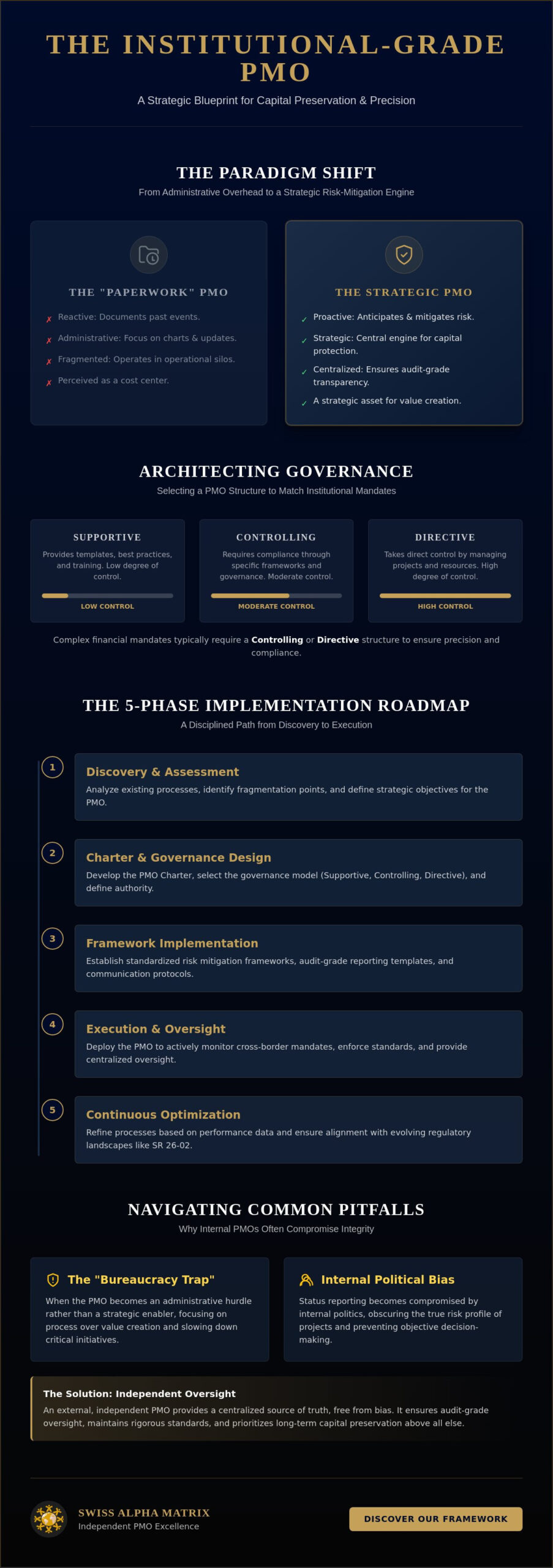
- Deploy a structured five-phase roadmap that moves from initial discovery and stakeholder alignment to the design of bespoke methodologies, whether Agile, Waterfall, or Hybrid.
- Neutralize common institutional failures, such as the bureaucracy trap and internal political bias, by prioritizing objective, audit-grade reporting and lean operational structures.
- Identify the strategic advantages of independent oversight to ensure that project visibility remains clear and that mandates are executed with the technical accuracy required by Tier-1 standards.
The Strategic Necessity of an Institutional-Grade PMO
The traditional view of a Project Management Office (PMO) as a mere clerical support center is fundamentally incompatible with the demands of modern institutional investing. In high-stakes environments, a PMO must function as a strategic governance body, specifically engineered to protect capital and preserve institutional reputation. This isn’t about tracking tasks on a spreadsheet; it’s about establishing a robust financial project governance framework that ensures every movement of capital is justified, documented, and aligned with overarching strategic mandates.
As we move through 2026, the industry is witnessing a significant shift from simple delivery-focused project management to a model centered on risk mitigation. Regulatory pressures, including the implementation of the community bank leverage ratio framework and new FASB accounting standards, have raised the stakes for every initiative. Fragmentation in cross-border investment programmes often results in a lack of visibility that invites non-compliance and inefficient deployment of resources. A centralized PMO acts as the primary safeguard against these vulnerabilities, providing the oversight necessary to manage complex mandates with absolute precision.
Moving Beyond Administrative Overhead
Generic project management often fails because it lacks the technical depth required to handle sophisticated financial instruments. A “Paperwork PMO” focuses on the optics of progress, yet a Strategic PMO focuses on the reality of risk. When dealing with complex portfolios, the requirement for audit-grade documentation begins on day one. It’s not enough to complete a project. One must prove that every step complied with internal risk management frameworks and external regulatory demands. This level of rigor transforms the PMO from a cost center into a value-preserving asset that protects the fiduciary interests of the organization.
The Role of Discretion and Precision in Governance
In the world of high-end wealth management and institutional finance, discretion isn’t a luxury; it’s a foundational requirement. Integrating Swiss-style precision into a financial project governance framework means managing sensitive information with the utmost care within a cross-border project environment. This approach mirrors Tier-1 banking standards, where technical accuracy and intellectual depth are prioritized over short-term speed. Establishing this culture of excellence ensures that all stakeholders feel their interests are in the hands of seasoned experts who prioritize long-term preservation and strategic growth over speculative gains.
Architecting the PMO: Structure, Charter, and Governance
The architecture of an institutional-grade PMO serves as the structural foundation for all subsequent investment activities. It isn’t merely a reporting line; it’s a deliberate configuration of authority designed to uphold fiduciary duties. Within the selection of PMO governance models, financial institutions must choose a structure that matches their specific risk appetite and the complexity of their portfolios. While supportive models provide templates and best practices, controlling and directive models are significantly better suited for the rigors of a financial project governance framework. These structures provide the necessary oversight to ensure that every initiative remains within the strictly defined parameters of risk and return.
Executive reporting lines are essential for maintaining visibility over high-stakes mandates. By positioning the PMO within the direct line of sight of the Chief Risk Officer or Chief Financial Officer, the organization ensures that project data isn’t diluted by middle-management filtering. This direct access allows for a more responsive approach to regulatory shifts, such as the 2026 capital leverage requirements, ensuring that the PMO functions as an extension of executive intent. Integrating regulatory compliance advisory as a core pillar within this structure ensures that every project is vetted against the latest legal and institutional standards from inception to completion.
Defining the PMO Charter for High-Stakes Mandates
A robust PMO Charter acts as the constitutional document for all project activities. It must move beyond generic objectives, instead crafting a mission statement that explicitly prioritizes capital preservation and technical precision. This clarity is vital when conducting cross-border investment due diligence, where jurisdictional nuances can complicate oversight. The charter should clearly identify which financial instruments fall under the PMO’s purview, from private equity placements to complex debt structures, ensuring no asset class remains in a governance vacuum. It’s this level of detail that establishes the quiet authority necessary to manage diverse stakeholder interests.
Establishing the Governance Framework
Effective governance requires a decision-making hierarchy that accounts for the multi-jurisdictional nature of modern finance. This financial project governance framework must integrate standardized risk management protocols into every stage of the project lifecycle. Crucially, an institutional PMO must possess the authority to halt non-compliant initiatives before they jeopardize the firm’s standing or capital reserves. This level of control is what distinguishes a high-impact governance body from a passive administrative unit. For organizations seeking to implement these standards without the overhead of an internal build, engaging an external partner for complex project management provides immediate access to seasoned expertise and proven methodologies.
The 5-Phase Roadmap to Creating a PMO from Scratch
Constructing a PMO within a sophisticated financial environment is a deliberate exercise in institutional engineering. It moves beyond the simplistic implementation of task-tracking software, requiring instead a sequence of phases that prioritize technical accuracy and capital preservation. This journey begins with an unyielding assessment of current capabilities, ensuring that the resulting financial project governance framework is tailored to the specific jurisdictional complexities of the firm’s portfolio. Each phase is designed to build upon the previous one, creating a steady, logical progression toward operational excellence.
Discovery: Identifying Institutional Pain Points
The initial phase focuses on a comprehensive gap analysis of current independent financial project management capabilities. This isn’t a superficial review; it’s an autopsy of previous project failures and systemic inefficiencies. By mapping existing stakeholders through a sophisticated RACI analysis, the organization identifies exactly where accountability currently dissipates. Defining a clear “Definition of Success” for the first 180 days ensures the PMO provides immediate, measurable value to the executive suite. This phase often references established standards, such as the Project Governance and Asset Management Manual, to align internal protocols with global institutional benchmarks.
Methodology: Precision in Execution
Phase two involves the selection of a delivery methodology that satisfies both operational speed and regulatory rigor. While Agile methodologies are popular in software development, a structured Waterfall or Hybrid approach often suits international financial regulations more effectively. The linear nature of Waterfall allows for the “hard gates” required for audit-grade validation of financial data. Standardizing a Deliverable Review Matrix ensures that no project output, from due diligence reports to capital deployment schedules, escapes rigorous scrutiny before reaching the steering committee.
Phase three transitions into the implementation of secure, institutional-grade infrastructure. Tooling must facilitate real-time visibility while maintaining the highest standards of data sovereignty and encryption. Once the infrastructure is set, phase four focuses on talent acquisition, sourcing senior-level expertise with Tier-1 banking backgrounds. These individuals possess the quiet authority required to manage complex mandates without succumbing to the pressure of short-term speculation. Finally, phase five involves the pilot execution, launching the PMO with a high-visibility, complex mandate to demonstrate the efficacy of the new financial project governance framework in a live, high-stakes environment.
Mitigating Objections: Why Internal PMOs Often Fail
Internal PMOs frequently collapse under the weight of the bureaucracy trap, where the pursuit of administrative compliance eventually overshadows the primary objective of strategic value creation. Instead of functioning as a lean, high-impact engine, the office often becomes a repository for redundant documentation that provides little actionable insight for executive decision-makers. This stagnation is particularly detrimental in complex financial environments where the speed of accurate data is paramount to protecting capital. When a PMO is viewed merely as an additional layer of red tape, it loses the quiet authority required to influence high-stakes mandates.
Political bias represents perhaps the most insidious failure mode within an internal financial project governance framework. Because internal project leaders often report to the same executives who are incentivized to close high-value deals, there exists a subtle yet persistent pressure to sugarcoat project statuses or downplay systemic risks. This lack of objectivity can lead to the obfuscation of critical red flags, ultimately compromising the firm’s fiduciary responsibilities and exposing it to regulatory non-compliance. For institutions requiring uncompromised objectivity, engaging independent complex project management ensures that oversight remains untainted by internal organizational politics.
The Conflict of Interest in Internal Reporting
The risks of self-policing in high-value investment programmes cannot be overstated. When the team responsible for delivery is also the team responsible for oversight, the boundary between due diligence and deal execution begins to blur. Internal pressure to meet quarterly targets or close complex transactions can lead to a compromise in the rigor of the financial project governance framework. An independent oversight model, conversely, provides a necessary “outside-in” perspective that prioritizes capital protection over internal career optics. This third-party objectivity is essential for identifying blind spots that internal teams, regardless of their competence, are often structurally prevented from seeing.
Sourcing the Right Expertise
A significant skill gap often exists when generalist project managers are tasked with overseeing complex financial instruments. A standard PMP certification, while valuable for general business processes, does not equate to the institutional financial wisdom required to manage transactional risk. A PMO lead in this sector must possess deep experience in transactional risk management and a comprehensive understanding of international regulatory shifts. Balancing technical project skills with deep regulatory knowledge is a requirement, not a preference. Without this specialized expertise, the PMO will struggle to provide the audit-grade validation and precision that Tier-1 banking standards demand, leading to a failure of both governance and execution.
The Swiss Alpha Matrix Approach: Independent PMO Excellence
Swiss Alpha Matrix represents the culmination of traditional Swiss discretion and modern institutional rigor, positioning itself as the premier partner for complex financial project oversight. By providing an alternative to the structural vulnerabilities inherent in internal departments, we ensure that your interests are in the hands of seasoned, unemotional experts. Our leadership consists of former Tier-1 executives who understand that a financial project governance framework must be as dynamic as the markets it monitors. This isn’t a mere outsourced administrative function; it’s a strategic partnership designed to ensure that every mandate is executed with the technical accuracy and moral character that sophisticated institutional entities expect.
Central to our methodology is the seamless integration of bank instrument validation services directly into the operational flow of the PMO. This ensures that capital is never deployed based on superficial documentation or unverified claims. By maintaining this level of scrutiny, we bridge the gap between high-level strategic planning and the granular reality of transactional risk management. It’s a promise of permanence and quality that safeguards both the asset and the institution’s standing in a cross-border environment, reflecting a standard of service that is meticulous in its attention to detail.
Our Methodology for Complex Mandates
We deploy a dual-layered oversight model that combines audit-grade validation with meticulous on-ground verification within the PMO structure. This approach ensures that the data driving your financial project governance framework is both accurate and contextually relevant to the specific jurisdiction. Leveraging institutional-grade intelligence allows for superior capital deployment decisions, particularly in environments where transparency is often obscured. Our retainer-based strategic consulting model provides the stability necessary for long-term oversight, ensuring that interests are managed by experts who prioritize preservation and strategic growth over short-term speculation.
Next Steps for Your Organisation
The transition toward an institutional-grade PMO begins with a sober assessment of your current project environment. We conduct an initial maturity assessment to identify existing gaps in oversight, visibility, and regulatory alignment. Following this analysis, we define a bespoke PMO roadmap tailored to the specific investment mandates and risk profile of your firm. Engaging with Swiss Alpha Matrix for independent, executive-level project management provides the clarity and authority required to navigate the complexities of the 2026 regulatory landscape. This structured path ensures that your methodology moves from broad philosophical principles to specific, high-performance strategic pillars with a calm, unwavering pace.
Securing Institutional Excellence in an Evolving Market
Transitioning from fragmented oversight to a centralized governance body is the defining shift for institutions navigating the regulatory landscape of 2026. We’ve examined how a robust financial project governance framework serves as the primary mechanism for capital preservation, moving beyond simple task management to provide audit-grade validation for every mandate. By implementing a structured roadmap and prioritizing independent oversight, organizations can effectively neutralize the political biases and administrative bloat that frequently compromise internal initiatives. It’s a strategic evolution that replaces speculative progress with logical, verified results.
Achieving this level of precision requires more than just standard certifications; it demands the technical depth and moral character found in seasoned practitioners. Swiss Alpha Matrix, managed by former Tier-1 global bank executives, offers decades of transactional and regulatory expertise to ensure your mandates are executed with absolute technical accuracy. Our methodology integrates audit-grade reporting and on-ground verification capabilities to protect your interests from the earliest stages of discovery. We invite you to secure your capital with independent financial project management from Swiss Alpha Matrix. Establishing a culture of excellence today ensures your interests remain protected in an increasingly complex global environment.
Frequently Asked Questions
What is a PMO in project management from an executive perspective?
In high-stakes finance, a PMO is a governance engine that ensures all project activities align with strategic risk-mitigation goals and regulatory requirements. It functions as the definitive source of truth for capital deployment, providing the board with the audit-grade data necessary to protect institutional interests. By centralizing oversight, the office moves beyond simple task tracking to focus on long-term preservation and the technical accuracy of complex mandates.
How long does it take to build a PMO from scratch?
An institutional-grade PMO can be established in distinct phases rather than the 12-month timeline often suggested by generic corporate guides. A core financial project governance framework for discovery and methodology can be deployed within 90 days. Full maturity, which includes the ability to oversee complex mandates and multi-jurisdictional portfolios, is typically achieved within 6 to 9 months, depending on specific regulatory complexities.
What are the three main types of PMO structures?
The three standard configurations are Supportive, Controlling, and Directive models. Supportive models offer templates and best practices, whereas Controlling models enforce compliance and specific methodologies. For complex financial instruments, a Directive model is usually required. This structure manages projects directly with full authority, ensuring that capital protection and strategic alignment are maintained with the highest degree of precision.
Do I need a PMO if I already have experienced project managers?
Yes, because project managers focus on the execution of individual tasks, while a PMO focuses on the strategic “what” and “why” across the entire portfolio. The office provides the objective governance and cross-project visibility that individual managers often lack in cross-border environments. It ensures that disparate initiatives don’t operate in silos, instead aligning them under a unified standard of institutional excellence.
What is the most critical document in a PMO setup?
The PMO Charter is the most vital document within the setup process. It defines the office mandate, scope of authority, and specific reporting lines to executive leadership. Without a clear, executive-signed Charter, the PMO risks becoming a toothless administrative function. A robust charter ensures the office has the quiet authority to act as a strategic risk-mitigation body rather than a clerical department.
How does a PMO help with regulatory compliance?
A PMO standardizes the documentation and validation processes across all initiatives, ensuring that every project meets necessary AML, KYC, and jurisdictional requirements. By centralizing these checks within a financial project governance framework, the organization reduces the risk of oversight. This structure ensures the entity remains audit-ready, providing a steady and logical approach to managing the dynamic regulatory landscape of 2026.