

While global M&A activity surged to $861.1 billion in the first quarter of 2026, the increasing complexity of international capital flows suggests that traditional oversight is no longer sufficient to protect institutional interests. You likely recognize that the widening chasm between Swiss, UK, and Asian regulatory standards has transformed financial due diligence for cross-border m&a from a procedural checklist into a high-stakes exercise in sovereign risk management. Relying solely on the curated environment of a virtual data room is a strategic vulnerability, especially as the June 2026 EU FDI Screening Regulation introduces more stringent mandates for sensitive sectors across the continent.
This article offers an executive-level analysis of the methodologies required to ensure capital protection and operational integrity in your most complex international transactions. We’ll provide a definitive framework for achieving absolute certainty in asset valuation through on-ground verification and audit-grade instrument validation. By moving beyond passive observation, you’ll gain the strategic tools to mitigate counterparty risk and secure the meticulous documentation necessary for board-level approval in an increasingly fragmented global market.
Key Takeaways
- Identify and resolve the profound information asymmetries inherent in multi-jurisdictional transactions, specifically regarding local accounting nuances and sovereign risk exposures.
- Establish a rigorous protocol for audit-grade instrument validation to confirm the absolute authenticity of high-value financial guarantees and standby letters of credit.
- Recognize the critical necessity of on-ground verification to validate physical asset existence and operational capacity beyond the inherent constraints of digital documentation.
- Refine your institutional framework for financial due diligence for cross-border m&a by incorporating modern mandates for cybersecurity resilience and ESG compliance.
- Leverage a boutique advisory perspective that emphasizes meticulous capital deployment and the preservation of institutional integrity throughout the entire transaction lifecycle.
Navigating Information Asymmetry in Cross-Border M&A
The fundamental challenge of any international transaction lies in the inherent imbalance of intelligence between the acquiring entity and the target. This phenomenon, often termed information asymmetry, is particularly acute when capital crosses jurisdictional boundaries where local norms diverge from Tier-1 banking standards. In the context of 2026, where global M&A activity reached $861.1 billion in the first quarter alone, the scope of financial due diligence for cross-border m&a has expanded to encompass not just the verification of historical earnings, but the forensic analysis of the structures supporting those figures. We’ve moved past the era where a cursory review of a digital data room sufficed; today’s environment demands a level of scrutiny that identifies hidden liabilities before they compromise the integrity of the deal.
Traditional due diligence often fails because it operates on a principle of “reasonable assurance” rather than absolute verification. This distinction is critical when dealing with multi-jurisdictional risks such as currency volatility and local accounting nuances. For instance, with the 30-day average SOFR sitting at 3.63279% as of late June 2026, the cost of financing is highly sensitive to timing and jurisdictional risk premiums. A comprehensive approach to financial due diligence for cross-border m&a serves as the primary mechanism for neutralizing these informational advantages, transforming a potential liability into a calculated strategic move. The mandate must shift toward a proactive investigation of the seller’s claims, specifically targeting areas where political exposure or regulatory divergence could lead to post-closing value erosion.
The Evolution of Transactional Risk
The architecture of risk has been fundamentally altered by the proliferation of digital financial structures, making asset tracing an increasingly intricate task for institutional investors. Standard procedures are often insufficient to pierce the veil of sophisticated cross-border entities that utilize layered corporate shells. Geopolitical shifts, such as the adoption of the revised EU FDI Screening Regulation on June 8, 2026, have introduced new layers of execution risk that can stall capital movement indefinitely. These changes mean that a “standard” audit is no longer a sufficient shield for your capital. It’s essential to recognize that modern transactional integrity relies on the ability to navigate these shifting regulatory sands with a level of precision that exceeds typical industry benchmarks.
Bridging the Gap Between Local and Global Standards
Reconciling the reporting practices of emerging markets with the stringent expectations of Tier-1 institutions is a cornerstone of successful capital deployment. There’s a persistent necessity for independent oversight in jurisdictions where regulatory transparency is limited and local standards are fluid. Establishing a robust baseline for cross-border investment due diligence allows for the identification of discrepancies that might otherwise remain obscured. This process ensures that every asset valuation is grounded in reality rather than optimistic local projections, providing the clarity required for board-level approval of complex international acquisitions. By prioritizing meticulous oversight, you ensure that your strategic growth isn’t undermined by unforeseen regulatory or fiscal hurdles.
The Architecture of Audit-Grade Financial Instrument Validation
The architecture of a successful transaction is only as resilient as the financial instruments that underpin its funding structure. In the high-stakes environment of 2026, where sophisticated financial fraud has become increasingly localized yet globally impactful, the necessity for specialized bank instrument validation services cannot be overstated. While many practitioners rely on the foundational concepts outlined in Harvard Law School’s 2023 cross-border M&A checklist, the modern landscape requires a technical depth that transcends general legal compliance. Effective financial due diligence for cross-border m&a must include a rigorous verification of Standby Letters of Credit (SBLC), bank guarantees, and other high-value instruments to ensure they aren’t merely sophisticated forgeries designed to facilitate illicit capital movement or mask insolvency.
Standard accounting software and traditional audit protocols frequently overlook subtle anomalies that indicate deeper structural issues. Identifying these “red flags” in financial documentation requires an expert eye for detail and an understanding of institutional issuance norms:
- Unauthorized or inconsistent signatory patterns across multi-jurisdictional filings that deviate from established banking protocols.
- Discrepancies in SWIFT transmission headers or metadata that suggest non-standard issuance or third-party manipulation.
- Inconsistencies between reported cash reserves and the collateral requirements of issued SBLCs, indicating potential over-leveraging.
Ensuring that funding sources meet the stringent 2026 AML and KYC requirements is no longer a peripheral concern; it’s a core component of capital protection. By validating the provenance of every dollar involved, institutional entities safeguard themselves against the regulatory scrutiny that follows suspicious cross-border transfers.
Technical Precision in Instrument Review
The process of multi-layered verification for complex project financing requires a transition from passive document review to active, forensic investigation. Distinguishing between authentic institutional commitments and sophisticated forgeries often involves analyzing the micro-details of security features and historical issuance patterns of the originating bank. Audit-grade validation is a process involving direct bank-to-bank confirmation and forensic document analysis. This level of technical precision ensures that the capital earmarked for the acquisition is both accessible and legally untainted, providing a level of certainty that digital data rooms alone cannot offer.
Protecting Capital Through Rigorous Scrutiny
Rigorous scrutiny serves as the primary defense against “funding failure,” a scenario where a transaction collapses post-signing due to the discovery of illegitimate financial instruments. Such failures don’t just result in lost opportunities; they inflict lasting damage on corporate reputation and can trigger severe legal repercussions under modern transparency laws. Integrating these specialized reviews into broader financial advisory methodologies allows for a seamless transition from initial assessment to final execution. For those seeking to fortify their transaction pipeline, adopting a sophisticated risk management framework ensures that every commitment is backed by verified, institutional-grade substance.
Beyond the Data Room: The Imperative for On-Ground Verification
The digital comfort of a Virtual Data Room (VDR) often provides a deceptive sense of security, offering a curated narrative that may not align with the physical realities of a foreign jurisdiction. While reviewing financial statements remains a foundational pillar, financial due diligence for cross-border m&a must extend into the physical world to be truly effective. Relying solely on “desktop” analysis assumes that the target’s internal reporting mechanisms are both accurate and honest, an assumption that frequently proves costly when dealing with complex international acquisitions. Truth isn’t always found in a PDF. It’s found in the operating facility.
The Swiss Alpha Matrix philosophy is rooted in the conviction that ultimate truth is found on the ground, not merely on the screen. In an era where cross-border deals accounted for 30% of global M&A activity in 2025, the risk of encountering “ghost assets” or inflated inventory reports has escalated significantly. Independent site visits serve as a critical corrective measure, ensuring that the assets appearing on a balance sheet actually exist and possess the operational capacity claimed by the seller. This proactive stance distinguishes a performance-oriented mindset from those who merely participate in the process.
The Mechanics of Operational Due Diligence
Operational verification involves a granular assessment of supply chain integrity and the authenticity of local partnerships, which are often the first points of failure in a cross-border merger. Assessing the “human element” is equally vital; interviewing floor managers and logistics personnel often reveals more about a firm’s health than a polished presentation from the executive suite. In one recent multi-billion dollar infrastructure deal, while the digital records indicated 90% completion, on-ground verification found that essential structural components were entirely missing. This discovery saved the acquirer from a disastrous capital commitment and a potential $400 million write-down post-acquisition.
Deploying Seasoned Expertise
The value of utilizing former Tier-1 bank executives for these tasks lies in their ability to identify subtle operational inconsistencies that junior auditors might overlook. These experts coordinate global teams to conduct simultaneous verifications across multiple jurisdictions, a necessity when dealing with globalized entities. Maintaining absolute discretion and professionalism during these on-site investigations is paramount to avoid disrupting ongoing operations or alerting competitors. This meticulous approach transforms financial due diligence for cross-border m&a from a passive review into a proactive safeguard for institutional capital. It ensures that every decision is backed by verified, physical reality.
A Strategic Framework for Regulatory and Operational Oversight in 2026
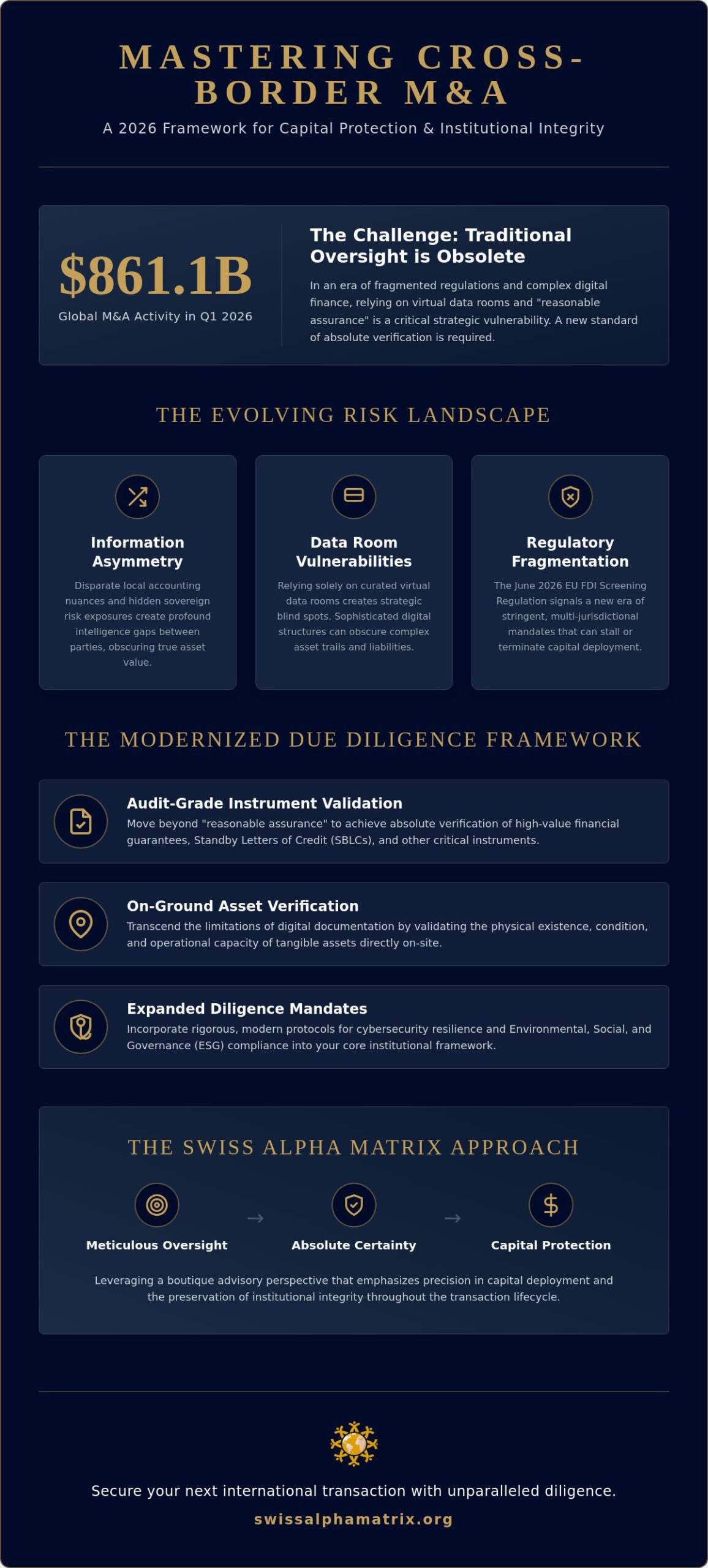
Successful capital deployment in the current fiscal year demands a framework that transcends the traditional siloed approach to transaction oversight. As global M&A activity continues its robust trajectory, reaching $861.1 billion in the first quarter of 2026, the necessity of aligning every acquisition strategy with the latest international financial regulations has become a prerequisite for institutional survival. Modern financial due diligence for cross-border m&a is no longer a isolated exercise in balance sheet verification; it is a multi-dimensional operation that must account for divergent regulatory paths, such as India’s June 6, 2026, FEMA amendment to simplify mergers and China’s simultaneously heightened scrutiny of cross-border financial data flows. Failure to reconcile these dynamics early in the process often results in significant post-closing value erosion or, in extreme cases, total transactional failure.
The integration of Environmental, Social, and Governance (ESG) factors and cybersecurity audits into the core financial due diligence process reflects a shift in how institutional value is calculated. A target’s digital resilience is now a primary financial metric, as a single data breach or regulatory fine regarding data export can devalue an acquisition by millions before the integration phase even begins. Managing stakeholder expectations through this complexity requires clear reporting and a structured RACI matrix to ensure that every executive has access to the intelligence required for board-level approval. Utilizing independent financial project management ensures that deal velocity is maintained without compromising the technical depth necessary for capital protection.
Navigating the 2026 Compliance Landscape
Adapting to the current transparency mandates requires a sophisticated understanding of how regional excellence and global standards intersect. Regulatory compliance in 2026 requires a proactive, rather than reactive, assessment of cross-border capital flows. This shift is essential to mitigate the risk of post-acquisition litigation and to navigate the tightening environment evidenced by the fact that in 2024, only 9% of covered transaction notices filed with CFIUS were cleared with mitigation. By establishing a mandate for proactive review, institutional entities can identify potential regulatory hurdles regarding outbound investment security before they become insurmountable obstacles to deal completion.
Structuring the Oversight Function
Defining clear milestones for the due diligence phase is the most effective method for preventing “deal fatigue” among internal teams and external stakeholders. The role of an independent project management office (PMO) is to manage these complex transaction workstreams with a sense of quiet authority, ensuring that every deliverable meets the highest standards of technical accuracy. Delivering executive-level intelligence with Swiss-grade precision provides the intellectual depth that sophisticated audiences value. For organizations seeking to fortify their transaction pipeline against unforeseen regulatory shifts, our regulatory compliance advisory services offer the meticulous oversight required to secure long-term strategic growth.
The Swiss Alpha Matrix Approach: Precision in Capital Deployment
The Swiss Alpha Matrix approach is defined by a deliberate departure from the high-volume, transactional mindset that often characterizes larger, more generalized advisory firms. We operate as a boutique entity, prioritizing the absolute preservation of capital and the strategic integrity of our clients’ interests over the mere pursuit of deal volume. This philosophy ensures that financial due diligence for cross-border m&a is never treated as a routine checklist, but rather as a bespoke exercise in forensic precision. By engaging our team, you’re not just hiring a service provider; you’re securing a partnership with former senior global banking executives who understand the nuances of international capital markets from an internal perspective. This level of seniority is essential for navigating the sophisticated financial discrepancies that standard audits often fail to detect.
Moving from standard due diligence to a comprehensive risk management framework involves a fundamental shift in perspective. It requires an acknowledgment that every jurisdiction carries a unique risk profile that cannot be mitigated through a one-size-fits-all approach. Whether you’re navigating the complexities of the June 2026 EU FDI Screening Regulation or verifying the authenticity of high-value bank instruments, our methodology is designed to provide the intellectual depth required by a sophisticated audience. We transition beyond the surface-level review of a data room to provide a definitive, audit-grade assessment of a transaction’s viability, ensuring that every strategic pillar is grounded in verified reality.
Our Commitment to Institutional Excellence
Institutional excellence is the result of a deliberate synthesis between rigid financial discipline and the traditional discretion associated with high-end Swiss wealth management. We deliver audit-grade reports that are designed to withstand the highest levels of scrutiny from regulatory bodies and internal boards alike. Very-high-net-worth (VHNW) individuals and institutional entities trust our independent verification process because it’s rooted in historical reliability and regional precision. This level of technical accuracy ensures that your interests are protected by seasoned experts who prioritize long-term stability and strategic growth over short-term speculation. Our reports provide the quiet authority necessary for confident board-level approval.
Securing Your Next Global Transaction
Engaging Swiss Alpha Matrix for your next complex project begins with a structured consultation to define the specific parameters of the mandate. We customize the scope of our financial due diligence for cross-border m&a to match the unique risk profile of the target jurisdiction, accounting for everything from local accounting nuances to specific political exposures. This tailored approach ensures that no detail is overlooked and that your capital deployment is backed by absolute certainty. To safeguard your interests and ensure the meticulous oversight of your global interests, we invite you to consult with our senior advisors. Our framework is designed to provide you with the professional calm and strategic clarity necessary for decisive action in a fragmented global market.
Securing Institutional Integrity in an Evolving Global Market
In the current landscape of international finance, where regulatory divergence and sophisticated financial discrepancies are the norm, the role of financial due diligence for cross-border m&a has evolved into a critical mechanism for long-term capital preservation. We’ve explored the necessity of transitioning from passive document reviews to active, on-ground verification and the technical architecture required for audit-grade instrument validation. These specialized methodologies, when combined with a proactive stance on global regulatory shifts, ensure that institutional interests remain protected against the inherent asymmetries of foreign markets. Achieving absolute certainty in asset valuation is no longer merely a goal; it’s a prerequisite for navigating the complexities of 2026.
Swiss Alpha Matrix provides the intellectual depth and technical precision necessary to navigate these intricate dynamics with unwavering professional calm. Managed by former senior executives from Tier-1 global banks, our boutique firm specializes in the meticulous oversight of high-value transactions, offering a global reach tempered by traditional Swiss discretion. We invite you to Secure your next cross-border transaction with Swiss Alpha Matrix and experience a standard of service where every detail is validated with forensic accuracy. Your strategic growth deserves the stability and reliability that only seasoned experts can provide.
Frequently Asked Questions
What is the primary difference between standard financial due diligence and audit-grade validation?
Audit-grade validation is distinguished by its transition from passive document review to a forensic investigation involving direct bank-to-bank confirmation. While standard diligence offers reasonable assurance based on provided records, audit-grade protocols verify the absolute authenticity of financial claims through technical forensic analysis. This level of technical scrutiny is essential for protecting capital in environments where local standards diverge from institutional norms.
How does on-ground verification mitigate the risks of cross-border M&A fraud?
Physical verification mitigates fraud by bypassing the curated environment of the virtual data room to confirm the existence of tangible assets in person. By conducting site visits, our experts identify discrepancies in inventory reports and uncover “ghost assets” that exist only on paper. This process also allows for the assessment of the human element, providing insights into operational integrity that digital files can’t convey.
Why are bank instrument validation services critical for complex project financing in 2026?
Bank instrument validation services are critical because they secure the funding structure against sophisticated forgeries and illegitimate guarantees. In the current fiscal climate, ensuring that Standby Letters of Credit and bank guarantees are authentic prevents catastrophic funding failures post-signing. These services provide the institutional-grade substance required to meet 2026 AML and KYC mandates for complex cross-border financing.
How long does a comprehensive cross-border financial due diligence process typically take?
A comprehensive engagement typically spans six to twelve weeks, depending on the number of jurisdictions involved and the complexity of the target’s financial structure. This period is necessary to conduct on-ground inspections, forensic document analysis, and the reconciliation of multi-jurisdictional accounting nuances. We prioritize meticulous accuracy over transactional speed to ensure that every valuation is grounded in verified physical and fiscal reality.
Can Swiss Alpha Matrix coordinate due diligence across multiple international jurisdictions simultaneously?
We maintain the capacity to coordinate global teams for simultaneous verification across multiple international jurisdictions, ensuring a unified risk management framework. This capability is vital for financial due diligence for cross-border m&a involving globalized entities with diverse regional footprints. By utilizing former senior banking executives, we ensure that every workstream adheres to the same standard of Swiss-grade precision and technical depth.
What are the most common financial red flags in international M&A transactions?
Frequent red flags include unauthorized signatory patterns across filings, metadata anomalies in SWIFT headers, and discrepancies between reported cash reserves and collateral requirements. We also look for opaque local partnership structures and sudden shifts in supply chain integrity that may suggest regulatory exposure. Identifying these indicators early allows for the mitigation of counterparty risk before it compromises the integrity of the deal.
How does the 2026 regulatory environment impact cross-border investment due diligence?
The 2026 environment demands a proactive approach to compliance, as evidenced by the formal adoption of the revised EU FDI Screening Regulation on June 8, 2026. These new mandates require deeper scrutiny of investment provenance and digital resilience, particularly in sensitive sectors. Successful due diligence now incorporates ESG and cybersecurity audits as core financial metrics to ensure long-term operational integrity and regulatory alignment.
Is independent project management necessary if we already have legal and accounting firms on the deal?
Independent project management is essential to bridge the gap between legal, accounting, and operational workstreams, ensuring that financial due diligence for cross-border m&a remains focused on capital protection. A dedicated PMO prevents deal fatigue by managing clear milestones and delivering executive-level intelligence with technical accuracy. This objective oversight ensures that the transaction maintains velocity without sacrificing the depth of analysis required for board-level approval.