

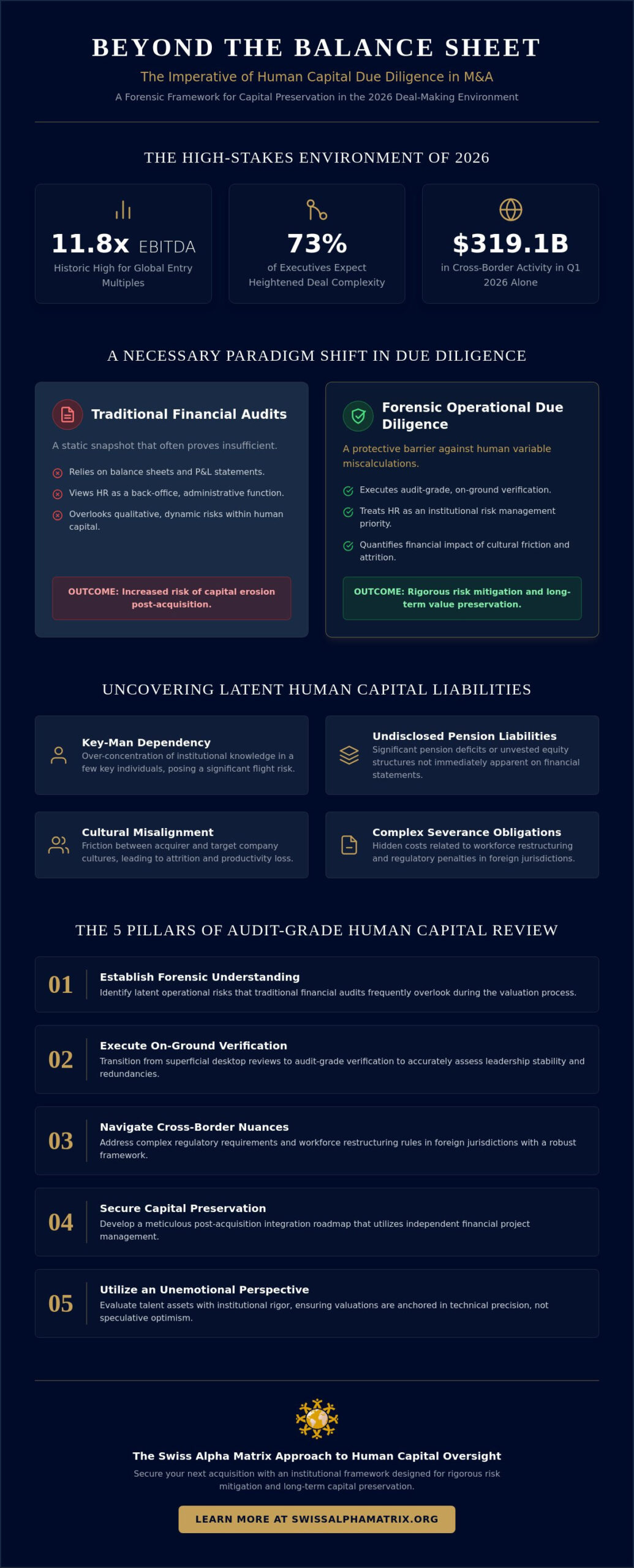
When one considers that global entry multiples have ascended to a historic high of 11.8x EBITDA as of May 2026, the imperative for surgical precision in every facet of the acquisition process becomes self-evident. You likely recognize that while traditional financial metrics offer a foundational baseline, the most profound threats to capital preservation often remain obscured within the intricate layers of human capital. As 73% of executives now anticipate heightened complexity in the deal-making environment, the integration of specialized operational due diligence in m&a is no longer a peripheral consideration but a core requirement for institutional stability.
We understand the gravity of managing undisclosed pension liabilities and the precarious nature of key-man dependency in foreign jurisdictions, particularly as cross-border activity reached $319.1 billion in the first quarter of 2026. This examination provides a sophisticated framework designed to identify latent operational risks through a forensic lens, ensuring that your strategic growth is underpinned by rigorous risk mitigation. You’ll gain access to a measured methodology for talent retention and the neutralization of operational liabilities, moving from broad philosophical principles of regional excellence to the specific strategic pillars required for the current economic cycle.
Key Takeaways
- Establish a forensic understanding of human capital to identify latent operational risks that traditional financial audits frequently overlook during the valuation process.
- Transition from superficial desktop reviews to audit-grade on-ground verification to accurately assess leadership stability and potential structural redundancies.
- Navigate complex cross-border regulatory nuances and workforce restructuring requirements through a robust framework for operational due diligence in m&a.
- Secure long-term capital preservation by developing a meticulous integration roadmap that utilizes independent financial project management for human resources workstreams.
- Utilize an unemotional, institutional perspective to evaluate talent assets, ensuring that acquisition valuations are anchored in technical precision rather than speculative optimism.
The Strategic Imperative of Operational Due Diligence in M&A
In the high-stakes environment of institutional acquisitions, the traditional reliance on financial and legal audits often proves insufficient for safeguarding long-term terminal value. While a balance sheet provides a static snapshot of assets and liabilities, it frequently fails to account for the dynamic, qualitative risks embedded within a target’s workforce. We define HR-focused Operational due diligence (ODD) as a forensic assessment of human capital liabilities, moving beyond mere administrative checklists to scrutinize the underlying stability of the organization’s intellectual and cultural architecture. This rigorous approach ensures that operational due diligence in m&a serves as a protective barrier against the erosion of capital that occurs when human variables are miscalculated.
The transition from viewing human resources as a back-office function to an institutional risk management priority is essential for 2026. Traditional audits might verify the existence of employment contracts, yet they rarely uncover the latent operational risks that arise from cultural misalignment or the concentration of institutional knowledge within a few key individuals. By adopting a forensic lens, we move from passive compliance to an active preservation of value, identifying where human capital might either accelerate strategic growth or act as a catalyst for systemic failure post-close.
Human Capital as a Financial Risk Vector
Quantifying the financial impact of cultural friction and executive attrition is a complex but necessary exercise for any sophisticated acquirer. Human capital risk represents the potential for qualitative workforce variables to disrupt projected cash flows and compromise the long-term preservation of invested capital. Beyond the obvious disruption of leadership gaps, hidden liabilities often lurk in the form of unvested equity structures, significant pension deficits, and complex severance obligations that aren’t immediately apparent on a standard P&L statement. Identifying these vectors early allows for a more accurate recalibration of the purchase price and the development of robust mitigation strategies before the capital is committed.
Beyond the Balance Sheet: Why ODD Matters in 2026
The global landscape for talent has become increasingly fragmented, with mobility and regulatory shifts in major financial hubs like Hong Kong and Geneva introducing new layers of complexity. In 2026, the ability to retain top-tier talent in foreign jurisdictions is a primary driver of acquisition valuation. It’s vital to align these findings with a broader cross-border investment due diligence framework to ensure that workforce restructuring plans don’t inadvertently trigger regulatory penalties or mass talent drains. High-level operational due diligence in m&a demands this level of regional precision, ensuring that the human element of a transaction is treated with the same technical rigor as any other financial asset.
Forensic Methodology: Executing Audit-Grade Human Capital Reviews
While many practitioners treat the evaluation of human assets as a cursory checklist of contracts and benefit schedules, a truly institutional approach to operational due diligence in m&a requires a shift toward forensic validation. We don’t merely accept the contents of a digital data room as an absolute truth; instead, we verify the operational reality through meticulous, audit-grade reviews. This involves a deep dive into organizational architecture to identify structural redundancies that may be inflating operational costs, as well as leadership gaps that could destabilize the entity once the transaction concludes. Academic research from institutions like the human resource due diligence centers at major universities underscores that the long-term success of a merger often hinges on these qualitative assessments that transcend standard financial reporting.
Forensic payroll analysis serves as a critical, albeit frequently overlooked, component of this methodology. By scrutinizing historical records, we aim to uncover misclassified workers or systemic pay inequities that could trigger future regulatory scrutiny or costly litigation. Identifying these hidden liabilities early in the process ensures that the final valuation reflects the true cost of the workforce, preventing post-acquisition surprises that erode capital. Our approach prioritizes technical accuracy, evaluating the target’s corporate governance and ethical compliance history to ensure that the entity’s moral character aligns with the high standards of our clients.
The Necessity of On-Ground Verification
A desktop review is inherently limited by the quality and transparency of the documentation provided by the seller. We believe that physical presence is required to validate management culture and gauge genuine employee sentiment, as these factors are rarely captured in a spreadsheet. Direct stakeholder interviews allow our experts to verify key-man dependency and identify any discrepancies between the provided documentation and the actual operational reality. It’s often during these on-ground verification services that we uncover the subtle cultural nuances that could either facilitate or hinder a seamless transition.
Analyzing Executive Leadership and Retention
The preservation of terminal value is intimately tied to the stay-power of critical talent once the acquisition is finalized. We meticulously assess the bench strength of middle management, particularly in complex cross-border entities where regional precision is paramount. Structuring retention incentives isn’t simply a matter of financial payouts; it’s about aligning those incentives with the strategic goals of the new organization to ensure long-term stability. By evaluating the intellectual depth of the leadership team, we provide a clear picture of the target’s ability to execute on the investment thesis without the constant threat of talent drain.
Navigating Cross-Border Complexities and Regulatory Nuance
Cross-border acquisitions necessitate a level of jurisdictional fluency that transcends the capabilities of generalist advisors. The standardisation of global operations, while theoretically efficient, often founders upon the jagged realities of local employment statutes and the intricate requirements of international financial regulations. When an institutional entity expands its footprint into disparate global financial centres, it encounters a friction that can only be mitigated through regional excellence and technical precision. Executing operational due diligence in m&a within this context requires a granular understanding of how local mandates dictate the pace and feasibility of workforce restructuring, ensuring that capital preservation remains the primary objective throughout the transition.
The complexity of these transactions is compounded by the varying degrees of state involvement and regulatory scrutiny currently observed in 2026. Negotiating regulatory risk allocations, particularly when dealing with higher reverse termination fees in European markets, demands an unemotional and forensic approach to human capital. We prioritise the identification of potential legal pitfalls before they manifest as cross-border litigation, providing a protective layer of authority that secures the acquisition’s terminal value against unforeseen regulatory shifts.
Regional Labour Law Variances: Geneva to Hong Kong
Navigating the strict protections of European labour markets, such as those found in Switzerland or the United Kingdom, requires a sophisticated grasp of the Transfer of Undertakings (Protection of Employment), or TUPE, regulations. These mandates often restrict the ability of an acquirer to harmonise terms and conditions post-merger, creating long-term operational liabilities if not properly accounted for during the initial assessment. In the APAC region, specifically within the Hong Kong environment, the nuances of mandatory benefits and social security contributions present a different set of challenges. Our methodology ensures that every regional variance is mapped with surgical precision, preventing the erosion of value that occurs when disparate labour regulations are treated with a one-size-fits-all mentality.
Cultural Due Diligence as a Risk Mitigation Strategy
Cultural due diligence is not a soft exercise in sentiment analysis; it’s a rigorous assessment of how communication styles and organizational values influence deal integrity. We examine the potential for culture clashes that lead to operational paralysis, particularly in cross-border entities where language barriers and differing management philosophies can stall integration. Cultural friction acts as a multiplier for financial risk, effectively compounding minor operational inefficiencies into significant capital erosion that threatens the long-term success of the investment. By identifying these misalignments early, we allow our clients to develop targeted mitigation strategies that ensure the target entity remains functional and productive throughout the integration phase.
The Operational Framework for Post-Acquisition Integration
The transition from the diagnostic phase of operational due diligence in m&a to the implementation of a post-acquisition framework represents the most critical juncture in the preservation of terminal value. A rigorous integration roadmap, which is built upon the forensic insights garnered during the earlier investigative stages, serves as the definitive blueprint for institutional stability. It’s not enough to identify risks; one must execute a strategy that neutralizes them with technical precision. By establishing specific, data-driven KPIs for human capital performance within the first 100 days, an acquirer can monitor the health of the newly integrated workforce and adjust strategic pillars before any latent cultural friction manifests as financial loss.
This phase requires a shift from forensic analysis to structured execution, where the primary objective is the seamless blending of disparate organizational architectures. We prioritize a measured, logical pace that avoids the frantic energy often associated with corporate mergers, opting instead for a steady movement toward broad philosophical principles of excellence. This institutional approach ensures that every decision, from leadership retention to workforce restructuring, is tethered to the original investment thesis and the long-term preservation of capital.
Mitigating Day One Operational Disruptions
Ensuring absolute continuity on the first day of new ownership is a non-negotiable requirement for maintaining the morale of the acquired workforce and the confidence of external stakeholders. Payroll continuity and the stability of benefits across all regions, particularly in complex cross-border environments, must be validated with surgical accuracy to prevent immediate attrition. Transparent stakeholder management plays a vital role here. We believe that communicating a clear, dignified vision to the workforce reduces the uncertainty that often triggers a talent drain. This steady, logical approach to communication fosters an environment of trust, allowing the new organization to stabilize while moving toward its long-term growth objectives.
The RACI Model for HR Integration
To prevent ownership gaps in multi-layered transitions, we employ a RACI matrix that defines who is Responsible, Accountable, Consulted, and Informed for every HR milestone. This level of structural clarity is essential when managing disparate workstreams across global financial centers where local nuances can easily lead to operational paralysis. By utilizing an independent financial project management approach, we ensure that these roles are followed with unwavering precision, removing the emotional bias that often plagues internal HR departments during a merger. Independent oversight provides a layer of protective authority, ensuring that the integration roadmap is executed according to the high-level standards established during the due diligence phase. To secure your acquisition’s future, consider the benefits of our professional Operational Due Diligence services.
The Swiss Alpha Matrix Approach to Human Capital Oversight
The Swiss Alpha Matrix approach distinguishes itself through a synthesis of financial rigor and the traditional discretion inherent in high-end Swiss advisory. By leveraging the collective expertise of former Tier-1 bank executives, we provide a level of sophistication in talent evaluation that generalist consultancies often lack. This institutional perspective allows us to maintain an unemotional distance, ensuring that the findings within our operational due diligence in m&a remain objective and anchored in technical reality. We don’t merely observe; we interrogate the human capital structure to ensure it can withstand the pressures of institutional transition. It’s through this lens that we execute operational due diligence in m&a, providing an authoritative perspective that prioritizes the integrity of the investment above all else.
Our mindset is informed by the same audit-grade precision required for bank instrument validation services, where the protection of capital is the absolute priority. This cross-disciplinary expertise ensures that our risk management frameworks are both broad in reach and meticulous in their attention to detail. We treat human capital as a primary risk vector, applying a forensic lens that aligns with the highest standards of institutional oversight. Our methodology is designed to lead you through a structured argument, creating a sense of inevitable logic that encourages confidence in the decision-making process.
Elite Oversight for High-Stakes Mandates
Boutique advisory offers a degree of hyper-personalization and meticulous attention that large-scale consultancies, often burdened by volume, struggle to replicate. Our commitment to capital preservation is reflected in exhaustive forensic investigations that go beyond surface-level data rooms. We provide executive-level intelligence that serves as a recurring thematic anchor for the final deployment decision, ensuring that every strategic pillar is validated by seasoned experts who prioritize long-term stability over short-term speculation. This elite level of oversight is essential for high-stakes mandates where the margin for error is non-existent.
Securing Your Investment Thesis
By positioning Swiss Alpha Matrix as your dedicated partner for complex project management, you gain access to an elite standard of service rooted in historical reliability and regional precision. We reduce exposure through rigorous on-ground verification, ensuring that your investment thesis is protected by institutional rigor. Our methodology moves from broad principles down to specific strategic actions, providing the clarity required for confident capital allocation. We invite you to secure your interests with a partner that values privacy and exclusivity above all else, delivering a standard of service where precision, discretion, and capital protection are the defining signatures of every mandate.
Safeguarding Terminal Value through Institutional Precision
The transition toward a forensic, audit-grade assessment of human capital represents a fundamental shift from administrative compliance to sophisticated risk management. By identifying latent liabilities and navigating the friction of cross-border regulatory landscapes with regional precision, institutional acquirers can effectively safeguard their terminal value. A structured integration roadmap, underpinned by a clear RACI matrix and performance-driven KPIs, ensures that the original investment thesis remains intact throughout the critical post-close period. This level of technical rigor is the cornerstone of effective operational due diligence in m&a, particularly as global transactions face heightened scrutiny and escalating entry multiples. It’s a process that demands the steady, unemotional oversight of experts who prioritize long-term preservation over speculative growth.
We invite you to secure your acquisition with audit-grade HR due diligence from Swiss Alpha Matrix. Managed by former senior executives from Tier-1 global financial institutions, our firm brings audit-grade verification standards and a global reach defined by Swiss precision and discretion to your most complex mandates. You can move forward with the confidence that your interests are protected by a partner dedicated to meticulous detail and institutional excellence.
Frequently Asked Questions
What is the primary objective of HR due diligence in an acquisition?
The primary objective is the forensic validation of human capital to identify latent risks that could threaten long-term capital preservation. This process ensures that the target’s workforce and leadership structures are robust enough to support the investment thesis post-close. By scrutinizing qualitative workforce variables, an acquirer can mitigate threats to projected cash flows and maintain institutional stability throughout the transaction.
How does HR due diligence differ from a standard legal review of employment contracts?
Legal reviews focus on administrative compliance and the enforceability of contracts, while HR-focused operational due diligence in m&a assesses the qualitative health of the organization. It goes beyond the paper trail to evaluate management culture, structural redundancies, and leadership bench strength. This forensic approach identifies operational friction that a standard legal audit of employment handbooks or benefit schedules often fails to capture.
What are the most common hidden HR liabilities discovered during an acquisition?
Hidden liabilities often manifest as undisclosed pension deficits, misclassified independent contractors, and significant unvested equity obligations that aren’t immediately apparent on a balance sheet. Acquirers also frequently encounter complex severance triggers and systemic pay inequities that could lead to future litigation. Identifying these vectors early allows for a precise recalibration of the purchase price and ensures that the final valuation reflects the true cost of the workforce.
Why is on-ground verification critical for human capital assessment in cross-border deals?
On-ground verification is essential because desktop reviews are inherently limited by the quality and transparency of documentation provided in a digital data room. Physical presence allows experts to validate management culture and gauge genuine employee sentiment through direct stakeholder interviews. This level of technical rigor is necessary to identify discrepancies between the provided records and the actual operational reality, particularly in complex cross-border environments.
How does cultural misalignment impact the financial valuation of a target company?
Cultural misalignment acts as a significant multiplier for financial risk, often leading to operational paralysis and a rapid erosion of terminal value. When disparate organizational philosophies clash, the resulting attrition of key talent can compromise the target’s ability to meet projected performance metrics. This friction creates inefficiencies that directly impact the long-term success of the investment, making cultural assessment a core component of the valuation process.
Can HR due diligence prevent post-acquisition executive attrition?
While no process can entirely eliminate attrition, a forensic assessment identifies the stay-power of critical talent and allows for the development of targeted retention strategies. By evaluating the bench strength of middle management and identifying key-man dependencies, an acquirer can structure incentives that align with long-term strategic goals. This proactive approach ensures that the leadership team remains stable and focused on executing the investment thesis post-acquisition.
What role does a RACI matrix play in the HR integration process?
A RACI matrix serves as a definitive framework for defining Responsible, Accountable, Consulted, and Informed roles across all HR integration milestones. This structural clarity is vital for preventing ownership gaps in complex, multi-layered transitions where local nuances might otherwise lead to operational confusion. By assigning clear accountability, the matrix ensures that the integration roadmap is followed with the technical precision required for institutional stability.
How much time should be allocated for a comprehensive HR due diligence mandate?
Comprehensive mandates typically require an additional one to three months, as 57% of executives according to Q4 2025 survey results report that due diligence timelines have extended. This window allows for audit-grade verification and on-ground interviews that go beyond a cursory checklist. Allocating sufficient time ensures a measured, steady pace that leads to a structured argument for the methodology, ultimately fostering greater confidence in the final investment decision.