

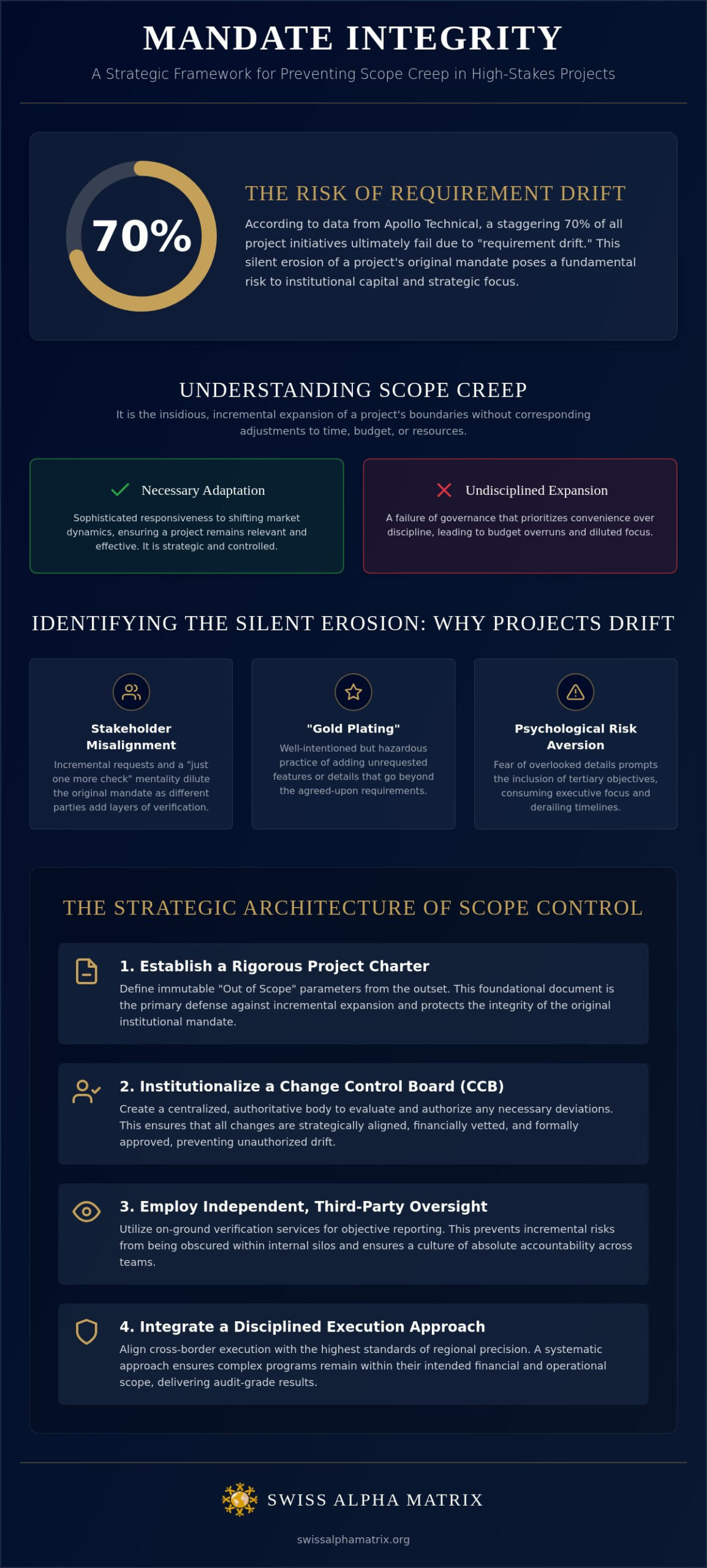
With recent data from Apollo Technical indicating that 70% of initiatives succumb to requirement drift, the challenge of avoiding scope creep in large projects has moved from a tactical concern to a fundamental risk to institutional capital. You’ve likely observed how the initial clarity of a mandate can slowly dissolve under the weight of incremental requests, where opaque reporting structures often mask the gradual dilution of executive focus until the budgetary threshold is breached. This erosion of strategic intent isn’t merely a failure of management, but rather a symptom of insufficient institutional discipline in an increasingly complex global environment.
This article explores a rigorous framework designed to restore mandate integrity, ensuring that every deployment of resources remains strictly aligned with your original strategic objectives. You’ll discover how to protect capital and ensure audit-grade results through sophisticated project oversight that prioritizes long-term preservation over short-term convenience. We’ll examine the integration of the PMBOK 8th Edition standards alongside on-ground verification services to establish a culture of absolute accountability across cross-border teams. By moving from broad philosophical principles to specific strategic pillars, we provide the logical structure necessary for maintaining precision in the face of inevitable project evolution.
Key Takeaways
- Define the boundaries of engagement through a rigorous Project Charter, establishing immutable “Out of Scope” parameters to protect the integrity of the original institutional mandate.
- Master the art of avoiding scope creep in large projects by recognizing the silent erosion caused by stakeholder misalignment and the well-intentioned, yet hazardous, practice of unrequested “Gold Plating.”
- Institutionalize a formal Change Control Board to provide a centralized, authoritative mechanism for evaluating and authorizing any necessary deviations from the project’s strategic path.
- Employ independent, third-party oversight and on-ground verification services to ensure objective reporting and to prevent incremental risks from being obscured within internal organizational silos.
- Integrate the Swiss Alpha Matrix approach to align cross-border execution with the highest standards of regional precision, ensuring that complex programs remain within their intended financial and operational scope.
Defining Scope Creep within High-Stakes Financial Mandates
In the context of institutional finance, the phenomenon known as What is Scope Creep? represents an insidious, incremental expansion of a project’s boundaries, often occurring without the requisite adjustments to capital allocation or temporal milestones. It’s a departure from the original mandate that, while seemingly minor in its individual stages, eventually threatens the structural integrity of the entire program. Distinguishing between necessary adaptation, which is the hallmark of sophisticated responsiveness, and undisciplined expansion is a critical skill for any master planner. While adaptation ensures that a project remains relevant amidst shifting market dynamics, scope creep is a failure of governance that prioritizes administrative convenience over strategic discipline.
Financial projects, particularly those involving cross-border due diligence, are uniquely susceptible to requirement drift. The complexity of navigating disparate regulatory jurisdictions often invites a “just one more check” mentality, where stakeholders attempt to mitigate localized risks by adding layers of verification that weren’t part of the initial agreement. For those tasked with avoiding scope creep in large projects, recognizing these subtle shifts is paramount to maintaining audit-grade results and ensuring that capital remains protected throughout the lifecycle of the transaction. Without a rigid adherence to the established framework, the cumulative effect of these additions can obscure primary objectives and lead to a significant dilution of executive focus.
The Anatomy of a Mandate Drift
The transition from project evolution to scope expansion is frequently masked by the high-pressure nature of investment environments. It often begins with the psychological trigger of risk aversion, where the fear of an overlooked detail prompts the inclusion of tertiary objectives. This “evolution” is, in reality, a strategic drift that consumes executive focus and dilutes the precision of the original mandate. Identifying this distinction requires a commitment to the project charter that transcends the immediate urge to accommodate every stakeholder request. When the strategic timeline is derailed by non-essential tasks, the project’s overall reliability is compromised, leading to a state of perpetual catch-up that undermines the authority of the management team.
The Cost of Indiscipline
The erosion of ROI through unmanaged expansion isn’t just a matter of increased expenditure; it’s a fundamental compromise of the project’s fiduciary foundation. When project boundaries are breached, the rigorous nature of bank instrument validation services can be severely compromised, as the attention of seasoned experts is diverted toward non-essential tasks. This lack of discipline often leads to missed milestones, which, in the world of institutional-grade programs, carries a heavy reputational risk that can take years to rectify. Avoiding scope creep in large projects is therefore not merely an operational goal but a prerequisite for maintaining the prestige and reliability associated with top-tier project management and long-term capital preservation.
The Strategic Architecture of Scope Control: A 5-Step Framework
Maintaining mandate integrity within institutional-grade programs necessitates a transition from reactive management to a proactive strategic architecture. To succeed in avoiding scope creep in large projects, one must first establish a definitive Project Charter that includes not only what is within the mandate but, perhaps more crucially, rigid “Out of Scope” definitions. This foundational document serves as the primary defense against the incremental expansion of requirements. By implementing a formal Change Control Board (CCB), organizations ensure that any proposed deviations undergo a rigorous evaluation process, preventing unauthorized drift from compromising the project’s financial and operational equilibrium.
Phase 1: The Pre-Execution Lockdown
Before a single unit of capital is deployed, the Master Planner must orchestrate a pre-execution lockdown. This phase is dedicated to defining absolute success criteria and securing explicit stakeholder buy-in on what will not be pursued. By clarifying these institutional boundaries early, you eliminate the ambiguity that often invites “shadow” requirements later in the lifecycle. This disciplined approach ensures that all parties are aligned with the primary investment thesis, fostering an environment where strategic growth is prioritized over tactical distractions. Organizations seeking to fortify their internal governance may find value in engaging Complex Project Management experts to oversee these intricate dynamics.
Accountability is further enforced through the utilization of a RACI analysis matrix, which clearly delineates who is Responsible, Accountable, Consulted, and Informed for every critical decision point. This level of granularity is essential for maintaining clarity in multi-jurisdictional transactions. When coupled with continuous alignment checks, the framework ensures that the project remains tethered to its original purpose. It requires an unemotional commitment to the original vision, resisting the urge to expand the scope for short-term perceived gains that may jeopardize long-term stability.
Phase 2: Rigorous Milestone Management
Precision in execution is maintained through rigorous milestone management. It’s imperative to distinguish between project milestones vs deliverables to ensure that progress reporting reflects genuine strategic advancement rather than mere task completion. Immutable milestones should trigger executive-level reviews, providing a fail-safe mechanism that halts momentum if the project deviates from its prescribed path. Data-driven reporting allows the project team to identify drift before it becomes critical, enabling the CCB to handle Change Requests with the necessary gravity without sacrificing deal momentum.
Ultimately, the goal is to prevent scope creep by fostering a culture of strategic discipline. By adhering to these five pillars, institutional entities can ensure their large-scale projects deliver the promised results while protecting their capital from the erosion of undisciplined expansion. Avoiding scope creep in large projects becomes a repeatable, audit-grade process that mirrors the traditional discretion and excellence expected in high-end financial management.
Identifying the Silent Erosion: Why Financial Projects Drift
The erosion of a project’s strategic boundaries often occurs not through a singular, catastrophic decision, but through a series of nearly imperceptible adjustments that collectively undermine the original fiduciary intent. Stakeholder misalignment serves as the primary catalyst for these “shadow” requirements, where disparate departments introduce subtle layers of complexity that were never authorized by the central steering committee. In the sophisticated environment of cross-border investment due diligence, these misalignments are frequently exacerbated by the intricate nature of jurisdictional dependencies, where a failure to define the exact perimeter of investigation leads to an undisciplined expansion of the analytical scope, highlighting the necessity of avoiding scope creep in large projects from the outset.
Another subtle yet pervasive threat is the phenomenon of “Gold Plating,” wherein project teams, motivated by a desire to provide superior service, add unrequested value that inadvertently increases the overall risk profile. While this may appear beneficial on the surface, such additions introduce new variables into the operational equation, potentially compromising the precision of the final output. Regulatory shifts also present a legitimate, though inherently dangerous, justification for scope expansion. While compliance is non-negotiable, the lack of a structured response to new international financial regulations can lead to a state of perpetual project flux, where the core mandate is sacrificed at the altar of exhaustive, yet non-essential, administrative compliance.
The Fallacy of ‘One Small Change’
The cumulative effect of minor deviations on total project risk is often underestimated by executive oversight committees, as each individual request appears manageable within existing resource constraints. These incremental additions frequently bypass standard governance protocols, creating a “scope debt” that eventually requires a painful and costly reconciliation. It’s a fundamental principle of complex systems that even a modest 5% increase in the project’s scope can result in a disproportionate 50% surge in systemic complexity, effectively doubling the potential points of failure. Avoiding scope creep in large projects requires a refusal to view any change as isolated, recognizing that every adjustment ripples through the entire strategic framework.
Managing External Pressures
Navigating requests from non-core stakeholders without diluting the primary mandate requires a delicate balance of institutional firmness and diplomatic precision. By utilizing the specific constraints of global regulatory frameworks, a master planner can provide a logical justification for maintaining strict scope boundaries, positioning the refusal of non-essential tasks as a necessary measure for ensuring compliance and capital protection. This approach allows for the maintenance of Swiss-level discretion, where the ability to say “no” is exercised with a quiet authority that reinforces the prestige of the service. Ensuring that the project remains focused on its essential pillars is the only way to guarantee the audit-grade results that institutional entities demand in 2026.
Mitigating Risk through Independent Oversight and Verification
The structural integrity of a high-stakes mandate depends on a rigorous separation between execution and oversight. Relying solely on internal project teams to identify requirement drift is a strategic vulnerability, as these teams are often influenced by internal politics or the momentum of the transaction itself. By contrast, independent project management introduces a detached, unemotional perspective that prioritizes the long-term preservation of capital over short-term milestones. This objectivity is the cornerstone of avoiding scope creep in large projects, as it ensures that every deviation is scrutinized through the lens of the original investment thesis rather than institutional convenience.
The Value of an Independent Perspective
Internal departments frequently fail to report scope drift until the cumulative complexity becomes unmanageable, as the proximity to day-to-day operations can often obscure the gradual shift in project boundaries. This delay is rarely malicious; it’s often a byproduct of a well-intentioned desire to accommodate stakeholder requests without escalating conflict or appearing inflexible. An independent advisor acts as a guardian, protecting the mandate from the silent erosion discussed in previous sections by providing an external anchor for the project’s original scope. It’s vital that independent financial project management remains uncoupled from deal-making incentives. This structural independence allows for the absolute precision required in cross-border programs where even minor oversights carry significant regulatory weight and reputational consequences.
Verification as a Control Mechanism
Verification serves as a definitive control mechanism to lock down the technical scope of an engagement, providing an empirical foundation for all subsequent decision-making. By utilizing Audit-Grade Instrument Validation, experts can confirm the legitimacy of financial assets before they’re integrated into the project workflow, thereby eliminating the “phantom” requirements that often arise from unverified data. This prevents the expansion of theoretical project risks that often lead to unnecessary, and costly, requirement gathering exercises. Additionally, On-Ground Verification Services provide a physical confirmation of deliverable authenticity, ensuring that executive reporting reflects tangible reality rather than optimistic, siloed projections. A Deliverable Review Matrix offers a structured, objective tool for quality control, allowing the Master Planner to verify that every output meets the established criteria before moving to the next phase, thus maintaining the audit-grade integrity of the entire program.
Establishing these layers of oversight transforms project management from an administrative task into a robust defensive strategy. To fortify your next mandate against the risks of undisciplined expansion, consider implementing our comprehensive Risk Management Frameworks today. Audit-grade documentation not only records progress but acts as a powerful deterrent against the unauthorized expansion of project boundaries, ensuring that your strategic objectives are met with the highest level of professional competence.
The Swiss Alpha Matrix Approach: Precision Execution for Complex Programs
The Swiss Alpha Matrix approach distinguishes itself by merging the traditional discretion inherent in high-end private wealth management with the rigorous, data-driven discipline required for Tier-1 institutional execution. By adopting a pre-emptive strategic architecture, we move beyond the limitations of reactive management, ensuring that every project component is anchored in a proprietary methodology designed specifically for the complexities of cross-border transactions. Avoiding scope creep in large projects becomes a natural outcome of this philosophy, as our framework prioritizes the preservation of the original mandate above the convenience of unvetted expansion. This level of control is only achievable through a refusal to oversimplify the intricate dynamics of global finance, opting instead for a methodology that mirrors the permanence and quality of the institutions we serve.
Precision in these environments isn’t merely a goal but a requirement for fiduciary safety. Our methodology treats the project charter as an immutable contract, where any deviation must survive a gauntlet of institutional scrutiny before being considered. This ensures that deal momentum is never sacrificed for the sake of undisciplined growth, maintaining a steady, logical rhythm from the initial philosophical principles down to the final strategic pillars. For the sophisticated stakeholder, this approach provides the reassurance that their interests are in the hands of seasoned experts who prioritize long-term stability over short-term speculation.
Institutional-Grade Advisory
Our senior-level experts leverage decades of transactional experience to anticipate potential scope risks before they manifest as operational delays. We intentionally structure our advisory mandates to prioritize technical accuracy and deep-dive analysis over mere project volume, catering to a sophisticated clientele that values nuance and thoroughness. Within this high-stakes environment, the persona of the Master Planner is essential, providing the quiet authority needed to maintain institutional boundaries while navigating the intricate dynamics of global finance. This specialized focus ensures that avoiding scope creep in large projects isn’t just a theoretical objective but a repeatable, audit-grade reality that protects the integrity of the investment.
Ensuring Long-Term Capital Protection
Project oversight, when executed with the precision we demand, serves as a fundamental safeguard for cross-border investments, protecting assets from the erosion of undisciplined requirements. Every milestone within our framework is inextricably linked to regulatory compliance, ensuring that the project’s evolution remains within the strict parameters of international law and fiduciary duty. This meticulous attention to detail is what distinguishes a performance-oriented mindset from passive participation in the market, providing an elite standard of service that is both broad in reach and meticulous in its execution. Discover how Swiss Alpha Matrix ensures precision in complex project management.
Fortifying Mandate Integrity for the Future
Securing the long-term success of complex financial programs requires more than just diligent management; it demands an unwavering commitment to mandate integrity and the implementation of a rigorous strategic architecture. By establishing definitive boundaries and utilizing independent oversight, institutional entities can effectively master the art of avoiding scope creep in large projects, ensuring that capital remains protected throughout the transaction lifecycle. It’s this transition from reactive adjustments to pre-emptive discipline that is essential for maintaining the audit-grade results that define regional excellence.
As the complexities of cross-border investment continue to evolve, the necessity for sophisticated, unemotional expertise becomes increasingly clear. Led by former Tier-1 global bank executives, our team provides the global reach and Swiss precision required to navigate these intricate dynamics with absolute technical accuracy. We invite you to secure your mandate with expert project oversight from Swiss Alpha Matrix, leveraging our audit-grade financial instrument validation expertise to safeguard your strategic growth. Your interests deserve the protection of seasoned planners who prioritize quality and moral character in every engagement. We look forward to partnering with you to achieve your most ambitious objectives with precision and discretion.
Frequently Asked Questions
What is the primary cause of scope creep in large financial projects?
The primary cause of scope creep in large-scale financial mandates is typically stakeholder misalignment, which leads to the introduction of unauthorized “shadow” requirements. When disparate departments attempt to mitigate localized risks without central steering committee approval, the project perimeter expands incrementally. This lack of initial strategic lockdown often results in a dilution of executive focus and a significant compromise of the original investment thesis.
How does scope creep differ from project evolution?
Project evolution is a disciplined, strategic response to shifting market dynamics, whereas scope creep is an undisciplined expansion that occurs without corresponding adjustments to resources or timelines. Evolution maintains the integrity of the mandate by ensuring that modifications remain aligned with the primary investment objectives. Conversely, creep represents a failure of governance where administrative convenience or risk aversion bypasses established project boundaries.
Can a RACI matrix effectively prevent scope drift?
A RACI matrix is an essential tool for enforcing accountability and preventing the ambiguity that often invites requirement drift. By clearly delineating who is Responsible, Accountable, Consulted, and Informed, the matrix eliminates the “shadow” decision-making processes that drive unauthorized expansion. When properly integrated into a project’s strategic architecture, it serves as a foundational defense in avoiding scope creep in large projects.
Why is independent project oversight better than an internal PMO for avoiding scope creep?
Independent project management provides a detached, unemotional perspective that is structurally uncoupled from internal politics and deal-making incentives. Unlike an internal PMO, which may succumb to the momentum of the transaction or department-level biases, an independent advisor prioritizes long-term capital preservation. This objective oversight ensures that every deviation is scrutinized through the lens of fiduciary duty rather than organizational convenience.
Is it possible to adjust project scope without it becoming ‘creep’?
Yes, project scope can be adjusted legitimately through a formal Change Control Board (CCB) that evaluates the impact on capital, time, and strategic alignment. When a modification is authorized with a corresponding update to the project charter and resource allocation, it’s considered a controlled change rather than creep. This rigorous process ensures that the project remains within a managed framework, protecting the integrity of the original mandate.
How do cross-border regulations impact project scope management?
Cross-border regulations often act as a catalyst for scope expansion due to the necessity of navigating disparate jurisdictional requirements. While compliance is mandatory, the lack of a structured framework for managing these dependencies can lead to an exhaustive, yet non-essential, increase in due diligence activities. Sophisticated oversight is required to integrate these regulatory shifts without allowing them to derail the strategic timeline or dilute executive focus.
What are the first signs that a project is suffering from scope creep?
The earliest indicators of scope creep include subtle requirement drift and the frequent appearance of “just one more check” requests that bypass formal approval. Other signs include a gradual slippage in milestones and an increase in meetings dedicated to tertiary objectives rather than core deliverables. Recognizing these minor deviations early is paramount to avoiding scope creep in large projects before the cumulative complexity becomes unmanageable.
How does Swiss Alpha Matrix handle change requests in complex mandates?
Swiss Alpha Matrix handles change requests through a proprietary methodology that utilizes a formal Change Control Board and a Master Planner persona. Every request is subjected to a rigorous evaluation of its impact on technical accuracy and capital protection before any deployment of resources occurs. This approach ensures that deal momentum is maintained while the structural integrity of the cross-border mandate remains absolutely secure.