

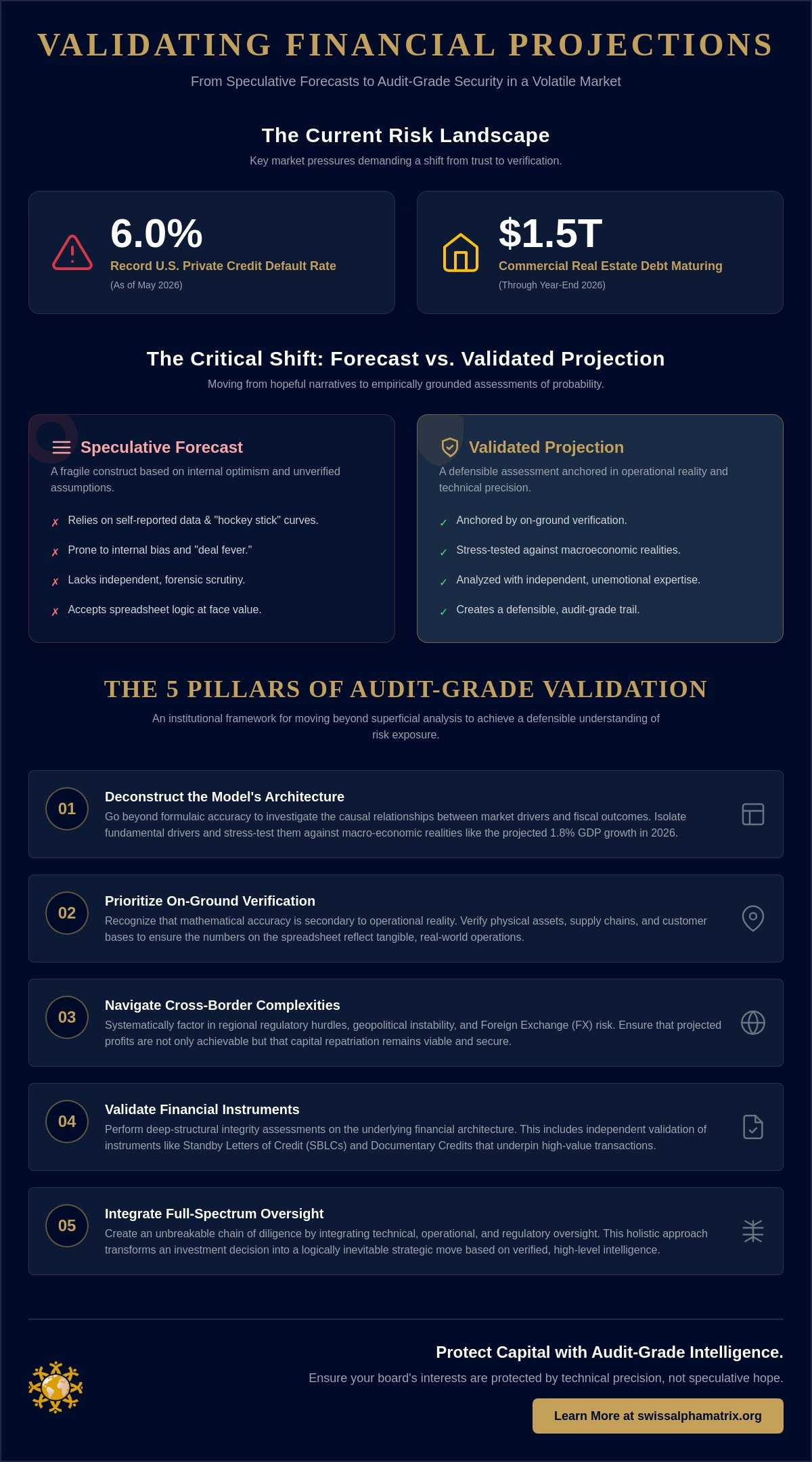
With U.S. private credit default rates reaching a record 6.0% in May 2026, the era of accepting self-reported revenue forecasts at face value has effectively ended for the discerning allocator. You likely recognize that a spreadsheet, regardless of its internal logic, remains a fragile construct if it isn’t anchored by regional market integrity and verified operational data. The process of validating financial projections for investment has transitioned from a mere checkbox in the due diligence phase to a forensic necessity for capital preservation in an increasingly volatile global market.
We understand the inherent skepticism you feel when confronted with the “hockey stick” growth curves often found in target entity disclosures, particularly as $1.5 trillion in commercial real estate debt matures through the conclusion of this year. This guide provides an institutional framework for moving beyond superficial analysis to achieve a defensible, audit-grade understanding of your risk exposure. You’ll discover how Tier-1 experts utilize on-ground verification and the fiscal certainties provided by the One, Big, Beautiful Bill Act to construct a rigorous “worst-case” scenario. By the conclusion, you’ll possess the strategic pillars required to ensure your board’s interests are protected by technical precision rather than speculative hope.
Key Takeaways
- Distinguish between a speculative forecast and a validated projection to ensure your fiduciary duties are met with technical precision and independent oversight.
- Learn to deconstruct financial models by identifying fundamental drivers and applying stress-test protocols that account for extreme macroeconomic shifts.
- Recognize why mathematical accuracy is secondary to operational reality when validating financial projections for investment through rigorous on-ground verification.
- Navigate the complexities of international financial regulations and FX risk to ensure capital repatriation remains viable across diverse regional markets.
- Understand how integrating technical, operational, and regulatory oversight creates an audit-grade framework for long-term capital protection and strategic growth.
The Institutional Imperative: Why Projections Require Independent Validation
The distinction between a mere financial forecast and a rigorously validated projection is often the difference between strategic growth and catastrophic capital erosion. In the sophisticated corridors of institutional finance, a forecast typically represents a statement of intent or a hopeful trajectory crafted by an entity seeking capital. Conversely, a validated projection is an empirically grounded assessment of probability, stripped of optimism and anchored in operational reality. Validating financial projections for investment requires a level of forensic scrutiny that internal teams, often compromised by the inherent optimism of deal-sourcing, are structurally incapable of providing without bias.
Fiduciary responsibility demands more than a cursory review of Excel spreadsheets. As U.S. private credit default rates reached a record high of 6.0% in May 2026, the necessity for independent oversight has become a primary pillar of risk management. When an allocator relies solely on self-reported data from a target entity, they’re essentially accepting a narrative rather than a verified fact. This lack of distance frequently leads to “deal fever,” where the desire to deploy capital obscures structural flaws in the revenue model. Independent validation serves as a critical circuit breaker, ensuring that every assumption is stress-tested against the harsh realities of the current macroeconomic environment.
Defining Audit-Grade Instrument Validation
To achieve an audit-grade standard, an advisory firm must look far beyond the surface-level logic of a financial model. It involves a deep-structural integrity assessment of the underlying financial architecture, including the verification of specialized assets such as Standby Letters of Credit (SBLCs) or Documentary Credits that often underpin cross-border transactions. The utilization of bank instrument validation services is no longer a luxury for the cautious; it’s a mandatory requirement for any entity looking to protect its principal in a landscape where sophisticated fraud can easily mirror legitimate institutional activity. We don’t just ask if the numbers work; we ask if the instruments themselves are authentic and enforceable.
The Psychology of Institutional Trust
The most dangerous errors in investment analysis are rarely the obvious ones; they’re the subtle miscalculations that look entirely plausible on a high-resolution display. Institutional trust isn’t built on a foundation of blind faith but on the quiet authority of technical precision and Swiss-inspired discretion. By engaging a partner that operates outside the internal politics of the target firm, you gain access to an unemotional expert perspective that prioritizes long-term preservation over short-term speculation. This independent stance provides the board with a defensible audit trail, transforming a subjective investment decision into a logically inevitable strategic move based on verified, high-level intelligence.
Structural Integrity: Evaluating the Architecture of Financial Models
Deconstructing the architecture of a financial model requires more than a simple audit of formulaic accuracy. It demands a rigorous investigation into the causal relationships between market drivers and fiscal outcomes. When validating financial projections for investment, one must treat the model as a living ecosystem rather than a static document. This involves isolating the fundamental drivers, such as unit economics and customer acquisition costs, to ensure they aren’t merely placeholders for optimistic assumptions. For instance, with The Conference Board projecting a modest 1.8% year-over-year GDP growth in 2026, any model premised on aggressive expansion without a clear competitive moat should trigger immediate scrutiny.
A sophisticated review also necessitates a deep dive into revenue recognition and cash flow timing. We often see aggressive accounting signatures where revenue is recognized well ahead of actual cash receipt, creating a deceptive liquidity profile. Identifying these discrepancies requires a mastery of financial advisory methodologies that prioritize cash-on-cash reality over paper profits. By aligning the model’s architecture with the actual flow of funds, an allocator can distinguish between a structurally sound enterprise and one that is merely surviving on accounting maneuvers.
Advanced Sensitivity and Scenario Analysis
Modern capital protection requires moving beyond basic best case and worst case scenarios. We employ nuanced probabilistic modeling, often integrating Monte Carlo simulations, to understand the distribution of potential outcomes. This allows us to identify the “Breaking Point,” the specific threshold where a combination of rising interest rates, projected to reach 3.8% by Q4 2026, and contracting margins renders the investment unviable. Understanding this limit is essential for a defensible audit-grade report that provides the board with absolute clarity on the risk-reward spectrum.
Error Detection and Logic Auditing
In the context of cross-border deals, structural flaws often emerge in the consistency of assumptions across multiple financial statements. A red flag frequently appears when the balance sheet doesn’t reflect the capital expenditure required to support the projected income statement growth. Our executive-level oversight focuses on these logic gaps that automated tools often miss. These include:
- Consistency checks: Ensuring depreciation schedules align with the 100% bonus depreciation reinstated by the One, Big, Beautiful Bill Act.
- FX Risk: Confirming that cross-currency projections account for the latest regional volatility indices.
- Instrument Integrity: Verifying that the model accurately reflects the cost of maintaining high-grade bank instruments in foreign jurisdictions.
By addressing these intricacies with a measured and steady logic, we ensure that the financial model serves as a reliable map for long-term strategic growth rather than a source of unforeseen liability.
Beyond the Spreadsheet: On-Ground Verification of Operational Assumptions
Mathematical precision, while necessary, is ultimately secondary to the integrity of the underlying operational data. A model can be logically perfect yet entirely fraudulent if the inputs aren’t anchored in physical reality. Validating financial projections for investment requires an institutional pivot from the digital to the tangible. This forensic approach ensures that every revenue assumption is backed by a verifiable operational footprint, preventing the catastrophic capital erosion that occurs when theoretical forecasts collide with actual market friction. Reality is rarely as clean as a spreadsheet.
Our methodology rejects the passive acceptance of self-reported data. By merging traditional financial discipline with rigorous on-ground investigation, we provide a level of certainty that desk-based audits simply cannot replicate. This is particularly critical in emerging markets where local market presence and supply chain integrity are often opaque. Our on-ground verification services act as a definitive gatekeeper, ensuring that the “operational reality” described in the boardroom matches the activity at the production site or the logistical hub.
The ‘Physical Audit’ of Financial Claims
The process of proving existence goes beyond verifying a list of serial numbers; it involves assessing the management team’s actual capacity to execute the stated strategy. In cross-border contexts, paper trails can be deceptively clean while the physical infrastructure is decaying or non-existent. In one instance involving a complex infrastructure mandate, on-site audits revealed that a key supplier’s inventory was 60% below the levels required to sustain the target’s projected growth. This discovery led to a strategic withdrawal that preserved institutional capital. A physical audit provides the necessary “ground-truth” intelligence to verify that the entity possesses the operational capacity to deliver on its projections.
Stakeholder and Counterparty Investigation
Identifying the true nature of project participants is a core component of risk mitigation. This involves a deep-structural investigation into the reputations and historical performance of key stakeholders. Hidden liabilities or undisclosed conflicts of interest often lurk beneath the surface of prestigious-looking corporate structures. This is where cross-border investment due diligence becomes an indispensable tool for the protective authority. By gathering ground-truth intelligence, we provide the board with a clear understanding of who they’re actually partnering with, ensuring that the project’s success is rooted in professional competence rather than speculative trust.
Cross-Border Nuance: Factoring in Regional Regulatory and Macro Volatility
The labyrinthine nature of global capital flow, particularly following the rigorous implementation of the Comprehensive Outbound Investment National Security Act of 2025, necessitates a more granular approach to validating financial projections for investment. While a domestic model may thrive in a relatively stable environment, cross-border deployment introduces layers of regulatory friction that can significantly alter the net present value of an asset. Navigating the complex web of international financial regulations in 2026 requires an understanding that compliance is not merely a legal hurdle, but a primary financial driver. Failure to account for the localized costs of regulatory adherence often results in a “compliance drag” that erodes projected margins long before the first dividend is realized.
Validating projections across multiple currencies introduces the dual challenge of FX volatility and the structural hurdles of capital repatriation. In an era where regional central bank policies may diverge sharply, relying on static exchange rate assumptions is a recipe for institutional exposure. A robust validation framework must account for the liquidity of the local currency and the potential for sudden shifts in repatriation laws, which can effectively trap capital in foreign jurisdictions despite a project’s nominal profitability. Our approach ensures that every projected cash flow is assessed through the lens of its actual deliverability to the parent entity, stripping away theoretical gains that cannot be realized in the home currency.
Regional Regulatory Frameworks
Comparing the compliance burdens across premier financial hubs like Geneva, London, and Hong Kong reveals significant variance in operational drag. While Geneva maintains its tradition of sophisticated discretion, the evolving AML and ESG mandates in 2026 have introduced new reporting requirements that must be factored into any long-term financial model. Validating cross-border compliance requires more than a checklist; it demands local expertise to identify how shifting regional standards will impact the target entity’s cost of capital. For those seeking to secure their international interests, our regulatory compliance advisory services provide the necessary technical precision to identify these hidden fiscal pressures before they manifest as losses.
Macro-Economic Stress Testing
True capital protection requires validating assumptions against regional inflation and interest rate volatility, particularly with the Federal Funds Rate projected to reach 3.8% by Q4 2026. When Core PCE Inflation is expected to hover around 3.3%, any model that assumes a return to the low-inflation environment of the previous decade is fundamentally flawed. Macro-Economic Integrity in 2026 is defined as the alignment of a project’s fiscal assumptions with the prevailing realities of regional monetary policy, inflationary pressures, and the structural stability of the host jurisdiction’s financial ecosystem. By integrating these macro-economic shifts into our stress-test protocols, we ensure that your investment remains viable even amidst trade barriers and the rising tide of supply chain nationalism.
The Swiss Alpha Matrix Methodology: Audit-Grade Intelligence for Capital Protection
The efficacy of any capital protection strategy is fundamentally tethered to the pedigree of the experts who oversee its execution. At Swiss Alpha Matrix, our methodology is defined by a collective history within the upper echelons of Tier-1 global banking, where the stakes of capital deployment are matched only by the rigor of the oversight required to protect it. Validating financial projections for investment is not a task we delegate to junior analysts or automated software; it is a high-level forensic exercise led by former executives who understand the nuances of institutional risk. We bring a sense of quiet authority to every mandate, ensuring that your interests are managed with the unemotional precision of seasoned practitioners.
Our proprietary “Matrix” approach serves as the connective tissue between the technical, operational, and regulatory pillars discussed in the preceding sections. Rather than treating these domains as isolated silos, we integrate them into a unified risk management framework. This integration is achieved through independent financial project management, a discipline that ensures deal integrity by maintaining a relentless focus on the “ground truth” of a transaction. By overseeing the entire investment lifecycle from initial validation to final execution, we provide a stabilizing influence that mitigates the risk of structural failure or sophisticated fraud.
Precision, Discretion, and Results
As a boutique advisory firm, we prioritize the traditional values of privacy and exclusivity that are often lost in larger, more transactional entities. This focus on discretion allows us to navigate sensitive cross-border negotiations while maintaining the absolute confidentiality of your strategic objectives. We don’t merely provide data; we deliver executive-level, actionable intelligence that serves as the “final word” on complex capital deployment decisions. Our commitment to technical accuracy ensures that when we validate a projection, it meets a standard of reliability that is defensible before any board or regulatory body.
Securing Your Next Strategic Engagement
The transition from skepticism to confidence begins with a structured engagement process designed for the specific caliber of our audience. From the moment a mandate is established, we move with a measured, steady pace to deconstruct the target entity’s claims and rebuild them upon a foundation of verified reality. Timing is often a critical variable in the validation phase of a transaction, as delays can lead to missed opportunities or increased exposure to market volatility. We invite you to contact Swiss Alpha Matrix for a confidential consultation regarding your cross-border programme, where we can discuss how our framework for validating financial projections for investment can secure your long-term strategic growth.
Securing Strategic Growth Through Technical Precision
Protecting institutional capital in an era of heightened default rates and regulatory flux requires a departure from passive analytical models. We’ve examined how a rigorous framework moves beyond the digital interface to verify operational reality; it identifies the breaking points where theoretical forecasts fail under macro-economic stress. Effective capital protection hinges on your ability to distinguish between optimistic narratives and audit-grade reality. The process of validating financial projections for investment ensures that every assumption is anchored in ground-truth intelligence and regional market integrity.
Our methodology is led by former Tier-1 global bank executives who bring decades of cross-border transactional and regulatory expertise to every mandate. We offer boutique discretion coupled with institutional-grade precision; this ensures your interests are managed by experts who prioritize long-term preservation over short-term speculation. To ensure your next deployment is supported by forensic-level certainty, secure your capital with audit-grade validation and consult with Swiss Alpha Matrix today. Your commitment to rigorous oversight is the most reliable foundation for enduring stability in a complex global landscape.
Frequently Asked Questions
What is the difference between financial model auditing and projection validation?
Financial model auditing focuses on the internal logic and formulaic accuracy of a spreadsheet, ensuring that the calculations themselves are free from error. Conversely, validating financial projections for investment is a forensic investigation into the structural integrity of the assumptions that drive those numbers. We move beyond the digital interface to confirm that the projected growth curves are anchored by verifiable operational data and regional market integrity.
How long does a comprehensive audit-grade validation typically take for cross-border deals?
The duration of a comprehensive audit-grade validation is contingent upon the complexity and jurisdiction of the mandate. For sophisticated cross-border deals, a timeline of several weeks is standard to allow for thorough technical review and on-ground investigation. This steady, measured pace ensures that every strategic pillar is scrutinized with the precision required to produce a defensible report for institutional stakeholders.
Can independent validation prevent investment fraud in emerging markets?
Independent validation is a highly effective deterrent against investment fraud, particularly in emerging markets where transparency is often limited. By employing on-ground verification services, we pierce through deceptive paper trails to confirm the physical existence of assets and the legitimacy of local counterparties. This forensic approach identifies discrepancies that desk-based audits often overlook, providing an essential layer of capital protection for discerning allocators.
What are the most common red flags when validating financial projections for investment?
The most common red flags when validating financial projections for investment include a significant mismatch between revenue recognition and actual cash flow timing. Other concerns involve a lack of physical infrastructure to support projected volumes or management teams with unverified track records in their local jurisdictions. We also look for “deal fever” signatures, such as aggressive unit economics that fail to account for rising regional compliance costs.
Is on-ground verification necessary for purely digital or financial service investments?
On-ground verification remains essential even for digital or financial service investments. While the primary product may be intangible, the entity’s operational capacity is anchored by physical data centers, executive offices, and human capital. Verifying the actual existence and regulatory standing of these physical components ensures that the digital projections aren’t merely a sophisticated construct designed to obscure a lack of institutional substance.
How does Swiss Alpha Matrix handle regulatory compliance across different jurisdictions like Switzerland and Hong Kong?
Navigating the regulatory labyrinth of Switzerland and Hong Kong requires a deep understanding of localized AML and ESG mandates. We utilize our regulatory compliance advisory frameworks to ensure every projection aligns with the specific legal requirements of the host jurisdiction. This localized expertise prevents the “compliance drag” that often erodes projected margins when cross-border investments are managed with a generic, one-size-fits-all approach.
Why should I use an independent advisor instead of my existing investment bank for validation?
Existing investment banks often face inherent conflicts of interest, as their primary motivation is frequently the successful closure of the transaction. An independent advisor provides an unemotional, objective perspective that prioritizes capital preservation and long-term stability over short-term deal volume. This boutique approach ensures that your interests are protected by a partner whose only mandate is the technical precision and integrity of the validation.
What specific financial instruments do you specialise in validating for international programmes?
We specialise in validating a broad spectrum of complex financial instruments, including Standby Letters of Credit (SBLCs), Documentary Credits, and other high-grade bank instruments. Our expertise is particularly valuable for international programmes where these instruments underpin the project’s financial architecture. We ensure that every instrument is authentic, enforceable, and accurately reflected within the target entity’s long-term financial projections.