

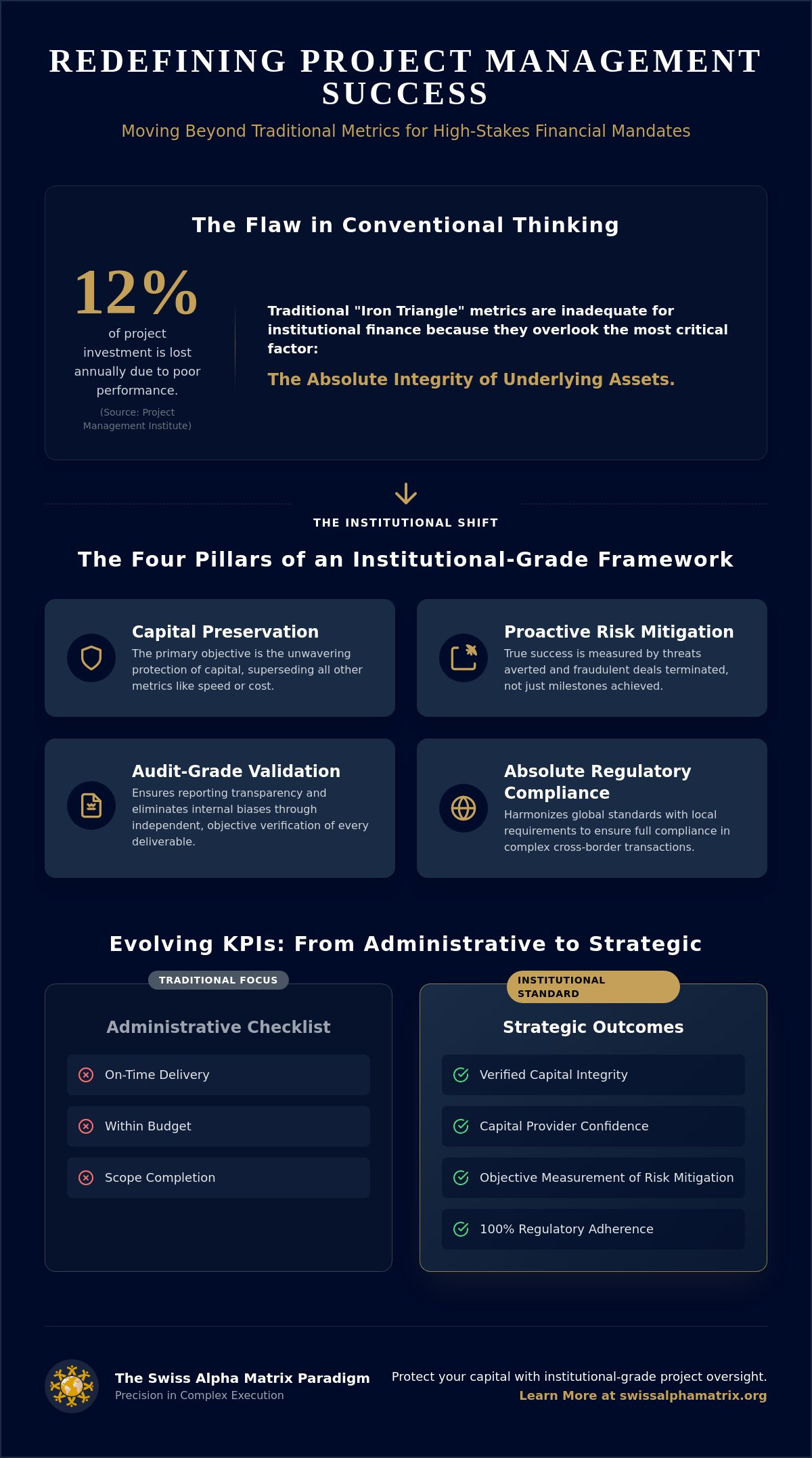
In the rarefied atmosphere of institutional finance, the mere adherence to a timeline or a budget is often the most deceptive indicator of a project’s ultimate viability. You’ve likely observed that standard metrics fail to capture the nuanced realities of capital risk or the transparency required in cross-border deal execution, especially when the Project Management Institute reports that nearly 12% of project investment is lost annually due to poor performance. Understanding how to measure project management success in these high-stakes environments requires a departure from basic administrative tracking in favor of a framework that prioritizes the absolute integrity of the underlying assets.
This article provides the institutional-grade metrics and strategic frameworks necessary to evaluate performance within complex financial mandates. We’ll explore the methodologies for quantifying risk mitigation and achieving audit-grade validation of project deliverables, ensuring that every milestone aligns with the long-term preservation of capital. Our discussion moves from broad principles of governance to the specific strategic pillars required to maintain a standard of service that’s both broad in reach and meticulous in its attention to detail. By shifting the focus from simple completion to rigorous, performance-oriented orchestration, you can establish a standard of excellence that satisfies the most demanding institutional requirements.
Key Takeaways
- Transition from traditional time and cost metrics toward a strategic framework that prioritizes capital preservation and institutional-grade risk mitigation.
- Identify the critical KPIs that resonate with institutional stakeholders, specifically focusing on absolute regulatory compliance and the objective measurement of capital provider confidence.
- Evaluate the necessity of independent, audit-grade validation to ensure reporting transparency and eliminate the inherent biases often found in internal project teams.
- Gain a comprehensive understanding of how to measure project management success in cross-border transactions by harmonizing global standards with local regulatory requirements.
- Apply the Swiss Alpha Matrix Paradigm to achieve a level of analytical precision and discretion that reflects the standards of Tier-1 financial institutions.
Redefining Success: Beyond the Iron Triangle in High-Stakes Finance
Traditional frameworks of evaluation typically rely on the Project Management Triangle, which posits that success is a balance of scope, time, and cost. While these metrics provide a foundational structure for general industry, they’re fundamentally inadequate for the intricacies of high-stakes financial mandates. In the institutional arena, the primary objective isn’t merely the completion of a checklist. It’s the unwavering protection of capital and the alignment of every transaction with rigorous regulatory standards. Understanding how to measure project management success in this context requires a deliberate shift from tactical task completion to strategic capital protection. A project delivered ahead of schedule is a catastrophic failure if the underlying assets are compromised or if the regulatory framework is disregarded.
The transition toward institutional-grade success metrics involves a refusal to oversimplify complex dynamics. Success is defined by the presence of verified capital integrity and the precision of transactional execution. It’s a standard that demands intellectual depth and a commitment to technical accuracy, catering to a sophisticated audience that values nuance over speed. When the stakes involve cross-border transactions and significant capital risk, the traditional “Iron Triangle” must be superseded by a framework that prioritizes the long-term preservation of assets above all else.
The Shift from Deliverables to Institutional Outcomes
The distinction between a completed deliverable and a validated financial outcome is the hallmark of sophisticated project oversight. In complex mandates, a project manager’s success isn’t defined by the sheer volume of tasks finished, but by the technical accuracy of the results. For instance, a delay in a cross-border transaction is often a strategic necessity rather than a failure of management. If deeper due diligence reveals a discrepancy in a counterparty’s history, the pause represents a successful application of institutional standards. Precision in these moments builds long-term stakeholder trust. It demonstrates that capital safety is prioritized over the optics of meeting a deadline.
Success as a Function of Risk Mitigation
True success in financial project management is frequently found in the “unseen” victories, such as the proactive prevention of cross-border investment fraud. We must redefine how to measure project management success by quantifying the risks mitigated rather than just the milestones reached. A project that results in the termination of a bad deal is, by institutional standards, a resounding success. This methodology necessitates the integration of specialized bank instrument validation services into the project’s core success criteria. By ensuring that every instrument is verified with audit-grade precision, the project manager transitions from a simple administrator to a protective authority. This ensures the mandate delivers genuine strategic value while maintaining the highest standards of integrity.
Strategic KPIs for Complex Financial Project Management
Defining how to measure project management success in a high-stakes mandate requires a departure from binary “done/not done” assessments. Instead, we must deploy a suite of Strategic Key Performance Indicators (KPIs) that reflect the gravity of the assets under management. These metrics serve as the definitive record of a project’s health, focusing on institutional-grade outcomes rather than administrative milestones. To truly ensure project success, the methodology must account for the depth of validation required to substantiate every claim made within the deal structure. Precision is not optional. It’s the standard by which all performance is judged.
A sophisticated framework for measuring success prioritizes the following pillars:
- Regulatory Compliance Accuracy: Ensuring 100% adherence to international standards, such as the FCA’s safeguarding requirements taking effect in May 2026.
- Stakeholder Confidence Levels: Quantifying the trust of institutional capital providers through structured feedback and commitment stability.
- Validation Depth: Tracking the ratio of verified versus assumed data points during operational due diligence.
- Capital Efficiency: Measuring the effectiveness of asset protection relative to the management effort expended.
- Operational Resilience: Assessing the project’s ability to maintain integrity despite sudden market shifts or regulatory updates, such as the NCUA’s ongoing deregulation project.
Quantifying Transactional Integrity
Success in complex execution is often determined by the validity of the financial instruments involved. Developing a scoring system for these instruments allows for an objective assessment of risk before capital is committed. On-ground verification services play a vital role here, as they provide the empirical evidence needed to substantiate project metrics and move beyond surface-level assumptions. Transactional integrity is the ultimate benchmark of financial success. Implementing a rigorous Risk Management Framework ensures these scores remain accurate throughout the project lifecycle.
Measuring Stakeholder Alignment and Clarity
Maintaining consensus among elite capital providers requires a structured communication rhythm. Utilizing a deliverable review matrix allows for absolute precision in ensuring that every executive stakeholder is aligned with the project’s trajectory. This alignment is measured by the resolution speed of high-priority risk red flags, where delayed action indicates a breakdown in governance. Meticulous stakeholder management is essential for navigating the intricate layers of cross-border deals, ensuring that project closure is achieved with the unanimous confidence of all parties involved.
The Critical Role of Independent Oversight in Measuring Success
Internal project teams, despite their technical proficiency, are frequently hampered by an inherent conflict of interest when tasked with self-evaluation. The pressure to maintain momentum often results in reporting that prioritizes the appearance of progress over the reality of risk. When determining how to measure project management success in a complex financial mandate, one must acknowledge that objectivity is the first casualty of internal bias. Independent oversight serves as the necessary corrective, transforming project management from a passive tracking exercise into a proactive risk-mitigation engine. This approach doesn’t just monitor milestones; it validates the technical integrity of every underlying transaction through a lens of seasoned, unemotional expertise. By merging institutional experience with objective verification, a master planner can ensure that the project’s trajectory remains aligned with the protective requirements of the mandate.
The necessity of audit-grade validation becomes apparent in the execution of complex, cross-border deals where reporting bias can obscure capital vulnerabilities. Relying solely on internal metrics often leads to a false sense of security, as teams may unintentionally oversimplify complex dynamics to meet perceived expectations. True success is found when an independent authority subjects every project deliverable to rigorous scrutiny, ensuring that the results are not just completed, but verified. This standard of service reflects the traditional discretion of high-end private wealth management, where interests are protected by experts who prioritize long-term preservation over short-term speculation.
Eliminating Information Asymmetry
Independent reviews are essential for uncovering hidden risks that internal teams might overlook due to their proximity to daily operations. Executive-level intelligence differs from standard PMO reporting. It seeks to identify asymmetries between reported progress and the actual health of the project. A “green status” report might indicate that tasks are moving according to the schedule, yet it may fail to flag a subtle shift in counterparty risk or a technical discrepancy in instrument validation. How to measure project management success effectively requires an external perspective that values nuance and technical accuracy, providing a dignified and reassuringly formal assessment of the project’s true standing.
Audit-Grade Reporting as a Success Benchmark
In 2026, the standard for institutional success is defined by audit-grade reporting that withstands the highest levels of scrutiny. This benchmark ensures that all project documentation meets the rigorous requirements of evolving international financial regulations, such as the May 2026 FCA safeguarding updates. Meticulous reporting is not merely an administrative burden; it’s a strategic pillar that anchors long-term capital security. When every project deliverable is substantiated by empirical evidence and verified by an independent partner, the resulting transparency fosters the stability and trust required by sophisticated capital providers.
Implementing a Success Framework for Cross-Border Transactions
The architecture of a cross-border mandate necessitates a success framework that is established well before the first transactional milestone is reached. Defining how to measure project management success in an international context requires the integration of local regulatory nuances into the overarching global metrics. A project that appears successful on paper but fails to account for the specific safeguarding requirements of a particular jurisdiction, such as the FCA’s May 2026 safeguarding updates, is inherently flawed. Success must be viewed as a function of jurisdictional alignment, where the durability of the financial structure is tested against the most stringent local standards. This requires a transition from passive observation to a state of active, strategic orchestration.
Effective execution moves beyond task-based reviews to embrace milestone-based risk assessments. This shift ensures that each phase of the mandate is evaluated not just for its completion, but for its impact on the project’s total risk profile. By conducting these assessments with a focus on institutional outcomes, a master planner can bridge the gap between theoretical planning and operational reality. The post-project evaluation should not merely check off a list of deliverables; it must assess the long-term durability of the financial structure created, ensuring it remains resilient against market volatility and regulatory shifts.
Navigating Global Regulatory Jurisdictions
The definition of success is rarely uniform across global financial centers. While a mandate in London may prioritize specific reporting transparency, a similar transaction in Geneva or Hong Kong might place a higher premium on certain types of transactional discretion or capital preservation protocols. Mastering cross-border investment due diligence is therefore a prerequisite for project success. Success is measured by the project’s ability to navigate these disparate legal frameworks without compromising the integrity of the underlying assets. Compliance across all involved jurisdictions isn’t a secondary goal; it’s a non-negotiable metric that determines the project’s ultimate viability.
The Importance of Physical Verification
In high-value transactions, “paper success” is often a deceptive precursor to catastrophic financial failure. Reports can be polished and documents can be meticulously prepared, but the physical reality of an asset remains the only definitive truth. Defining the “Ground Truth” through on-ground verification is the only valid metric for instrument validation in 2026. This empirical substantiation ensures that the project’s reported health is mirrored by its actual technical status. On-ground verification serves as the ultimate safeguard, ensuring that the success reported to stakeholders is grounded in verified, physical reality. To ensure your next mandate meets these elite standards, engage our Complex Project Management services for unparalleled transactional precision.
The Swiss Alpha Matrix Paradigm: Precision in Complex Execution
The Swiss Alpha Matrix team, comprised of seasoned professionals with extensive backgrounds in Tier-1 banking institutions, redefines the metrics of performance by prioritizing capital integrity over mere administrative efficiency. When determining how to measure project management success, we look beyond the superficial completion of tasks to the underlying security of the mandate. Our methodology integrates the traditional discretion of Swiss financial culture with the rigorous analytical precision required by modern institutional entities, ensuring that every strategic pillar is anchored in technical accuracy. We don’t view project management as a peripheral service but as a dedicated partnership where the master planner’s role is to act as a protective authority for the client’s interests.
Our mandates consistently prioritize long-term stability and strategic growth over the seductive allure of short-term project speed. In the world of high-stakes financial execution, a project that concludes rapidly but leaves residual capital risk or regulatory vulnerability is considered a fundamental failure. We’ve seen that success is a presence of verified capital integrity, substantiated by audit-grade validation and on-ground verification. This measured, steady, and highly logical approach creates a sense of professional calm, allowing institutional stakeholders to feel that their interests are in the hands of seasoned, unemotional experts who refuse to oversimplify complex dynamics.
Bespoke Solutions for Institutional Stakeholders
Success metrics must be as specialized as the mandates they evaluate. We reject standardized templates in favor of bespoke frameworks that are tailored to the specific risk profile and regional requirements of the client. This boutique approach is a significant advantage in high-stakes project management, as it allows for hyper-personalization of the due diligence process. Every project deliverable is subjected to a level of scrutiny that ensures it functions as a verified asset rather than a potential liability. By aligning project outcomes with the meticulous standards of private wealth management, we ensure that the final financial structure is both durable and compliant with the highest levels of institutional expectation.
Securing the Future of Capital Deployment
Initiating a mandate with Swiss Alpha Matrix begins with a structured argument for the methodology, moving from broad philosophical principles of capital preservation down to specific strategic execution. We offer a standard of service that is broad in reach yet meticulous in its attention to detail, providing high-level access to expertise that distinguishes a performance-oriented mindset from passive participation. Our commitment to exclusivity ensures that every engagement receives the full depth of our analytical precision and historical reliability. How to measure project management success becomes clear when the final outcome is a validated, secure, and resilient financial structure that stands the test of time and regulatory scrutiny.
Discover how Swiss Alpha Matrix ensures the success of your most complex financial projects.
Advancing the Standard of Institutional Project Governance
The evolution of high-stakes financial mandates requires a fundamental reappraisal of how to measure project management success, moving beyond administrative checklists toward a paradigm of verified capital integrity. We’ve explored the necessity of transitioning from traditional constraints to a framework that prioritizes strategic risk mitigation and absolute regulatory alignment. Precision remains the ultimate benchmark. By integrating independent oversight and on-ground verification, institutional stakeholders can bridge the gap between reported progress and the physical reality of their assets.
Swiss Alpha Matrix provides the elite expertise required to navigate these complexities, led by former senior executives from Tier-1 global banks who bring decades of transactional and regulatory experience to every engagement. Our boutique approach ensures that your mandates benefit from specialized audit-grade instrument validation and meticulous cross-border oversight, preserving the long-term stability of your interests. Request a Strategic Consultation for Independent Project Oversight to secure the precision your capital deserves. We look forward to partnering with you to achieve a standard of execution that reflects the highest ideals of regional excellence and professional discretion.
Frequently Asked Questions
What is the most important metric for project success in finance?
The most important metric is the absolute preservation of capital integrity throughout the mandate’s lifecycle. While standard metrics track administrative progress, financial mandates require a focus on whether the underlying assets remain protected and the transactional structures remain resilient. Success is defined by the absence of capital erosion and the unwavering adherence to the mandate’s protective requirements rather than simple task completion.
How does financial project management differ from standard project management?
Financial project management differs from standard methodologies by prioritizing risk mitigation and regulatory alignment over simple deliverable completion. Standard project management often utilizes the triple constraint of time, cost, and scope, but financial mandates involve complex layers of cross-border compliance and capital risk. Understanding how to measure project management success in this field necessitates a focus on institutional-grade outcomes rather than administrative milestones.
Is it possible for a project to be on time and on budget but still fail?
It’s entirely possible for a project to meet all schedule and budgetary targets while remaining a fundamental failure. If a transaction is completed on time but fails to identify a technical discrepancy in a bank instrument or breaches a local regulatory requirement, the result is a catastrophic loss of capital integrity. True success requires the presence of verified safety and technical accuracy, not just the fulfillment of a timeline.
How do you measure the success of cross-border investment due diligence?
Success in cross-border investment due diligence is measured by the project’s ability to achieve absolute jurisdictional alignment. This involves verifying that the transaction complies with disparate legal frameworks, such as the FCA’s May 2026 safeguarding updates, while maintaining the durability of the financial structure. Success is substantiated when every local nuance is integrated into the global risk management framework without compromising the integrity of the assets.
What role does independent oversight play in project evaluation?
Independent oversight provides the objective verification necessary to eliminate internal reporting bias. Internal teams often oversimplify complex dynamics to maintain the appearance of progress, whereas an independent partner seeks the “Ground Truth” through seasoned expertise. This protective authority ensures that the metrics reported to stakeholders are grounded in empirical evidence and technical accuracy, transforming the evaluation process into a proactive risk-mitigation engine.
Can audit-grade validation be integrated into existing project life cycles?
Audit-grade validation can be seamlessly integrated into existing project life cycles through the implementation of milestone-based risk assessments. Rather than waiting for the project’s conclusion, these rigorous evaluations occur at critical intervals to verify the technical integrity of deliverables. This approach ensures that every phase of the mandate meets institutional standards, preventing the accumulation of unseen liabilities that could jeopardize the final outcome of the transaction.
How does Swiss Alpha Matrix define project success for its clients?
Swiss Alpha Matrix defines success as the presence of verified capital integrity and the achievement of long-term strategic stability for our clients. We prioritize the meticulous protection of assets over short-term project speed, ensuring that every transaction reflects the standards of Tier-1 banking institutions. Our mandates are successful only when the final financial structure is resilient, compliant, and substantiated by rigorous on-ground verification and analytical precision.
What are the common pitfalls in measuring financial project outcomes?
A common pitfall is the over-reliance on “paper success,” where polished reports mask underlying technical vulnerabilities. Teams frequently fail to account for the inherent bias in internal reporting or the limitations of standard metrics in capturing capital risk. Learning how to measure project management success requires avoiding these superficial assessments in favor of deep, audit-grade validation that subjects every assumption to empirical scrutiny and institutional-level oversight.