

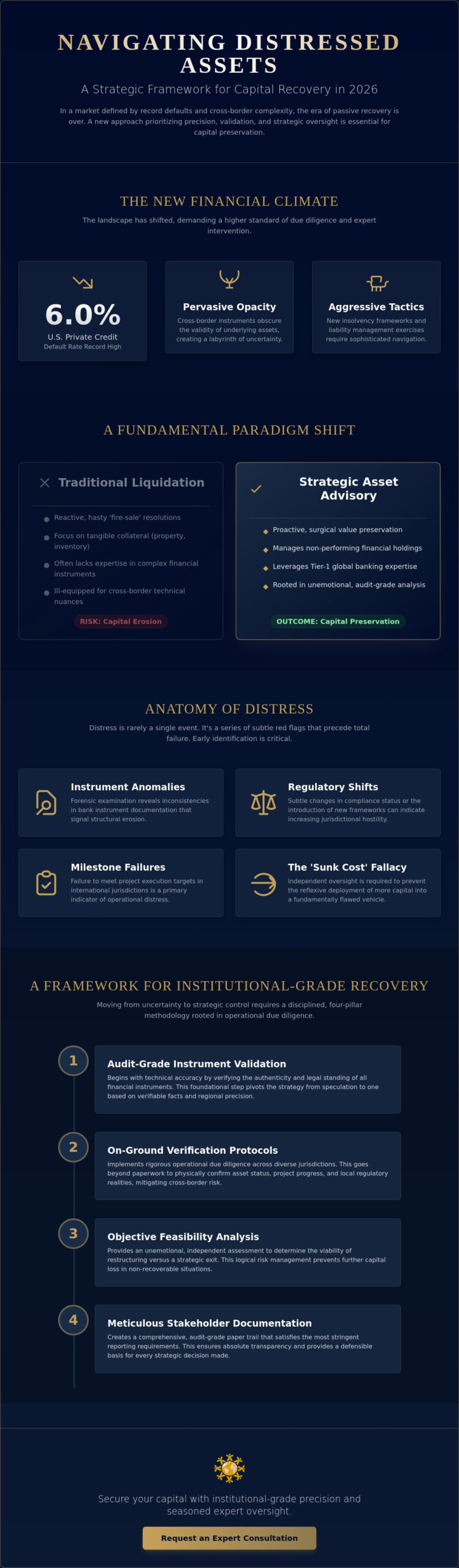
With the U.S. private credit default rate reaching a record high of 6.0% in May 2026, the era of passive capital recovery has officially concluded, replaced by a climate that demands surgical precision and absolute transparency. For institutional entities and sophisticated family offices, the inherent opacity of cross-border financial instruments often transforms a manageable risk into a labyrinth of regulatory uncertainty, where the validity of underlying assets remains frustratingly obscured. You likely recognize that in this current landscape, marked by increasingly aggressive liability management exercises and the implementation of new frameworks like the Cross-Border Insolvency Act 2026 in Malaysia, the absence of rigorous oversight is a direct precursor to irreversible capital erosion.
This article outlines a sophisticated strategic framework for leveraging distressed asset advisory services to navigate these complexities with institutional-grade precision and seasoned expert oversight. We’ll explore the essential pillars of capital recovery, including audit-grade instrument validation, on-ground verification protocols, and the creation of meticulous documentation that satisfies the most stringent stakeholder reporting requirements. By shifting from reactive liquidation toward a methodology rooted in operational due diligence and logical risk management, you can effectively mitigate further loss and secure a clear, definitive assessment of asset recoverability in an increasingly volatile global market.
Key Takeaways
- Identify the strategic transition from traditional asset liquidation to the management of sophisticated financial instruments and stalled investment programmes.
- Recognize institutional red flags within bank instrument documentation and project milestones that indicate underlying distress or procedural failures.
- Understand how professional distressed asset advisory services utilize audit-grade validation to determine the objective feasibility of restructuring versus a strategic exit.
- Navigate the complexities of international recovery by implementing on-ground verification protocols and rigorous operational due diligence across diverse jurisdictions.
- Adopt a measured, expert-led framework that prioritizes long-term capital preservation through unemotional analysis and institutional-grade oversight.
Defining Distressed Asset Advisory Services in Complex Financial Ecosystems
The discipline of distressed asset advisory services has evolved into a high-stakes arena of strategic evaluation, moving far beyond the rudimentary liquidation of tangible collateral. While traditional market participants often equate distress with real property or physical inventory, the modern financial landscape of 2026 is increasingly defined by underperforming distressed securities and stalled investment programmes that lack a physical footprint. This shift necessitates a framework that prioritizes the preservation of capital through the rigorous management of non-performing financial holdings rather than a hasty rush toward fire-sale resolutions.
Traditional insolvency practitioners frequently find themselves ill-equipped to manage the technical nuances of non-performing financial instruments. Their expertise, while robust in domestic statutory frameworks, often lacks the depth required to dissect cross-border project distress or the intricacies of Tier-1 banking protocols. This specialized advisory role demands more than just a list of creditors. It requires an unemotional, independent oversight that can identify the ‘sunk cost’ fallacy before it consumes remaining capital reserves. By providing a logical, structured argument for the recovery methodology, seasoned experts prevent the reflexive deployment of further capital into fundamentally flawed vehicles.
The Spectrum of Asset Distress
Distress is rarely a binary state; it exists on a spectrum that ranges from mere operational friction to total financial instrument invalidity. In the context of cross-border investment structures, identifying these tremors early is paramount. Often, the first sign of failure isn’t a missed payment but a subtle shift in regulatory compliance or a failure to meet milestone execution targets in international jurisdictions. Recognizing the intersection of regulatory non-compliance and asset underperformance allows for a structured recovery before the legal environment becomes prohibitively hostile. This is particularly relevant as jurisdictions like Malaysia introduce the Cross-Border Insolvency Act 2026, which alters the landscape for international enforcement and requires a more sophisticated approach to asset identification.
Why Institutional Expertise Matters
Navigating complex mandates requires the quiet authority that only decades of Tier-1 global banking experience can provide. Transitioning from reactive liquidation to proactive value preservation is the hallmark of a sophisticated recovery framework. This process begins with a foundation of technical accuracy, specifically through bank instrument validation services. By verifying the authenticity and status of instruments at the earliest stages, stakeholders can pivot from speculation to a strategy rooted in regional precision and historical reliability. It’s about moving from the chaos of uncertainty to a position of informed, strategic control where every decision is backed by audit-grade documentation.
The Anatomy of Distress: Identifying Red Flags in Financial Instruments
The anatomy of distress is rarely defined by a single, catastrophic event, but rather by a series of subtle, technical anomalies that signify a deeper erosion of structural integrity. In an environment where the U.S. leveraged loan default rate reached 4.5% in May 2026, identifying these early signals requires a departure from traditional financial observation. Effective distressed asset advisory services must therefore prioritize the forensic examination of bank instrument documentation, where inconsistencies often precede total project failure. For institutional entities, mastering the nuances of distressed asset investing requires a vigilant eye for discrepancies between reported asset values and the tangible, on-ground operational reality that often tells a different story.
Technical Red Flags in SBLCs and LCs
Technical distress often manifests within the specialized Swift messaging protocols that underpin international trade and finance. Sophisticated participants monitor for manipulations in MT760 and MT799 messages, where unauthorized alterations can mask a lack of liquidity or the total invalidity of a Standby Letter of Credit (SBLC). Assessing the audit-grade quality of financial instrument validation reports is essential to distinguish between standard market-driven volatility and terminal structural failure. When these protocols lack transparency, the risk of capital loss escalates significantly, necessitating immediate expert-led intervention to verify the instrument’s standing within Tier-1 banking systems.
Operational Indicators of Project Failure
Beyond the technical documentation, the breakdown of independent financial project management serves as a primary indicator of impending distress. Project failure is frequently telegraphed by a lack of transparent reporting from on-ground leads or unexplained delays in milestone execution within cross-border structures. These operational hurdles are often exacerbated by stalled regulatory approvals in foreign jurisdictions, which can trap capital in a state of perpetual uncertainty. It’s during these phases that the emergence of counterparty risk, often triggered by increased regulatory scrutiny or international sanctions, becomes a critical factor in determining whether an asset remains recoverable.
The presence of these red flags demands a measured, unemotional response that prioritizes long-term preservation over short-term speculation. Discerning whether a delay is a temporary friction point or a sign of systemic fraud is the cornerstone of professional oversight. For those seeking to fortify their recovery strategy, implementing a rigorous operational due diligence framework can provide the technical accuracy required to navigate these complex mandates with confidence.
Beyond Liquidation: A Strategic Framework for Asset Value Preservation
The standard reaction to asset impairment is often a hasty retreat toward liquidation, yet sophisticated distressed asset advisory services recognize that such a path frequently crystallizes losses that might otherwise be mitigated. While many market participants prioritize a quick exit through loan sales or collateral fire sales, a more dignified approach centers on a strategic framework for value preservation. This methodology begins with an audit-grade validation of the asset’s core value, ensuring that any subsequent decision is rooted in technical reality rather than emotional urgency. It’s about establishing a milestone-based recovery roadmap that provides stakeholders with clear, documented deliverables at every stage of the process, moving from the chaos of uncertainty to a position of informed, strategic control.
The Validation-Led Recovery Model
Effective recovery is built upon the foundation of financial advisory methodologies that prioritize instrument legitimacy above all else. By utilizing independent oversight, advisors can provide the unbiased evaluation necessary to determine if a project warrants further capital deployment or if the structural defects are terminal. This deep-dive investigation informs the critical “pivot or persevere” decision, moving beyond the speculative nature of many recovery efforts. According to Wharton’s Distressed Asset Investing Framework, the most successful restructuring efforts are those that treat the distressed situation as a complex project requiring high-level management rather than just a legal dispute. This perspective allows seasoned experts to identify value where others see only failure, leveraging technical accuracy to protect the interests of institutional entities.
Restructuring Complex Mandates
When the validation phase confirms the underlying viability of a project, the focus shifts toward re-negotiating terms with counterparties based on verified status. This isn’t merely a financial exercise; it’s a structural realignment that must harmonize with the latest international financial regulations. In a year where jurisdictions are rapidly updating their frameworks, such as the UK’s adaptation to the Hague Judgments Convention of 2019, compliance isn’t optional. It’s the primary safeguard for the integrity of remaining capital. By implementing a rigorous stakeholder management plan, advisors ensure that expectations are managed with the discretion and precision that institutional entities demand. Protecting capital through strict regulatory compliance advisory ensures that the recovery process itself doesn’t trigger secondary exposures or legal complications in foreign jurisdictions.
Navigating the Operational Hurdles of Cross-Border Recovery
Cross-border recovery often founders on the rocks of local market opacity and jurisdictional friction. While previous sections detailed the technical red flags within financial instruments, the operational reality of recovery requires a transition from the digital to the physical. Professional distressed asset advisory services must manage these hurdles with a sense of quiet authority, ensuring that every step taken in a foreign jurisdiction is backed by regional precision. It’s essential that cross-border investment due diligence is continuously updated to reflect the specific pressures of distress, such as the UK’s adaptation to the Hague Judgments Convention or the implementation of the Cross-Border Insolvency Act 2026 in Malaysia. These frameworks change the legal enforcement landscape, requiring a sophisticated understanding of how to salvage value without triggering secondary exposures.
The Role of Physical On-Ground Verification
Digital audit trails, while necessary, are fundamentally insufficient for distressed cross-border projects where documentation can be meticulously fabricated. True recovery requires the physical verification of assets and the legitimacy of local entities in person. This process involves merging the traditional discretion of Swiss oversight with granular local market intelligence. By deploying experts to the project site, an advisory firm can verify operational reality against reported milestones. It ensures the recovery strategy is based on facts rather than optimistic projections. This level of scrutiny is often the only way to overcome communication barriers and the inherent opacity of emerging markets.
Regulatory and Compliance Alignment
Navigating the transfer of distressed assets requires a meticulous approach to Anti-Money Laundering (AML) and Know Your Customer (KYC) requirements. Failure to adhere to these standards during the recovery phase can expose an institution to “successor liability,” where the acquirer becomes responsible for the previous entity’s regulatory failures or moral character deficits. Every effort must adhere to audit-grade documentation standards to satisfy both internal stakeholders and external regulators. This rigor ensures that the recovery process itself doesn’t become a source of further regulatory risk or reputational damage. It’s a protective measure that mirrors the discretion of high-end private wealth management, prioritizing long-term stability over short-term gains.
For institutions facing the intricacies of international project distress, securing on-ground verification services is the most logical step to ensure technical accuracy and capital protection in an increasingly complex global ecosystem.
The Swiss Alpha Matrix Approach to Distressed Asset Oversight
The efficacy of capital recovery in 2026 is fundamentally linked to the caliber of oversight applied to the mandate. At Swiss Alpha Matrix, we leverage decades of Tier-1 global banking expertise to manage complex mandates that require more than just a superficial review. Our distressed asset advisory services are characterized by an independent, unemotional analysis that prioritizes long-term capital preservation over short-term speculation. This boutique approach ensures that every engagement is conducted with the traditional discretion of high-end private wealth management, providing institutional entities with the privacy and exclusivity they demand. By merging financial discipline with meticulous technical accuracy, we position ourselves as a dedicated partner rather than a mere service provider, acting as a master planner in the landscape of complex finance.
Mandate-Specific Engagement Strategies
We recognize that no two distressed situations are identical, particularly when dealing with the technical nature of non-performing financial instruments. Our advisory is tailored to the specific nuances of the instrument in question, moving away from broad consulting toward a precise, milestone-based execution. This hyper-personalized strategy ensures that every step of the recovery process is backed by executive-level intelligence, allowing for precise capital deployment decisions. Whether the distress involves inconsistencies in Swift messaging or the failure of a cross-border project, our focus remains on providing technical accuracy and on-ground verification that digital audit trails simply cannot replicate. It’s a performance-oriented mindset that distinguishes our methodology from passive participants in the market.
Protecting the Stakeholder’s Long-Term Interests
The ultimate objective of our framework is the seamless transition from distress management to stable project oversight. We don’t merely resolve the immediate crisis; we establish robust risk management frameworks designed to prevent the recurrence of distress. By implementing rigorous operational due diligence and regulatory compliance advisory, we ensure that the integrity of the asset is maintained long after the initial recovery phase is complete. This enduring commitment to regional excellence and technical precision reinforces our reputation for historical reliability. Institutional entities and high-net-worth individuals find confidence in our ability to navigate the most intricate financial ecosystems with a calm, unwavering pace, ensuring that their interests remain in the hands of seasoned experts who value prestige and moral character above all else.
Securing Capital Integrity through Institutional Oversight
The evolution of capital recovery in 2026 demands a fundamental shift from reactive, fire-sale liquidation toward a methodology rooted in technical validation and on-ground operational reality. By prioritizing audit-grade instrument validation and maintaining a vigilant eye for the subtle technical red flags discussed throughout this framework, institutional entities can effectively navigate the complexities of cross-border project distress while mitigating further exposure to capital loss. It’s the implementation of a structured, milestone-based roadmap, rather than speculative recovery efforts, that transforms jurisdictional uncertainty into a logical path toward long-term value preservation.
Engaging professional distressed asset advisory services ensures that your interests are managed by former Tier-1 global bank executives who bring decades of cross-border transactional expertise to every mandate. Our boutique framework prioritizes discretion and technical accuracy, providing the master planning required to stabilize underperforming holdings in an increasingly volatile global landscape. We invite you to secure a confidential consultation with our senior advisory team to discuss the specific technical nature of your mandate. With the right strategic partner, even the most complex financial distress can be managed with the precision and professional calm that your stakeholders expect.
Frequently Asked Questions
What qualifies as a distressed asset in complex financial project management?
A distressed asset in this context is any financial holding or investment programme that has deviated from its projected performance milestones or exhibits signs of structural invalidity. Beyond traditional real property, this includes stalled financial instruments where the underlying liquidity or collateral is no longer transparently verifiable. Identifying these assets early requires a focus on operational friction and regulatory non-compliance before the impairment becomes terminal.
How do distressed asset advisory services differ from standard investment consulting?
Unlike standard consulting, which prioritizes portfolio growth and initial deployment, distressed asset advisory services focus on the forensic recovery and preservation of existing capital. This specialized discipline requires a technical depth that extends into instrument-specific distress and operational due diligence. It’s an expert-led intervention designed to navigate the complexities of non-performing mandates with a level of precision that generalist consultants simply don’t possess.
Is physical on-ground verification necessary for financial instrument validation?
Physical on-ground verification is absolutely essential because digital audit trails can be meticulously manipulated to mask a project’s actual failure. Direct inspection of local entities and assets ensures that the reported milestone execution aligns with operational reality. This process merges Swiss discretion with granular market intelligence, providing the technical accuracy required to make informed decisions about the viability of a cross-border recovery strategy.
What are the first steps an institution should take when a cross-border project stalls?
The immediate priority should be the cessation of further capital deployment followed by a rigorous, independent assessment of the project’s current status. Institutions must secure audit-grade instrument validation to determine if the underlying financial vehicle remains legitimate. By taking these initial steps, stakeholders can avoid the sunk cost fallacy and establish a clear, documented baseline for either restructuring the mandate or pursuing a strategic exit.
How does Swiss Alpha Matrix handle the regulatory complexities of international asset recovery?
We manage these complexities through a framework of Regulatory Compliance Advisory that aligns with modern international standards, such as the UK’s Hague Judgments Convention of 2019. Our approach ensures that every step of the recovery process adheres to stringent AML and KYC requirements. This meticulous oversight protects the institution from successor liability and ensures that all documentation meets the standards required for high-level stakeholder reporting.
Can a distressed financial instrument be salvaged, or is liquidation always the goal?
Liquidation is never the default objective; many distressed instruments can be salvaged through a validation-led restructuring framework. If the core value of the asset is confirmed through deep-dive investigations, we can re-negotiate terms with counterparties to align with current market realities. The goal is to preserve capital and restore the project’s integrity, moving toward stable oversight rather than a reflexive, fire-sale disposition.
What role does independent oversight play in the recovery of capital from non-performing mandates?
Independent oversight serves as a protective barrier against the emotional urgency and bias that often characterize distressed scenarios. It provides an unemotional, logical analysis of the asset’s recoverability, ensuring that technical accuracy isn’t compromised by internal pressures. This transparency is vital for providing stakeholders with the audit-grade documentation they require to verify that their interests are being handled by seasoned, objective experts.
How does Tier-1 banking experience translate to distressed asset advisory?
Tier-1 banking experience provides the intellectual depth necessary to dissect complex Swift messaging protocols and institutional risk management frameworks. This background allows advisors to understand the internal mechanisms of global financial systems, from MT760 verification to the nuances of multi-jurisdictional enforcement. It’s this regional precision and historical reliability that enable us to navigate the most sophisticated mandates with the quiet authority our clients expect.