

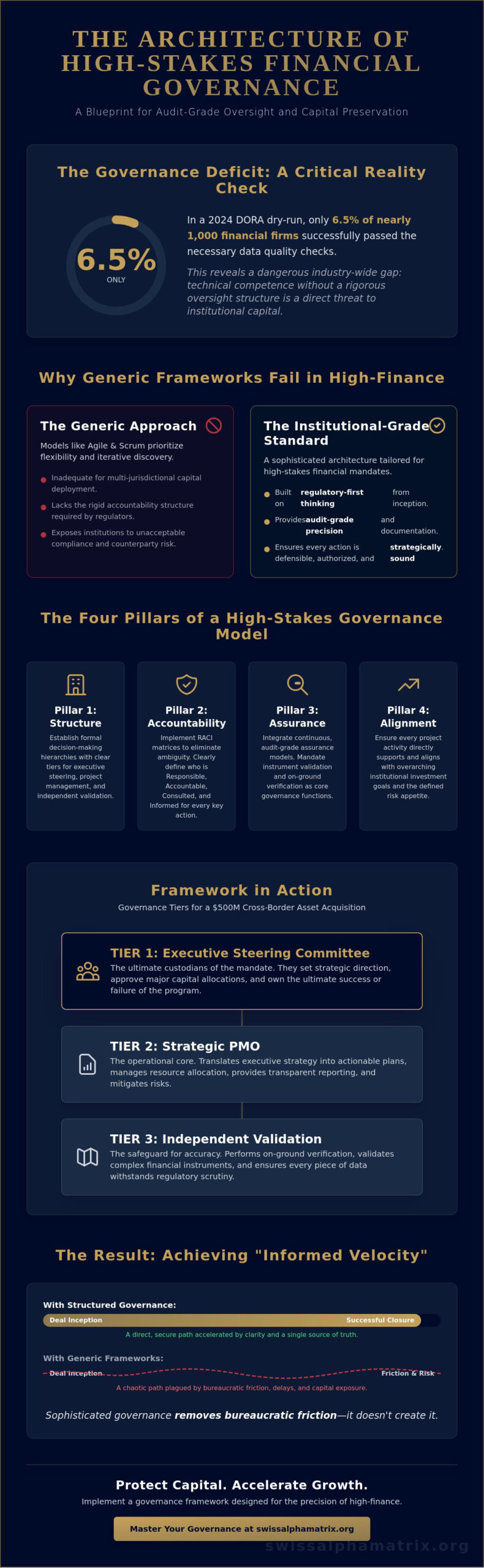
When a 2024 dry-run exercise for the Digital Operational Resilience Act (DORA) revealed that only 6.5% of nearly 1,000 participating financial firms successfully passed the necessary data quality checks, the industry received a sobering reminder that technical competence is insufficient without a rigorous oversight structure. In a landscape defined by the COINS Act of 2025 and increasingly intricate cross-border mandates, relying on a generic project governance framework example is no longer a viable strategy for the preservation of institutional capital. It’s clear that the complexity of modern financial programmes demands a level of precision that transcends standard administrative checklists, requiring instead a sophisticated architecture that mirrors the traditional discretion of high-end wealth management.
You likely recognize that the traditional ambiguity surrounding decision-making rights often leads to unacceptable capital exposure and regulatory friction in multi-jurisdictional deals. This article provides a strategic blueprint to master the architecture of high-stakes project oversight. By reading, you’ll learn to ensure every mandate adheres to the strictest standards of audit-grade accountability and regulatory precision. We’ll examine the evolution of the Strategic PMO, the integration of continuous assurance models, and the specific methodology required to align intricate project activities with your overarching investment objectives and risk appetite.
Key Takeaways
- Distinguish between permanent corporate structures and mandate-specific project governance to ensure that high-stakes financial programmes receive the dedicated oversight required for capital preservation.
- Analyze a sophisticated project governance framework example through the lens of a $500M cross-border asset acquisition, detailing the necessary tiers for executive steering and independent validation.
- Implement formal decision-making hierarchies and RACI matrices to eliminate ambiguity in decision rights, effectively reducing operational and counterparty risk in complex financial transactions.
- Adopt the concept of “informed velocity” to accelerate deal closures, demonstrating how structured governance removes bureaucratic friction rather than creating it.
- Align project execution with institutional investment goals by integrating audit-grade instrument validation and on-ground verification into the core governance architecture.
Defining the Institutional-Grade Project Governance Framework
A Project governance framework serves as the strategic architecture that directs, controls, and ultimately protects a specific financial mandate from the erosion of value. While corporate governance provides the permanent, overarching structure for an enterprise, project governance is a distinct and temporary discipline. It’s meticulously tailored to the unique risks of a specific transaction or initiative, such as a large-scale asset acquisition or the validation of complex financial instruments. It’s the mechanism that ensures institutional capital isn’t merely deployed but is actively safeguarded through every phase of a complex lifecycle, providing a level of oversight that mirrors the traditional discretion of high-end wealth management.
For mandates involving cross-border deals or intricate regulatory requirements, the margin for error is non-existent. This environment necessitates “audit-grade” precision. Such precision isn’t a bureaucratic burden; it’s a strategic necessity. When dealing with the movement of capital across jurisdictions, the governance framework acts as a protective shield. It ensures that every action is documented, every decision is authorized, and every risk is mitigated before it can impact the balance sheet. Without this rigour, the alignment between project activities and investment goals becomes fractured, exposing the institution to regulatory non-compliance and unnecessary counterparty risk.
The Distinction Between Management and Governance
It’s vital to recognize that management and governance are complementary yet fundamentally different functions. Management is the engine of execution, focused on the tactical necessity of “doing things right” to meet immediate milestones. Conversely, governance provides the steering. It’s focused on “doing the right things” in accordance with long-term fiduciary duties. Governance provides the essential checks and balances that management teams, who are often incentivized by speed and delivery, may overlook. By establishing a robust project governance framework example, an organization creates a single source of truth. This allows executive stakeholders to maintain absolute visibility and technical accuracy without becoming mired in daily operational minutiae.
Why Generic Frameworks Fail in High-Finance
Generic models, particularly those born from software development like Agile or Scrum, often prove inadequate for high-finance mandates. These models prioritize flexibility and iterative discovery. While these traits are useful for developing applications, they’re often dangerous when applied to multi-jurisdictional capital deployment. A sophisticated governance structure must prioritize regulatory-first thinking from the outset. Capital deployment requires a rigid accountability structure that prioritizes permanence and precision over the fluid adaptability of typical operational projects. Within the context of complex financial mandates, the framework must be designed to withstand the scrutiny of regulators and auditors alike, ensuring that every deployment of capital is both defensible and strategically sound.
The Four Pillars of a High-Stakes Financial Governance Model
Building upon the foundational definitions of institutional oversight, a functional project governance framework example must rest upon four non-negotiable pillars that ensure strategic alignment and capital preservation. These pillars function as the structural load-bearers of a mandate, providing the stability required to manage multi-million dollar deployments across differing regulatory environments. Without these core elements, even the most promising investment programmes risk succumbing to the weight of decision-paralysis and operational drift.
Pillar 1 & 2: Structure and Accountability
The hierarchy of authority begins with the Project Sponsor, who acts as the ultimate custodian of the mandate’s success and the primary link to the organization’s broader investment objectives. Beneath the Sponsor, the Project Steering Committee (PSC) serves as the strategic decision-making body. In a financial context, the PSC is responsible for approving major budgetary shifts, resolving high-level resource conflicts, and ensuring that the project remains within the predefined risk appetite of the institution. This committee provides a necessary layer of separation from the project team, allowing for objective, unemotional oversight that prioritizes long-term stability.
Absolute clarity in these structures is achieved through a rigorous RACI analysis. This matrix defines who is Responsible, Accountable, Consulted, and Informed for every critical milestone. In cross-border deals, where jurisdictional nuances can lead to conflicting interpretations of authority, the RACI matrix prevents the ambiguity that often leads to capital exposure. It ensures that every stakeholder understands their specific role, creating a culture of accountability that is essential for maintaining technical accuracy in complex transactions. For those seeking to refine their internal controls, implementing bespoke Risk Management Frameworks can provide the necessary rigour to support these accountability structures.
Pillar 3 & 4: Engagement and Risk Mitigation
Managing the intricate needs of investors, internal boards, and regulators requires a sophisticated stakeholder engagement strategy. This is particularly vital when dealing with multi-jurisdictional regulatory bodies, where compliance isn’t a static requirement but a dynamic process. Effective governance involves mapping these stakeholders and establishing formal communication protocols that ensure all parties receive the appropriate level of detail at the correct frequency. This proactive approach fosters trust and ensures that regulatory requirements, such as those mandated by the COINS Act or DORA, are addressed well in advance of enforcement deadlines.
The final pillar, Risk and Compliance Oversight, involves embedding audit-grade validation into the very fabric of the project lifecycle. This includes the integration of bank instrument validation services directly into the governance reporting cycle. By treating validation as a recurring governance activity rather than a one-time management task, institutions can maintain a continuous state of assurance. All governance activities, decisions, and validation reports should be housed within a centralized Governance Information Repository. This repository serves as the definitive audit trail, providing a transparent and immutable record of the project’s adherence to its strategic blueprint and regulatory obligations.
A Practical Project Governance Framework Example: Cross-Border Asset Acquisition
To move from theoretical principles to practical application, consider a $500M cross-border investment programme involving the acquisition of distressed infrastructure assets across multiple European jurisdictions. In such a high-stakes environment, the margin for operational error is non-existent. This specific project governance framework example illustrates how institutional rigour is maintained through three distinct yet interlocking tiers of oversight, each designed to provide the necessary checks and balances that prevent capital erosion and ensure regulatory precision.
Tier 1: The Executive Steering Committee
The first tier consists of the Executive Steering Committee, a body typically composed of former Tier-1 bank executives and lead strategic advisors who possess the technical depth to oversee complex financial mandates. Their primary objective is fiduciary oversight, ensuring that every deployment of capital remains strictly aligned with the institution’s long-term risk appetite and strategic goals. Unlike a standard project board, this committee focuses on strategic pivot decisions and the mitigation of systemic risks that could threaten the programme’s viability. Their key deliverable is the Strategic Alignment Report, a monthly document that provides an unemotional assessment of the mandate’s health against its original investment thesis.
Tier 2: The Independent Validation Unit
The second tier, the Independent Validation Unit, serves as a critical firewall against internal bias and the “deal-fever” that often plagues large-scale acquisitions. By utilizing third-party advisory for instrument and entity verification, the institution ensures that all due diligence is conducted with absolute objectivity. This unit operates outside the direct reporting line of the project management team, providing an unbiased perspective on counterparty reliability and the technical accuracy of financial instruments. Integrating such a unit is a hallmark of mastering cross-border investment due diligence, as it provides the audit-grade evidence required for final investment committee approvals.
The success of this tiered approach relies on a disciplined reporting cadence that balances technical detail with strategic oversight. Weekly Executive Summaries provide the Steering Committee with granular data on operational progress and immediate risks, while Monthly Strategic Reviews focus on broader market shifts and regulatory changes, such as the implementation of the COINS Act. This dual-speed reporting ensures that no detail is overlooked while maintaining a focus on long-term preservation.
Central to this project governance framework example is a clearly defined Escalation Path. This mechanism identifies red flags in real-time, such as unexpected jurisdictional regulatory hurdles or discrepancies in financial instrument validation. When a red flag is raised, the framework mandates an immediate, structured response that surfaces the issue to the appropriate tier of authority within twenty-four hours. This ensures that informed velocity is maintained, allowing the institution to mitigate risks before they escalate into significant capital exposures.
Navigating Complexity: Overcoming the Bureaucracy Objection
A common point of resistance among transaction teams is the perception that rigorous oversight serves only as a bureaucratic anchor, dragging down the momentum of time-sensitive deals. This view, while common, fails to account for the reality that true speed in institutional finance is not measured by the velocity of the initial handshake, but by the efficiency of the final closing. A robust project governance framework example demonstrates that clear decision-rights actually accelerate deal closing by removing the ambiguity that often leads to late-stage stalls. By front-loading the architecture of authority, an organization replaces the frantic energy of reactive problem-solving with the measured, steady pace of a master planner.
Informed Velocity vs. Reckless Speed
The most successful global mandates operate on a philosophy where slow is smooth and smooth is fast. Reckless speed often leads to the omission of critical regulatory checks, resulting in costly re-work or, in severe cases, the collapse of a trade during the final audit. Consider the impact of missing a key validation milestone in a cross-border trade; the subsequent delays while retracing steps to satisfy compliance requirements far outweigh the time invested in initial oversight. Right-sizing this project governance framework example for different mandate complexities ensures that the rigour applied is always proportionate to the capital at risk, allowing for what we define as informed velocity.
This right-sizing approach, often described as T-shirt sizing for finance, allows an institution to apply varying levels of oversight based on the mandate’s profile. A $50M domestic project may require a streamlined version of the framework, whereas a $500M multi-jurisdictional acquisition demands the full weight of audit-grade validation and executive steering. This flexibility ensures that governance remains a facilitator of progress rather than a hindrance, providing the necessary precision without unnecessary administrative weight.
Independent Project Oversight as a Value-Add
Positioning independent financial project management as an insurance policy for the C-suite transforms governance from a perceived cost into a strategic asset. External experts bring a sense of dignified neutrality to contentious stakeholder debates, particularly when navigating the conflicting interests of multi-jurisdictional partners. This independent layer provides an underlying emotional current of stability and trust, reassuring executive boards that the mandate is in the hands of seasoned, unemotional experts who prioritize long-term preservation over short-term speculation.
The psychological benefit of this stability cannot be overstated. When stakeholders feel that interests are being managed by a protective authority with regional precision, the friction typically associated with complex negotiations dissipates. This environment of professional calm encourages confidence in the decision-making process, ultimately leading to more secure and successful capital deployments. To secure this level of institutional precision for your next mandate, consider implementing bespoke Risk Management Frameworks designed for high-stakes oversight.
Implementing Sophisticated Governance with Swiss Alpha Matrix
At Swiss Alpha Matrix, we recognize that a standard project governance framework example, while useful for academic purposes, often fails to meet the exacting requirements of the world’s most sophisticated institutional entities. Our approach is defined by a merging of rigid institutional discipline with the traditional discretion synonymous with Swiss financial excellence. We don’t merely apply a template; we design a bespoke architecture that mirrors the intricate nature of your specific financial mandate, ensuring that capital is not only deployed but is protected by a framework characterized by absolute technical accuracy and a refusal to oversimplify complex dynamics.
The strength of our oversight resides in the caliber of our personnel. By leveraging the expertise of former Tier-1 bank executives, we bring a level of intellectual depth and historical reliability to every project. These seasoned experts understand the nuances of global performance metrics and the subtle pressures of multi-jurisdictional compliance, allowing them to act as master planners who anticipate risks before they manifest as operational failures. This elite level of access ensures that our clients are not merely participants in the market but are leaders who benefit from a standard of service that is both broad in reach and meticulous in its attention to detail.
Our Proprietary Advisory Methodology
Our institutional-grade financial advisory methodologies are built upon the principle of audit-grade reporting and continuous assurance. This means every validation step, from on-ground verification to complex instrument analysis, is documented with a level of precision that satisfies the most stringent regulatory bodies. We prioritize the long-term preservation of capital over short-term speculation, providing our clients with a sense of quiet authority and the reassurance that their interests are managed by experts who value moral character and high-level standards above all else. This methodology ensures a project governance framework example that is as robust as it is refined, tailored specifically to the needs of high-net-worth individuals and institutional entities.
Engagement and Strategic Partnership
We position ourselves as a dedicated partner rather than a mere service provider, a distinction that reflects our commitment to exclusivity and hyper-personalization. This boutique approach ensures that every client receives meticulous attention to detail and high-level access to our senior leadership. Moving from a conceptual framework to an operationalised governance structure requires a steady, logical transition that aligns your project activities with your overarching investment goals. It’s a journey from broad philosophical principles down to specific strategic pillars, executed with a calm, unwavering pace that encourages confidence. To begin this process and secure a standard of regional excellence for your capital, we invite you to consult with our senior executives on your governance requirements, ensuring your next mandate is governed with the precision it deserves.
Mastering the Architecture of Strategic Preservation
The shift from passive project participation to active strategic oversight requires a fundamental re-evaluation of how authority is structured within complex financial mandates. By distinguishing between permanent corporate functions and the temporary, high-stakes requirements of a specific transaction, institutions can effectively mitigate capital exposure. We’ve explored how a robust project governance framework example serves not as a bureaucratic constraint but as a sophisticated mechanism for informed velocity, ensuring that every deployment of capital is supported by technical accuracy and unassailable accountability through every phase of the lifecycle.
Achieving this level of precision requires a partner who possesses the intellectual depth to navigate multi-jurisdictional complexities with regional excellence. Led by former Tier-1 global bank executives, our team brings decades of cross-border transactional and risk management expertise to the table, maintaining audit-grade instrument validation standards that are designed to withstand the most rigorous scrutiny. It’s time to move beyond the ambiguity of standard oversight and embrace a methodology rooted in historical reliability and strategic growth. Secure your capital with Swiss Alpha Matrix’s bespoke project governance advisory and ensure your interests remain in the hands of seasoned experts committed to your long-term success.
Frequently Asked Questions
What are the three main pillars of project governance in a financial context?
The primary pillars consist of decision-making structures, absolute accountability through formal matrices, and rigorous risk and compliance oversight. These elements work in tandem to ensure that every strategic pivot is authorized by the appropriate tier of authority while maintaining a continuous state of audit-grade validation. By prioritizing these pillars, institutions can protect capital from the operational drift that often characterizes poorly governed mandates.
How does project governance differ from corporate governance in 2026?
While corporate governance provides a permanent, enterprise-wide structure for an organization, project governance is a temporary discipline meticulously tailored to the unique risks of a specific financial mandate. In 2026, this distinction is critical as mandates must navigate time-sensitive regulatory requirements, such as the DORA reporting deadlines occurring in March. Project governance provides the hyper-personalization needed to manage these specific jurisdictional nuances without disrupting the broader corporate hierarchy.
Why is a RACI matrix essential for a project governance framework example?
A RACI matrix is essential because it eliminates the ambiguity in decision-making rights that often leads to capital exposure in complex transactions. Within a project governance framework example, the matrix ensures that for every milestone, there’s a single point of ultimate accountability, which prevents the decision-paralysis common in multi-jurisdictional deals. This formalization of roles creates a culture of technical accuracy and intellectual depth, ensuring that all stakeholders understand their specific fiduciary duties.
Can project governance be scaled for smaller investment mandates?
Project governance is highly scalable through a methodology often referred to as right-sizing, where the rigour of oversight is made proportionate to the capital at risk. Smaller mandates may utilize a streamlined version of the framework that maintains core fiduciary checks and balances without the extensive administrative weight required for a $500M programme. This flexibility allows institutions to maintain institutional discipline across their entire portfolio, regardless of the individual mandate’s size.
Who should sit on a Project Steering Committee for a cross-border deal?
A Project Steering Committee for cross-border mandates should ideally include the Project Sponsor, lead strategic advisors, and seasoned experts such as former Tier-1 bank executives who possess deep technical knowledge. These individuals provide the necessary separation from the project team to offer objective, unemotional oversight. Their collective experience in navigating multi-jurisdictional regulatory hurdles is vital for ensuring that the programme remains aligned with the institution’s long-term strategic goals.
How does a governance framework help with international financial regulatory compliance?
A governance framework facilitates compliance by embedding regulatory-first thinking into the project lifecycle, ensuring that requirements such as the COINS Act of 2025 are addressed well before capital deployment. By establishing a project governance framework example that includes a centralized information repository, institutions can provide a transparent audit trail for regulators. This structured approach to continuous assurance allows for real-time monitoring of compliance across differing jurisdictions, significantly reducing the risk of non-compliance penalties.
What is the most common reason project governance frameworks fail?
The most frequent cause of failure is a lack of clarity in decision-making rights, often compounded by a failure to distinguish between management execution and governance oversight. When the hierarchy of authority is blurred, mandates often succumb to deal-fever or internal bias, leading to unmitigated risk exposure. Without a rigid structure that enforces accountability, the alignment between project activities and the original investment thesis inevitably fractures, resulting in the erosion of institutional capital.
Is independent project oversight necessary if we have an internal PMO?
Independent oversight is often necessary because it provides a critical firewall against the internal bias and groupthink that can develop within a permanent PMO structure. While an internal PMO focuses on the tactical necessity of execution, external advisors bring a sense of dignified neutrality and an unbiased perspective on counterparty reliability. This independent layer acts as an insurance policy for the C-suite, ensuring that instrument validation and risk assessments are conducted with absolute technical accuracy and institutional discretion.