

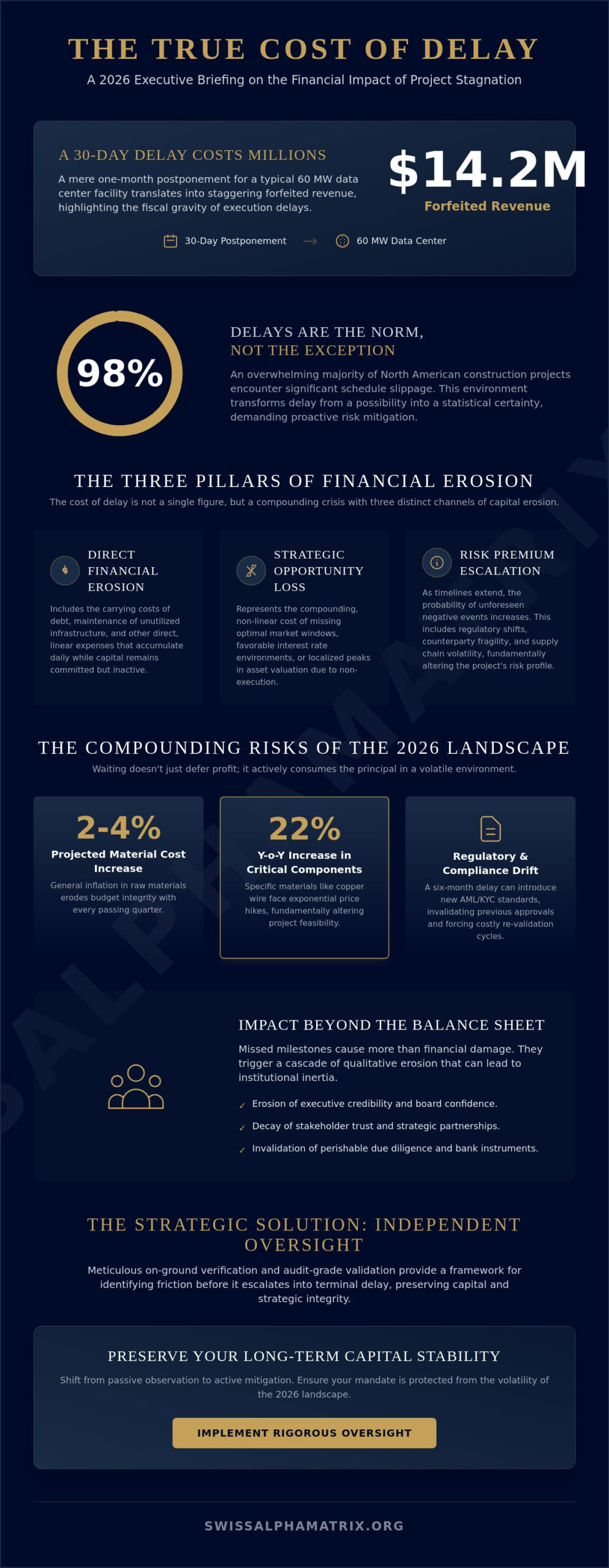
Consider that a mere thirty-day postponement for a 60 MW data center facility translates into a staggering $14.2 million in forfeited revenue, a figure that underscores the profound fiscal gravity of modern execution. In an environment where 98% of North American construction projects encounter significant schedule slippage, the cost of delaying a major project has evolved from a simple line-item overage into a compounding erosion of institutional capital and strategic advantage. You’re likely aware that in complex financial environments, the passage of time without progress doesn’t just stall growth; it actively invites regulatory shifts and market window closures that can render a mandate obsolete before it ever reaches completion.
This analysis provides an executive-level framework designed to quantify these multifaceted delay costs while establishing the necessity for rigorous, independent oversight. We’ll explore how stalled mandates compromise strategic integrity and increase regulatory exposure, ultimately offering sophisticated risk mitigation strategies to preserve your long-term capital stability. By moving from broad philosophical principles to specific strategic pillars, we’ll demonstrate how meticulous on-ground verification protects your interests from the volatility of the 2026 landscape.
Key Takeaways
- Distinguish between linear carrying costs and compounding opportunity losses to understand the true fiscal impact of institutional stagnation.
- Analyze how regulatory drift and counterparty fragility in cross-border mandates can invalidate existing bank instruments during periods of non-execution.
- Implement the “Capital Exposure Matrix” to precisely quantify the cost of delaying a major project and justify the necessity for immediate intervention.
- Address the qualitative erosion of executive credibility and board confidence that often follows missed milestones, preventing a culture of institutional inertia.
- Discover how independent project oversight and audit-grade validation provide a framework for identifying friction before it escalates into a terminal delay.
Defining the Economic Cost of Delay in High-Stakes Finance
In the sophisticated sphere of institutional capital deployment, time isn’t merely a chronological metric; it’s a direct variable in the calculation of net present value. The Economic Cost of Delay (CoD) serves as a critical diagnostic for assessing how stagnant mandates erode the fundamental viability of a transaction. For the year 2026, where material cost increases are projected between 2% and 4% and skilled trade deficits continue to widen, the cost of delaying a major project becomes an exponential burden rather than a linear one. When capital remains committed but unutilized, the institutional engine experiences a loss of momentum that often precedes more terminal failures in strategic execution.
The Three Pillars of Financial Delay Costs
Institutional delay costs generally manifest through three distinct channels. First, direct financial erosion encompasses the carrying costs of debt and the maintenance of unutilized infrastructure. Second, strategic opportunity loss occurs when a firm misses the optimal market window for a transaction, such as a localized peak in asset valuation or a favorable interest rate environment. Third, the risk premium escalation reflects how extended timelines increase the probability of unforeseen events. As we move through 2026, the volatility of global sourcing and the 22% year-over-year increase in critical components like copper wire demonstrate that a delay of even one quarter can fundamentally alter a project’s original feasibility study. It’s a reality where waiting doesn’t just defer profit; it actively consumes the principal.
Quantifying Value vs. Measuring Time
Traditional project management often relies on Gantt charts that prioritize schedule adherence over economic preservation. In high-stakes finance, we must transition toward economic value-stream mapping. In the context of a $100M+ cross-border mandate, the cost of delay is the daily erosion of net present value resulting from the deferred activation of revenue-generating assets and the simultaneous inflation of regulatory and operational risk premiums. This precise quantification requires independent financial project management to establish baseline targets that are tethered to fiscal reality rather than optimistic procurement projections. Such oversight ensures that every milestone is viewed through the lens of capital protection. By identifying the cost of delaying a major project early, stakeholders can shift from passive observation to active mitigation, ensuring that the standard of service remains broad in reach yet meticulous in its attention to detail.
The Compounding Risks of Stalled Cross-Border Transactions
In the intricate architecture of international finance, a delay isn’t a static pause; it’s a dynamic escalation of risk. When a transaction stalls, the underlying assumptions of the original deal begin to decouple from reality. The cost of delaying a major project in a multi-jurisdictional context involves more than just interest accrual. It introduces a volatility premium that can fundamentally alter the risk profile of the entire mandate. As timelines extend, the “perishable value” of due diligence data and bank instrument validations begins to decay, often requiring a complete restart of the verification process to maintain institutional integrity.
Regulatory and Compliance Drift
The global regulatory environment is in a state of constant flux. A six-month pause in execution can easily push a project into a new window of international financial regulations, potentially invalidating previously approved compliance structures. Shifting AML and KYC standards in 2026 mean that documentation which was “audit-grade” in January might be considered deficient by July. This drift necessitates a recursive cycle of re-filing and re-validation, adding layers of administrative friction that further erode capital. Maintaining deal integrity requires constant oversight to ensure that the project remains aligned with the most current jurisdictional requirements, preventing a scenario where a mandate becomes legally unexecutable despite having the necessary funding.
Counterparty and Market Fragility
Delays often serve as a silent signal of institutional weakness or internal misalignment to external partners. This perception of fragility invites counterparties to renegotiate terms, frequently at the expense of the delayed party’s equity or control. Beyond the financial metrics, a GAO report on project delays highlights how budgetary uncertainty and labor shortages contribute to a loss of momentum that can lead to significant scope reductions. This “Deal Fatigue” sours relationships and diminishes the enthusiasm of essential stakeholders. On-ground verification mandates must be re-performed if delays exceed a ninety-day threshold to ensure the underlying collateral or operational status hasn’t materially degraded. To navigate these complexities, seasoned experts often employ Risk Management Frameworks to identify these fracture points before they manifest as terminal failures. Such precision ensures that the standard of service remains broad in reach yet meticulous in its attention to detail, protecting the cost of delaying a major project from spiraling beyond the point of recovery.
Beyond Financial Metrics: Qualitative Erosion and Stakeholder Trust
While the quantifiable erosion of capital remains a primary concern for the treasury, the qualitative damage to a firm’s reputation often carries a longer tail of consequence. The cost of delaying a major project extends deep into the fabric of executive credibility, where missed milestones signal a systemic failure in governance to both the board and external investors. In the context of multi-layered investment vehicles, effective stakeholder management relies upon a foundation of predictable execution. When that predictability vanishes, it’s replaced by a culture of “acceptable friction,” where institutional inertia becomes the default setting, and strategic growth is sacrificed for the sake of administrative safety.
The adage “slow is smooth” represents a dangerous fallacy in modern finance. While it suggests that a measured pace ensures precision, the reality is that every day of non-execution leaves capital exposed to unhedged market risks and inflationary pressures. Precision isn’t born from slowness; it’s the result of rigorous, high-level standards and meticulous attention to detail. In an environment where 70% of large infrastructure projects run over budget, a lack of momentum isn’t a sign of caution, but a symptom of operational decay.
The Psychology of Institutional Inertia
Project stalls frequently trigger a quiet exodus of key personnel, as high-caliber experts tend to gravitate toward mandates characterized by momentum and efficacy. This loss of institutional knowledge is particularly acute given the projected deficit of nearly 499,000 skilled trade workers and the rising salaries for specialized technicians, which can reach up to $150,000 for certified roles. Re-mobilizing a complex team after a significant pause isn’t a simple matter of re-issuing instructions. It requires a fundamental rebuilding of trust and a re-validation of the project’s core objectives. Some argue that more time allows for better due diligence, yet excessive time often leads to data obsolescence and a dilution of the original strategic intent.
Protecting the Mandate’s Reputation
A delayed project sends a clear signaling effect to market participants, often suggesting that the entity lacks the operational due diligence required to manage complex transactions. Maintaining a “Swiss standard” of precision requires a refusal to oversimplify the dynamics of execution. An academic study on cost overruns suggests that adopting structured forecasting methodologies can significantly reduce the probability of these qualitative failures. By utilizing audit-grade validation and on-ground verification, a boutique entity can project an image of intellectual superiority and historical reliability, even amidst broader market turbulence. Ultimately, the cost of delaying a major project is the potential loss of the firm’s elite standing in the eyes of its most valued partners.
Quantifying the Impact: A Framework for Executive Decision-Making
Quantifying the fiscal consequences of institutional inertia requires a departure from traditional accounting toward a more sophisticated model of risk assessment. For the Chief Financial Officer, the cost of delaying a major project is not a static figure but a dynamic intersection of market volatility and capital commitment. By employing structured frameworks, institutions can move beyond anecdotal concerns to a rigorous, data-driven defense of their strategic mandates. This precision is essential in an era where infrastructure project delays in the United States alone account for $47 billion in annual costs, often driven by a lack of early-stage financial discipline.
The Capital Exposure Matrix
The Capital Exposure Matrix serves as a primary diagnostic for measuring the daily erosion of potential value by integrating real-time market shifts into the project’s baseline valuation. In 2025, we witnessed significant volatility with aluminum prices rising over 30% and steel increasing by 17%, illustrating how a stalled timeline directly inflates procurement costs. To weight regulatory risk as a quantitative factor, we calculate the estimated capital required for a full compliance re-filing against the temporal probability of new jurisdictional mandates being enacted during the delay period. Utilizing institutional-grade financial advisory methodologies allows for the refinement of these models, ensuring that capital remains protected against the compounding effects of non-execution. This logical progression from broad principles to specific pillars creates a sense of professional calm that encourages confidence in the decision-making process.
The Re-Validation Penalty
A frequently overlooked component of the cost of delaying a major project is the mandatory refreshing of essential validations and due diligence reports. Because bank instrument validation services typically operate with a strict shelf-life, any delay exceeding a standard ninety-day cycle necessitates a comprehensive re-audit to maintain institutional integrity. These redundancy costs are not merely administrative; they represent a significant drain on the project’s liquidity. Budgeting for these penalties is a hallmark of seasoned, unemotional experts who prioritize long-term preservation over short-term speculation. Identifying the “Point of No Return” involves determining the exact moment when these sunk costs and re-validation fees outweigh the remaining net present value of the asset. Institutions seeking to maintain strategic growth should utilize a robust Risk Management Framework to establish these quantitative baselines and ensure that every mandate remains broad in reach yet meticulous in its attention to detail.
Mitigating Delay through Independent Project Oversight
While the preceding analysis has quantified the compounding cost of delaying a major project, the final imperative for any institutional entity is the transition from reactive accounting to proactive mitigation. Effective delay prevention is not merely a matter of increased effort; it’s the result of implementing a rigorous, independent framework that operates outside the influence of internal corporate politics. In high-stakes finance, where the margin for error is increasingly narrow, the introduction of an independent Project Management Office (PMO) provides the necessary distance to identify operational friction before it crystallizes into a terminal delay. This approach replaces the “ambiguity” often found in internal reporting with a standard of transparency that is both broad in reach and meticulous in its attention to detail.
The Independent Oversight Advantage
Internal project teams, despite their technical competence, are frequently susceptible to optimism bias or the pressure to align reporting with broader corporate narratives. By utilizing independent, audit-grade project management, an institution ensures that every milestone is evaluated with unemotional precision. This oversight serves as a protective authority, verifying that bank instruments and operational workflows remain within the strict parameters of the original mandate. On-ground verification services play a critical role here, as they provide the empirical data necessary to prevent the “surprises” that frequently derail international deals. When every variable is validated by a seasoned expert, the institution can maintain its reputation for historical reliability and regional precision, even when navigating the most complex transactions.
Precision Execution for 2026
The current economic climate, characterized by 2.8% increases in construction input prices and a persistent deficit of skilled trade workers, demands a “zero-drift” policy for major capital deployments. In this environment, waiting for a delay to manifest is equivalent to accepting a loss of principal. Leveraging cross-border investment due diligence as a proactive management tool allows firms to anticipate regulatory shifts and counterparty fragility before they impact the critical path. Swiss Alpha Matrix positions itself as the dedicated partner for this level of precision, merging the traditional discretion of high-end private wealth management with the technical rigor of complex project management. By maintaining a logical, unwavering pace from concept to completion, we ensure that the cost of delaying a major project is mitigated through disciplined execution. The ultimate goal remains the long-term preservation of capital, achieved through a standard of service that reflects the intellectual superiority and moral character of our institutional partners.
Securing Strategic Integrity through Disciplined Execution
The transition from a theoretical understanding of risk to the active preservation of institutional capital requires a commitment to unwavering milestone adherence. As we’ve explored throughout this analysis, the cost of delaying a major project in 2026 is an escalating burden that encompasses not only direct fiscal erosion but also the qualitative decay of stakeholder confidence. By implementing the Capital Exposure Matrix and adhering to a zero-drift policy, sophisticated entities can protect their mandates from the volatility of shifting regulations and counterparty fragility. This level of precision is not merely an operational goal; it’s a fundamental requirement for maintaining the strategic integrity of complex financial programmes.
To ensure your interests remain in the hands of seasoned experts who prioritize long-term preservation, Engage Swiss Alpha Matrix for Independent Financial Project Management. Led by former Tier-1 bank senior executives, our team provides audit-grade instrument validation standards and global operational due diligence expertise designed to identify friction before it manifests as a terminal delay. We invite you to partner with a boutique entity that values exclusivity and historical reliability, ensuring that your most critical mandates are executed with the meticulous attention to detail they deserve. Your path to strategic growth remains secure when supported by a framework of logical, professional calm.
Frequently Asked Questions
How do you calculate the cost of delay for a financial instrument validation?
Calculating this cost requires summing the daily interest on committed capital, the projected fees for mandatory re-validation once the current certificate expires, and the risk premium associated with shifting market conditions. Because validations are temporal in nature, the cost is essentially the total value of re-performing audit-grade checks to ensure the instrument remains unencumbered and legally viable.
What are the most common causes of delay in cross-border investment projects?
The primary disruptors usually involve misaligned jurisdictional compliance standards, counterparty due diligence failures, and significant labor shortages in specialized trades. In the current 2026 landscape, ongoing volatility in global sourcing for materials such as copper and steel, which saw price increases of 22% and 17% respectively, also serves as a critical driver for timeline slippage.
Can a delay in project execution lead to regulatory non-compliance?
Project delays frequently result in non-compliance because international financial regulations are in a state of constant evolution. A significant pause can push a mandate into a new regulatory window where previous AML or KYC standards are no longer sufficient. This drift necessitates a complete re-filing of documentation to maintain institutional integrity and avoid legal exposure.
Is it ever safer to delay a project for further due diligence?
A delay is only justifiable if the identified risk of proceeding with incomplete data exceeds the compounding fiscal erosion of the pause itself. However, in high-stakes environments, due diligence data is often perishable. Excessive waiting frequently results in the need to re-verify the entire mandate, effectively doubling the administrative burden without necessarily increasing capital protection.
How does market volatility affect the cost of delaying a major project in 2026?
Market volatility increases the cost of delaying a major project by simultaneously inflating material inputs and financing rates. With construction input prices rising by 2.8% annually and specialized trade salaries reaching up to $150,000, a delay of even one quarter can fundamentally alter the original feasibility study and erode the project’s net present value.
What is the difference between carrying cost and opportunity cost in project management?
Carrying cost refers to the direct, tangible expenses incurred by maintaining stagnant capital, such as interest payments and facility maintenance. Opportunity cost represents the intangible but profound loss of revenue or strategic advantage that would’ve been realized had the project reached activation. Both metrics must be weighted to understand the total impact of non-execution.
How can independent project oversight reduce the risk of timeline slippage?
Independent oversight removes internal political bias and implements a zero-drift policy that prioritizes milestone adherence. By utilizing audit-grade validation and on-ground verification, independent experts identify friction points before they escalate into terminal delays. This methodology ensures that the project remains aligned with its strategic pillars through unemotional, master-planned execution.
What happens to bank instrument validity if a project is paused for more than 90 days?
Most bank instruments require comprehensive re-validation if a project is stagnant for more than 90 days to confirm that the underlying collateral hasn’t been encumbered or cancelled. This threshold typically triggers a mandatory re-audit. Such a process is essential to maintain the high-level standards of service and precision that institutional entities require for complex transactions.