

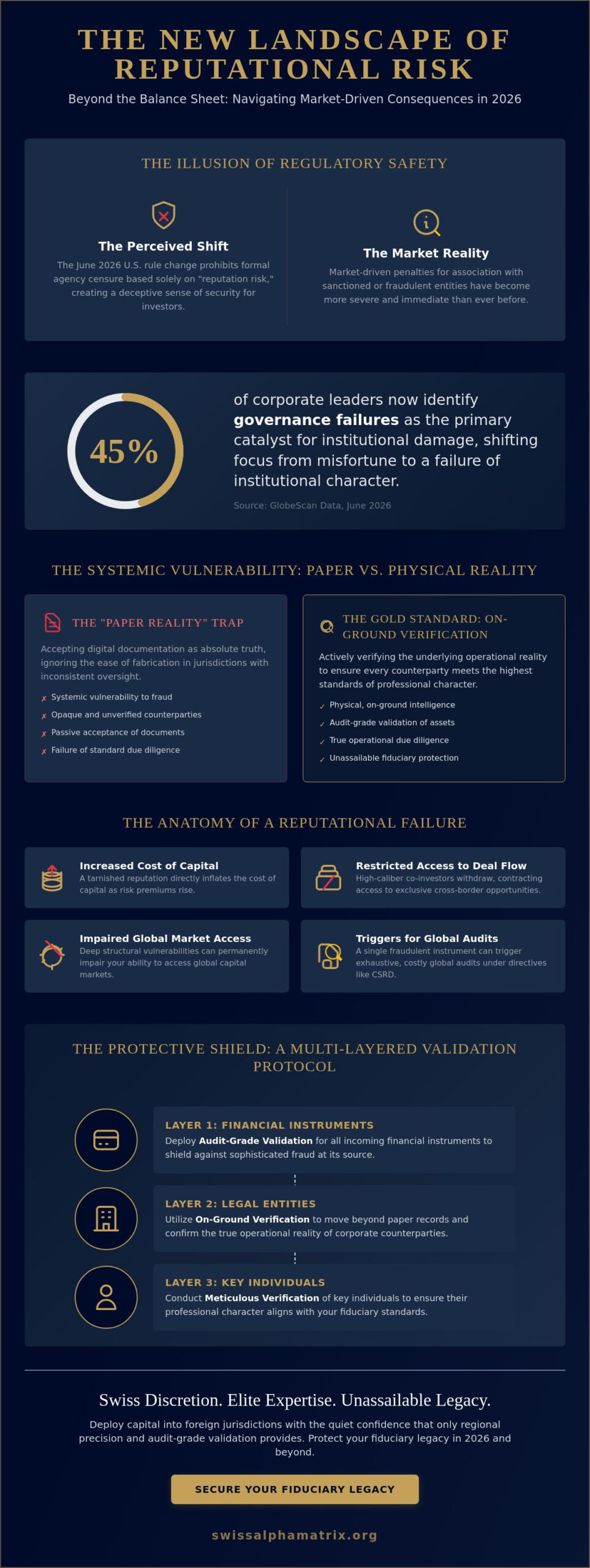
The recent pivot in U.S. regulatory frameworks, specifically the June 2026 rule prohibiting agencies from formal censure based on “reputation risk,” creates a dangerous illusion of safety for the institutional investor. While the threat of direct regulatory rebuke may have receded, the market-driven consequences of unintended associations with sanctioned entities or fraudulent counterparties have never been more severe. Managing reputational risk in investments has evolved from a secondary compliance checkbox into a sophisticated exercise in on-ground intelligence and meticulous verification. It’s no longer enough to rely on the perceived security of international legal frameworks when 45% of corporate leaders now identify governance failures as the primary catalyst for institutional damage.
You likely recognize that standard due diligence often fails to penetrate the veil of operational fraud in cross-border transactions, leaving your legacy vulnerable to opaque counterparties. This article demonstrates how elite investors utilize audit-grade validation and on-ground verification to shield their professional standing and capital from these hidden hazards. We will examine a structured methodology for identifying risks that exist beyond the balance sheet, ensuring your fiduciary duties remain unassailable. By moving from broad principles to specific strategic pillars, you can deploy capital into foreign jurisdictions with the quiet confidence that only regional precision provides.
Key Takeaways
- Distinguish between transient event-driven risks and the deep structural vulnerabilities that can permanently impair your access to global capital markets.
- Identify the systemic weaknesses of the “Paper Reality” trap and why physical, on-ground verification remains the gold standard for validating cross-border counterparties.
- Master a structured methodology for managing reputational risk in investments through a multi-layered validation protocol covering financial instruments, legal entities, and key individuals.
- Bridge the gap between standard legal compliance and true operational due diligence by deploying audit-grade validation for all incoming financial instruments.
- Explore how the integration of Swiss discretion and elite institutional expertise provides a protective shield for your organization’s fiduciary legacy in 2026.
What is Reputational Risk in the Context of Institutional Investment?
In the sophisticated theater of institutional finance, the definition of risk has undergone a fundamental transformation. Historically categorized as a secondary consequence of operational or market failures, Reputational risk now stands as a primary, quantifiable pillar of “total risk,” demanding the same analytical rigor as credit or liquidity assessments. Within the context of 2026, this risk is defined as the probability that negative perceptions among stakeholders, including co-investors, regulators, and counterparties, will materially impair an organization’s ability to access capital or sustain its fiduciary standing. Managing reputational risk in investments requires a nuanced understanding of the distinction between “event-driven” risks, such as a localized scandal, and “structural” risks, which emerge from systemic failures in a firm’s internal verification protocols.
The current landscape is increasingly defined by the intersection of ESG mandates and fiduciary legacy. As governance issues now rank as the primary ESG concern for 45% of corporate leaders according to GlobeScan data from June 2026, the failure to identify an unethical counterparty is no longer viewed as a misfortune. Instead, it’s interpreted as a failure of institutional character and a breach of the duty to protect capital. In this environment, reputation isn’t merely a byproduct of performance; it’s the foundation upon which long-term strategic growth is built.
The Intangible Asset: Why Credibility is Capital
For the elite investor, credibility functions as a form of non-liquid capital that dictates the terms of engagement in high-stakes environments. A tarnished reputation doesn’t merely invite scrutiny; it directly increases the cost of capital and restricts access to the exclusive, cross-border deal flow that defines superior performance. When an institution’s integrity is beyond reproach, it attracts higher-caliber co-investors and secures more favorable positioning in complex project management scenarios. Conversely, the erosion of this intangible asset leads to a contraction of opportunities, as sophisticated partners prioritize the preservation of their own standing over short-term speculative gains.
Regulatory Implications of Reputational Failure
The regulatory environment of 2026 has transitioned toward a model of market accountability and “guilt by association.” While recent U.S. policy shifts have limited the ability of agencies like the OCC to force the termination of lawful business relationships based on vague reputational concerns, the European Union’s Corporate Sustainability Reporting Directive (CSRD) has made audited governance disclosures mandatory. A single fraudulent instrument or an unintended association with a sanctioned entity can trigger exhaustive global audits. Managing reputational risk in investments involves shielding the firm against these “unseen” hazards by moving beyond digital documentation into the realm of audit-grade validation and on-ground verification to ensure every counterparty meets the highest standards of professional character.
The Anatomy of Reputational Failure in Cross-Border Deals
Reputational ruin in the international investment sphere rarely occurs as a sudden, unpredictable event. Instead, it’s the logical culmination of overlooked technical discrepancies, often rooted in what we define as the “Paper Reality” trap. This systemic vulnerability arises when sophisticated institutions accept digital documentation as absolute truth, failing to account for the ease with which modern financial instruments can be fabricated or manipulated in jurisdictions where oversight is inconsistent. In the context of 2026, where market-driven penalties have surpassed regulatory censure in their severity, managing reputational risk in investments requires a transition from passive acceptance of documents to active, on-ground verification of the underlying operational reality.
The primary catalysts for these failures are typically found in three specific areas: instrument fraud, counterparty opacity, and jurisdictional volatility. When these elements converge, they create a cascade effect that begins with a single failed transaction and ends with a total erosion of investor confidence. According to GARP on Reputational Risk Management, aligning strategic goals with operational focus is essential to prevent these fractures. Without this alignment, the “Paper Reality” of a deal remains unverified, leaving the firm’s legacy exposed to the fallout of unverified bank instruments that appear legitimate on a screen but lack any institutional substance.
Instrument Fraud and its Reputational Consequences
Sophisticated financial forgery, particularly involving Standby Letters of Credit (SBLCs) and other high-value instruments, has become increasingly difficult to detect through standard KYC and AML protocols. These procedures are often designed to tick boxes rather than to uncover the deep-seated structural flaws of a forged instrument. When an institution unknowingly presents or relies upon a fraudulent document, the damage to its professional standing is immediate and often irreversible. Bank instrument validation services serve as the first line of reputational defence, ensuring that the financial bedrock of a deal is both authentic and enforceable before capital is ever committed.
Counterparty Risk and the “Shadow” Network
The danger of undisclosed beneficial ownership remains a significant hazard in complex international programmes, where hidden political or criminal affiliations can lie buried beneath layers of corporate shell entities. Relying on digital databases is insufficient when dealing with sophisticated actors who understand how to manipulate jurisdictional opacity to their advantage. Managing reputational risk in investments necessitates a deep-dive investigation into the “moral character” of transaction principals. By conducting on-ground inquiries into the history and associations of these individuals, an institution can avoid the “guilt by association” that characterizes the modern regulatory and market environment. For those seeking to preserve their fiduciary standing, engaging a partner with regional precision and institutional expertise is the only way to ensure that the individuals behind a deal are as reputable as the proposal suggests.
Paper vs. Physical: The Necessity of On-Ground Verification
While digital monitoring provides a sophisticated facade of security, it remains fundamentally incapable of verifying the physical existence of assets or the authentic presence of a bank branch in a volatile jurisdiction. In the intricate environment of 2026, where digital trails can be meticulously curated to project an image of stability, managing reputational risk in investments necessitates a departure from desk-based models that prioritize speed over substance. As highlighted by NC State on Managing Reputation Risk, evaluating the reality of a counterparty’s operational claims is a critical step in assessing long-term viability. Without physical verification, an institution remains blind to the tangible truth, relying instead on a curated digital narrative that may be entirely divorced from the underlying operational reality.
The role of “boots on the ground” in validating a foreign entity cannot be overstated, particularly when dealing with “ghost” assets or fabricated financial histories that appear flawless in a virtual environment. Integrating on-ground intelligence into the broader cross-border investment due diligence process ensures that every claim made by a counterparty is anchored in a demonstrable, physical fact. This rigorous approach serves as the only effective antidote to the sophisticated fraud schemes that target institutional capital, providing the quiet confidence required for strategic deployment in unfamiliar territories.
The Limitations of Digital Due Diligence
The proliferation of generative AI and deepfake technologies has enabled the creation of “audit-ready” digital trails that can deceive even the most seasoned risk officers. These manufactured histories present a polished, professional image that often appeals to the psychological biases of C-suite executives who value efficiency and high-level summaries. In this climate, the traditional maxim of “trust but verify” has become dangerously obsolete. It’s now essential to verify physically then trust, ensuring that a counterparty’s digital presence isn’t merely a sophisticated construction designed to bypass standard KYC protocols.
Executing Physical Verification in High-Risk Jurisdictions
True operational security is achieved only through the physical audit of asset registries and the face-to-face verification of signatories within local banking institutions. This process requires a level of regional precision that accounts for “local bias,” where regional due diligence reports may be influenced by local economic pressures or political affiliations. By utilizing independent, third-party oversight, an institution ensures that its risk profile remains objective and unclouded by regional interests. Managing reputational risk in investments is, at its core, a commitment to uncovering the tangible truth behind the digital curtain, protecting both capital and fiduciary legacy from the hazards of unverified international deals.
Constructing a Robust Reputational Risk Management Framework
The transition from identifying vulnerabilities to implementing a resilient defense requires more than a standard compliance checklist. It demands an institutional architecture designed to withstand both internal operational failures and external jurisdictional shifts. Managing reputational risk in investments involves the integration of high-level intelligence with rigid procedural oversight, ensuring that every transaction principal and financial instrument is scrutinized with the same intensity applied to financial performance metrics. This framework functions as a master plan for capital preservation, moving beyond passive observation into the realm of active, strategic protection.
A comprehensive framework for 2026 is built upon five foundational pillars:
- Step 1: Multi-Layered Validation Protocol. This involves a simultaneous investigation of the financial instrument, the legal entity presenting it, and the moral character of the individuals involved.
- Step 2: Audit-Grade Validation. Every incoming financial instrument must undergo a rigorous authentication process that exceeds standard bank-to-bank messaging, verifying the specific ledger entries and the authority of the signatories.
- Step 3: Accountability Mapping. Implementing a RACI analysis ensures that every facet of risk oversight is assigned to a specific, accountable executive, preventing the diffusion of responsibility that often characterizes institutional failure.
- Step 4: Behavioral Monitoring. Risk management doesn’t end at the closing of a deal. Continuous monitoring of counterparty behavior and regional stability is essential to identify early indicators of structural decay.
- Step 5: Resilience Stress Testing. Regular simulations of reputational crises allow the firm to refine its response protocols and ensure that its fiduciary standing remains unshakeable under pressure.
Audit-Grade Validation as a Strategic Pillar
Standard bank confirmations often fall short in high-stakes transactions because they rely on automated systems that can be manipulated by sophisticated actors. Audit-grade validation, by contrast, provides a level of technical depth that satisfies the most stringent requirements of institutional boards and global regulators. This methodology involves the direct, on-ground verification of the instrument’s provenance and its alignment with international banking standards. Independent financial project management ensures that these risk mitigation protocols are seamlessly integrated into every project milestone, providing a continuous shield for the firm’s capital and reputation.
The Role of Stakeholder Management in Risk Mitigation
Transparency is the cornerstone of institutional trust. By communicating robust risk management protocols to investors, a firm demonstrates its commitment to the long-term preservation of capital rather than short-term speculative gains. This internal alignment between Legal, Finance, and Operations teams under a unified risk framework ensures that the firm presents a consistent, professional front during high-stakes M&A or capital deployment. Effectively managing the news cycle and deal integrity requires a persona of quiet authority and intellectual superiority, qualities that are reinforced by a commitment to regional excellence and precision. For institutions seeking to formalize these protections, adopting sophisticated Risk Management Frameworks is the definitive step toward securing an unassailable professional legacy.
The Swiss Alpha Matrix Approach: Precision and Discretion
The methodology employed by Swiss Alpha Matrix represents a synthesis of traditional private wealth discretion and modern, hyper-personalized risk mitigation. We believe that managing reputational risk in investments is not merely a technical requirement but a fundamental commitment to the highest standards of professional character. By leveraging the collective expertise of former Tier-1 global bank executives, we provide our clients with a level of transactional risk mitigation that is rooted in historical reliability and regional precision. This approach ensures that interests are held in the hands of seasoned experts who prioritize long-term preservation over short-term speculation, opting for a dignified and formal path to capital protection that mirrors the discretion of the world’s most exclusive financial institutions.
Our commitment to Swiss discretion is not a passive stance; it’s an active, strategic pillar of our service. We recognize that for the elite investor, the preservation of privacy is as critical as the preservation of capital. By merging rigorous financial discipline with meticulous on-ground verification, we uncover the tangible truth behind complex international proposals, ensuring that every counterparty and financial instrument meets our exacting standards of moral and operational integrity. This level of scrutiny is essential for maintaining a performance-oriented mindset that distinguishes our partners from passive participants in the global market.
Institutional Expertise for Global Mandates
Generic advisory services often lack the intellectual depth required to navigate the intricate nature of multi-billion dollar transactional risks. Our team moves beyond surface-level summaries, providing mandate-specific, executive-level intelligence that accounts for the specific nuances of each engagement, whether it involves complex project management or the validation of high-value bank instruments. Our deep understanding of international financial regulations ensures that every cross-border deal maintains absolute compliance, shielding your organization from the regulatory scrutiny and market penalties often found in volatile jurisdictions. We merge this financial discipline with meticulous on-ground verification, ensuring that the operational reality of a counterparty matches its digital narrative, thereby eliminating the systemic vulnerabilities inherent in desk-based due diligence.
Securing Your Legacy in a Volatile Market
In an era where information spreads with unprecedented speed, the margin for error in fiduciary oversight has effectively vanished. Positioning Swiss Alpha Matrix as your dedicated partner allows for the implementation of customized risk management frameworks that are both broad in reach and meticulous in detail. We serve as a protective authority, ensuring that your capital and professional standing are shielded from the hidden hazards of unverified international transactions. This partnership is built on the foundation of Swiss discretion, where privacy and exclusivity are valued above all else, providing a sense of professional calm in the face of complex capital deployment. To ensure your organization’s legacy remains unassailable in 2026, engage with Swiss Alpha Matrix for bespoke risk advisory and experience a standard of service defined by exclusivity and high-level access.
Orchestrating Long-term Capital Preservation in 2026
The landscape of 2026 demands a fundamental departure from passive risk observation toward a model of active, strategic guardianship. By recognizing that the “Paper Reality” of digital documentation represents a systemic vulnerability, sophisticated investors can transition to a framework where physical, on-ground verification serves as the ultimate arbiter of truth. Managing reputational risk in investments has become an exercise in regional precision; here, the validation of financial instruments and the exhaustive scrutiny of counterparty character are integrated into every project milestone to protect the firm’s fiduciary standing.
As the global market continues to pivot from mere regulatory oversight toward direct market-driven accountability, the necessity of partnering with seasoned experts who prioritize long-term stability becomes undeniable. Swiss Alpha Matrix, directed by former Tier-1 global bank executives, provides the audit-grade instrument validation and expansive global reach required to navigate high-stakes international mandates with absolute Swiss discretion. We invite you to secure your institutional legacy with Swiss Alpha Matrix’s specialised risk advisory. Your capital deserves a standard of protection that is as meticulous as it is exclusive.
Frequently Asked Questions
How does reputational risk differ from operational risk in investments?
Reputational risk centers on the external perception of an institution’s integrity, whereas operational risk pertains to the internal failure of systems or processes. While an operational lapse may trigger reputational damage, the latter’s impact is measured by the subsequent loss of capital access and stakeholder trust. In 2026, the market-driven penalties for a tarnished reputation often exceed the direct financial costs of the underlying operational failure.
Can reputational risk be quantitatively measured for an institutional portfolio?
Reputational risk can be approximated through quantitative proxies such as fluctuations in the cost of capital, credit spread widening, and standardized ESG governance metrics. By analyzing these data points alongside stakeholder sentiment surveys, institutions can develop a clearer picture of their standing. Managing reputational risk in investments involves translating these qualitative perceptions into actionable risk parameters that inform capital deployment strategies.
What are the most common red flags for instrument-based fraud in 2026?
Primary red flags in 2026 include inconsistencies in SWIFT messaging protocols and financial instruments issued by “ghost” branches in jurisdictions with opaque regulatory oversight. Sophisticated actors often use fabricated digital trails to simulate legitimacy. If a counterparty resists physical, on-ground verification of a signatory’s authority, it’s a definitive indicator that the underlying asset or instrument lacks institutional substance.
Why is standard legal due diligence often insufficient for managing reputational risk?
Legal due diligence is designed to verify the existence and enforceability of contracts, yet it rarely penetrates the operational reality of the entities involved. It confirms that the “Paper Reality” is legally sound without addressing the moral character of the principals or the physical existence of the assets. Relying solely on legal frameworks leaves a firm exposed to the reputational fallout of unintended associations with fraudulent actors.
How does on-ground verification protect against cross-border transaction fraud?
On-ground verification serves as a physical audit that bypasses the limitations of digital documentation by placing seasoned experts directly at the source of the transaction. This process involves visiting local bank branches, auditing physical asset registries, and conducting face-to-face interviews with key signatories. It’s the only effective method to ensure that a cross-border counterparty’s operational claims are anchored in tangible facts rather than digital fabrications.
What role does the board of directors play in reputational risk oversight?
The board of directors is the ultimate steward of an institution’s legacy, responsible for defining the risk appetite and ensuring that robust validation protocols are strictly enforced. Effective board oversight requires the integration of audit-grade validation into the firm’s core governance structure. This proactive involvement ensures that executive-level intelligence is utilized to protect fiduciary standing and maintain the long-term confidence of co-investors and global regulators.
How can a firm recover its reputation after a failed international investment?
Recovery necessitates a dignified and transparent response that prioritizes the full disclosure of the failure and the immediate implementation of more rigorous risk frameworks. A firm must demonstrate that it has identified the systemic vulnerability and adopted audit-grade validation standards to prevent a recurrence. Restoring trust is a measured process that relies on a return to the core values of regional precision and meticulous attention to detail.
Is continuous monitoring necessary for all cross-border investment programmes?
Continuous monitoring is essential for all international programmes because jurisdictional volatility and counterparty behavior can shift with little warning. Managing reputational risk in investments requires an ongoing commitment to oversight that extends far beyond the initial closing of a deal. Regular stress testing and behavioral monitoring ensure that the firm’s interests remain protected against the evolving hazards of the global financial environment.