

The traditional due diligence report has become a dangerously thin veil, often providing nothing more than a cursory glance at digital records while ignoring the profound risks inherent in opaque cross-border jurisdictions. True capital protection demands a departure from these superficial checklists in favor of a forensic, multi-layered validation process that scrutinizes both the intangible legal structures and the physical reality of the underlying assets. Mastering how to vet an investment opportunity at an institutional level requires adopting a standard of audit-grade scrutiny that prioritizes the absolute integrity of financial instruments over the convenience of standard reporting. It’s a disciplined approach where the preservation of wealth is predicated on the refusal to oversimplify complex global dynamics.
You understand that as the effective federal funds rate reaches 3.63% and regulatory bodies like the SEC increase their focus on investor protection, the cost of inadequate oversight is no longer a theoretical risk but a tangible threat to your portfolio. This guide promises to equip you with the sophisticated, Tier-1 vetting protocols necessary to mitigate institutional risk and ensure the legitimacy of complex global placements. We will explore the essential transition from passive due diligence to active on-ground verification, the application of rigorous risk management frameworks, and the precise methodology for validating instruments to an audit-grade standard.
Key Takeaways
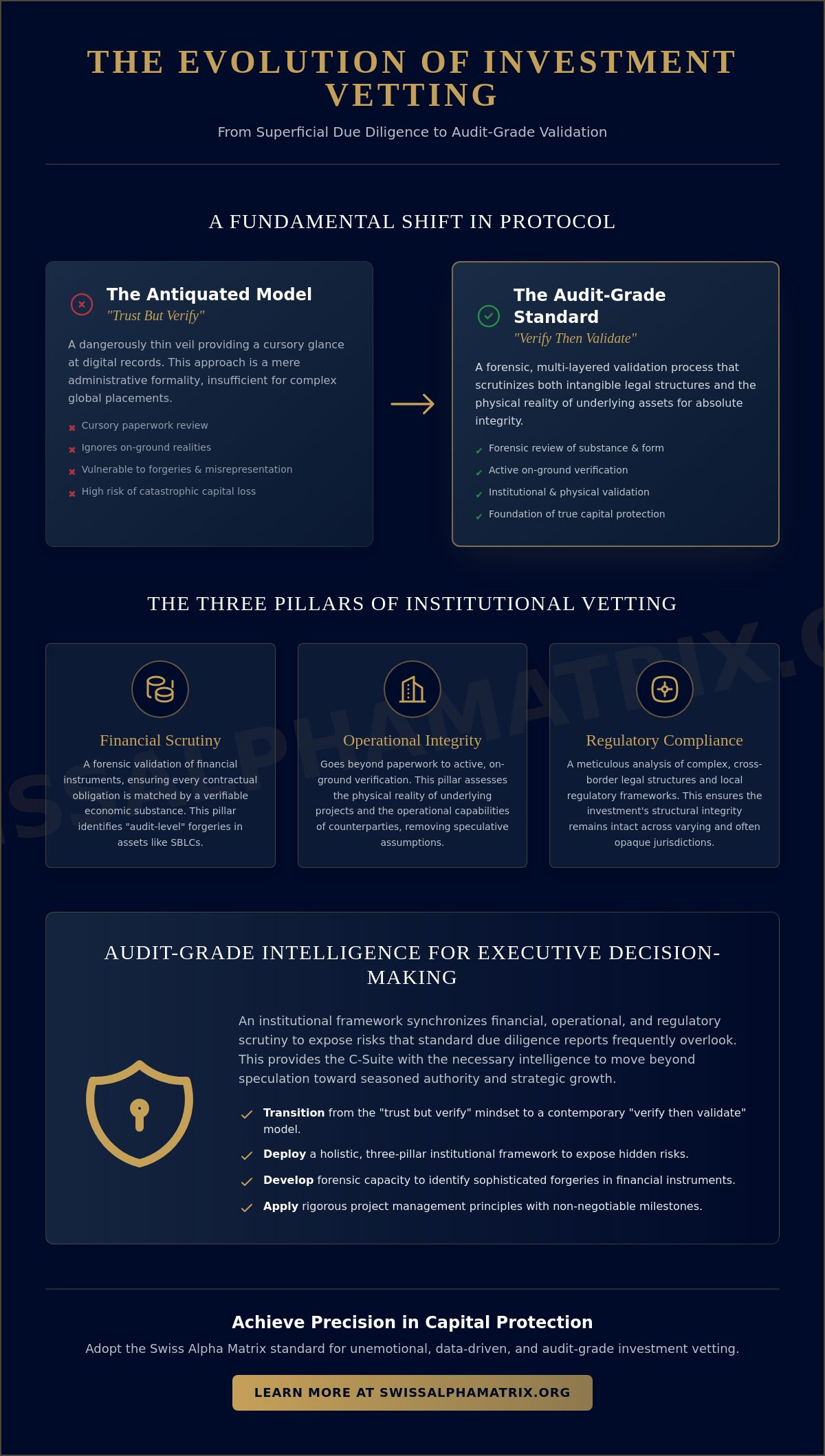
- Transition from the antiquated “trust but verify” mindset to a contemporary “verify then validate” model, establishing a sophisticated baseline for how to vet an investment opportunity in volatile global markets.
- Deploy a holistic, three-pillar institutional framework that synchronizes financial, operational, and regulatory scrutiny to expose risks that standard due diligence reports frequently overlook.
- Develop the forensic capacity to identify “audit-level” forgeries in complex financial instruments, ensuring that standby letters of credit and other intangible assets are validated against physical and institutional realities.
- Apply rigorous project management principles to the vetting lifecycle, utilizing structured timelines and non-negotiable milestones to maintain the integrity of the capital protection process.
- Gain the audit-grade intelligence necessary for high-level executive decision-making, moving beyond speculation toward a position of seasoned authority and strategic growth.
The Evolution of Investment Vetting: Defining the Audit-Grade Standard
The landscape of global finance in May 2026 has witnessed a fundamental shift in the protocols governing capital protection. While traditional methods once relied on a “trust but verify” approach, the current era of sophisticated financial instruments demands a more stringent “verify then validate” mandate. Understanding how to vet an investment opportunity in this context requires moving beyond the standard due diligence process, which often serves as a mere administrative formality rather than a true safeguard. It’s an evolution that reflects a growing recognition that standard compliance checks are insufficient to identify the nuanced risks embedded in cross-border transactions and complex legal structures.
Specialized advisory oversight has become an indispensable component of the vetting lifecycle, particularly as financial instruments grow in technical complexity. Internal investment teams, while proficient in market analysis, are frequently susceptible to institutional bias or the psychological pressure of deal momentum. By engaging an independent authority, stakeholders can ensure a detached, unemotional assessment that prioritizes long-term preservation over short-term participation. This objective distance is critical when scrutinizing the moral character of counterparties and the operational integrity of the underlying projects. It removes the incentives that often lead to the oversimplification of complex dynamics.
What Constitutes Audit-Grade Vetting?
Audit-grade validation is a forensic review of both legal form and economic substance, ensuring that every contractual obligation is matched by a verifiable physical or financial reality. For the C-suite executive, this standard represents the highest tier of precision, where “good enough” is replaced by an absolute requirement for institutional-grade intelligence. In cross-border environments, this involves on-ground verification and a meticulous analysis of local regulatory frameworks to ensure that the investment’s structural integrity remains intact across varying jurisdictions. Precision isn’t optional; it’s the foundation of capital deployment.
The Cost of Inadequate Due Diligence
History is replete with instances where a “paperwork-only” approach to vetting resulted in catastrophic capital loss, often because the stakeholders were blinded by the perceived prestige of the opportunity. This psychological trap of deal momentum creates a sense of urgency that bypasses critical skepticism, leading to the acceptance of forged or misrepresented financial instruments. Establishing a rigorous standard for how to vet an investment opportunity prevents the erosion of wealth by ensuring that every claim is anchored in verifiable fact. To counter these vulnerabilities, we advocate for a financial advisory methodology that prioritizes structural skepticism over speculative enthusiasm. This framework ensures that the vetting process remains a logical, steady progression toward certainty, rather than a hurried race to closing.
The Institutional Framework: Three Essential Pillars of Vetting
The architecture of institutional capital protection isn’t built upon a linear checklist, but rather a multi-dimensional system of checks and balances. A truly rigorous methodology for how to vet an investment opportunity must synthesize three distinct pillars: Financial, Operational, and Regulatory. When these pillars interact, they form a cohesive risk management framework that effectively eliminates the space for speculative assumptions or oversight. This disciplined approach requires the unemotional, data-driven perspective of seasoned experts who understand that the surface-level presentation of a deal, no matter how polished, often masks structural vulnerabilities. It’s a process of maintaining intellectual depth, where every qualifying clause in a contract is scrutinized to ensure it aligns with the broader strategy of long-term preservation. While many focus exclusively on the recipient of capital, sophisticated entities also conduct due diligence on investors and partners to ensure that the moral character and strategic intent of all involved parties meet institutional standards.
Pillar I: Financial Instrument Validation
Standard balance sheet analysis is fundamentally insufficient when dealing with the intricate nature of modern financial vehicles. Audit-grade vetting moves beyond traditional accounting to focus on instrument-specific forensics, particularly for standby letters of credit (SBLC) and documentary letters of credit (LC). Utilizing specialized bank instrument validation services ensures that the provenance and liquidity of the underlying assets are verified at the source. In a market where the bank prime loan rate stands at 6.75% as of May 13, 2026, the cost of mismanaged capital is too high to ignore the technical accuracy of the instruments being deployed.
Pillar II: Operational and On-Ground Verification
Digital data rooms, while efficient, provide a curated and often sanitized perspective of a project’s operational health. High-stakes cross-border transactions require on-ground verification to confirm that physical assets and day-to-day realities match the digital narrative provided by the counterparty. We look for “ghost” operations where a project appears robust on paper but lacks the necessary infrastructure, personnel, or local permissions to execute its mandate. This level of regional precision is what distinguishes a performance-oriented mindset from a passive participant who relies solely on third-party reports.
Pillar III: Regulatory and Jurisdictional Compliance
Navigating the nuances of international financial regulations has become increasingly complex as global standards evolve. As of May 2026, the SEC’s heightened focus on conflict of interest disclosures and the modernization of FINRA rules regarding short-interest reporting have redefined the baseline for counterparty risk assessment. Ensuring that AML and KYC protocols meet these stringent 2026 standards is a non-negotiable requirement for maintaining the integrity of the capital protection process. For those seeking this level of meticulous attention to detail, a partnership with Swiss Alpha Matrix provides the seasoned expertise necessary to navigate these complex regulatory waters with professional calm.
Paperwork vs. Reality: Verifying the Intangible
In the current financial environment, relying solely on official databases or digital repositories for verification is a profound strategic error. While these tools offer a baseline, they’re often lagged or susceptible to sophisticated manipulation in complex international scenarios. Understanding how to vet an investment opportunity requires a forensic departure from the surface level, particularly when dealing with “Audit-Level” forgeries. These are documents that appear entirely legitimate to the untrained eye, often featuring authentic-looking seals and letterheads, yet they lack the underlying institutional substance. It’s not enough to view a Standby Letter of Credit (SBLC); one must validate the specific SWIFT MT760 parameters and the bank-to-bank communication channels through which they’re transmitted. Knowing how to vet an investment opportunity means recognizing that a document is only as valuable as the verification protocol behind it.
Sophisticated red flags in SBLCs often reside in the technical nuances of the language, such as non-standard ICC 600 or 758 verbiage that subtly shifts the liability away from the issuing institution. Independent verification of bank-to-bank communications is the only reliable method to confirm that an instrument hasn’t been fabricated. This process involves a meticulous, multi-step protocol where advisory experts engage directly with the corresponding banking entities to ensure the instrument’s provenance. It’s a steady, logical movement from broad claims to specific strategic pillars of truth, ensuring that capital is never deployed based on unverified digital imagery.
Digital Forensics in Document Review
Authenticity in the digital age is rarely a matter of visual inspection. We utilize techniques that scrutinize document metadata and digital signatures to identify indicators of tampering that often occur during cross-border transitions. Independent third parties play a critical role here, providing the technical accuracy required to distinguish between a genuine financial instrument and a high-fidelity replica. It’s a refusal to oversimplify the intricate nature of modern fraud, prioritizing the integrity of the information over the convenience of the deal.
The Necessity of On-Ground Verification
Physical audits are the final, non-negotiable barrier against capital loss. Remote analysis has inherent limitations that only a local presence can overcome. By implementing a rigorous protocol for cross-border investment due diligence, we ensure that asset-backed opportunities have tangible substance. Unannounced site visits are particularly valuable; they strip away the curated narrative of a scheduled tour and reveal the unvarnished operational reality. This level of meticulous attention to detail ensures that your interests are in the hands of experts who prioritize reality over rhetoric, providing the quiet authority needed for executive decision-making.
Establishing a Rigorous Vetting Protocol: A Project Management Approach
Vetting is not a passive act of observation but a disciplined exercise in execution that requires a structured, institutional-grade workflow. To truly master how to vet an investment opportunity, one must move beyond the informal inquiries common in retail environments and adopt a rigorous project management methodology. The application of independent financial project management principles transforms a disparate series of checks into a cohesive, audit-grade lifecycle. This approach utilizes a RACI matrix to clearly define which stakeholders are Responsible, Accountable, Consulted, or Informed at every juncture of the investigation. By establishing this level of structural clarity, institutional entities can maintain executive-level oversight and prevent the deal fatigue that often leads to the erosion of critical skepticism during prolonged negotiations.
A measured, logical progression through non-negotiable milestones ensures that no technical nuance is overlooked. This steady pace allows for the integration of specialized expertise, such as on-ground verification and forensic instrument review, without succumbing to the frantic energy that often characterizes high-stakes capital deployment. It’s a refusal to oversimplify the intricate nature of the industry, positioning the vetting process as a dedicated partnership between the investor and the advisory specialists who prioritize long-term preservation over the immediate gratification of a closed deal.
Defining the Vetting Milestones
- Stage 1: Preliminary Screening and “Fatal Flaw” Analysis. This initial phase focuses on high-level alignment and the identification of immediate disqualifiers, such as jurisdictional instability or counterparty transparency issues.
- Stage 2: Deep-Dive Validation and Forensic Instrument Review. Here, the focus shifts to the technical accuracy of financial instruments and the physical reality of assets, utilizing audit-grade protocols to ensure absolute legitimacy.
- Stage 3: Final Risk Assessment and Executive Reporting. The process concludes with a comprehensive synthesis of all findings, providing the intelligence necessary for a final, unemotional decision by the C-suite.
The Executive Vetting Checklist
The transition from data gathering to decision-making requires a curated list of “hard questions” designed to expose operational opacity. Counterparty executives should be scrutinized on their historical reliability, the exact provenance of their liquidity, and their specific protocols for regulatory compliance in 2026. Red flag responses, such as vague descriptions of asset custody or a refusal to allow unannounced site visits, indicate a lack of the moral character required for high-level partnership. In every transaction, verifying the professional provenance and moral character of the individuals behind the instrument is as critical as the validation of the instrument itself. For those seeking to implement these standards within their own portfolios, our complex project management services provide the seasoned authority and regional precision necessary to safeguard your interests.
The Swiss Alpha Matrix Standard: Precision in Capital Protection
The Swiss Alpha Matrix standard represents the culmination of decades of Tier-1 banking experience, distilled into a methodology that prioritizes the absolute security of client interests above all else. While the preceding sections have detailed the technical requirements for how to vet an investment opportunity, the execution of these protocols, especially in jurisdictions where transparency is limited, requires a level of discretion and regional precision that only a boutique entity can provide. Our approach is rooted in the traditional values of Swiss private wealth management, where the moral character of a transaction, alongside its legal and economic substance, is as vital as its projected financial performance. We don’t merely provide reports; we produce audit-grade intelligence that is designed to withstand the most rigorous institutional scrutiny, ensuring that every qualifying clause and operational detail has been validated by seasoned, unemotional experts.
Moving from the initial vetting phase to the actual execution of a deal requires a seamless transition into long-term project oversight and structural management. We recognize that the risks identified during the due diligence process don’t vanish upon the signing of a contract; instead, they evolve as the project matures and market conditions shift. By maintaining a presence throughout the lifecycle of the investment, we ensure that the strategic architecture remains intact and that the initial validation of the opportunity continues to reflect the ongoing operational reality. This commitment to permanence and historical reliability distinguishes our methodology from passive participants who view vetting as a one-time administrative hurdle rather than a continuous pillar of capital protection.
Boutique Advisory vs. Large-Scale Consulting
Large-scale consulting firms often delegate complex investigations to junior analysts who lack the depth of experience required to identify sophisticated fraud, a practice that introduces significant risk when dealing with high-value, cross-border programs. In contrast, Swiss Alpha Matrix offers senior-level, mandate-specific engagement where hyper-personalization is the standard. This boutique model ensures that sensitive financial investigations are conducted with the highest degree of privacy and exclusivity, catering to a sophisticated audience that values nuance and professional competence. By limiting the number of mandates we accept, we provide the intellectual depth and meticulous attention to detail required to manage the intricate nature of global capital protection with a sense of quiet authority.
Securing Your Next Opportunity
Engaging our team for your next cross-border deal ensures that your capital is protected by a standard of service that is both broad in reach and meticulous in its execution. The transition from initial due diligence to ongoing strategic advisory is a logical progression that provides consistent stability and trust in a volatile market. If you are seeking a partner who understands how to vet an investment opportunity with the technical accuracy of a master planner, we invite you to begin a formal dialogue. You can contact Swiss Alpha Matrix for bespoke investment vetting and capital protection to ensure your interests are managed with the prestige and permanence they deserve.
Advancing the Standard of Capital Preservation
The transition from superficial due diligence to an audit-grade framework represents the only viable path for protecting capital in a global market defined by increasing complexity and sophisticated fraud. By prioritizing forensic instrument validation and on-ground operational audits, you move beyond the limitations of digital paperwork to establish a baseline of absolute certainty. Mastering the institutional protocols of how to vet an investment opportunity ensures that your portfolio is shielded from the psychological traps of deal momentum and jurisdictional opacity. This disciplined approach, which is rooted in the three pillars of financial, operational, and regulatory scrutiny, provides the quiet authority required for high-level executive decision-making.
Led by former Tier-1 banking executives, our boutique advisory specializes in the meticulous validation of financial instruments with a global reach that maintains traditional Swiss precision and discretion. It’s a standard of service that prioritizes moral character and technical accuracy above speculative gains. You can secure your capital with Swiss Alpha Matrix’s institutional-grade vetting services to ensure your next cross-border transaction is managed by seasoned, unemotional experts. We invite you to adopt a methodology where long-term preservation is the inevitable result of logical, meticulous expertise.
Frequently Asked Questions
What is the most common red flag when vetting a cross-border investment?
The most prevalent indicator of risk is a lack of transparency regarding the provenance of liquidity or the moral character of the ultimate beneficial owners. This often manifests as a refusal to provide direct, bank-to-bank verification of funds or a reliance on complex, multi-jurisdictional shell structures that obscure the true source of capital. Such opacity serves as a fundamental warning that the counterparty may be attempting to bypass the stringent AML and KYC protocols established in 2026.
How does audit-grade instrument validation differ from a standard legal review?
Audit-grade validation scrutinizes the economic substance and technical accuracy of financial instruments, whereas a standard legal review focuses primarily on contractual form and enforceability. While a legal professional ensures that an agreement is binding, an audit-grade specialist validates that the underlying assets exist and that the instrument’s metadata is authentic. This forensic approach is essential for those seeking to master how to vet an investment opportunity with the precision required by Tier-1 institutions.
Why is on-ground verification necessary if the paperwork looks legitimate?
On-ground verification is the only reliable method to confirm that the physical reality of an asset matches its digital representation in a curated data room. Digital files can be manipulated or sanitized to hide operational deficiencies, but a physical inspection reveals the unvarnished truth of infrastructure, personnel, and local regulatory standing. This level of regional precision ensures that your interests are protected by a standard of service that is both broad in reach and meticulous in its attention to detail.
How long should a professional vetting process typically take for a complex deal?
A professional vetting process for a complex, institutional-grade deal typically requires a timeline of four to eight weeks, depending on the jurisdictional complexity and the responsiveness of counterparties. This measured, steady pace is essential to accommodate deep-dive forensic reviews and on-ground inspections without succumbing to the frantic energy that often leads to oversight. It’s a logical progression designed to create a sense of professional calm and confidence in the final decision-making process.
Can a standard financial advisor perform institutional-grade due diligence?
Standard financial advisors typically focus on market analysis and asset allocation, lacking the specialized forensic tools and global on-ground networks required for institutional-grade validation. Mastering how to vet an investment opportunity at this level requires an elite understanding of bank instrument forensics and risk management frameworks that exceeds the scope of retail wealth management. True capital protection demands a boutique entity that prioritizes structural skepticism and technical accuracy over the generalist approach of large-scale firms.
What role does a RACI matrix play in the investment vetting process?
The RACI matrix serves as a critical project management tool that defines stakeholder responsibilities as Responsible, Accountable, Consulted, or Informed throughout the vetting lifecycle. This structural clarity prevents the dilution of responsibility that often occurs in multi-layered transactions, ensuring that every technical detail is scrutinized by the appropriate specialist. By establishing these non-negotiable milestones, we maintain an unwavering pace and professional authority, even when navigating the most intricate global placements.
How can I verify the authenticity of a standby letter of credit (SBLC)?
Authenticity is verified through a multi-step forensic protocol involving independent SWIFT MT760 validation and direct, secure communication between the corresponding banking entities. Visual inspection is insufficient, as modern forgeries often replicate official seals with high fidelity. Our specialists scrutinize the technical verbiage for non-standard qualifying clauses that could shift liability, ensuring that the instrument’s provenance and liquidity are verified at the source with Swiss precision and discretion.
What are the risks of ignoring operational due diligence in an M&A transaction?
Ignoring operational due diligence exposes the acquirer to hidden liabilities, such as systemic infrastructure failures or non-compliance with the stringent 2026 global regulatory standards. While financial audits reveal historical performance, only operational scrutiny uncovers the reality of day-to-day management and the moral character of the leadership team. This oversight can lead to the erosion of long-term value, as the integration of a structurally flawed entity often results in unforeseen capital loss.