

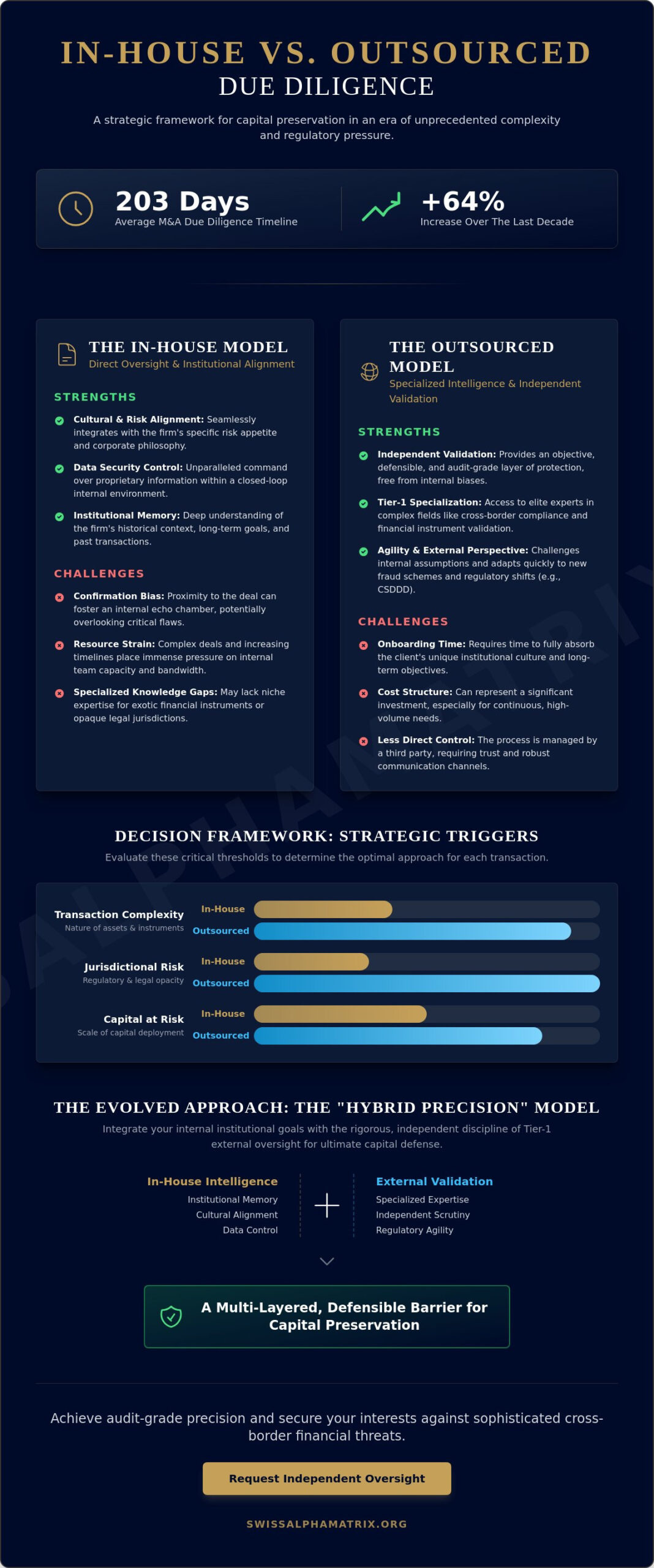
The prevailing debate surrounding in-house vs outsourced due diligence has matured beyond simple cost-benefit analyses, evolving into a critical architectural choice for the preservation of institutional capital. You’re likely aware that the average timeline for pre-announcement M&A due diligence has expanded to 203 days, a staggering 64% increase over the last decade that places immense strain on internal teams. While maintaining a Tier-1 internal department offers a sense of direct control, the inherent risk of confirmation bias and the sheer complexity of the 2026 regulatory environment, particularly with the finalized CSDDD mandates, often necessitates a more specialized touch.
We understand that your objective isn’t merely to complete a checklist, but to ensure that every deployment of capital is defended by audit-grade precision and an unwavering commitment to risk mitigation. This article provides an institutional-grade framework designed to help you determine when internal oversight suffices and when specialized external validation becomes a strategic necessity. We’ll examine the shifting thresholds of cross-border compliance, the impact of the global talent gap on internal efficacy, and the methodology required to achieve a truly defensible validation of complex financial instruments.
Key Takeaways
- Learn to transition your risk management from basic administrative checks to a multi-layered protective barrier designed for the preservation of capital in volatile global markets.
- Identify the specific operational scenarios where internal oversight provides superior cultural alignment and control over proprietary data security protocols.
- Evaluate the critical thresholds in instrument complexity and jurisdictional opacity that define the strategic choice between in-house vs outsourced due diligence for high-stakes transactions.
- Discover the necessity of specialized bank instrument validation to secure your interests against increasingly sophisticated forms of cross-border financial fraud.
- Explore the “Hybrid Precision” model, a framework that integrates your internal institutional goals with the rigorous, independent discipline of Tier-1 external oversight.
The Strategic Architecture of Due Diligence in 2026
The concept of due diligence has shifted from a procedural necessity to a sophisticated protective barrier designed to safeguard institutional capital against unprecedented volatility. In 2026, the mere verification of balance sheets no longer suffices. We’re witnessing an era where transactional risk has morphed from administrative inconsistencies into intricate, multi-jurisdictional fraud schemes that exploit the gaps between regional legal frameworks. This evolution demands a shift in perspective. Decision-makers are increasingly finding that the traditional, binary debate of in-house vs outsourced due diligence is a relic of a less complex financial epoch. For Tier-1 transactions, the objective isn’t merely to choose a provider; it’s to architect a defense mechanism that combines internal institutional intelligence with specialized external validation.
Effective capital protection requires a precise definition of scope. While Operational Due Diligence (ODD) focuses on whether a portfolio or entity is structurally sound, it often fails to address the catastrophic risk of unvalidated financial instruments. True precision involves audit-grade validation of the instruments themselves. It ensures that underlying assets are not only present but also legally unencumbered and authentically issued by the stated authorities. Relying solely on internal reviews for these exotic or cross-border instruments can leave a firm vulnerable to sophisticated actors who operate in the shadows of regulatory shifts.
The Stakes of Capital Deployment Precision
The cost of failure in cross-border investment is rarely limited to the loss of the principal. It extends to reputational degradation and the potential breach of fiduciary duties toward institutional boards. Boards now require more than just “check-the-box” compliance. They demand executive-level strategic intelligence that can withstand the scrutiny of a forensic audit. Independent validation serves as the ultimate arbiter of truth. It provides a defensible layer of protection that internal teams, regardless of their proficiency, might struggle to provide due to inherent proximity to the transaction.
Institutional Memory vs. External Agility
Institutional memory remains a core asset for any in-house team. These professionals understand the firm’s long-term risk appetite and historical context better than any third party ever could. However, this deep familiarity can occasionally foster confirmation bias. External advisors provide the necessary “outsider perspective” required to challenge internal assumptions. By balancing the deep-rooted alignment of internal staff with the short-term tactical expertise of external specialists, firms can navigate the 2026 landscape with both historical wisdom and modern agility. It’s about merging the known with the verified.
The In-House Model: Direct Oversight and Institutional Alignment
The internal model of investigative review relies on the premise of proximity, where the team functions as a direct extension of the firm’s executive leadership. When weighing the merits of in-house vs outsourced due diligence, the most immediate argument for maintaining internal capacity is the seamless alignment with a firm’s specific risk appetite. Internal practitioners act as custodians of the corporate philosophy, possessing an intimate understanding of long-term strategic goals that an external entity might take months to absorb. This cultural integration ensures that every assessment is filtered through the lens of the organization’s unique moral character and historical risk tolerance, providing a level of nuanced judgment that is difficult to replicate through external mandates alone.
Beyond cultural alignment, the in-house model offers unparalleled control over the architecture of data security. For institutions managing highly sensitive cross-border deal flow, the ability to maintain a closed loop for proprietary information is often paramount. By keeping these processes within a controlled internal environment, executives can enforce rigorous information handling protocols that mirror the traditional discretion of private wealth management. This setup allows for the rapid implementation of international financial regulations without the friction of third-party data transfers, ensuring that compliance remains a silent, steady pillar of the operational workflow.
The Value of Direct Control and Confidentiality
Direct oversight permits a level of resource agility that is essential when deal dynamics shift unexpectedly. Internal teams can pivot their focus instantly, reallocating intellectual capital to address emerging concerns in real-time. This immediate responsiveness is a hallmark of a boutique approach to capital preservation, where the speed of internal communication can be the deciding factor in securing a time-sensitive opportunity. To ensure these internal efforts remain rigorous, many firms choose to refine their internal risk management frameworks through periodic expert consultation.
The Generalist Trap and Talent Scarcity
However, the true total cost of ownership for a Tier-1 internal team involves more than just salary; it encompasses the immense difficulty of recruiting and retaining the caliber of expertise required for specialized instrument validation. These internal departments often fall into the “Generalist Trap,” where professionals who are adept at broad operational reviews struggle when faced with niche instruments such as Standby Letters of Credit (SBLCs) or complex, multi-layered Documentary Credits. The global talent gap, particularly for those with deep-seated institutional experience in fraud prevention, means that internal teams may lack the “Master Planner” perspective necessary to identify sophisticated deceptions. This scarcity can lead to a dangerous form of tunnel vision, where internal confirmation bias overrides the objective skepticism required to protect capital from increasingly complex cross-border threats.
The Outsourced Model: Specialized Intelligence and Independent Validation
While internal teams provide essential cultural alignment, the strategic pivot in the in-house vs outsourced due diligence debate often rests on the requirement for specialized intelligence. External validation brings a “Master Planner” perspective, typically sourced from former global bank executives who have spent decades navigating the very institutional architectures they are now tasked to scrutinize. This level of unemotional expertise is indispensable in high-stakes environments where internal momentum might inadvertently cloud objective judgment. By engaging an independent partner, executives ensure that their capital is protected by a standard of skepticism that is both rigorous and detached from internal corporate politics.
Specialized boutique firms distinguish themselves from large, generic consultancies through a commitment to hyper-personalized service and technical precision. Rather than assigning junior associates to review data rooms, these entities deploy seasoned experts to perform bank instrument validation services that are truly audit-grade. This ensures that every standby letter of credit, guarantee, or complex financial instrument is verified against its source of issuance, providing a level of certainty that satisfies the most demanding institutional boards. The result is a defensible risk mitigation framework that transforms raw data into strategic intelligence.
Tier-1 Expertise on Demand
Accessing Tier-1 expertise on an as-needed basis allows firms to leverage decades of transactional and regulatory experience without the prohibitive fixed overhead of a permanent senior-level department. This model is particularly effective when dealing with the 7.8% compound annual growth rate of the due diligence market, where the complexity of fraud is outpacing traditional internal training. External advisors act as dedicated partners, offering a steady, logical rhythm of verification that leads to a sense of inevitable logic in the final decision-making process.
Physical On-Ground Verification
Digital documentation is increasingly insufficient for validating high-value assets or entities in 2026. Sophisticated fraud often involves impeccable digital paperwork that masks a lack of physical substance. On-ground verification serves as the ultimate arbiter of truth, bridging the gap between desktop-based analysis and jurisdictional reality. This process involves independent financial instrument review in global regions where local presence is the only way to uncover hidden liabilities or shell structures. For instance, while a desktop review might confirm a bank’s SWIFT capability, an on-ground operative can identify if the entity is merely a shell office in a high-risk jurisdiction, a red flag that internal teams frequently overlook due to resource constraints. This meticulous attention to detail ensures that capital deployment is guided by fact, not just appearance.
Decision Framework: Evaluating Complexity, Jurisdiction, and Frequency
The determination of an optimal equilibrium in the in-house vs outsourced due diligence equation requires a clinical evaluation of a transaction’s specific DNA. It’s a strategic calculation that moves beyond mere administrative capacity, focusing instead on the technical thresholds where internal generalist oversight may no longer provide a sufficient shield for institutional capital. When a mandate involves standard, repeatable operational reviews within familiar jurisdictions, the internal model often suffices. However, as the instrument architecture shifts from standard to bespoke, or the geographical focus moves toward opaque, high-risk cross-border regions, the necessity for specialized external validation becomes an absolute requirement for the preservation of fiduciary integrity.
Regulatory pressure in 2026, intensified by the cascading effects of the EU’s CSDDD, has elevated the standard for what constitutes “defensible” review. Boards and shareholders no longer accept surface-level assurances. They demand audit-grade validation that can withstand the scrutiny of external regulators and forensic auditors. This creates a decision matrix based on three primary pillars: the complexity of the financial instrument, the transparency of the jurisdiction, and the frequency of the transaction type. A high-stakes “one-off” mandate in an emerging market, for instance, represents a risk profile that few internal teams are equipped to navigate with the requisite precision.
The Complexity Threshold
Determining when a transaction exceeds the technical capacity of an internal team is the first step in capital protection. High-complexity indicators often include the presence of exotic instruments such as Standby Letters of Credit or multi-layered documentary credits that require a “Master Planner” perspective to verify. In these instances, the depth of cross-border investment due diligence required extends far beyond digital data rooms. It necessitates a forensic understanding of local banking protocols and the ability to identify “High-Complexity” indicators, such as:
- Instruments issued by non-rated or offshore financial entities.
- Transaction structures involving three or more jurisdictions with varying regulatory standards.
- Projects where the underlying asset’s physical existence cannot be verified through public records.
Managing Stakeholder Expectations
Independent oversight provides a critical “safe harbor” for executive decision-makers, shielding them from the personal and professional liabilities associated with capital deployment failure. By integrating independent financial project management into existing PMO structures, firms can demonstrate to shareholders a commitment to unemotional, Tier-1 discipline. This approach doesn’t replace internal goals; it validates them. It allows executives to communicate a rationale for external validation that is rooted in historical reliability and regional precision. To ensure your next complex mandate is defended by this level of institutional-grade oversight, we invite you to explore our risk management frameworks.
The Swiss Alpha Matrix Approach: Independent Project Oversight
At Swiss Alpha Matrix, we reframe the traditional advisory role into that of a dedicated partner in capital protection, moving beyond the transactional to the institutional. The debate regarding in-house vs outsourced due diligence often reaches a stalemate when executives feel forced to choose between internal cultural alignment and specialized external expertise. Our “Hybrid Precision” model resolves this tension by merging your internal strategic goals with Tier-1 external discipline. This methodology ensures that your capital deployment is guided by executive-level intelligence, providing the meticulous precision required to navigate the volatile 2026 market landscape while maintaining the traditional discretion that remains the hallmark of Swiss financial excellence.
We function as a master planner for your most complex mandates. By integrating our specialized validation protocols into your existing structures, we provide a layer of quiet authority that reinforces fiduciary integrity. This approach is rooted in historical reliability and regional precision, ensuring that every decision is backed by a structured argument and professional calm. We don’t merely provide a service; we establish a standard of excellence that distinguishes performance-oriented leaders from passive market participants.
Beyond the Checklist: Investigative Depth
Our methodology for audit-grade validation of complex financial instruments transcends simple data room reviews. We utilize the collective experience of former senior bank executives to deconstruct transactional risk at its foundation. This process involves:
- Deconstructing the issuance chain of exotic instruments to ensure absolute legal clarity.
- Utilizing on-ground verification to validate the physical and jurisdictional reality of assets.
- Delivering precision-based reports that stand up to the most rigorous institutional and regulatory scrutiny.
Securing Your Next Transaction
Integrating Swiss Alpha Matrix into your current project management framework is a seamless process designed for exclusivity and efficiency. Our onboarding for mandate-specific due diligence engagements begins with a deep dive into your specific risk parameters, ensuring that our oversight is hyper-personalized to your firm’s unique moral character and high-level standards. This structured transition from broad principles to specific strategic pillars creates a sense of inevitable logic that encourages confidence in the deployment process. To begin this partnership, we invite you to engage our senior advisors for a confidential review of your due diligence needs.
Architecting a Defensible Future for Capital Preservation
The landscape of 2026 demands a departure from the binary choice of in-house vs outsourced due diligence. It’s essential to recognize the threshold where the technical complexity of a financial instrument exceeds the capacity of a generalist team. By prioritizing audit-grade validation, firms ensure that their fiduciary duties are met with the highest standard of moral character and technical accuracy. This synthesized approach, where internal institutional memory is fortified by specialized, on-ground verification, creates a robust barrier against multi-jurisdictional fraud.
Managed by former Tier-1 global bank executives, Swiss Alpha Matrix provides the intellectual depth necessary to deconstruct transactional risk. Our methodology ensures your interests are protected by Swiss-level discretion and precision, offering a standard of service that is both broad in reach and meticulous in its attention to detail. We invite you to consult with our Tier-1 experts on your due diligence architecture to refine your strategy for the coming mandates. Secure your legacy through a partnership rooted in historical reliability and unwavering precision.
Frequently Asked Questions
What is the primary difference between in-house and outsourced due diligence?
The primary distinction lies in the vantage point of the reviewer. Internal teams provide cultural alignment and institutional memory, but the choice between in-house vs outsourced due diligence often hinges on the need for independent validation. External specialists offer a structural separation that ensures the review process remains insulated from the internal momentum and potential bias often associated with high-stakes deal closures.
How do I know if my internal team is equipped to handle complex bank instrument validation?
An internal team is likely unequipped if they lack former Tier-1 banking executives who specialize in the forensic deconstruction of bespoke instruments. If your current review protocols rely primarily on digital database checks rather than direct, audit-grade verification with the issuing bank’s compliance department, the risk of technical oversight is significant. Specialized validation requires a level of niche expertise that generalist departments rarely maintain.
Is outsourced due diligence more expensive than maintaining an in-house team?
The total cost of ownership for a Tier-1 internal team includes high fixed overhead, recruitment challenges, and the ongoing expense of specialized technical training. While external mandates involve project-specific fees, they often prove more efficient by providing elite expertise on demand. This model avoids the long-term carry of senior-level salaries when the volume of complex transactions fluctuates throughout the fiscal year.
How does independent project oversight improve capital protection?
Independent oversight introduces a master planner perspective that actively challenges internal assumptions and confirmation bias. By utilizing a steady, logical framework for risk mitigation, executives gain a defensible layer of protection that satisfies fiduciary duties. This process ensures that capital deployment is guided by verified facts and forensic evidence rather than the optimistic projections frequently found in deal-side documentation.
What are the risks of relying solely on in-house due diligence for cross-border deals?
Relying solely on internal reviews for cross-border transactions introduces the risk of geographical blind spots and jurisdictional opacity. In the context of in-house vs outsourced due diligence, the internal model often lacks the on-ground presence required to navigate high-risk regions. This can result in missed localized red flags, especially as the 2026 CSDDD mandates create new, multi-layered layers of environmental and human rights compliance complexity.
Can external due diligence advisors work alongside my internal PMO?
External advisors are designed to integrate seamlessly into existing Project Management Office structures as dedicated partners rather than mere service providers. This hybrid model allows the internal team to maintain strategic alignment while the external experts handle the technical validation and audit-grade reporting. It’s a collaborative architecture that strengthens the overall defense of the transaction without disrupting internal workflows or proprietary security protocols.
What does “audit-grade” instrument validation actually entail?
Audit-grade validation entails a forensic review that meets the rigorous standards of international regulatory bodies and institutional boards. It goes beyond verifying the existence of a digital document. The process involves confirming the legal authority of the signatories, the authenticity of the bank’s transmission protocols, and the unencumbered status of the underlying assets to ensure the instrument is enforceable and authentic.
Why is on-ground verification critical for international investment due diligence?
On-ground verification is the only method to confirm the physical and jurisdictional reality behind digital documentation. In many global regions where public records are unreliable or incomplete, a physical presence allows for the verification of entities and assets that might otherwise exist only on paper. It bridges the gap between theoretical compliance and the actual operational reality of a target entity.