

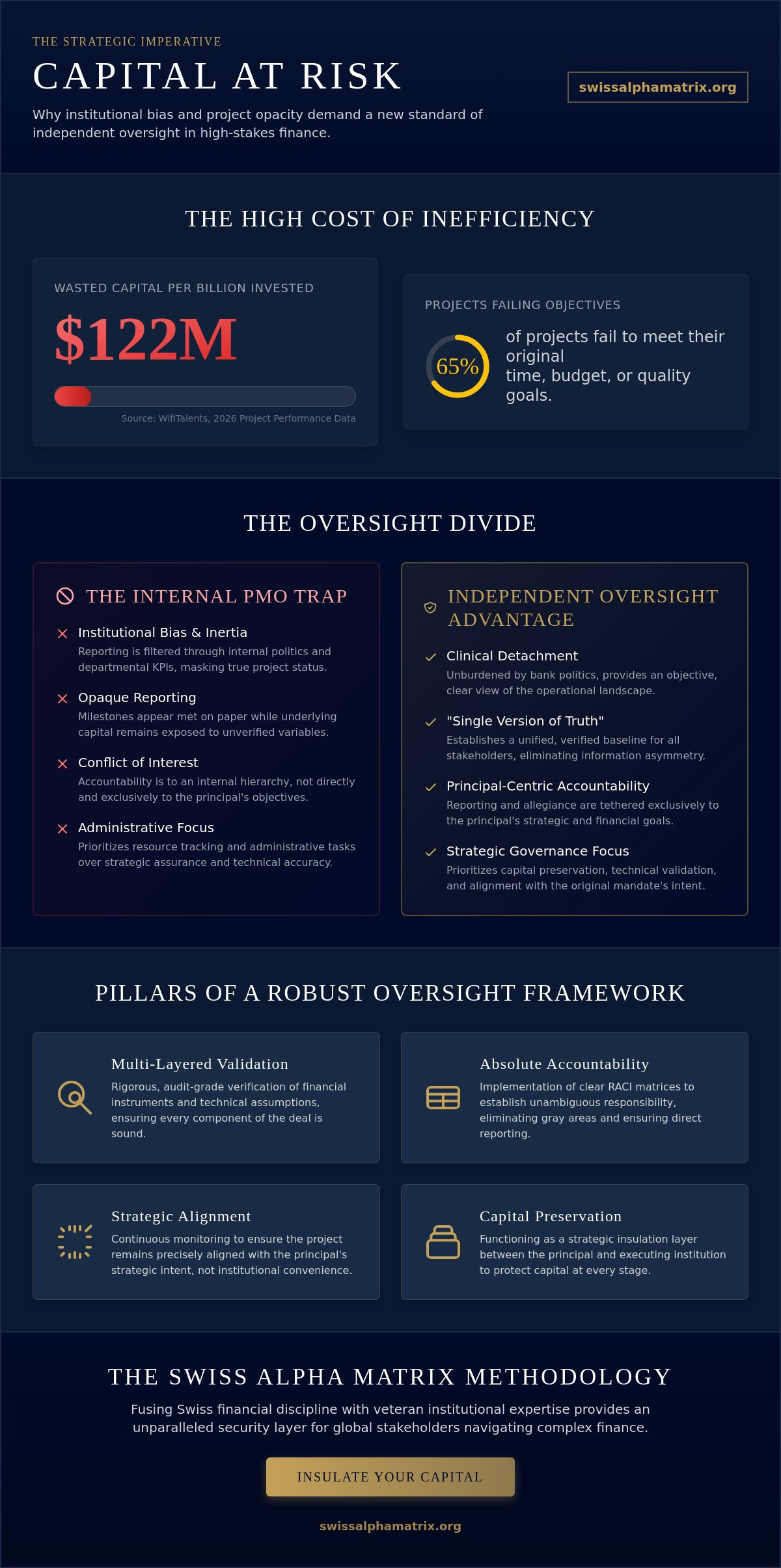
In the rarefied atmosphere of high-stakes global finance, the cost of inefficiency is never merely a line item; it’s a systemic erosion of capital. According to 2026 data from WifiTalents, organizations waste an average of $122 million for every $1 billion invested due to poor project performance. This reality is particularly acute in complex, cross-border mandates where the benefits of independent project management oversight become a non-negotiable pillar of capital preservation. You’ve likely recognized that while Tier-1 institutions offer significant prestige, their internal reporting often suffers from inherent institutional bias and information asymmetry that leaves your capital unacceptably exposed.
It’s our firm belief that your strategic growth shouldn’t be held hostage by unverified financial instruments or opaque reporting structures. Discover how institutional-grade independent oversight insulates your capital, eliminates the friction of institutional bias, and ensures the precise execution of bespoke financial mandates. We’ll examine the shift toward strategic oversight, the integration of the new PMBOK Eighth Edition standards, and the rigorous, audit-grade validation of financial instruments that define modern, risk-adjusted project success.
Key Takeaways
- Understand why the inherent reporting bias and inertia within Tier-1 institutions necessitate a bespoke layer of external vigilance to safeguard high-value mandates.
- Learn how the benefits of independent project management oversight manifest through multi-layered instrument validation and the creation of a cross-border “single version of truth.”
- Identify the structural limitations and expertise gaps that often prevent internal bank project managers from effectively challenging technical assumptions or mitigating operational risk.
- Master the implementation of robust oversight frameworks using clear RACI matrices to establish absolute accountability and distinguish critical milestones from administrative tasks.
- Explore how the fusion of Swiss financial discipline and veteran institutional expertise provides an unparalleled security layer for global stakeholders navigating complex finance.
The Strategic Imperative: Why Complex Financial Programs Require External Vigilance
The execution of cross-border financial mandates requires a level of precision that standard institutional frameworks often struggle to maintain under the weight of their own bureaucracy. Within this sophisticated environment, we define independent project management oversight as a bespoke mandate designed specifically for capital protection, functioning as a strategic insulation layer between the principal and the executing institution. This role, which we characterize as the Strategic Architect, ensures that the complex architecture of a deal is not compromised by the internal biases of Tier-1 banks. As we move through 2026, the global financial environment has become increasingly intolerant of the passive monitoring models of the past. The benefits of independent project management oversight are most visible when they transform a project from a series of unverified administrative updates into a rigorous, audit-grade trajectory toward a successful closing.
The Erosion of Alpha through Institutional Opacity
High-value mandates are inherently vulnerable to institutional inertia, where internal project teams don’t always prioritize candid risk reporting over departmental harmony or internal KPIs. This opacity creates a fertile ground for hidden project stagnation, where milestones appear met on paper while the underlying capital remains exposed to unverified variables. When decision-making is delayed in volatile global markets, the resulting erosion of alpha can be catastrophic for long-term wealth preservation. An independent lens, unburdened by internal bank politics, identifies these points of friction with clinical detachment. By providing a clear view of the operational landscape, it ensures the project remains aligned with the principal’s original strategic intent rather than the bank’s internal convenience.
Distinguishing Independent Oversight from Traditional PMOs
While a traditional Project Management Office focuses on administrative tracking and resource allocation, independent oversight operates as a project governance framework that prioritizes strategic assurance and technical accuracy. The fundamental distinction lies in the direction of accountability; whereas internal PMOs report upward through an institutional hierarchy, independent oversight remains tethered exclusively to the principal’s objectives. This independence is the primary driver of reporting integrity, particularly when linked to specialized bank instrument validation services. By integrating these technical verifications into the broader project lifecycle, stakeholders realize the full benefits of independent project management oversight, ensuring that every financial instrument is validated with the same level of scrutiny as the project’s operational milestones. This dual-layered approach provides a standard of service that is both global in its reach and local in its attention to detail.
Quantifying the Benefits of Independent Project Management Oversight in Capital Preservation
The transition from administrative project tracking to rigorous capital preservation requires a methodology that acknowledges the inherent fragility of global financial mandates. It’s a sobering reality that, as of early 2026, approximately 65% of projects fail to meet their original time, budget, or quality objectives. For institutional investors, this isn’t merely a missed milestone; it’s a direct threat to the integrity of their multi-asset diversification strategies. The benefits of independent project management oversight manifest most clearly when they bridge the gap between theoretical project plans and the volatile reality of cross-border execution. By establishing a “single version of truth” that exists outside the influence of the executing bank, stakeholders gain the clarity needed to accelerate timelines and remove the institutional bottlenecks that typically stifle complex deals.
Operational efficiency in this context is inextricably linked to adherence with evolving international financial regulations. As regulatory bodies increase their scrutiny on “Value for Money” analyses and infrastructure credit assistance, having an independent partner ensures that every phase of the project remains compliant with the most current standards. This proactive stance does more than just avoid penalties; it reinforces the project’s structural integrity, making it an attractive prospect for further institutional participation. If you’re seeking to fortify your current mandates, you might consider how our bespoke risk management frameworks can align your project with these global benchmarks.
Audit-Grade Validation of Financial Instruments
In the specialized world of SBLCs, Letters of Credit, and other complex bank instruments, the risk of sophisticated fraud is a persistent shadow. One of the primary benefits of independent project management oversight is the deployment of audit-grade validation that goes beyond superficial paperwork. We don’t just review digital copies; we facilitate on-ground verification services to ensure the underlying legitimacy of the instrument at its source. This multi-layered approach creates a synergy between high-level project governance and physical due diligence, effectively insulating your capital from the unverified instruments that often cause catastrophic losses in unmonitored deals.
Objective Risk Mitigation and Early Warning Systems
The “Wise Guardian” persona isn’t a marketing trope; it’s a functional necessity in high-stakes negotiations where emotional bias can cloud executive judgment. By utilizing data-driven assessments and executive-level intelligence, independent oversight functions as an early warning system. It detects red flags, such as misalignment between project objectives and business strategy, which TaskFino reports as a leading cause of failure for 44% of projects. This unemotional, clinical detachment allows for the identification of operational negligence before it manifests as capital loss, ensuring that the project’s trajectory remains fixed on alpha generation rather than damage control.
- Identification of “hidden” project stagnation through independent lens.
- Deployment of on-ground verification to supplement digital due diligence.
- Alignment with 2026 ISO quality management revisions for institutional-grade delivery.
Beyond Internal PMOs: Addressing the Conflict of Interest and Expertise Gap
The structural limitations inherent in Tier-1 global banking hierarchies often create an environment where reporting integrity is inadvertently sacrificed at the altar of institutional harmony. Internal project managers, regardless of their individual competence, operate within a reporting line that discourages the challenging of senior-level technical assumptions. This creates a significant expertise gap, where generalist project managers are tasked with overseeing intricate financial mandates that require the nuanced understanding of a seasoned former bank executive. One of the most profound benefits of independent project management oversight is the removal of this conflict of interest, ensuring that the principal’s capital is protected by an entity whose loyalty isn’t divided by internal bank politics or career-track considerations. By leveraging independent financial project management, stakeholders can bridge the chasm between routine administrative execution and high-level strategic alignment.
The Fallacy of the “Self-Correcting” Internal Team
Psychological bias toward optimistic reporting is a documented phenomenon in corporate structures, where internal teams often feel pressured to present a narrative of progress even when milestones are slipping. This is frequently exacerbated by the “sunk cost fallacy,” which prevents internal bank teams from pivoting or admitting project failure until the capital exposure has reached a critical threshold. External mandates serve as a necessary corrective, providing the “uncomfortable truth” that is essential for capital safety. Unlike internal stakeholders who might fear the repercussions of delivering bad news to senior management, an independent partner prioritizes transparency. This clinical objectivity is a cornerstone of the benefits of independent project management oversight, allowing for the early detection of systemic issues that internal reporting lines might otherwise obscure.
Accessing Institutional-Grade Financial Advisory
True oversight in complex finance requires more than just a mastery of scheduling software; it demands a deep familiarity with how Tier-1 bank balance sheets are managed and how cross-border mandates are structured. Our approach provides access to institutional-grade advisory conducted by professionals who have previously operated at the highest levels of global finance. This background allows us to translate complex technical jargon into actionable executive-level intelligence, ensuring that you aren’t just receiving data, but strategic insight. This level of service mirrors the traditional discretion of Swiss financial traditions, where privacy and excellence are paramount. We ensure that every bespoke mandate is handled with a sense of quiet authority, positioning ourselves as your dedicated partner in navigating the intricate dynamics of the global market.
- Elimination of institutional bias through external reporting lines.
- Bridging the gap between generalist management and senior-level technical expertise.
- Mitigation of the “sunk cost fallacy” through objective project evaluation.
- Translation of complex banking data into strategic executive summaries.
Structural Implementation: Designing a Robust Oversight Framework for 2026
Designing an oversight framework for the 2026 financial landscape requires a departure from the generic, often superficial administrative tracking that characterizes retail project management. As the Project Management Institute transitions toward the structured Focus Areas of the PMBOK Eighth Edition, the necessity for a rigid, technically accurate architecture in complex finance has never been more apparent. One of the primary benefits of independent project management oversight is the imposition of a multi-jurisdictional structure that survives the inherent volatility of global markets. By implementing financial advisory methodologies that prioritize capital protection, we ensure that the execution of a mandate is never left to the discretion of an internal bank team with competing priorities. This structural integrity is maintained through real-time data monitoring, which we then synthesize into monthly executive-level deep dives to provide the principal with absolute clarity.
Establishing the RACI Matrix for Global Stakeholders
In the context of cross-border deals, accountability drift is a persistent risk that often leads to catastrophic project delays. We mitigate this by establishing a clear RACI matrix, which precisely defines who is Responsible, Accountable, Consulted, and Informed for every technical phase of the project. This framework is essential for eliminating the ambiguity that often arises in multi-jurisdictional financial programs, where different legal and regulatory requirements can cloud the decision-making process. By ensuring the principal remains the ultimate decision-maker, we maintain a reporting line that is both transparent and uncompromising. It’s through this meticulous allocation of roles that the true benefits of independent project management oversight are realized, as it prevents the diffusion of responsibility that typically occurs within large-scale institutional hierarchies.
Milestone-Driven Execution vs. Deliverable Tracking
Tracking routine administrative deliverables is insufficient for mandates involving complex financial instrument validation. We distinguish between routine tasks and “Hard Milestones,” which are critical points in the project lifecycle that trigger capital release or necessitate strategic pivots. Every high-stakes milestone undergoes independent verification to ensure that the technical requirements have been met with audit-grade precision. This milestone-driven approach ensures that the project’s trajectory is dictated by actual progress rather than optimistic projections. If you’re overseeing a mandate with significant capital exposure, you can explore our complex project management services to ensure your framework is resilient enough for the current regulatory environment.
- Elimination of accountability drift through multi-jurisdictional RACI matrices.
- Prioritization of “Hard Milestones” to safeguard capital release protocols.
- Integration of PMBOK Eighth Edition “Focus Areas” for institutional-grade delivery.
- Synthesis of real-time monitoring into actionable executive intelligence.
The Swiss Alpha Matrix Methodology: Bespoke Oversight for Global Stakeholders
The Swiss Alpha Matrix methodology represents a paradigm shift from traditional consultancy to a state of permanent strategic vigilance. By assembling a team comprised exclusively of former Tier-1 bank executives, we provide an unparalleled layer of security that generalist firms simply cannot replicate. This methodology is a fusion of rigorous financial discipline and the historical precision of Swiss advisory; it’s an environment where capital deployment decisions are made with surgical precision. The benefits of independent project management oversight are fundamentally tied to the caliber of the practitioners involved. We move beyond the transactional nature of traditional monitoring, establishing a long-term strategic partnership that prioritizes long-term wealth preservation and strategic growth over short-term market speculation.
Integrating Precision with Discretion
Our identity as a boutique firm allows us to prioritize privacy and exclusivity, catering to a sophisticated audience that values nuance and thoroughness. Bespoke mandates aren’t merely a service offering; they’re a commitment to hyper-personalization, ensuring that the specific intricacies of your multi-asset diversification strategies are reflected in our oversight framework. We maintain the “Wise Guardian” persona in every stakeholder interaction, projecting an image of intellectual superiority tempered by traditional values. This dignified approach mirrors the discretion of Swiss private banking, ensuring that even the most complex, multi-layered sentence structures in our reporting provide absolute technical accuracy and professional calm.
Securing the Future of Cross-Border Capital
As we navigate the 2026 regulatory landscape, characterized by the July 2026 update to the PMBOK Eighth Edition and the Autumn 2026 revision of the ISO 9001 standard, the necessity for a Strategic Architect is undeniable. While AI integration begins to automate routine administrative tasks, the most valuable competencies remain human-centric: emotional intelligence, leadership, and strategic business acumen. We believe that on-ground verification remains the gold standard in an increasingly digital-first financial world. By verifying the physical reality behind the digital instrument, we ensure the benefits of independent project management oversight translate into concrete capital protection. If your current mandates require this level of institutional-grade rigor, we invite you to engage Swiss Alpha Matrix for strategic project oversight and secure the execution of your global financial mandates.
- Utilization of former Tier-1 executive intelligence for surgical capital deployment.
- Adherence to 2026 ISO and PMBOK standards for institutional-grade governance.
- Commitment to on-ground verification as the definitive safeguard against fraud.
- Hyper-personalized reporting that mirrors the discretion of Swiss private banking.
Securing the Future of Institutional Mandates through Strategic Vigilance
The evolution of global financial markets toward greater complexity and tighter regulatory standards demands a transition from traditional project tracking to a state of permanent strategic vigilance. By adopting a methodology that prioritizes capital protection over institutional convenience, stakeholders can effectively insulate their mandates from the inherent risks of information asymmetry and operational negligence. We’ve explored how the structural benefits of independent project management oversight provide a clinical detachment that internal bank teams simply cannot achieve; particularly when verifying the technical legitimacy of cross-border financial instruments. This approach ensures that every phase of execution remains aligned with the principal’s original strategic intent.
As we move deeper into 2026, the distinction between successful execution and capital erosion will depend on the presence of a Strategic Architect who understands the nuances of Tier-1 bank balance sheets. Our firm, managed by former senior executives from global institutions, offers the precise audit-grade validation and Swiss-based discretion required for high-stakes mandates. It’s time to move beyond the limitations of internal reporting and embrace a partnership built on transparency and technical excellence. Secure your capital with institutional-grade project oversight. Contact Swiss Alpha Matrix today. Your strategic objectives deserve the protection of seasoned experts who prioritize long-term preservation above all else.
Frequently Asked Questions
What is the primary difference between an internal PMO and independent project oversight?
The primary distinction lies in the direction of accountability and the elimination of institutional bias that typically colors internal reporting. While an internal PMO is tethered to the bank’s hierarchy and departmental KPIs, independent oversight operates as a bespoke mandate reporting exclusively to the principal. This ensures that the benefits of independent project management oversight include an uncompromising focus on capital protection rather than institutional harmony or career-track preservation.
How does independent oversight specifically prevent cross-border financial fraud?
Independent oversight prevents fraud by deploying a dual-layered verification process that combines digital audit-grade validation with physical on-ground verification services. We don’t rely on the digital copies provided by intermediaries; instead, we verify the underlying legitimacy of bank instruments at their source. This rigorous approach effectively insulates capital from the sophisticated cross-border fraud that often thrives in the opaque reporting environments of unmonitored mandates.
Can independent project management oversight be integrated into existing bank-led projects?
Integration is not only possible but recommended for mandates where the principal feels a growing sense of information asymmetry. We function as a strategic insulation layer, working alongside existing bank-led teams to provide an objective “single version of truth” without disrupting the underlying transactional mechanics. This external layer ensures that project milestones are verified with clinical detachment, aligning the project’s execution with the principal’s long-term wealth preservation goals.
What are the key red flags that indicate a project requires immediate independent review?
Significant red flags include persistent milestone slippage, a lack of transparency regarding the verification of financial instruments, and a misalignment between project objectives and broader business strategy. When internal reporting becomes overly optimistic despite tangible delays, it’s often a sign of institutional inertia. Immediate independent review is necessary when the principal can no longer verify the technical accuracy of the reports received from the executing institution.
How does Swiss Alpha Matrix ensure the confidentiality of sensitive financial mandates?
We maintain confidentiality by adhering to the traditional discretion of Swiss private banking, operating as a boutique firm that prioritizes privacy above all else. Our communication is characterized by a sense of quiet authority, ensuring that sensitive data is only accessible to a limited circle of seasoned experts. This exclusive approach mirrors the historical reliability of Swiss financial traditions, positioning us as a dedicated partner rather than a conventional service provider.
What is the typical ROI of engaging independent project oversight for a high-value transaction?
The ROI of independent oversight is most accurately measured by the mitigation of operational and fraud risk, which globally accounts for an average waste of $122 million for every $1 billion invested according to 2026 WifiTalents data. Organizations utilizing proven project management practices waste 28 times less money than those without such frameworks. Beyond cost avoidance, the benefits of independent project management oversight include the acceleration of project timelines and the precise realization of risk-adjusted returns.
How do you handle stakeholder management when internal teams are resistant to external oversight?
We manage resistance by positioning our team as a technical partner rather than a monitoring adversary, utilizing executive-level diplomacy to align all parties with the project’s success. Our background as former Tier-1 bank executives allows us to speak the same institutional language as the internal teams, fostering an environment of mutual respect. This approach reduces friction and ensures that the oversight framework is viewed as a strategic asset for the project’s overall alpha generation.
What technical qualifications should an independent project monitor possess in the financial sector?
An independent project monitor in the complex finance sector should possess a background as a senior executive within Tier-1 global institutions. This seniority ensures they have a deep, practical understanding of bank balance sheets and the intricate nature of cross-border mandates. Beyond technical mastery of project governance frameworks, they must demonstrate digital fluency and a high degree of emotional intelligence to navigate the sophisticated dynamics of global financial markets.