

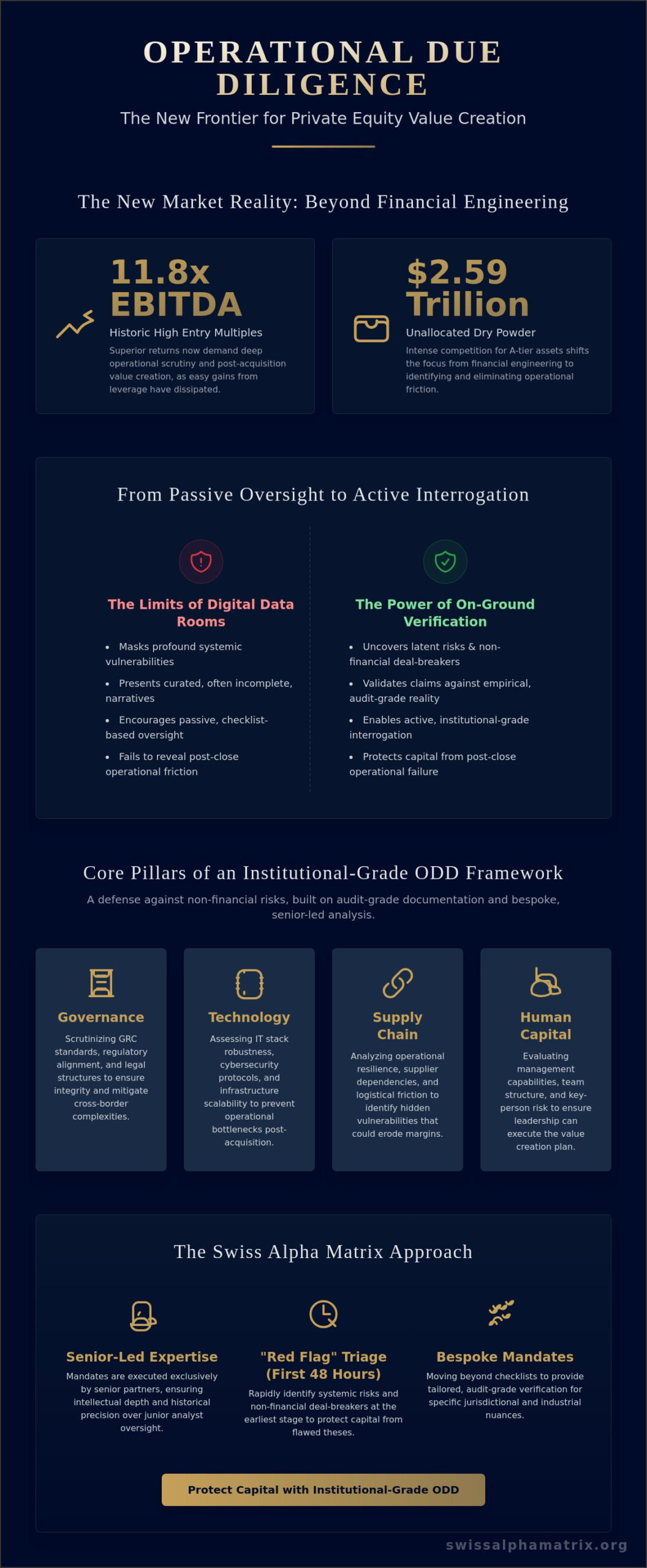
With global entry multiples reaching a historic zenith of 11.8x EBITDA, the era of securing superior returns through mere financial engineering has effectively concluded. In this sophisticated climate, characterized by $2.59 trillion in unallocated dry powder, the traditional reliance on digital data rooms often masks profound systemic vulnerabilities that manifest only after capital is committed. Rigorous operational due diligence for private equity is no longer a secondary administrative exercise; it’s the primary mechanism for preserving the integrity of an investment thesis against the friction of post-close operational failures and cross-border regulatory complexities.
You likely recognize that the transition from passive market participation to active value creation requires a level of scrutiny that transcends standard checklists. This article provides the strategic architecture necessary to master institutional-grade operational due diligence, enabling you to mitigate non-financial risks and validate management’s claims with audit-grade precision. We will examine a repeatable framework designed to protect limited partner capital through bespoke verification and robust risk management, ensuring your mandates reflect the excellence and stability synonymous with Swiss financial traditions.
Key Takeaways
- Appreciate the strategic necessity of transitioning from passive oversight to active operational scrutiny to secure long-term alpha amidst 2026 global volatility.
- Implement an institutional-grade framework that utilizes audit-grade documentation to validate governance, technology, and human capital claims.
- Recognize the limitations of digital data rooms and the imperative for physical on-ground verification when conducting operational due diligence for private equity.
- Master the “Red Flag” phase of the deal lifecycle to identify systemic risks and non-financial deal-breakers within the critical first 48 hours.
- Adopt a senior-led approach to bespoke mandates that prioritizes intellectual depth and historical precision over the use of junior analysts.
The Strategic Evolution of Operational Due Diligence in Private Equity (2026)
Institutional investors increasingly recognize that Operational Due Diligence serves as the definitive barrier against systemic failure by scrutinizing the non-investment functions that sustain a firm’s architecture. It is no longer sufficient to merely evaluate financial statements or market positioning; instead, a comprehensive assessment of a target’s internal infrastructure is required to identify latent risks that could compromise capital preservation. In this sophisticated environment, operational due diligence for private equity has transitioned from a peripheral “check-the-box” exercise into a central pillar of the investment committee’s decision-making process, focusing on the robustness of middle and back-office operations.
The landscape of 2026 demands a fundamental shift from passive oversight to active operational interrogation. With global private equity deal value reaching $1.2 trillion in 2025 and entry multiples peaking at a historic high of 11.8x EBITDA, the margin for error has narrowed significantly. It’s clear that the easy gains once provided by leverage and multiple expansion are dissipating, leaving operational integrity as the primary lever for growth. Unlike a standard financial audit, which remains largely retrospective and focused on historical accuracy, institutional-grade ODD is prospective, seeking to uncover how systemic weaknesses might buckle under the weight of future market volatility or aggressive scaling.
Shifting from Financial to Operational Alpha
In high-stakes mid-market deals, the ability to drive EBITDA margin expansion is increasingly contingent on a firm’s operational resilience rather than its capital structure. As competition for A-tier assets intensifies, sophisticated sponsors are looking beyond the balance sheet to identify where operational friction—such as antiquated technology stacks or fragile supply chains—is eroding potential value. By addressing these inefficiencies pre-acquisition, investors can secure a distinct competitive advantage that persists through the entire holding period, which now typically extends beyond six and a half years. Operational Alpha is the premium achieved through the systematic elimination of operational friction.
ODD in the Context of Global Regulatory Shifts
The modern practitioner must also account for an increasingly fragmented geopolitical environment where compliance is a moving target. Recent developments in international financial regulations have introduced complex layers of scrutiny that directly impact deal structuring and fund administration. From the rigorous oversight of the SEC to the specific mandates governing jurisdictions like Geneva and Hong Kong, ODD must now ensure that a target company’s Governance, Risk, and Compliance (GRC) standards are beyond reproach. Aligning target operations with institutional-grade ESG and regulatory expectations isn’t just a matter of legal safety; it’s a prerequisite for maintaining the trust of limited partners who demand absolute transparency in how their capital is managed across borders.
Core Pillars of an Institutional-Grade ODD Framework
To construct a defense against the myriad non-financial risks inherent in high-value transactions, a sophisticated investor must look beyond the superficial metrics provided by standard financial audits. The architecture of a truly institutional-grade framework for operational due diligence for private equity rests upon four immutable pillars: Governance, Technology, Supply Chain, and Human Capital. Each pillar necessitates the collection of audit-grade documentation, providing a verifiable trail that validates management’s qualitative claims against empirical reality. Relying on the curated narratives found in digital data rooms is a strategy fraught with peril; instead, the assessment requires a bespoke mandate tailored to the specific jurisdictional and industrial nuances of the target infrastructure.
This rigorous approach ensures that every operational component is examined through a lens of permanence and precision. When entry multiples remain elevated at 11.8x EBITDA, the margin for error in assessing a target’s internal machinery has vanished. It’s no longer enough to confirm that systems exist; one must verify that they’re capable of sustaining the firm’s investment thesis over a holding period that now frequently exceeds six and a half years. Engaging with a partner like Swiss Alpha Matrix ensures these assessments are conducted with the intellectual depth required for complex capital protection.
Governance, Risk, and Compliance (GRC) Infrastructure
The GRC pillar evaluates the target’s internal control environment and its capacity to withstand the intensifying regulatory scrutiny observed in 2026. This process involves a meticulous verification of the independence and expertise of the board, alongside an assessment of how the firm manages conflicts of interest and expense allocations. Following the SEC’s 2025 shift toward scrutinizing the operational reality of fund management, ODD must now confirm that the target’s risk management frameworks align with the highest institutional standards, ensuring that compliance isn’t merely a document but a functional reality.
Technological Resilience and Cybersecurity
Modern diligence must move beyond basic IT audits to assess the scalability and security of the target’s core technology stack through a Tier-1 banking lens. This involves a deep-dive analysis of disaster recovery and business continuity plans to ensure they’re robust enough to survive systemic shocks. Cybersecurity remains the most significant unquantified liability in modern private equity transactions. By identifying these vulnerabilities pre-close, investors can accurately price risk and develop a strategic roadmap for post-acquisition remediation, protecting the long-term integrity of the asset’s digital infrastructure.
Beyond the Data Room: The Imperative for On-Ground Verification
While digital data rooms offer a semblance of transparency, they often function as carefully curated environments designed to project an optimized version of reality, which, in the context of sophisticated capital deployment, remains insufficient for the mitigation of non-financial risks. Relying solely on uploaded documentation is a strategy that ignores the potential for systemic manipulation or the unintentional omission of operational bottlenecks. To truly protect institutional capital, investors must move beyond the screen. Physical, on-ground verification serves as the ultimate safeguard against cross-border fraud and operational misrepresentation, providing a level of certainty that no digital interface can replicate. This is where operational due diligence for private equity transitions from a theoretical exercise into a rigorous, physical validation of a firm’s systemic integrity.
Swiss Alpha Matrix distinguishes its methodology by deploying former senior banking executives to conduct these critical site inspections. These seasoned professionals possess the intellectual depth to look past polished presentations, identifying the “Operational Friction” index that quantifies bottlenecks never captured on a balance sheet. Whether it’s assessing the true throughput of a manufacturing facility or verifying the existence of remote infrastructure, this senior-led oversight ensures that the investment committee operates on facts, not representations. It’s a commitment to precision that reflects the traditional discretion and thoroughness of Swiss financial excellence.
Identifying ‘Ghost’ Assets and Operational Friction
Physical verification frequently reveals discrepancies that “desktop diligence” simply cannot detect, such as “ghost” inventory or equipment that, while listed as active, is functionally obsolete. While desktop reviews are fast and low-cost, they’re inherently high-risk in an era where entry multiples exceed 11.0x EBITDA. On-ground validation provides the audit-grade certainty required for high-stakes mandates. This level of scrutiny is particularly vital when mastering cross-border investment due diligence, where jurisdictional nuances can mask significant facility capacity issues or supply chain fragilities.
Assessing Management Culture and Human Capital Risk
The behavior of middle management and the general atmosphere of a facility serve as leading indicators of operational health. Intellectual superiority in diligence requires an assessment of management culture that goes beyond the C-suite, identifying key-man risks and potential cultural friction that could jeopardize post-merger integration. We conduct these assessments with extreme discretion, ensuring that the broader workforce remains unaware of the scrutiny while we evaluate the human capital architecture. A target’s culture isn’t a “soft” metric; it’s a structural component that dictates whether a firm can achieve its projected operational alpha or succumb to internal inertia post-close.
Integrating ODD into the Private Equity Deal Lifecycle
The lifecycle of a private equity transaction is a continuous spectrum of risk mitigation, where the integration of operational due diligence for private equity serves as the primary stabilizing force from initial interest through to the eventual exit. This integration begins with the critical ‘Red Flag’ phase, a high-intensity interrogation conducted within the first 48 hours of diligence. During this window, seasoned experts identify non-negotiable deal-breakers, such as systemic regulatory non-compliance or significant technological debt, which might otherwise remain obscured until late-stage negotiations. By surfacing these vulnerabilities early, the investment committee can make informed decisions regarding the viability of the mandate before incurring the substantial costs associated with full-scale confirmatory diligence.
As the deal progresses, the empirical findings from on-ground inspections and document reviews directly inform the final purchase price and the architecture of indemnity clauses. If a bespoke assessment reveals operational friction that necessitates immediate capital expenditure post-close, these costs are factored into the valuation model to protect the investor’s projected risk-adjusted returns. Coordinating these multi-faceted workstreams requires the strategic architecture of independent financial project management, ensuring that operational insights are seamlessly synthesized with legal and financial streams. For institutional investors navigating these complexities, Swiss Alpha Matrix offers the senior-led oversight necessary to maintain deal momentum without compromising on scrutiny.
Pre-Mandate Scoping and Exploratory Diligence
Before a formal mandate is finalized, the parameters of the ODD process must be precisely defined based on the target’s specific industry and geographic footprint. This phase utilizes public records and sophisticated market intelligence to build a preliminary risk profile, identifying potential cross-border compliance mandates that may require specialized attention. Selecting external advisors with Tier-1 institutional experience is paramount; these individuals must possess the intellectual depth to navigate the nuances of global financial markets while maintaining the traditional discretion expected in high-stakes transactions.
Post-Close Value Creation and Turnarounds
The transition from identifying risks to executing operational improvements represents the final, most critical phase of the lifecycle. The ODD report serves as the comprehensive blueprint for the 100-day plan, detailing the specific interventions required to eliminate operational friction and enhance EBITDA margins. By systematically addressing the vulnerabilities identified during the diligence phase, the firm can drive genuine value creation that persists through the entire holding period. ODD’s true value is realized in the exit multiple, not just the entry price.
The Swiss Alpha Matrix Approach to Bespoke Operational Oversight
The execution of a high-stakes mandate requires a level of intellectual depth and professional maturity that large-scale consulting networks, which often rely on junior analysts for data aggregation, simply cannot provide. At Swiss Alpha Matrix, we position ourselves as the premier partner for institutional investors who demand a higher standard of operational due diligence for private equity. Every engagement is led by a Senior Executive, ensuring that the nuances of global financial markets are interpreted with the seasoned judgment of practitioners who’ve spent decades navigating the complexities of institutional capital. This executive-led approach guarantees that the resulting risk management frameworks are not merely theoretical constructs, but actionable strategies rooted in the historical reliability of Swiss financial traditions.
Our methodology extends beyond the typical scope of M&A advisory, incorporating specialized bank instrument validation services into the broader ODD framework. In an era where entry multiples remain elevated at 11.8x EBITDA and regulatory scrutiny is intensifying, the ability to verify the operational backdrop of a financial instrument is as critical as the instrument itself. We provide the stability and trust necessary to navigate these intricate dynamics, ensuring that your capital remains protected through every phase of the investment lifecycle. Our commitment to excellence is reflected in our core operational values:
- Intellectual Superiority: Leveraging decades of Tier-1 banking experience to identify systemic risks that remain invisible to standard audits.
- Bespoke Precision: Crafting hyper-personalized mandates that address the specific jurisdictional and industrial nuances of each target.
- Strategic Discretion: Maintaining the traditional privacy of Swiss financial institutions while operating in complex, cross-border environments.
- Audit-Grade Integrity: Delivering validation reports that provide a definitive, repeatable framework for operational risk assessment.
Merging Swiss Discretion with Tier-1 Banking Rigour
The firm’s heritage in Swiss private banking informs a culture of absolute confidentiality, a necessity when handling sensitive mandates in cross-border jurisdictions where transparency is often limited. Our “Audit-Grade” standard is applied to every validation report, providing stakeholders with a level of precision that withstands the most rigorous institutional scrutiny. By operating with a sense of quiet authority, we secure the long-term wealth preservation our clients expect, prioritizing strategic growth over the frantic energy of short-term market speculation. This ensures that the alpha generated is not just a result of market timing, but a consequence of structural operational excellence.
Validation of Complex Mandates and Financial Instruments
Validating the systemic integrity of a financial entity requires a unique methodology that combines on-ground verification with sophisticated analytical rigour. We don’t just review balance sheets; we interrogate the operational reality of the entities that issue or manage financial instruments, identifying latent vulnerabilities before they manifest as financial losses. This bespoke approach ensures that the performance-oriented mindset of our clients is matched by a standard of service that is both global in reach and local in its attention to detail. Engage Swiss Alpha Matrix for your next cross-border ODD mandate.
Securing Operational Alpha Through Strategic Precision
As the private equity landscape continues to favor operational value creation over mere financial engineering, the necessity for a robust, physical validation of systemic integrity has never been more apparent. By prioritizing on-ground verification and senior-led oversight, institutional investors effectively insulate their portfolios from the non-financial risks that frequently erode value post-close. This rigorous commitment to operational due diligence for private equity ensures that every mandate is grounded in empirical reality rather than the curated representations often found within a digital data room. It’s clear that the path to long-term alpha is paved with the elimination of operational friction and the validation of every management claim.
Success in this complex environment depends on a firm’s ability to synthesize technological resilience, regulatory compliance, and human capital assessment into a single, audit-grade framework. It’s a level of scrutiny, characterized by the traditional discretion and intellectual depth of Swiss financial excellence, that provides the definitive safeguard for limited partner capital in cross-border transactions. Secure your capital with institutional-grade operational due diligence from Swiss Alpha Matrix. Our firm is led by former Tier-1 Global Bank Executives; we provide audit-grade instrument validation and global reach with the unwavering precision of Swiss discretion. We look forward to architecting your next successful mandate.
Frequently Asked Questions
What is the primary difference between financial and operational due diligence?
Financial due diligence evaluates the accuracy of historical financial statements and quality of earnings, whereas operational due diligence for private equity interrogates the target’s internal infrastructure to identify systemic risks. While the former confirms what has happened, the latter assesses the firm’s capacity to deliver future returns. This involves scrutinizing non-investment functions, such as supply chain resilience and human capital, to ensure they can sustain the projected investment thesis over a multi-year holding period.
How long does a comprehensive operational due diligence process typically take?
A comprehensive engagement typically requires between three and six weeks to complete, depending on the complexity of the target’s geographic footprint. This timeline allows for the meticulous collection of audit-grade documentation and the execution of on-ground inspections. While the “Red Flag” phase occurs within the first 48 hours, the depth required for a bespoke mandate necessitates a steady, logical pace to ensure every operational component is validated with absolute precision.
Can ODD be conducted remotely, or is on-ground verification strictly necessary?
Physical on-ground verification is strictly necessary for high-value capital protection, as digital data rooms are inherently limited in their ability to reveal operational friction. While preliminary scoping may utilize remote data analysis, the validation of physical assets and management culture requires the presence of seasoned experts. This on-site scrutiny serves as the ultimate safeguard against cross-border fraud, providing a level of certainty that desktop diligence simply cannot replicate in complex global markets.
What are the most common operational red flags in mid-market private equity deals?
Common red flags in mid-market transactions include excessive key-man dependency and fragmented supply chains that lack institutional-grade redundancy. We frequently identify antiquated technology stacks that present significant cybersecurity vulnerabilities or a lack of formalized GRC frameworks. These issues often remain obscured on a balance sheet but manifest as significant bottlenecks post-close, potentially eroding the projected operational alpha if they aren’t identified and priced during the diligence phase.
How does operational due diligence impact the final valuation of a target company?
Findings from the ODD process directly influence the final purchase price by identifying necessary capital expenditures or operational remediations. If the assessment reveals systemic weaknesses, the investment committee may adjust EBITDA projections or insist on robust indemnity clauses to mitigate identified risks. This ensures that the entry price reflects the true operational reality of the target, protecting the investor’s risk-adjusted returns and providing a clear blueprint for post-acquisition value creation.
Who should lead the ODD process within a private equity firm?
The process must be led by senior executives with Tier-1 institutional experience to ensure the intellectual depth required for complex mandates. Utilizing junior analysts for critical files risks overlooking nuanced operational vulnerabilities that only a seasoned practitioner would recognize. At Swiss Alpha Matrix, we prioritize an executive-to-executive engagement model, which maintains the traditional discretion of Swiss private banking while providing the sophisticated oversight necessary for high-stakes private equity transactions.
How has the 2026 regulatory environment changed the scope of ODD?
The 2026 regulatory landscape has expanded the scope of ODD to include rigorous scrutiny of ESG transparency and cross-border compliance mandates. Following the SEC’s shift toward promoting capital formation while maintaining strict oversight of expense allocations, firms must now demonstrate functional GRC excellence. This requires a deeper interrogation of how targets manage conflicts of interest and regulatory reporting in diverse jurisdictions, ensuring that every investment aligns with evolving global standards of institutional integrity.
What role does cybersecurity play in modern operational due diligence?
Cybersecurity has emerged as a foundational operational risk that represents the most significant unquantified liability in modern transactions. A robust operational due diligence for private equity framework assesses the target’s digital infrastructure through a Tier-1 banking lens, looking beyond basic IT audits to evaluate disaster recovery and business continuity. By identifying technological vulnerabilities pre-acquisition, investors can accurately price the risk of systemic disruption and develop a strategic roadmap for immediate post-close remediation.