

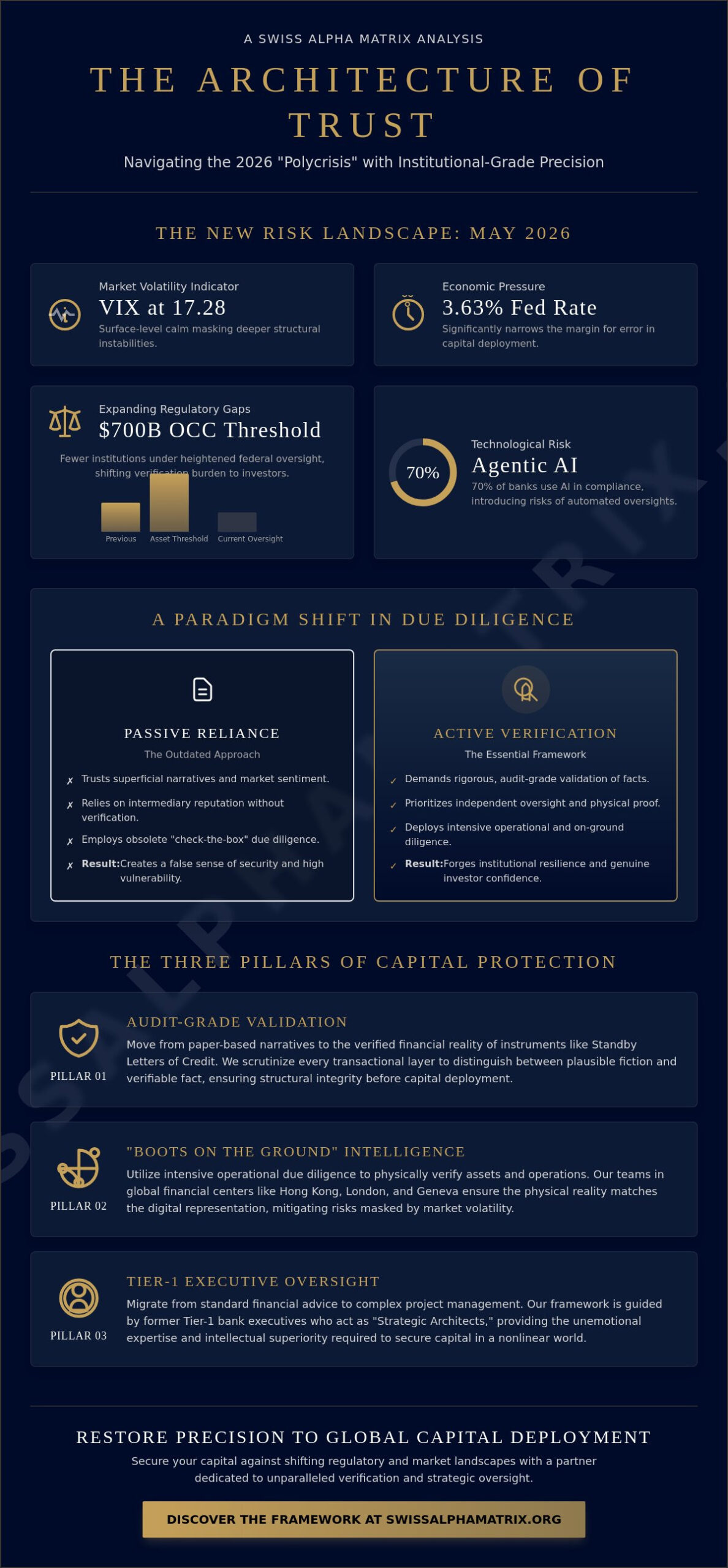
True institutional resilience isn’t found in the optimistic projections of a pitch deck; it’s forged in the clinical, audit-grade verification of the underlying financial reality. As the CBOE Volatility Index sits at 17.28 as of May 8, 2026, it’s clear that building investor confidence during uncertainty requires a paradigm shift away from passive market reliance toward active, bespoke oversight. You’ve likely observed that with the US Federal Funds Effective Rate at 3.63%, the margin for error in complex capital deployment has narrowed significantly, leaving little room for the opacity often found in cross-border instruments. Traditional due diligence often fails to capture the nuances of a landscape where the OCC has raised asset thresholds for heightened standards to 700 billion dollars, effectively reducing regulatory safety nets for many participants.
This article outlines a sophisticated framework for institutional capital protection that moves beyond mere compliance to deliver genuine alpha through precision and independent intelligence. We’ll explore how integrating on-ground verification and rigorous operational due diligence provides the strategic clarity necessary to navigate regulatory shifts, such as the new UK non-financial misconduct rules arriving in September 2026. By the end of this analysis, you’ll possess a repeatable methodology for securing capital in an increasingly nonlinear and interconnected world.
Key Takeaways
- Understand how the 2026 “Polycrisis” necessitates a transition from superficial market sentiment to rigorous, institutional-grade precision in every stage of capital deployment.
- Master a bespoke framework for building investor confidence during uncertainty by prioritizing the three pillars of audit-grade validation, independent oversight, and strategic precision.
- Learn to distinguish between paper-based narratives and verified financial reality by identifying critical red flags in complex bank instruments such as Standby Letters of Credit.
- Implement a “Boots on the Ground” strategy that utilizes intensive operational due diligence to physically verify assets in global financial centers like Hong Kong, London, and Geneva.
- Discover how migrating from standard financial advice to complex project management, guided by former Tier-1 bank executives, secures capital against shifting regulatory and market landscapes.
Beyond the Polycrisis: Redefining Investor Confidence in 2026
The global investment landscape in May 2026 is no longer defined by isolated shocks, but by a “Polycrisis” where fragmented trade corridors and accelerating climate shifts converge to disrupt traditional valuation models. While Market sentiment often fluctuates based on high-frequency headlines, institutional confidence remains anchored in something more substantial than a temporary trend. The VIX index sitting at 17.28 as of May 8, 2026, reflects a surface-level calm that often masks deeper structural instabilities. Building investor confidence during uncertainty requires moving past the superficial “narrative-flipping” common in retail sectors; instead, it demands a return to the quiet authority of Swiss financial traditions where stability is maintained through meticulous, multi-asset verification rather than market speculation. This dignified approach prioritizes long-term wealth preservation over short-term gains, ensuring that capital remains protected even when broader indices falter.
The Shift from Passive to Active Trust
Trust is not a static state. In the current environment, passive trust, which relies on the reputation of intermediaries or the historical performance of an instrument, has become a liability. Active trust is the only viable alternative. It’s the byproduct of exhaustive, audit-grade due diligence that refuses to take documentation at face value. Transparency alone is insufficient; without independent verification, transparency often provides nothing more than a false sense of security. Sophisticated stakeholders now seek the psychological assurance that comes from unemotional expertise. They value a strategic partner who views a project through the lens of a “Strategic Architect,” ensuring that every layer of a complex mandate is scrutinized for structural integrity before a single dollar is deployed.
Identifying the New Risks of 2026
The regulatory environment has become increasingly localized, creating a web of fragmentation across Western Europe and East Asia. For instance, the UK’s extension of non-financial misconduct rules to all firms in September 2026 represents a significant shift in compliance expectations. Simultaneously, the rise of sophisticated financial instrument fraud in cross-border programs has made traditional “check-the-box” due diligence obsolete. Volatility often acts as a smokescreen, masking operational weaknesses in project management that only become apparent during a crisis. With 70% of banking firms now utilizing Agentic AI in their compliance processes, the risk of technical hallucinations or automated oversights has grown. This necessitates a “Boots on the Ground” approach to verify that the physical and financial reality of a project matches its digital representation. The Office of the Comptroller of the Currency’s decision to raise the asset threshold for heightened standards to 700 billion dollars as of May 2026 means that fewer institutions are under rigorous federal oversight, placing the burden of verification squarely on the investor.
The Architecture of Trust: Moving from Narrative to Verification
While global entities often emphasize policy predictability as the primary driver of capital flow, sophisticated stakeholders understand that genuine security is constructed through a bespoke framework of verification. Building investor confidence during uncertainty is not a function of persuasive communication; it’s a result of rigorous, independent validation of every transactional layer. This architecture moves beyond the volatile fluctuations of market sentiment to establish a foundation of intellectual superiority. By integrating traditional Swiss financial discipline with the requisite speed of modern global transactions, investors can mitigate the inherent risks of internal deal-bias. While the SEC maintains macro-level Investor Protection Measures to manage systemic volatility, private capital requires a more granular level of scrutiny to ensure long-term wealth preservation and strategic growth.
The Validation Pillar: Audit-Grade Intelligence
Trust, when properly engineered, is a product of exhaustive financial investigations that provide an unemotional counterpoint to the high-frequency noise of emerging markets. Relying on surface-level checks is a strategy that often fails when market indicators, such as the US Federal Funds Effective Rate sitting at 3.63% as of May 7, 2026, signal a tightening margin for error. Audit-grade intelligence reports are essential for executive-level decision making. They replace the ambiguity of marketing narratives with precision data. This clinical approach ensures that capital deployment decisions are based on verified financial reality, effectively insulating the portfolio from the psychological turbulence that characterizes high-stakes cross-border deals.
The Oversight Pillar: Independent Project Management
Maintaining the integrity of a mandate over its entire lifecycle necessitates a level of senior expertise that many internal teams simply can’t sustain. Independent project management acts as a strategic bulwark, ensuring that every phase of a transaction adheres to strict protocols and regulatory compliance, such as the new EU Anti-Money Laundering framework being phased in throughout 2026. By utilizing independent financial project management, stakeholders can ensure that their strategic growth objectives aren’t compromised by operational weaknesses or shifting regulatory sands. This level of oversight remains a cornerstone for building investor confidence during uncertainty, providing the quiet authority required to navigate complex instruments safely. For those seeking to refine their own protective protocols, exploring our institutional-grade risk management frameworks can offer a path toward more resilient capital deployment.
Instrument Validation as a Hedge Against Market Volatility
In a global financial ecosystem where the VIX remains a persistent indicator of underlying tension, the distinction between a facially valid document and a verified financial reality is the primary determinant of capital safety. Building investor confidence during uncertainty requires a transition from accepting institutional narratives to demanding clinical, audit-grade proof of every asset’s provenance. While many participants rely on the perceived security of digital transmissions, sophisticated capital stakeholders understand that sophisticated fraud often thrives within the very systems designed to prevent it. A single failure in the validation chain doesn’t just result in a financial loss; it creates a systemic collapse of trust that can take years to remediate. By employing bank instrument validation services, investors can effectively decouple their risk profiles from the broader market’s unpredictability, ensuring that their mandates are supported by authentic, executable instruments.
Paperwork vs. Reality: A Comparison Framework
Instrument validation is defined as the rigorous cross-referencing of bank-issued data with on-ground reality to ensure that the underlying capital is both unencumbered and authentically represented. The “SWIFT trap” remains a significant vulnerability in 2026, as many investors mistakenly believe that a digital MT760 or MT799 message is a substitute for senior-level verification of the issuing officer’s authority. Digital messages can be fabricated or issued by unauthorized personnel within smaller, less regulated entities, making physical confirmation a non-negotiable requirement for institutional-grade protection.
| Feature | Standard Due Diligence | Swiss Alpha Matrix Validation |
|---|---|---|
| Verification Depth | Surface-level SWIFT confirmation | Multi-layered, officer-to-officer audit |
| Authority Check | Assumed based on letterhead | Verification of signatory power and mandate |
| Asset Reality | Documentary evidence only | On-ground verification of underlying liquidity |
Mitigating Counterparty Risk in High-Stakes Deals
Verifying the issuing authority of global bank instruments requires an unemotional analysis of counterparty claims, particularly when dealing with instruments like Standby Letters of Credit (SBLC). Red flags often include inconsistencies in the bank’s internal compliance codes or the use of non-standard verbiage that circumvents ICC 600 or 750 protocols. Ensuring regulatory compliance across diverse jurisdictions like Geneva, London, and Hong Kong is essential, especially as the new EU Anti-Money Laundering framework begins its phase-in throughout 2026. This localized precision allows for a strategic defense against cross-border fraud, maintaining the integrity of the investment even when traditional market indicators signal heightened risk. By prioritizing this level of technical scrutiny, the Strategic Architect ensures that capital deployment is guided by excellence and historical reliability rather than misplaced trust.
Operational Due Diligence: The Strategic Bulwark for Cross-Border Deals
Macro-economic theories often posit that policy predictability is the primary bedrock of foreign direct investment, yet this perspective frequently fails to account for the operational decay that occurs within the local layers of a complex project. Building investor confidence during uncertainty necessitates a transition from remote data analysis to a “Boots on the Ground” methodology, particularly within the interconnected financial hubs of Hong Kong, London, and Geneva. It’s in these specific jurisdictions where the discrepancy between a digital prospectus and physical capacity becomes most apparent. By executing rigorous cross-border investment due diligence that includes physical asset audits, stakeholders can move beyond the “SWIFT trap” mentioned previously to secure their capital against hidden operational liabilities that surface only under clinical scrutiny.
The On-Ground Verification Protocol
A clinical on-ground verification protocol begins with the rigorous auditing of key personnel and their actual operational capacity, ensuring that the team presented in the pitch deck possesses the technical depth required for multi-year execution. This process involves physical site visits to verify that tangible assets exist in the state described, a step that’s increasingly critical as 70% of banking firms report using Agentic AI in their compliance processes as of early 2026. These visits serve as the final filter in the capital deployment decision, providing a layer of institutional-grade intelligence that legal counsel alone cannot provide. When the VIX sits at 17.28, the difference between a successful mandate and a total loss often rests on the ability to verify the “human element” behind the digital documentation.
Managing Regulatory Complexity in 2026
Navigating the intersection of international financial regulations and localized mandates requires a specialized understanding of the 2026 regulatory landscape. For instance, as the UK implements its new “targeted support” regulation in April 2026, the gap between financial advice and strategic guidance has widened significantly. Independent advisory services bridge this divide, ensuring that every project mandate remains “audit-ready” and compliant with the evolving EU Anti-Money Laundering framework being phased in throughout the year. This level of risk management is essential for protecting long-term wealth preservation from the shifting sands of global governance. To secure your next international mandate with this level of precision, consider engaging our on-ground verification services to ensure your capital is anchored in reality rather than narrative.
Swiss Alpha Matrix: Restoring Precision to Global Capital Deployment
Swiss Alpha Matrix serves as the definitive anchor for institutions seeking to transcend the limitations of traditional advisory models. By positioning former Tier-1 bank executives as strategic guardians, the firm provides a level of intellectual depth that is often absent in standard retail or commercial finance. This transition from mere financial advice to comprehensive, complex project oversight ensures that every facet of a mandate is scrutinized with the technical accuracy required to maintain long-term wealth preservation. Building investor confidence during uncertainty is a deliberate act of engineering, achieved through the relentless application of financial advisory methodologies that prioritize capital preservation above all else. These bespoke mandates allow for a hyper-personalized approach to risk management, ensuring that your specific exposure profile is addressed with the historical reliability and precision of Swiss financial traditions.
The Wise Guardian Persona in Practice
The Strategic Architect doesn’t merely observe market fluctuations; they construct the barriers that protect capital from them. Our senior-led team provides executive-level intelligence that filters out the “noise” of global market shocks, replacing frantic energy with a measured, logical flow of structured reporting. In high-stakes environments where discretion and exclusivity are paramount, our boutique approach ensures that your privacy is maintained while your interests are defended by seasoned, unemotional experts who prioritize strategic growth over short-term speculation. This level of professional competence is what distinguishes a dedicated partner from a mere service provider, offering a standard of excellence that passive market participants simply cannot replicate.
Next Steps: Securing Your 2026 Mandate
As the global regulatory perimeter expands to include new activities like the UK’s “deferred payment credit” regulation in July 2026, the need for precision-led execution has never been more acute. Engaging Swiss Alpha Matrix for instrument validation or independent project oversight is the first step toward restoring clarity to your capital deployment strategy. Building investor confidence during uncertainty requires a partner who understands that alpha generation is inseparable from rigorous risk mitigation. We invite sophisticated stakeholders to move beyond the volatility of the “NAVI” world and embrace a standard of service that is both global in reach and local in its attention to technical detail. To initiate this transition from uncertainty to institutional-grade precision, we encourage you to contact Swiss Alpha Matrix for a bespoke consultation regarding your current and future mandates.
Securing the Future of Institutional Capital Deployment
Navigating the nonlinear world of 2026 requires more than a reactive posture; it demands the implementation of a proactive, verification-led architecture that prioritizes long-term wealth preservation. Building investor confidence during uncertainty is no longer achievable through standard market disclosures alone. It requires the clinical scrutiny of audit-grade instrument validation and on-ground operational audits within key financial hubs like Geneva, London, and Hong Kong. With the VIX recorded at 17.28 and the US Federal Funds Effective Rate at 3.63% as of May 7, 2026, the margin for operational error has effectively vanished.
By moving away from superficial narratives and toward independent project oversight, sophisticated stakeholders can ensure their capital is anchored in verified financial reality. Our team, led by former Tier-1 global bank senior executives, specializes in the validation of complex financial instruments to mitigate the risks of cross-border fraud. The path toward institutional-grade resilience begins with a commitment to precision and technical excellence. Secure your capital with Swiss Alpha Matrix’s bespoke advisory services and transform market volatility into a managed strategic advantage.
Frequently Asked Questions
How do you build investor confidence during market volatility?
Building investor confidence during uncertainty is achieved by replacing speculative market sentiment with rigorous, audit-grade verification of underlying assets. Relying on the VIX index, which stood at 17.28 on May 8, 2026, is insufficient for institutional protection. Confidence is engineered through clinical, independent oversight that ensures every capital deployment decision is rooted in financial reality rather than narrative projections.
What is the difference between standard due diligence and audit-grade validation?
Standard due diligence typically involves a documentary review of bank-issued communications, whereas audit-grade validation requires a multi-layered, officer-to-officer cross-referencing process. It’s a clinical investigation into the provenance and executability of an instrument. This methodology ensures that the signatory power and underlying liquidity are authentic, providing a level of precision that surface-level checks cannot offer.
Can financial instruments like SBLCs be fully verified during uncertainty?
Yes, sophisticated financial instruments like Standby Letters of Credit can be fully verified even during periods of extreme volatility through clinical, independent validation protocols. This process involves bypassing the “SWIFT trap” and confirming the authenticity of the instrument directly with the issuing officer. It’s a necessary step to prevent cross-border fraud, especially when the Bank Prime Loan Rate is at 6.75% as of May 7, 2026.
What are the common red flags in cross-border investment projects in 2026?
Common red flags in 2026 include the use of non-standard verbiage that circumvents ICC 600 protocols and the presence of unauthorized signatories within smaller financial entities. Inconsistencies in internal compliance codes often signal deeper operational weaknesses. Additionally, a lack of transparency regarding the new EU Anti-Money Laundering framework phase-in represents a significant risk to the long-term integrity of any international mandate.
How does on-ground verification differ from digital due diligence?
On-ground verification involves physical site visits and direct asset audits, whereas digital due diligence relies exclusively on electronic data and automated compliance reports. With 70% of banking firms utilizing Agentic AI for compliance as of early 2026, the risk of automated oversights has grown. Physical confirmation ensures that the tangible reality of an asset matches its digital representation, providing a strategic bulwark against operational failure.
Why is independent project oversight necessary for institutional investors?
Independent project oversight is essential to mitigate internal deal-bias and ensure that capital deployment adheres to strict, bespoke protocols throughout the mandate’s lifecycle. It provides a level of senior-level expertise that maintains transactional integrity in the face of shifting regulatory sands. This strategic architecture ensures that every phase of a project is scrutinized by seasoned experts who prioritize capital preservation over short-term market speculation.
How does Swiss Alpha Matrix manage regulatory compliance across multiple jurisdictions?
Swiss Alpha Matrix utilizes a localized approach to regulatory compliance advisory, navigating the complex intersection of international regulations and local mandates in hubs like London and Hong Kong. We provide the intelligence required to ensure projects are “audit-ready” for new frameworks, such as the UK’s non-financial misconduct rules arriving in September 2026. This expertise allows for seamless cross-border operations while maintaining institutional-grade integrity.
What role does Swiss discretion play in modern financial advisory?
Swiss discretion remains the cornerstone of modern advisory, providing a dignified and exclusive environment for high-stakes capital protection. It creates an emotional current of stability and trust, ensuring that sensitive mandates are handled with the traditional reliability of Swiss private banking. This quiet authority allows investors to feel their capital is in the hands of seasoned, unemotional experts dedicated to long-term strategic growth and wealth preservation.