

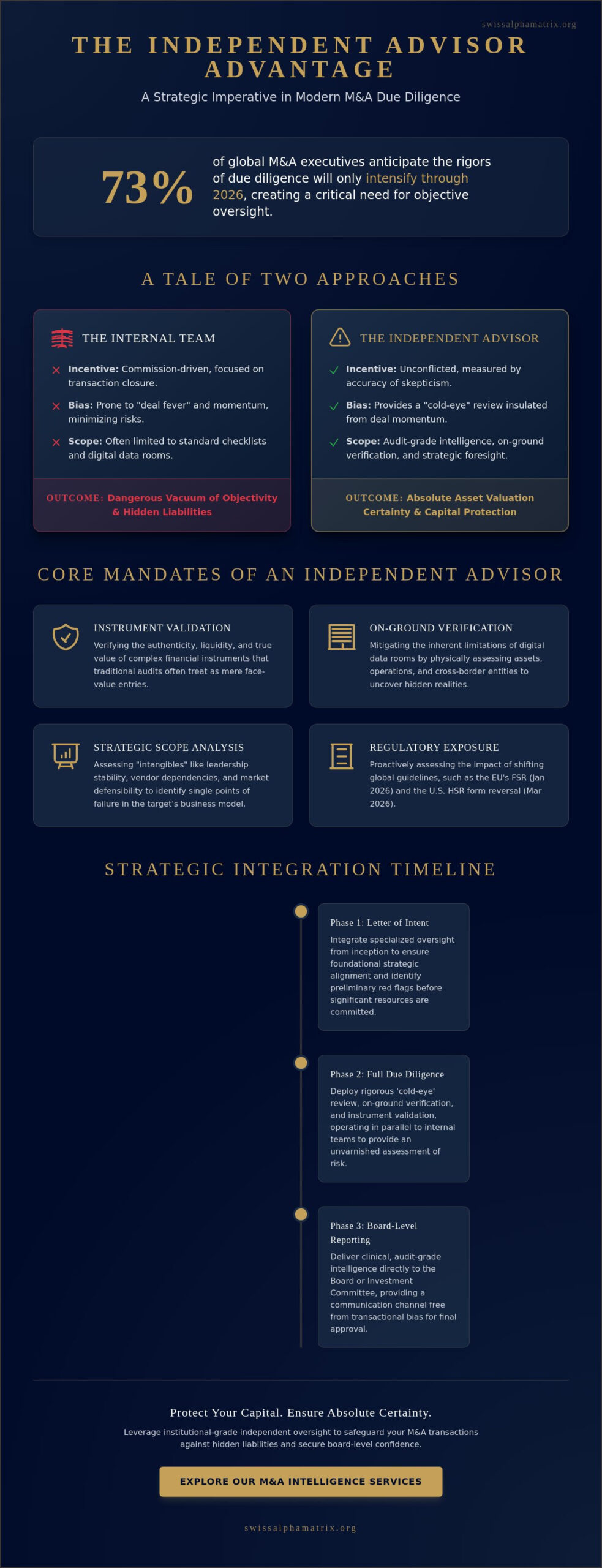
When 73% of global M&A executives anticipate that the rigors of due diligence will only intensify through 2026, the reliance on internal deal teams often creates a dangerous vacuum of objectivity. While global M&A deal value reached a staggering $4.8 trillion in 2025, the inherent pressure to finalize transactions frequently obscures the structural vulnerabilities found within complex financial instruments and cross-border regulatory frameworks. This systemic bias necessitates a fundamental re-evaluation of the independent due diligence advisor role in m&a transactions, as these specialists operate strictly outside the commission-driven incentives of traditional investment banks to provide a clinical, unvarnished assessment of risk.
You likely recognize that the transition to the 2026 regulatory environment, specifically the European Commission’s Foreign Subsidies Regulation guidelines published on January 12, 2026, demands a level of precision that transcends standard checklists. This article demonstrates how an independent advisor delivers the audit-grade intelligence required to protect your capital against hidden liabilities that conventional audits routinely overlook. We’ll examine the specific mechanics of on-ground verification, the impact of the March 19, 2026, U.S. HSR form reversal, and the strategic framework for securing board-level approval through absolute asset valuation certainty.
Key Takeaways
- Understand how the independent due diligence advisor role in m&a transactions serves as a critical third-party validator, ensuring that all financial and operational assumptions undergo a rigorous, ‘cold-eye’ review independent of brokerage incentives.
- Explore the necessity of audit-grade instrument validation and on-ground verification services to mitigate the inherent limitations of digital data rooms when assessing physical assets and cross-border entities.
- Identify how to insulate your capital from the internal deal-team biases that often prioritize transaction closure over the meticulous identification of hidden liabilities within complex financial instruments.
- Establish a strategic framework for integrating specialized oversight into the transaction lifecycle, starting from the Letter of Intent phase, to ensure absolute certainty in asset valuation and regulatory compliance for board-level approval.
Defining the Independent Due Diligence Advisor Role in M&A Transactions
The independent due diligence advisor role in m&a transactions represents a deliberate departure from the transactional velocity inherent in buy-side and sell-side brokerages. It functions as a structural firewall, providing an essential layer of validation that’s insulated from the commission-driven incentives of investment banks. While traditional deal teams are often measured by their ability to bring a transaction to fruition, the independent advisor is measured by the accuracy of their skepticism. This role isn’t merely procedural; it’s a mandate for a “cold-eye” review, a process that scrutinizes every financial, operational, and regulatory assumption with a level of technical rigor that internal teams, often susceptible to the momentum of “deal fever,” simply cannot replicate.
The independent advisor serves as the Wise Guardian of capital deployment, ensuring that every strategic move is underpinned by empirical truth rather than deal-momentum.
There’s a fundamental distinction between standard accounting audits and institutional-grade independent oversight. A typical audit is designed to verify historical compliance and the accuracy of trailing financial statements. In contrast, independent oversight evaluates the future viability of the target’s business model, assessing whether the underlying assets can actually generate the projected risk-adjusted returns. It’s the difference between looking at a map and actually surveying the terrain for hidden geological faults.
The Mandate of Unconflicted Oversight
Independence is the only effective antidote to the internal biases that naturally occur within complex deal teams. When a transaction moves toward the final stages, the psychological pressure to justify significant time and resource investments can inadvertently lead to the minimization of risk. By reporting directly to the Board of Directors or the Investment Committee, the independent advisor provides a communication channel that remains unpolluted by the desire for a “close.” This ensures that cross-border investment due diligence remains a purely strategic exercise, focused on protecting the firm’s long-term stability against the volatility of global markets.
Beyond Financial Forensics: The Strategic Scope
Modern due diligence must extend far beyond the verification of a Confidential Information Memorandum (CIM). It involves a granular assessment of “intangibles” that frequently dictate the success of an acquisition, such as leadership stability, vendor dependencies, and the actual defensibility of market positioning. Validating the integrity of a business model requires financial advisory methodologies that prioritize risk mitigation over simple data aggregation. The strategic scope includes several critical workstreams:
- Instrument Validation: Verifying the authenticity and liquidity of complex financial instruments that traditional audits often treat as face-value entries.
- Operational Redundancy: Identifying critical single points of failure in the target’s supply chain or technology stack that could jeopardize post-merger integration.
- Regulatory Exposure: Assessing the impact of shifting global guidelines, such as the EU’s FSR guidelines published on January 12, 2026, which can introduce unforeseen hurdles for below-threshold deals.
Core Responsibilities: On-Ground Verification and Instrument Validation
The reliance on digital data rooms has created a veneer of transparency that can be remarkably deceptive in high-stakes environments. While a Virtual Data Room (VDR) provides a centralized repository for contracts and financial statements, it cannot verify the physical existence of inventory in a remote warehouse or the actual operational health of a manufacturing facility in a foreign jurisdiction. The independent due diligence advisor role in m&a transactions is designed to bridge this gap between digital documentation and physical reality, moving beyond the screen to conduct on-ground verification that protects against sophisticated misrepresentation. This level of scrutiny ensures that the “unvarnished truth” promised to the board is actually delivered through empirical evidence rather than curated PDF files.
In the current 2026 landscape, where cross-border deals often involve multi-layered financial structures, the necessity for bank instrument validation services has never been more acute. Relying on the face value of a Standby Letter of Credit (SBLC) or a corporate guarantee without independent verification of the issuing bank’s current standing is a risk that institutional investors can no longer afford to take. This skepticism is particularly vital when dealing with complex instruments where the counterparty may be leveraging assets across multiple jurisdictions, a scenario that 73% of M&A executives expect will become increasingly common as deal complexity rises.
Audit-Grade Instrument Validation
Verifying the authenticity of financial guarantees requires a level of technical expertise that typically resides within the senior echelons of Tier-1 global banking. This process involves a granular examination of the instrument’s terms, the verification of SWIFT messaging authenticity, and an assessment of the counterparty’s actual capacity to perform under the stated conditions. Paperwork validation is the first line of defense, but it’s never the final word in a truly robust risk management framework. By employing former banking executives who understand the nuances of institutional protocols, an independent advisor reduces exposure to cross-border fraud and ensures that the deal structure is built on verified liquidity. This level of scrutiny, which defines the independent due diligence advisor role in m&a transactions, identifies red flags in SBLCs that traditional accounting audits frequently overlook.
Operational and Regulatory Deep-Dives
A physical presence in global financial hubs such as Geneva, London, or Hong Kong is vital for conducting effective operational due diligence. On-ground verification allows for the direct observation of a target’s day-to-day activities, providing insights into leadership stability and vendor dependencies that are invisible in financial reports. As we move through 2026, assessing compliance with evolving international financial regulations requires a localized understanding of how specific jurisdictions implement global standards. Mapping counterparty risk across multiple borders ensures that a transaction doesn’t inadvertently trigger regulatory sanctions or reveal hidden liabilities in local standing. If you require a more rigorous assessment of your target’s physical and financial integrity, consider how a bespoke risk management framework can safeguard your next major acquisition.
The Independence Advantage: Mitigating Conflict of Interest
The inherent structural tension within the global M&A market, which reached a staggering $4.8 trillion in value during 2025, often stems from the misalignment of incentives between transaction facilitators and capital providers. While traditional investment banks typically operate on success fees ranging from 1% to 5% of the total deal value, their primary motivation is the successful consummation of the transaction, rather than the long-term preservation of the acquirer’s capital. This fundamental conflict of interest underscores why the independent due diligence advisor role in m&a transactions is not merely an auxiliary service but a strategic necessity. By removing the commission-based incentive, the independent advisor is empowered to provide the unvarnished truth, which includes the critical authority to recommend a withdrawal from a deal when the risk-adjusted return threshold isn’t met.
Maintaining the absolute integrity of a transaction requires a framework of independent financial project management that operates in parallel to the deal team but remains administratively distinct. This separation ensures that the findings of the diligence process aren’t diluted to fit a pre-existing investment thesis. Institutional investors increasingly prioritize these bespoke mandates over generic advisory services because they recognize that the value of an expert who can say “No” far outweighs the cost of a compromised acquisition. It’s about ensuring that the deployment of capital is governed by technical accuracy rather than transactional velocity.
Neutralizing Deal Fever
Internal deal teams, particularly in the high-velocity environment of private equity where deals increased by 54% in value in 2025, often fall victim to the psychological phenomenon known as deal fever. This state creates immense pressure to justify the months of work and significant resources already expended on a potential target. An independent advisor acts as an unemotional buffer, utilizing a devil’s advocate framework to challenge every optimistic projection. They provide the executive team with the intellectual distance required for precision, ensuring that the decision to proceed is based on empirical validation rather than organizational momentum.
Ensuring Long-Term Capital Protection
The focus of an independent mandate extends beyond the immediate close, specifically targeting post-merger integration risks that commission-focused teams often overlook. By aligning the advisor’s findings with the ultimate investment thesis, the process prioritizes the protection of the principal’s legacy and the consistent generation of alpha. This strategic architecture ensures that the acquisition contributes to long-term wealth preservation, rather than becoming a source of future liability due to unexamined operational or regulatory gaps. It’s a commitment to institutional-grade discipline that transcends the short-term noise of the market.
Integrating Independent Oversight into the Transaction Lifecycle
The integration of the independent due diligence advisor role in m&a transactions within the transaction lifecycle is a strategic necessity that transcends the linear “pre-close” checklist favored by generic advisory firms. Effective oversight begins during the Letter of Intent (LOI) phase, a critical juncture where the validation scope is established before deal momentum obscures potential structural risks. By engaging an independent partner at this early stage, institutional investors ensure that the mandate is tailored to the specific complexities of the target, rather than relying on a standardized review process that may fail to account for the $1.08 trillion in technology-driven deal value recorded in 2025. This proactive alignment allows for the deployment of specialized workstreams, such as audit-grade instrument validation and on-ground verification, precisely when the initial financial assumptions are being tested.
As the transaction progresses, the advisor maintains a cadence of continuous reporting and milestone-based risk assessment, providing the executive team with real-time intelligence that informs negotiation strategy. This process culminates in the delivery of a final report that meets the highest institutional standards, providing the Board of Directors with the empirical certainty required for formal sign-off. Given that 73% of M&A executives expect due diligence to become more complex through the remainder of 2026, this structured approach provides a necessary safeguard against the rapid regulatory shifts seen in jurisdictions like the EU and the UK. Even after the transaction concludes, post-close oversight remains vital to ensure the seamless realization of the investment thesis and the successful integration of the acquired assets. To secure your capital against these evolving complexities, we invite you to consult with our experts on bespoke risk management frameworks.
The Milestone-Based Approach
A project-based advisory model ensures absolute accountability by defining clear, technical deliverables at every stage of the acquisition process. This methodology moves away from the vague “look under the hood” approach, instead focusing on specific pillars of operational and financial health. By establishing these milestones, independent oversight reduces friction between stakeholders, as all parties operate from a shared foundation of verified data. This structured transparency is particularly effective in mitigating the “information asymmetry” that often plagues cross-border transactions involving complex financial instruments.
Cross-Border Coordination
Managing the intricate requirements of deals spanning global financial centers like London, Geneva, and Hong Kong requires a sophisticated logistical presence. The independent advisor ensures that regulatory compliance is maintained across disparate legal jurisdictions, particularly as firms navigate the EU’s Foreign Subsidies Regulation guidelines published on January 12, 2026. This global coordination allows for the simultaneous execution of on-ground verification and regulatory deep-dives, ensuring that no local liability is overlooked in the broader strategic assessment. The result is a unified, institutional-grade view of the transaction’s risk profile, regardless of geographical dispersion.
The Swiss Alpha Matrix Approach: Bespoke M&A Intelligence
The Swiss Alpha Matrix methodology is rooted in a tradition of quiet authority and technical precision, a philosophy that fundamentally redefines the independent due diligence advisor role in m&a transactions. We recognize that in an era where 111 megadeals exceeding $5 billion were finalized in 2025 alone, the application of generic, high-volume advisory models is no longer sufficient to protect institutional capital. Our approach rejects the oversimplification of market dynamics; instead, it favors a bespoke architecture that aligns with the intricate requirements of each unique mandate. This commitment to hyper-personalization ensures that the specific risk profile of a transaction, whether it involves complex multi-asset diversification or the validation of obscure financial instruments, is addressed with absolute technical accuracy.
Elite stakeholders trust our firm for complex financial project management because we operate with the intellectual depth of seasoned, unemotional experts. The “Swiss Alpha” standard is not merely a branding signature; it’s an institutional-grade discipline that prioritizes long-term wealth preservation over short-term transactional gains. By maintaining a measured, steady, and highly logical rhythm throughout the lifecycle of an acquisition, we provide a sense of professional calm that allows boards to make high-stakes decisions with confidence. This unwavering focus on excellence ensures that every strategic pillar of the transaction is tethered to the historical reliability associated with Swiss financial traditions.
Executive-Level Intelligence
Access to senior partners with decades of transactional experience is a cornerstone of our service, moving beyond the mere aggregation of data to provide actionable, board-ready insights. Our partners, many of whom are former Tier-1 global bank executives, understand that the independent due diligence advisor role in m&a transactions requires more than just checking boxes; it requires the strategic judgment to interpret subtle market signals. This level of executive-level intelligence is essential for identifying the “red flags” that automated AI tools or junior-led teams often overlook, particularly in cross-border environments where regulatory divergence is the norm. We provide the clarity necessary to distinguish between surface-level performance and sustainable alpha generation.
A Commitment to Excellence and Discretion
Preserving the privacy and integrity of high-profile transactions is a non-negotiable aspect of our mandate. We function as a dedicated partner, mirroring the traditional discretion of Swiss private banking to ensure that sensitive capital deployment decisions remain confidential. Our commitment to excellence means that every report we deliver is designed to meet the most stringent institutional standards, providing a foundation of integrity for your firm’s legacy. If you require a standard of service that is global in reach yet local in its attention to detail, engage Swiss Alpha Matrix for your next complex M&A mandate.
Securing the Future of Capital Deployment through 2026
The evolution of global markets, particularly following the 41% increase in deal value witnessed in 2025, necessitates a fundamental transition from reactive verification to proactive, unconflicted oversight. This strategic framework has demonstrated how the independent due diligence advisor role in m&a transactions provides the clinical skepticism required to neutralize internal biases and validate the integrity of complex financial guarantees. By prioritizing audit-grade validation over the curated transparency of virtual data rooms, institutional investors can navigate the regulatory shifts of 2026 with absolute technical certainty and professional calm.
Swiss Alpha Matrix, led by former Tier-1 global bank senior executives, offers a bespoke standard of excellence through our strategic presence in Hong Kong, London, and Geneva. Our specialized expertise in on-ground verification and instrument validation ensures that your investment thesis is supported by empirical truth rather than transactional momentum. We invite you to secure your capital with Swiss Alpha Matrix independent advisory services. Your next acquisition deserves the precision and long-term stability that only institutional-grade discipline can provide.
Frequently Asked Questions
What is the primary difference between an M&A advisor and a due diligence advisor?
An M&A advisor, typically an investment bank, focuses on transaction facilitation and the successful closing of the deal, often driven by commission structures. Conversely, the independent due diligence advisor role in m&a transactions is defined by a mandate for unvarnished validation and risk mitigation, operating entirely outside the success-fee model to ensure that the principal’s capital is protected by objective, audit-grade intelligence rather than transactional momentum.
When is the optimal time to engage an independent due diligence advisor in a deal?
The optimal period for engagement is during the Letter of Intent (LOI) phase, specifically before the finalization of the validation scope. Early involvement allows the advisor to establish a rigorous risk management framework that informs the subsequent negotiation process, ensuring that the 73% of M&A executives who anticipate increased deal complexity through 2026 are equipped with the necessary on-ground intelligence from the outset.
Can an independent advisor replace our internal legal and accounting teams?
Independent advisors don’t replace legal or accounting teams; they provide a specialized layer of operational and instrument validation that traditional audits often overlook. While legal counsel manages contractual structures and accountants verify trailing financials, an independent advisor focuses on the authenticity of bank instruments and the physical reality of operations, creating a comprehensive shield for your capital that complements existing workstreams.
How do independent advisors verify complex financial instruments like SBLCs?
Verification of Standby Letters of Credit (SBLCs) involves a multi-layered protocol that includes SWIFT messaging authentication and direct communication with senior issuing bank officers. By leveraging the expertise of former Tier-1 banking executives, an independent advisor scrutinizes the instrument’s liquidity and the issuing institution’s current standing, ensuring that the guarantees within a transaction are both authentic and enforceable across disparate jurisdictions.
What are the common red flags an independent advisor looks for in cross-border M&A?
Common red flags include significant information asymmetry in cross-border entities and unverified vendor dependencies that could jeopardize post-merger integration. Additionally, advisors look for non-compliance with the EU’s Foreign Subsidies Regulation guidelines published on January 12, 2026, and irregularities in complex financial instruments that may signal underlying liquidity issues or sophisticated misrepresentation that digital data rooms fail to capture.
Does hiring an independent advisor increase the risk of deal fatigue or delays?
Engaging an independent advisor actually mitigates the risk of deal fatigue by providing a structured, milestone-based approach to complex project management. By identifying critical red flags early, the advisor prevents the costly delays associated with late-stage discoveries, ensuring that the board-level approval process is supported by precise, audit-grade documentation that streamlines the final decision-making lifecycle rather than obstructing it.
How does ‘on-ground verification’ differ from a standard site visit?
On-ground verification is a forensic, operational deep-dive that goes far beyond the surface-level observations of a standard site visit. While a site visit might involve a cursory inspection of facilities, on-ground verification includes the physical validation of inventory, the assessment of local regulatory standing, and the direct observation of leadership stability to ensure the target’s operational reality matches its digital documentation in the VDR.
Why is independence particularly critical for private equity and family office mandates?
Independence is critical for private equity and family offices because these stakeholders prioritize long-term wealth preservation and the consistent generation of alpha over short-term market speculation. The independent due diligence advisor role in m&a transactions ensures that the investment thesis is protected from the internal deal-team biases that often push for a “close” regardless of the underlying risk-adjusted return profile or hidden liabilities.