

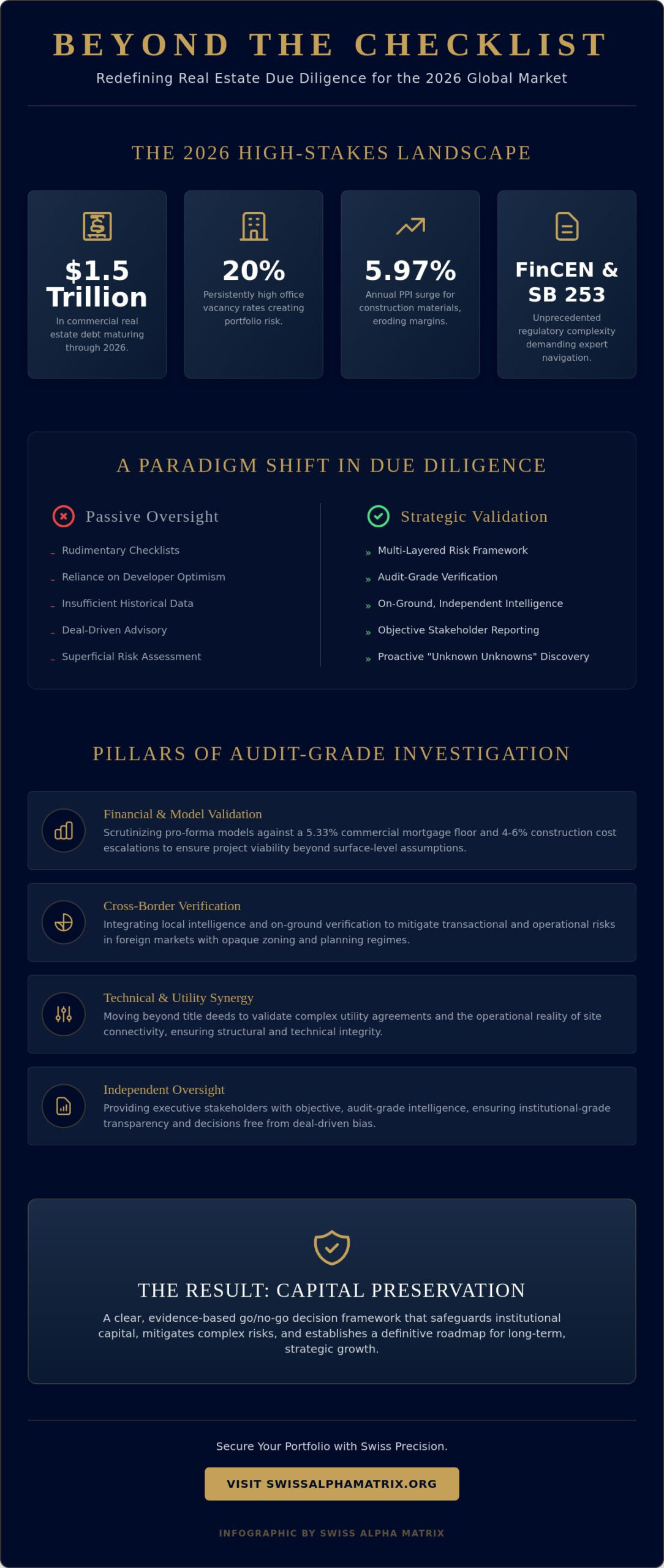
With $1.5 trillion in commercial real estate debt maturing through the conclusion of 2026, the era of passive oversight has yielded to a landscape where the slightest miscalculation in risk-adjusted returns can jeopardize an entire portfolio. You likely recognize that the traditional, superficial approach to real estate development due diligence is no longer sufficient when confronting 20% office vacancy rates and a 5.97% annual surge in the Producer Price Index for construction materials. We share your conviction that institutional capital demands a more rigorous, bespoke architecture for validation, especially as the March 1, 2026, FinCEN reporting rules and California’s SB 253 mandates introduce unprecedented layers of regulatory complexity.
This article details the sophisticated methodologies required to validate complex projects and safeguard your capital against the volatility of the current global market. We’ll provide a clear go/no-go decision framework based on independent intelligence, ensuring that every project assumption undergoes audit-grade verification before a single dollar is committed. By integrating on-ground verification with a structured analysis of the 5.33% commercial mortgage floor, we’ll establish a roadmap for achieving long-term wealth preservation and strategic growth.
Key Takeaways
- Establish a sophisticated, multi-layered risk mitigation framework that transcends traditional checklists to address the specific complexities of 2026 global markets.
- Execute audit-grade validation of financial instruments and technical utility agreements to ensure the absolute precision of all project assumptions.
- Navigate the “Future Value” trap by prioritizing bespoke development IRR modeling over insufficient historical yield data and passive asset performance metrics.
- Mitigate transactional and operational risks in foreign markets by integrating local intelligence and rigorous on-ground verification into your real estate development due diligence process.
- Secure institutional-grade transparency through independent oversight, ensuring executive stakeholders receive objective intelligence rather than deal-driven advisory.
Beyond the Checklist: Redefining Real Estate Development Due Diligence for Institutional Capital
Real estate development due diligence, when executed with the precision required for institutional capital, functions as a multi-layered risk mitigation framework that transcends the rudimentary checklists utilized by passive market participants. While the foundational concept of due diligence establishes a baseline of investigation, the complexities inherent in the 2026 market require a bespoke strategic architecture. This framework must validate the structural integrity of a project’s financial modeling and its regulatory alignment before any capital is committed. The transition from simple asset acquisition to complex development oversight reflects a broader shift toward sophisticated risk management, where the identification of hidden transactional vulnerabilities is paramount to long-term wealth preservation and the generation of stable, risk-adjusted returns.
The 2026 Global Real Estate Landscape
With the Federal Reserve maintaining the benchmark interest rate at a target range of 3.5% to 3.75% as of April 29, 2026, the era of low-cost capital has been replaced by a climate that demands rigorous underwriting. Commercial mortgage rates starting at 5.33% and $1.5 trillion in real estate debt set to mature through 2026 have created a high-stakes environment where office vacancy rates remain at 20%. New regulatory mandates, such as California’s SB 253 and SB 261, have elevated ESG factors from peripheral concerns to central pillars of institutional mandates. 2026 market volatility, driven by cost escalations and shifting regulatory landscapes, necessitates audit-grade validation to ensure that every project assumption is rooted in verifiable intelligence rather than developer optimism.
Due Diligence as a Strategic Safeguard
Moving beyond the traditional “caveat emptor” philosophy, modern capital protection strategies prioritize a proactive, independent assessment of the pre-construction phase. This involves identifying “unknown unknowns” within foreign zoning and planning regimes that could derail a project’s timeline or financial viability. Independent financial project management ensures that project assumptions are audited against real-world data, such as the 5.97% annual increase in the Producer Price Index for construction materials recorded in March 2026. By establishing a clear go/no-go decision framework, investors can navigate opaque regulatory environments with the quiet authority that comes from possessing superior, on-ground intelligence. It’s this commitment to institutional-grade precision that distinguishes a strategic architect from a mere service provider in the global financial arena.
The Pillars of Audit-Grade Real Estate Investigation: Financial, Legal, and Technical Synergy
The transition from a standard Real Estate Development Due Diligence Checklist to a rigorous process of real estate development due diligence requires a synergy of financial, legal, and technical disciplines that few firms can execute with precision. While many developers present pro-forma models that appear robust on the surface, the underlying assumptions often fail to account for the 4% to 6% construction cost escalation expected throughout 2026. Audit-grade investigation demands a bespoke mandate to validate every entry, moving beyond the mere presence of title deeds to scrutinize complex utility agreements and the operational reality of site connectivity. This level of scrutiny ensures that all data points meet the exacting standards of Tier-1 global financial institutions, transforming real estate development due diligence into a definitive instrument of capital protection.
Financial Instrument and Model Validation
Verifying the integrity of pro-forma models and cash flow projections is a critical exercise in neutralizing the “Future Value” trap. It’s essential to scrutinize developer equity and the validity of standby letters of credit (SBLCs) to ensure that the project remains solvent under the pressure of a 5.33% commercial mortgage floor. Utilizing professional bank instrument validation services allows institutional investors to secure development credit by confirming the authenticity of the financial tools being deployed. This process identifies potential leverage gaps before they manifest as operational failures, protecting the investor’s risk-adjusted returns from the volatility of unverified financial representations.
Legal and Regulatory Integrity
Navigating the international financial regulations governing cross-border property deals requires more than just legal review; it necessitates a deep understanding of how global mandates intersect with local zoning laws. For instance, the New Jersey Resilient Environments And Landscapes (REAL) rules adopted on January 20, 2026, illustrate how climate change risks now dictate site potential and permit timelines. Validating environmental compliance and permit expediting schedules ensures that developers aren’t overpromising on project velocity. By cross-referencing zoning laws with actual site potential and future infrastructure plans, we provide executive stakeholders with a clear “go/no-go” decision framework. For those seeking to fortify their portfolios, implementing our institutional risk management frameworks provides the necessary transparency to move forward with confidence.
Development vs. Acquisition Due Diligence: Navigating the Complexities of Future Asset Performance
While acquisition due diligence relies heavily on historical performance and stabilized yields, real estate development due diligence requires a forward-looking analytical lens that accounts for the inherent volatility of future asset performance. The “Future Value” trap often ensnares investors who rely on outdated market data, failing to recognize that historical yields are a poor predictor of success in a market defined by a 20% office vacancy rate and shifting tenant demands. Development mandates necessitate an exhaustive evaluation of internal rates of return (IRR) that are sensitive to the 4% to 6% construction cost escalation projected for 2026. Transitioning from a passive observer to a strategic architect involves scrutinizing every variable of the build, from the solvency of general contractors to the impact of 50% tariffs on essential materials like steel and aluminum.
The complexity of these multi-year projects demands a level of oversight that traditional real estate advisors rarely provide. Establishing independent financial project management is essential for projects with long-term horizons, as it provides a neutral layer of validation between the developer’s optimism and the investor’s capital. This strategic architecture ensures that the project remains viable even if market conditions deteriorate during the 24 to 48 months required for completion. By prioritizing audit-grade validation over surface-level checklists, institutional investors can protect their wealth against the “unknown unknowns” of the construction cycle.
The Speculative Risk Framework
Assessing market absorption rates for assets scheduled for delivery in late 2027 or 2028 requires a sophisticated understanding of macro-economic trends and localized supply-demand dynamics. Physical on-ground verification becomes far more critical in development than in acquisition, as the investor isn’t merely buying a building but a series of promises regarding its eventual utility. We utilize a deliverable review matrix to monitor construction milestones, ensuring that the project remains aligned with the initial investment thesis. This includes accounting for the reality that the industry must attract 500,000 new workers annually to meet demand, a labor shortage that directly impacts project velocity and cost-efficiency.
Milestone-Based Risk Mitigation
Structuring real estate development due diligence to align with capital drawdowns is the only way to maintain control over a project’s financial health. Independent oversight plays a decisive role in preventing project drift and budget overruns by verifying that each construction phase meets technical specifications before funds are released. This rigorous scheduling must remain realistic within the context of local regulatory changes, such as the March 2026 FinCEN reporting rules, which add administrative layers to capital deployment. By anchoring the due diligence process in measurable milestones, we provide executive stakeholders with the transparency required for disciplined capital protection.
Operational and Cross-Border Verification: Mitigating Transactional Risk in Global Markets
In the high-stakes arena of international capital deployment, the efficacy of real estate development due diligence is often measured by the depth of its local intelligence rather than the volume of its digital documentation. As institutional investors look toward markets with evolving regulatory landscapes, such as the New Jersey REAL rules adopted in January 2026 or the widespread zoning reforms across North America, the risk of misrepresentation grows exponentially. Successful cross-border investment due diligence requires an unwavering commitment to validating the reputation and track record of local partners through forensic analysis of their previous project delivery cycles. This process is essential for identifying red flags that digital audits frequently overlook, including “ghost” permits that lack actual municipal backing or land values inflated by 25% or more through opaque local secondary markets.
The Physicality of Due Diligence
Moving beyond the inherent limitations of virtual data rooms, the strategic architect recognizes that physical site inspections are the only method to confirm the actual capacity of local utilities and the structural readiness of existing infrastructure. While digital models may suggest a site is ready for a multi-asset development, on-ground verification often reveals discrepancies in utility connectivity or environmental conditions that could stall a project for months. Senior-level on-ground presence is the only way to prevent cross-border fraud. This physical oversight ensures that the project’s foundational assumptions remain aligned with the operational reality of the site, protecting the investor from the 5.97% annual increase in material costs that can quickly erode the margins of an unverified project plan.
Operational Due Diligence (ODD)
Evaluating a developer’s internal controls and project management capabilities is a vital component of long-term wealth preservation, particularly when navigating the 3.5% to 3.75% federal funds rate environment of May 2026. By applying institutional-grade financial advisory methodologies to operational workflows, we can assess the counterparty risk of all major project stakeholders with absolute precision. This granular scrutiny extends to the developer’s ability to navigate the March 2026 FinCEN reporting rules, ensuring that all capital movements remain compliant with federal anti-money laundering mandates. To ensure your international deployments are backed by this level of audit-grade intelligence, we invite you to utilize our on-ground verification services to secure your strategic interests.
Ultimately, the goal of operational verification is to provide a transparent view of the developer’s execution capacity before the first capital drawdown occurs. In a market where office vacancy rates persist at 20% and commercial valuations have seen significant adjustments from their 2021 peaks, the ability to distinguish between a robust operational framework and a speculative venture is the hallmark of sophisticated capital protection. This measured, steady approach to investigation creates a sense of professional calm, allowing executive stakeholders to make “go/no-go” decisions based on verified intelligence rather than market speculation.
The Case for Independent Oversight: Why Swiss Precision Is Essential for Complex Real Estate Mandates
The distinction between deal-driven advisors, whose incentives are often tethered to the successful closure of a transaction, and capital-protection-driven partners is fundamental to the preservation of institutional wealth. While a developer’s primary objective is project completion, the strategic architect prioritizes the long-term integrity of capital deployment through rigorous, independent real estate development due diligence. This level of oversight provides executive stakeholders with absolute transparency, ensuring that the 20% office vacancy rates and the 5.97% rise in the Producer Price Index don’t become invisible erosion factors within a portfolio. By utilizing the traditional discretion and technical precision associated with Tier-1 banking expertise, we facilitate multi-jurisdictional deals where the validation of financial instruments is as critical as the physical inspection of the asset itself.
Structuring a bespoke mandate for ongoing project monitoring and regulatory oversight allows for a level of intellectual depth that standard service providers cannot replicate. Unlike entities that merely facilitate permits, an independent partner serves as a Wise Guardian, identifying where the 5.33% commercial mortgage floor might conflict with a developer’s projected internal rate of return. This unwavering focus on risk-adjusted returns ensures that capital remains in the hands of seasoned, unemotional experts who prioritize long-term stability over short-term market speculation.
Intellectual Depth in Capital Deployment
C-suite stakeholders don’t require more raw data; they require executive-level intelligence that synthesizes complex market dynamics into a clear strategic path. Our approach integrates financial discipline with deep real estate sector expertise, moving beyond the surface-level permit assistance offered by standard service providers. We employ a RACI matrix to define clear accountability across all project phases, ensuring that every stakeholder, from the general contractor to the regulatory compliance officer, remains aligned with the investor’s alpha generation objectives. This structured accountability is particularly vital when managing projects impacted by the March 1, 2026, FinCEN reporting rules, where administrative precision is a prerequisite for maintaining operational standing.
Securing the Future of the Investment
The value of audit-grade reporting extends far beyond the pre-construction phase, as it serves as a critical asset during future exit strategies and secondary market sales. When an institution can present a comprehensive, independently validated record of real estate development due diligence, it significantly enhances the liquidity and perceived value of the asset for future purchasers. Independent validation isn’t merely a procedural step; it’s the ultimate insurance policy against the volatility of a global market where commercial valuations have adjusted by as much as 40% since 2021. To secure your capital against these intricate market forces, we invite you to contact Swiss Alpha Matrix for a bespoke due diligence mandate tailored to your specific institutional requirements. This commitment to Swiss excellence ensures that your capital remains in the hands of seasoned experts who prioritize strategic growth through the lens of unwavering wealth preservation.
Securing Capital Integrity in an Evolving Global Landscape
The transition from passive observation to proactive capital protection requires a synthesis of financial rigor and local intelligence that few firms can provide. We’ve explored how a robust real estate development due diligence framework must account for the 5.33% commercial mortgage floor and the $1.5 trillion in maturing debt that defines the 2026 landscape. By prioritizing independent oversight over deal-driven advisory, executive stakeholders can ensure that their project assumptions are validated against the reality of 4% to 6% construction cost escalations and shifting regulatory mandates. It’s through this meticulous validation that sophisticated investors distinguish between speculative ventures and strategic assets.
Swiss Alpha Matrix provides the intellectual depth required for these complex mandates. Led by former Tier-1 global bank executives, our firm applies audit-grade verification standards across a global reach that includes offices in London, Geneva, and Hong Kong. We invite you to Request an Executive Advisory Consultation for Your Real Estate Mandate to ensure your deployment is anchored in the precision of Swiss financial traditions. We’re committed to the belief that your capital remains most secure when guided by the unwavering discipline of the Strategic Architect.
Frequently Asked Questions
What is the primary difference between real estate acquisition and development due diligence?
Real estate development due diligence prioritizes the validation of future performance metrics and construction viability over the historical yield data typical of acquisition mandates. While acquisition assesses stabilized assets, development requires a speculative analytical lens to account for the 24 to 48 months of build-time risk. This process scrutinizes the 4% to 6% cost escalation projections for 2026, ensuring that the initial internal rate of return remains robust against supply chain volatility.
How long does a comprehensive institutional-grade due diligence process typically take?
A comprehensive institutional-grade process typically requires 45 to 90 days to execute with the necessary technical precision. This timeline allows for the deep-dive validation of financial instruments and the coordination of on-ground verification across multiple jurisdictions. Rushing this window often results in a failure to identify the “unknown unknowns” that can jeopardize long-term wealth preservation and risk-adjusted returns.
Why is physical on-ground verification necessary if the developer provides a digital data room?
Digital data rooms, while efficient for document transmission, cannot verify the physical existence of infrastructure or the actual capacity of local utilities. On-ground verification is the only method to confirm that a site’s operational reality matches the developer’s representations. This physical scrutiny prevents cross-border fraud by identifying discrepancies in site connectivity that digital audits frequently overlook, protecting the investor’s strategic interests.
Can due diligence identify potential fraud in cross-border real estate transactions?
Yes, real estate development due diligence is a primary tool for identifying fraud by cross-referencing local intelligence with global financial mandates. Our forensic approach uncovers inflated land values and unverified developer equity that might otherwise be obscured in opaque foreign markets. Compliance with the March 1, 2026, FinCEN rules adds a necessary layer of transparency to these high-stakes transactions by requiring the reporting of all-cash residential deals involving LLCs.
What are the most common red flags in real estate development financial models?
Common red flags include the omission of the 5.97% annual increase in the Producer Price Index for materials and unrealistic exit cap rates in a 3.5% interest rate environment. Models that fail to account for the 5.33% commercial mortgage floor or the current 20% office vacancy rates should be viewed with extreme skepticism. These oversights often indicate a deal-driven bias rather than a capital-protection mindset rooted in Swiss precision.
How does ESG compliance impact the due diligence process in 2026?
ESG compliance has transitioned from a peripheral concern to a core institutional mandate due to the 2026 reporting requirements of California’s SB 253 and SB 261. Investors must now validate greenhouse gas emissions and climate-related risks as part of their standard risk management frameworks. Failure to align with these sustainability standards can significantly impair the future liquidity and secondary market value of the development in an increasingly regulated global market.
Is independent project oversight necessary if we have internal legal counsel?
Independent project oversight is essential because internal legal counsel primarily focuses on contractual risk rather than operational or financial integrity. While legal teams manage documentation, independent advisors validate the technical milestones and capital drawdowns that protect the project’s solvency. This separation of duties ensures that executive stakeholders receive objective intelligence rather than deal-driven optimism, maintaining the traditional discretion of institutional mandates.
What role does bank instrument validation play in real estate development?
Bank instrument validation confirms the authenticity of standby letters of credit and developer equity before any capital is committed. In a market where $1.5 trillion in debt is maturing through 2026, verifying the structural integrity of these financial tools is vital for securing development credit. This institutional-grade validation prevents the catastrophic failure of projects backed by unverified or fraudulent financial instruments, ensuring that your capital remains in the hands of seasoned experts.