

If a physical site inspection represents the apex of your risk assessment, your capital remains exposed to the sophisticated financial architectures that increasingly mask structural fragility in emerging markets. You’ve likely recognized that the traditional reliance on local legal counsel often fails to uncover the intricate layers of fraudulent financial instruments that can derail a multi-billion dollar mandate. It’s a reality where 15% of cross-border infrastructure projects face significant delays or cancellations due to unforeseen regulatory shifts in the first 24 months. We understand that for the institutional investor, the preservation of capital is not merely a goal but a foundational requirement of every bespoke mandate.
This article provides a sophisticated infrastructure project due diligence checklist designed to transcend superficial site surveys, offering a framework for the rigorous validation of financial integrity and the mitigation of cross-border operational risks. We’ll examine the strategic pillars of audit-grade stakeholder validation and the bespoke methodologies required to ensure capital protection through Swiss-standard precision. By adhering to this institutional-grade protocol, you’ll secure the transparency necessary to generate sustainable alpha while insulating your portfolio from the volatility of opaque jurisdictions.
Key Takeaways
- Identify why the transition from traditional asset appraisal to the validation of complex financial ecosystems is essential for mitigating global capital volatility.
- Utilize a sophisticated infrastructure project due diligence checklist to perform audit-grade verification of Standby Letters of Credit and assess counterparty risks beyond the balance sheet.
- Distinguish between technical engineering surveys and institutional financial oversight to prevent technical successes from masking underlying structural fraud.
- Establish on-ground verification protocols that utilize face-to-face stakeholder engagement to ensure reported milestones reflect real-time operational progress.
- Apply the precision of seasoned Tier-1 bank executives to your bespoke mandates, ensuring capital protection through a methodology rooted in Swiss financial traditions.
The Evolution of Infrastructure Risk: Why a Standard Checklist Fails in 2026
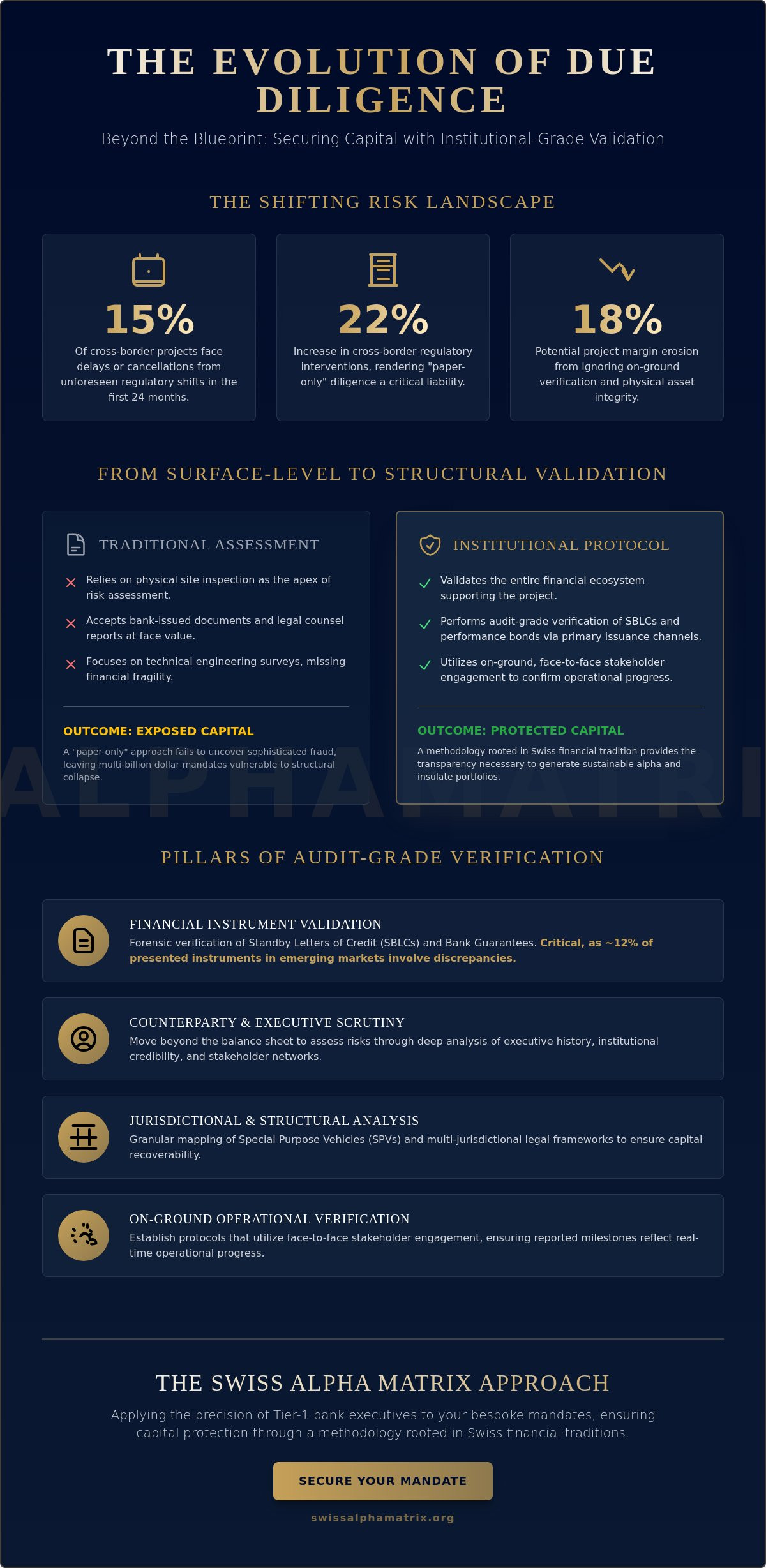
The global investment landscape has transitioned into a period of heightened volatility, where the traditional metrics of asset appraisal are no longer sufficient to safeguard institutional capital. Effective infrastructure due diligence in 2026 requires a departure from the static, surface-level assessments of the past, moving instead toward a comprehensive validation of the entire financial ecosystem that supports a project. It’s a reality that standard industry practices often prioritize speed over the meticulous verification of underlying financial instruments; however, a robust infrastructure project due diligence checklist must now account for the synthesis of technical data and the verification of complex credit enhancement tools. This evolution is driven by a 22% increase in cross-border regulatory interventions recorded in the 2025 fiscal year, which has rendered “paper-only” due diligence a liability rather than a protection. We’ve observed that the hidden costs of ignoring on-ground realities in favor of digital documentation can erode project margins by as much as 18% before the first phase of construction even concludes.
The Complexity of Cross-Border Project Finance
Modern infrastructure mandates often involve a labyrinth of Special Purpose Vehicles (SPVs) designed to optimize tax efficiency, yet these structures frequently serve as veils for unallocated risk. Analyzing multi-jurisdictional legal frameworks isn’t merely a compliance exercise; it’s a strategic necessity to ensure that capital remains recoverable in the event of local sovereign shifts. The interconnectedness of global supply chains means that a delay in a single secondary jurisdiction can trigger a cascade of force majeure claims across the entire project. Our approach involves a granular mapping of these dependencies, ensuring that every link in the financial chain is as resilient as the physical assets themselves. It’s not just about the bridge or the terminal; it’s about the integrity of the legal and fiscal conduits that allow capital to flow securely across borders.
Institutional-Grade Standards vs. General Market Practice
There’s a profound distinction between the “reasonable care” practiced by generalist firms and the audit-grade validation required for high-value mandates. While general market practice often accepts bank-issued documents at face value, institutional-grade standards demand the direct verification of Standby Letters of Credit and performance bonds through primary issuance channels. This shift from defensive risk management to strategic capital protection is what distinguishes a passive participant from a sophisticated investor. By applying the same rigor found in Tier-1 banking environments, we ensure that every stakeholder’s history and financial standing are scrutinized with Swiss-standard precision. This level of thoroughness doesn’t just mitigate loss; it provides the intellectual depth necessary to pursue alpha in markets where others only see impenetrable complexity.
The Financial Integrity Checklist: Validating the Foundation
While the technical specifications of a bridge or power plant often dominate the initial narrative, the actual risk to institutional capital resides within the opaque layers of the financing structure. The integrity of an infrastructure project rests not upon the concrete poured, but upon the veracity of the financial instruments that underpin the capital stack. A comprehensive infrastructure project due diligence checklist must prioritize the audit-grade validation of Standby Letters of Credit (SBLCs) and Bank Guarantees, as these instruments are frequently the primary targets for sophisticated cross-border fraud. In many emerging markets, as noted in the 2025 Financial Crime Report, nearly 12% of presented bank instruments involve some form of documentary discrepancy or lack of verifiable backing. Ensuring that your capital is protected requires a methodology that moves beyond a simple balance sheet review to encompass a forensic examination of executive history and institutional credibility. For those seeking to deepen their understanding of these complexities, Mastering Cross-Border Investment Due Diligence provides an essential institutional framework for the 2026 landscape.
Financial Instrument Authentication Protocols
Authenticating bank instruments requires a multi-step protocol that bypasses intermediaries to establish direct communication with the issuing institution’s trade finance department. Verification of SWIFT MT760 and MT799 messages is paramount; these must be confirmed as authentic, unencumbered, and issued by a bank with a credit rating acceptable to your bespoke mandate. Red flags often include requests for upfront fees to “release” guarantees or the use of non-standard verbiage that limits the instrument’s enforceability. We ensure that every instrument is scrutinized for these anomalies, providing a layer of security that standard checklists frequently overlook. It’s a process that demands the quiet authority of experts who understand the nuances of international trade finance.
Stakeholder and Counterparty Deep-Dives
Assessing counterparty risk involves a deep-dive into the forensic background of project sponsors and EPC contractors, evaluating their historical performance across similar high-value mandates. A contractor’s balance sheet might show liquidity, but their executive history may reveal a pattern of litigation or abandoned projects in volatile jurisdictions. We also evaluate the reliability of government guarantees, particularly in regions where political shifts can nullify sovereign commitments overnight. This level of scrutiny ensures that every stakeholder aligns with the principles of excellence and integrity that define your investment strategy. Beyond the instruments themselves, the verification of “Proof of Funds” must be absolute. We analyze debt-to-equity ratios against 10-year liquidity projections, ensuring that the project remains viable even under stressed market conditions. If you require a more tailored assessment of your current portfolio, engaging with our strategic architects can provide the clarity needed for long-term wealth preservation.
Technical vs. Institutional Due Diligence: A Strategic Comparison
While geotechnical surveys and environmental impact assessments remain indispensable components of any comprehensive infrastructure project due diligence checklist, they frequently operate within an intellectual vacuum that ignores the structural integrity of the underlying capital stack. Civil engineering focuses primarily on the physical feasibility of the asset, yet even the most resilient bridge cannot withstand the collapse of an opaque or fraudulent financial structure. We observe that technical flaws, such as 5% variances in soil stability or structural load calculations, are typically mitigatable through standard engineering adjustments; conversely, financial fraud or instrument invalidity often results in a total and irrecoverable loss of institutional capital. The synergy between physical asset appraisal and rigorous instrument validation is the only mechanism through which an investor can achieve true capital security in a volatile global market.
The Limits of Engineering-Led Investigations
Traditional investigations often suffer from siloed reporting, where technical experts fail to communicate effectively with financial auditors, leading to critical “blind spots” in the risk profile. A perfect site survey provides no protection if the project’s primary funding source is a shell entity or if the bank guarantees are unencumbered by real, verifiable assets. These systemic failures are where 80% of institutional capital losses occur in complex cross-border mandates, as technical success often masks deep-seated financial fragility. A sophisticated investor understands that the physical reality on the ground must be perfectly tethered to the legal and fiscal conduits that facilitate project execution.
The Swiss Alpha Matrix Integrated Model
Our methodology synthesizes financial discipline with on-ground technical verification to ensure that every stakeholder remains aligned with the project’s long-term strategic objectives. By merging these disparate disciplines, we provide a holistic view that transcends the limitations of general market practice and protects the integrity of the mandate. This approach is explored in depth within our framework on The Strategic Architecture of Independent Financial Project Management, which outlines how independent oversight acts as a safeguard against the misaligned incentives prevalent in complex project management. Determining the appropriate balance of expertise for your bespoke mandate is not merely a logistical choice, but a strategic imperative that defines your capacity for alpha generation. It’s the difference between passive participation and the active, strategic guardianship of your portfolio’s growth.
Operational and On-Ground Verification Protocols
Strategic capital preservation depends on the ability to reconcile digital data with the tangible realities of the project site. While desk-based research provides a necessary baseline, it frequently fails to capture the subtle operational frictions that can erode project timelines and jeopardize long-term returns. A sophisticated infrastructure project due diligence checklist must, therefore, mandate physical site visits and face-to-face stakeholder interviews to ensure that the reported progress aligns with the actual physical state of the asset. In many cross-border environments, the “last mile” of regulatory compliance often presents the most significant hurdle, as local bureaucratic nuances can differ substantially from centralized legal frameworks. A 2024 industry analysis of emerging market infrastructure found that 14% of projects experience significant cost overruns due to a failure to account for local labor market dynamics and supply chain bottlenecks that weren’t visible in initial sanitized corporate reports.
Physical Asset and Inventory Audits
Ensuring the existence and condition of high-value equipment is a foundational step in our verification process. We cross-reference logistics documentation with physical delivery logs, bypassing traditional reporting channels to obtain an unvarnished view of the project’s inventory. This level of scrutiny prevents the common pitfall of “phantom assets” where materials are billed but never arrive on-site. By utilizing on-ground intelligence, we provide the intellectual depth required to validate that capital is being deployed exactly as specified in your bespoke mandate. If you require an unvarnished audit of your project’s physical progress, consult with our strategic architects to ensure institutional-grade precision.
Regulatory and ESG Compliance on the Ground
Verifying environmental impact mitigation requires more than just reviewing a permit; it demands an assessment of how these protocols are executed in accordance with international standards on the ground. We evaluate local community relations to identify potential social risks that could lead to project shutdowns or reputational damage for institutional investors. Our team ensures that Anti-Money Laundering (AML) protocols are strictly followed at the project level, protecting your capital from the legal complexities of non-compliant local contractors. This on-ground verification ensures that every aspect of the project remains aligned with the principles of excellence and integrity that define the Swiss financial tradition.
Executing the Mandate: The Swiss Alpha Matrix Approach
Transitioning from a theoretical framework to active execution requires an institutional rigor that only seasoned experts can provide. At Swiss Alpha Matrix, our team consists of former Tier-1 bank executives who have managed multi-billion dollar portfolios across volatile jurisdictions for decades. We don’t just provide a document; we offer a strategic partnership rooted in the traditional discretion and quiet authority of Swiss private banking. By implementing our comprehensive infrastructure project due diligence checklist, we ensure that every financial instrument and operational milestone is validated with an uncompromising attention to detail. This transition from static assessment to active, ongoing oversight is what secures your capital against the unforeseen variables of the 2026 global market. It’s the role of the Strategic Architect, ensuring that the intricate layers of global financial markets are navigated with intellectual depth and a refusal to oversimplify complex dynamics.
Our Methodology: Precision, Discretion, Excellence
Our 4-pillar validation process is designed to provide executive-level intelligence for your most critical capital deployment decisions. We focus on instrument authentication, counterparty forensic analysis, on-ground operational audits, and long-term fiscal sustainability. This methodology ensures that the alpha you seek is built upon a foundation of absolute integrity and strategic growth. We prioritize long-term wealth preservation over short-term market speculation, a philosophy that has defined our approach to bespoke mandates. For a deeper analysis of our technical protocols, please refer to our Bank Instrument Validation Services, which serves as an executive guide to protecting capital in increasingly complex financial environments.
Next Steps for Institutional Stakeholders
Engaging our firm for a project-based advisory mandate begins with a confidential consultation to define the specific scope of your due diligence requirements. We understand that every institution has unique risk tolerances and specific strategic goals that require a hyper-personalized touch. Whether your mandate involves renewable energy infrastructure in Southeast Asia or transport hubs in sub-Saharan Africa, our strategic architects provide the precision necessary to navigate these complexities. Our communication rhythm is steady and logical, designed to lead you through a structured argument for our methodology. To begin a dialogue regarding the security and growth of your portfolio, we invite you to contact our senior advisors in Geneva, London, or Hong Kong. We remain committed to the principles of excellence and the standard of service that is both global in reach and local in its attention to detail.
Securing the Future of Institutional Capital
Infrastructure investment in 2026 demands a synthesis of technical precision and institutional-grade financial oversight. You’ve seen that relying on surface-level site surveys is insufficient for protecting long-term wealth in a volatile cross-border environment. A robust infrastructure project due diligence checklist must encompass the rigorous validation of the financial instruments that provide the project’s foundation. This approach ensures that capital remains unencumbered and that stakeholders are aligned with the highest standards of integrity. It’s the only way to transform risk into a structured path toward alpha generation. The preservation of capital remains the primary objective of every bespoke mandate we undertake.
Our firm, led by former Tier-1 bank executives, provides the audit-grade instrument validation necessary for high-value mandates. With a global presence in Geneva, London, and Hong Kong, we offer the discretion and intellectual depth required to navigate complex market dynamics. We invite you to secure your next infrastructure mandate with Swiss precision. By partnering with strategic architects who prioritize long-term wealth preservation, you ensure your portfolio’s growth remains resilient against the uncertainties of global finance. Your capital deserves the guardianship of seasoned experts who value excellence above all else.
Frequently Asked Questions
What are the most common red flags in an infrastructure project due diligence checklist?
Primary red flags include discrepancies in SWIFT MT760 or MT799 messaging protocols and requests for non-refundable upfront fees to facilitate the release of bank guarantees. We also scrutinize project sponsors whose historical data reveals a pattern of litigation or abandoned mandates in secondary markets. An effective infrastructure project due diligence checklist must identify these anomalies early to prevent the total loss of capital that often accompanies sophisticated financial fraud.
How does financial instrument validation differ from standard legal due diligence?
Legal due diligence focuses on the enforceability of contracts and the validity of permits; however, financial instrument validation involves the direct verification of the underlying capital’s existence and liquidity. While a legal review might confirm a document’s form is correct, our audit-grade validation ensures the issuing bank has the actual capacity to honor the obligation. This process requires direct communication with issuing institutions to confirm that credit enhancements are unencumbered and authentic.
Why is on-ground verification critical for infrastructure projects in 2026?
On-ground verification is essential because digital records and sanitized corporate reports frequently mask operational delays that aren’t visible from a distance. In the 2025 fiscal year, approximately 18% of cross-border projects reported milestones that didn’t align with physical progress on the site. Real-time verification ensures that labor market dynamics and local regulatory hurdles are identified before they escalate into significant financial liabilities for the institutional investor.
What is the role of a Tier-1 bank executive in the due diligence process?
Former Tier-1 bank executives provide the institutional rigor necessary to navigate the complexities of global trade finance and multi-layered project architectures. Their experience allows them to identify subtle irregularities in financial documentation that generalist firms often overlook. By applying the same precision found in elite private banking, they ensure that every bespoke mandate is executed with the highest level of professional competence and strategic oversight.
How long does a comprehensive infrastructure due diligence mandate typically take?
A comprehensive mandate typically requires between 45 and 90 days, depending on the complexity of the project’s financial structure and the transparency of the host jurisdiction. This timeline allows for the forensic background checks, physical site audits, and direct bank verifications required to meet Swiss-standard precision. We prioritize thoroughness over speed to ensure that the foundation of your investment is structurally and financially secure before capital is deployed.
Can Swiss Alpha Matrix provide ongoing oversight after the initial due diligence phase?
Yes, we frequently transition from the initial validation phase to a role of strategic guardianship and independent project management. This ongoing oversight ensures that all stakeholders remain aligned with the project’s original financial and technical milestones throughout the construction lifecycle. By maintaining a constant presence, we help mitigate the risk of operational drift and ensure that the project continues to meet the requirements for long-term alpha generation.
How do you handle due diligence in jurisdictions with limited public records?
In jurisdictions where public databases are opaque or incomplete, we rely on a network of on-ground intelligence and forensic investigators to verify stakeholder history. We bypass traditional records by conducting face-to-face interviews with local regulatory bodies and cross-referencing logistics data with physical inventory. This primary source verification is the only reliable method for ensuring capital protection in markets that lack the transparency of traditional financial hubs.