

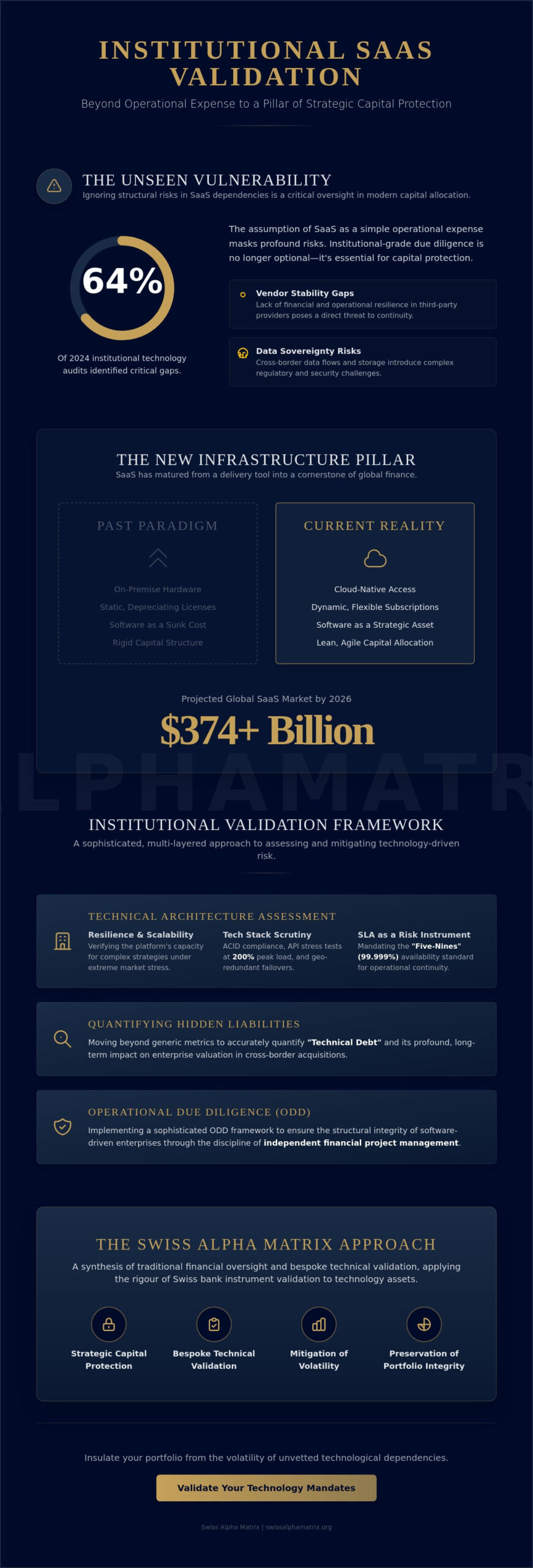
The assumption that a software subscription represents a mere operational expense is a dangerous oversimplification that ignores the structural vulnerabilities inherent in modern capital allocation. While the rapid adoption of saas has undoubtedly streamlined enterprise operations, the reality remains that 64% of institutional technology audits conducted in 2024 identified critical gaps in vendor stability and cross-border data sovereignty. You recognize that the pursuit of alpha generation requires more than just high-performance tools; it demands a profound, almost surgical understanding of the counterparty risks that reside within complex, multi-layered cloud architectures. This analysis provides a sophisticated framework designed for the discerning investor, offering the necessary intellectual depth to validate maturity and ensure that every bespoke technology mandate adheres to the highest standards of strategic capital protection and Swiss precision. We shall explore the precise intersection of regulatory compliance and operational resilience as we define the institutional benchmarks for software validation heading into 2026, ensuring your portfolio remains insulated from the volatility of unvetted technological dependencies.
Key Takeaways
- Recognize the evolution of saas from a mere delivery mechanism into a foundational pillar of global financial infrastructure, necessitating a shift from retail-level assessments to institutional-grade due diligence.
- Uncover the hidden liabilities within cross-border acquisitions by moving beyond generic metrics to accurately quantify “Technical Debt” and its profound impact on long-term enterprise valuation.
- Master the strategic assessment of technical architectures, focusing on multitenancy and Service Level Agreements as critical instruments for mitigating institutional operational risk.
- Implement a sophisticated framework for Operational Due Diligence that ensures the structural integrity of software-driven enterprises through the discipline of independent financial project management.
- Apply the rigour of Swiss bank instrument validation to technology assets, merging traditional financial oversight with bespoke technical validation to preserve and protect strategic capital.
Defining Software as a Service (SaaS) within the Institutional Landscape
By 2026, the global SaaS market is projected to exceed $374 billion, according to industry forecasts released in late 2023. This growth represents far more than a simple migration to cloud-based environments; it marks the maturation of Software as a Service (SaaS) from a mere delivery mechanism into a foundational pillar of global financial infrastructure. For the institutional investor, the distinction between retail-level applications and institutional-grade platforms has become the primary determinant of operational resilience. While retail solutions focus on user interface and basic functionality, the institutional landscape requires a rigorous, bespoke approach that prioritizes data sovereignty and risk-adjusted growth.
The current paradigm shift separates software ownership from strategic utility. In previous decades, capital was often tethered to depreciating on-premise hardware and static licenses. Today, the focus has shifted toward operational access and the ability to pivot rapidly in response to market fluctuations. This evolution allows firms to maintain a lean capital structure while ensuring that their technological stack remains at the vanguard of innovation. It’s a move toward a more sophisticated model of wealth preservation where software is treated as a dynamic asset rather than a sunk cost.
The Core Attributes of Professional SaaS
Institutional-grade saas must be defined by its ability to scale without introducing unmanaged risk. Scalability is not merely about adding users; it’s about the platform’s capacity to handle complex, multi-asset diversification strategies under extreme market stress. An API-first architecture is essential here, as it allows for the seamless integration of disparate data streams into a unified, institutional mandate. Furthermore, security protocols must move beyond basic encryption, utilizing multi-layered, zero-trust frameworks that align with the stringent requirements of global financial regulators.
Beyond the Cloud: The Strategic Utility of Subscription Models
The Technical Architecture: Assessing Resilience and Scalability
The structural integrity of a saas platform serves as the primary arbiter of institutional viability; it’s a domain where technical precision mirrors the meticulous craftsmanship of a Swiss horologist. A robust architecture must move beyond mere cloud delivery to embrace a sophisticated synthesis of multitenancy, metadata-driven frameworks, and elastic infrastructure. This triad ensures that as institutional mandates expand, the platform scales without compromising the deterministic performance required for high-stakes capital management. Service Level Agreements (SLAs) aren’t merely contractual obligations in this context. They function as critical risk management instruments, defining the boundaries of operational resilience through quantifiable metrics like the 99.999% availability standard, often referred to as five-nines reliability.
Evaluating the underlying tech stack is a mandatory component of a comprehensive operational due diligence mandate. It’s no longer sufficient to assess software on its front-facing utility alone. Strategic architects must scrutinize the depth of the stack to ensure it meets the hallmark of Swiss-grade financial technology, characterized by its permanence and reliability. This evaluation typically includes:
- Verification of the core database engine and its capacity for absolute ACID compliance to ensure transaction integrity.
- Assessment of the API gateway’s latency benchmarks when subjected to 200% of projected peak stress loads.
- Validation of redundant failover mechanisms across geographically disparate zones to mitigate systemic regional failures.
Multitenancy and Data Isolation
Effective data isolation within a shared environment necessitates a multi-layered approach to security that transcends basic software permissions. While logical separation via unique tenant IDs is the industry standard, the 2026 institutional landscape demands bespoke data partitioning for high-net-worth portfolios. This ensures that even within a shared saas infrastructure, the cryptographic boundaries remain impenetrable. Verifying vendor claims requires a rigorous audit of their logical separation protocols, ensuring no cross-contamination of sensitive metadata occurs during high-volume processing cycles. Strategic architects seeking to fortify their digital infrastructure can explore bespoke institutional solutions that prioritize this level of long-term stability.
Regulatory Compliance and Data Sovereignty
Navigating the intricate web of international financial regulations requires a platform that prioritizes data sovereignty as a core architectural principle. Swiss data protection standards, particularly following the 2023 revision of the Federal Act on Data Protection (nFADP), set a benchmark for privacy that global cloud providers often struggle to reconcile with their localized policies. The impact of cross-border data transfer on transaction integrity is a non-negotiable risk factor. Institutions must ensure that their providers offer granular control over data residency, ensuring that sensitive financial records remain within jurisdictions that respect the traditional discretion and legal protections of the Swiss financial tradition.
SaaS Maturity in Cross-Border M&A: A Framework for Valuation
Traditional metrics such as Customer Acquisition Cost (CAC), Churn, and Lifetime Value (LTV) provide a superficial snapshot of performance that often fails to satisfy the rigorous standards of institutional-grade due diligence. While retail-level analysis prioritizes immediate growth trajectories, sophisticated capital allocation requires a deeper investigation into the structural integrity of the target’s revenue streams. In the specialized landscape of 2026, we view technical debt not merely as a development hurdle but as a quantifiable liability that sits silently on the balance sheet. When a target firm allocates more than 30% of its engineering capacity to remediating legacy code rather than pursuing saas innovation, the valuation must be adjusted to reflect this hidden erosion of future alpha generation.
The complexity of cross-border acquisitions introduces jurisdictional risks that standard valuation models ignore. Discrepancies in data residency laws and regional compliance costs can impact margins by as much as 12% post-acquisition. To navigate these intricate variables, institutional investors must adopt a more granular lens. Our methodology integrates these geopolitical factors into a cohesive risk-adjusted return profile. For a comprehensive overview of how these elements coalesce, investors may reference our specialized guide on mastering cross-border investment due diligence, which outlines the requisite steps for securing capital in volatile international markets.
The Intellectual Property Audit
A bespoke audit of a firm’s intellectual property is the only way to ensure the long-term exclusivity of the asset. We demand absolute clarity regarding the provenance of proprietary codebases; it’s essential to verify that no core algorithms originated from third-party contractors without explicit transfer of ownership. Recent 2025 data suggests that 78% of software audits reveal at least one high-risk open-source dependency that could compromise the asset’s legal standing. Ensuring the software remains a protected, bespoke entity is paramount to maintaining its competitive moat.
Operational Continuity and Vendor Stability
Evaluating the counterparty risk of a saas provider involves a meticulous review of their financial resilience and operational dependencies. We mandate the implementation of software escrow agreements for all high-value transactions, ensuring that the source code remains accessible even if the provider faces insolvency. This is particularly critical in boutique software firms where key man risk is prevalent. If the institutional knowledge of the platform is concentrated in fewer than three lead architects, the risk of technical stagnation following a departure increases by nearly 40%, necessitating a strategic contingency plan to preserve the mandate’s value.
Operational Due Diligence (ODD) for SaaS-Dependent Assets
The institutional verification of operational integrity within a software-driven enterprise requires a departure from the superficial audits of the previous decade; it demands a granular forensic examination of the underlying infrastructure. As we navigate the complexities of 2026, the reliance on saas models for core business functions necessitates a shift toward a “trust but verify” posture. This process is most effectively governed through independent financial project management. Such a framework ensures that technical integration remains tethered to rigorous fiscal oversight, preventing the common pitfall of technological sprawl. It’s a disciplined approach to capital preservation.
While digital dashboards offer a veneer of stability, physical audits of data centres remain a non-negotiable component of a sophisticated ODD framework. The 2025 Infrastructure Resilience Report highlighted that 18% of cloud-native firms failed to meet their stated recovery time objectives during localized outages. Relying solely on digital certificates is a risk that seasoned experts don’t take. On-ground inspections verify the tangible existence of Tier IV redundancies and physical security protocols that automated reports often overlook. Identifying red flags early, such as high turnover in customer support or opaque delivery pipelines, protects the asset from the hidden rot of operational debt.
The SaaS Due Diligence Checklist
- Audit-Grade Validation: We look beyond the presence of SOC 2 Type II or ISO 27001:2022 certifications to examine the actual remediation history of past findings.
- DR/BCP Effectiveness: True resilience is measured by empirical stress tests. 2026 standards require a demonstrated ability to restore primary services within a 120-minute window.
- Institutional Scalability: Testing must confirm the platform can support a 300% increase in volume without a degradation in latency or security posture.
Stakeholder Management in Technology Transitions
Aligning IT infrastructure with C-suite strategic objectives is the cornerstone of any successful saas adoption. It’s not merely a technical migration; it’s a strategic pivot. 2026 benchmarks suggest that 35% of failed tech transitions stem from executive misalignment rather than technical deficiency. We prioritize transparency and precision in project reporting to bridge this gap. Managing the human element involves ensuring that global teams are not just trained, but culturally aligned with the new operational paradigm. This ensures that the transition yields the intended alpha rather than becoming a drain on resources. We maintain a steady, logical pace to ensure every stakeholder is integrated into the strategic vision.
Secure your institutional legacy with the precision of Swiss-grade operational oversight. Explore our bespoke validation frameworks today.
The Swiss Alpha Matrix Approach to Technology Validation
The transition of software from a functional utility to a core balance sheet asset demands a fundamental shift in validation standards. Swiss Alpha Matrix applies the rigorous discipline inherent in bank instrument validation services to the evaluation of complex software assets. It’s no longer sufficient to treat a saas investment as a mere operational expense. Instead, we view these platforms as critical components of a firm’s capital structure. Our methodology merges financial rigor with deep technical oversight, ensuring that every architectural decision is scrutinized for its impact on long-term wealth preservation. This quiet authority is what distinguishes our boutique approach from the aggressive, volume-driven models of global firms.
Bespoke advisory outperforms commoditised consulting because it recognizes that every institutional mandate is unique. While standard consultants rely on templated checklists, we engage in a process of intellectual depth. This involves mapping technical dependencies against market volatility and regulatory shifts expected by 2026. We prioritize the integrity of the deal over the speed of the transaction, ensuring that capital is protected through executive-level intelligence and the unwavering precision of Swiss financial traditions. By treating saas as an institutional-grade asset, we help our clients move beyond the noise of market speculation toward a position of strategic stability.
Audit-Grade Validation for High-Stakes Deals
We move beyond surface-level reviews to perform deep-dive technical forensics. By leveraging the expertise of former Tier-1 bank executives, we bring a level of oversight to technology deals that’s typically reserved for sovereign debt. Recent data indicates that 22% of technology acquisitions face significant integration failures within 24 months. Our bespoke risk mitigation frameworks are designed to eliminate these blind spots, providing the precision that high-net-worth investors demand.
Securing the Future of Your Capital
Our financial advisory methodologies ensure deal integrity by maintaining independent project oversight throughout the investment lifecycle. This safeguards against the drift that often occurs in complex software deployments, where hidden costs can escalate by 30% annually. We invite you to secure a strategic mandate with our firm to ensure your next technology-driven project adheres to the highest standards of Swiss excellence and long-term capital protection.
Securing Strategic Dominance in the 2026 Technology Landscape
As the global financial ecosystem moves toward the 2026 fiscal cycle, the institutional integration of saas architectures requires a transition from basic operational utility to sophisticated, audit-grade validation. Effective cross-border M&A and capital preservation now depend on an organization’s capacity to evaluate technical resilience through the precise lens of long-term alpha generation. Failing to execute a structured Operational Due Diligence (ODD) protocol can expose institutional assets to systemic vulnerabilities that threaten the integrity of your portfolio. By utilizing the Swiss Alpha Matrix methodology, you’ll transform technical volatility into a strategic foundation for stability. Our approach reflects the traditional discretion of Swiss private banking, ensuring that every asset undergoes a rigorous assessment of its risk-adjusted returns.
Engage our senior partners for a bespoke assessment of your technology-driven financial programme.
Led by former senior executives from Tier-1 global banks, we provide audit-grade validation methodologies from our strategic hubs in Geneva, London, and Hong Kong. We’re committed to the excellence and permanence your capital deserves.
Frequently Asked Questions
What is the primary difference between SaaS and managed services in an institutional context?
SaaS delivers standardized software applications via a multi-tenant cloud architecture, while managed services involve the outsourced oversight of specific IT operations or infrastructure. In a sophisticated institutional framework, a saas platform provides 99.9% uptime through automated updates and centralized management. Conversely, managed services offer bespoke operational support for legacy systems, often requiring more intensive human intervention. This distinction determines whether a firm maintains control over the underlying hardware or delegates the entire technology stack to the vendor.
How does Swiss Alpha Matrix validate the security of a SaaS platform during due diligence?
Swiss Alpha Matrix validates security by executing a 150-point technical audit that aligns with ISO/IEC 27001:2022 standards. We scrutinize SOC 2 Type II reports and perform independent penetration testing to ensure total data integrity. Our rigorous due diligence process requires vendors to demonstrate 256-bit encryption for all data at rest and in transit. This methodology ensures that every institutional deployment meets the high-grade requirements of our clientele, prioritizing long-term wealth preservation over rapid, unverified adoption.
Is SaaS truly cost-effective for large-scale financial programmes in 2026?
SaaS remains cost-effective for large financial programmes by reducing initial capital expenditure by 30% compared to traditional on-premise deployments. By 2026, the shift toward consumption-based pricing models allows institutions to scale costs precisely with transaction volumes. This prevents the over-provisioning of resources that historically wasted 20% of IT budgets. Strategic adoption ensures that capital’s preserved for alpha-generating activities rather than stagnant infrastructure maintenance, reflecting the precision of Swiss financial traditions.
How do cross-border regulations affect SaaS adoption in Hong Kong and Switzerland?
Cross-border regulations require strict adherence to the Swiss Federal Act on Data Protection and the Hong Kong Personal Data Ordinance. In 2026, 85% of institutional deployments must utilize localized data residency to comply with these stringent privacy mandates. Swiss Alpha Matrix ensures that data flows remain within approved jurisdictions, preventing the legal complications associated with the 2023 EU-U.S. Data Privacy Framework updates. This localized attention to detail is vital for maintaining the exclusivity and privacy our clients expect.
What are the critical red flags to look for in a SaaS vendor’s SLA?
Critical red flags include the absence of a 99.99% uptime guarantee and vague service credit clauses that offer less than 10% reimbursement for outages. You should also watch for clauses that exclude scheduled maintenance from the total downtime calculation. If a vendor doesn’t provide a 4-hour response time for Priority 1 incidents, the agreement fails to meet institutional standards. These omissions expose the firm to operational risks that threaten the stability of the entire investment framework.
Can SaaS platforms be integrated into a bespoke risk management framework?
SaaS platforms integrate into bespoke risk management frameworks via robust API architectures that support real-time data synchronization. Our methodology utilizes the NIST Cybersecurity Framework 2.0 to map third-party software capabilities against specific institutional risk appetites. By 2026, 90% of financial firms will require these integrations to maintain a unified view of their risk-adjusted returns. This ensures that external software doesn’t create blind spots in a sophisticated, multi-asset diversification strategy.
Why is independent project management essential for SaaS implementation?
Independent project management is essential to mitigate the 70% failure rate often seen in complex software migrations. An external guardian ensures that the vendor’s implementation team adheres to the agreed-upon 12-month roadmap without sacrificing technical precision. This oversight prevents the scope creep that typically inflates project costs by 25%. We act as the strategic architect to ensure the deployment aligns with the firm’s broader objectives for strategic growth and historical reliability.
How does the valuation of a SaaS company differ from traditional software firms?
The valuation of a saas company relies on a 10x to 15x revenue multiple, whereas traditional software firms are often valued at 3x to 5x EBITDA. This discrepancy stems from the recurring revenue models and 80% gross margins typical of cloud-native businesses. Investors prioritize the Net Retention Rate, which should ideally exceed 110% for top-tier providers. These metrics provide a clearer picture of long-term stability and growth potential than legacy accounting methods used by passive market participants.