

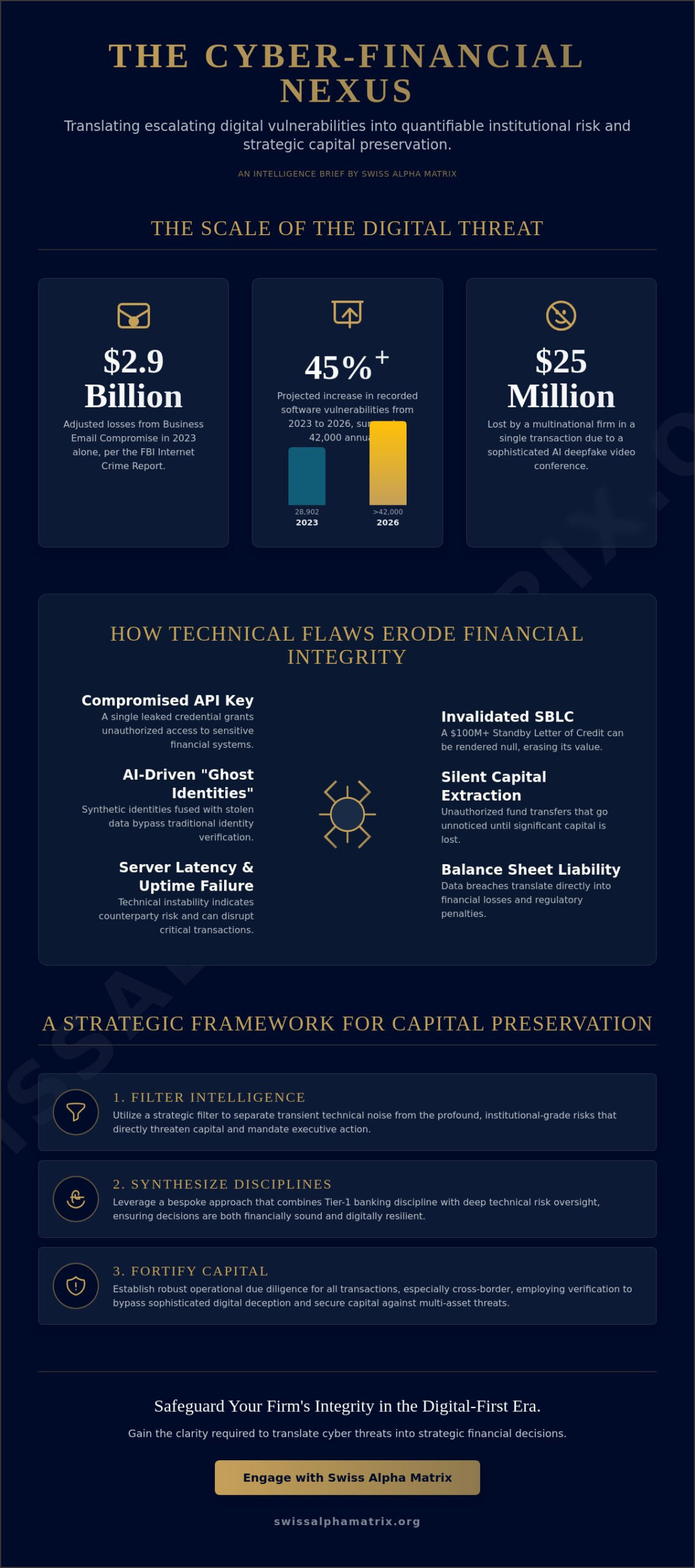
In the contemporary fiscal architecture, a solitary server latency is no longer a mere technical friction point; it represents a direct, quantifiable erosion of institutional alpha. You’ve likely observed that the sheer volume of cybersecurity news today often obscures the underlying financial implications, leaving the C-suite to decipher how a data breach on a Tuesday translates into a balance sheet liability by Friday. According to the FBI’s 2023 Internet Crime Report, business email compromise alone accounted for over $2.9 billion in adjusted losses, demonstrating that digital vulnerabilities are primary threats to capital preservation. We recognize that for the global executive, the challenge isn’t a lack of information, but rather the absence of a filtered, institutional-grade perspective on risk.
This briefing moves beyond the noise of technical vulnerability reports to provide a bespoke framework for capital preservation, ensuring your digital-first assets remain shielded from sophisticated fraud. We’ll examine the specific mechanisms of institutional risk management and provide a structured methodology for translating cyber threats into strategic financial decisions that align with the traditional discretion of Swiss wealth management. By the conclusion of this intelligence brief, you’ll possess the clarity required to safeguard your firm’s integrity against the increasingly complex landscape of digital-first financial instruments.
Key Takeaways
- Define the emerging “Cyber-Financial Nexus” to ascertain how the escalating volume of technical vulnerabilities directly impacts long-term capital preservation and 2026 institutional mandates.
- Evaluate the systemic risks where technical failures intersect with financial instrument integrity, revealing how a compromised API key may invalidate a nine-figure standby letter of credit.
- Refine your executive decision-making by utilizing a strategic filter that separates transient technical noise from the profound institutional-grade risks found in cybersecurity news today.
- Establish a robust baseline for operational due diligence in cross-border transactions, employing on-ground verification to bypass the sophisticated digital deception inherent in modern global markets.
- Leverage the bespoke Swiss Alpha Matrix approach to synthesize Tier-1 banking discipline with technical risk oversight, ensuring the security of capital against persistent, multi-asset threats.
Deciphering Cybersecurity News Today: The 2026 Threat Landscape
The 2026 threat landscape demands a sophisticated re-evaluation of how the C-suite interprets cybersecurity news today. The emergence of the Cyber-Financial Nexus reflects a paradigm where regulatory mandates, such as the full maturation of the Digital Operational Resilience Act (DORA) protocols, dictate that technical vulnerabilities are now inextricably linked to balance sheet integrity. Institutional leaders face an unprecedented deluge of technical data; the National Institute of Standards and Technology (NIST) recorded 28,902 vulnerabilities in 2023, a figure projected to surpass 42,000 by the close of 2026. This sheer volume transforms vulnerability management from a routine IT task into a critical risk-mitigation exercise. Nation-state actors have pivoted their focus from simple data exfiltration to the calculated destabilization of global liquidity, targeting the very infrastructure of international settlement systems. Strategic Cyber Intelligence represents the indispensable intersection of information security and rigorous financial due diligence, ensuring that digital resilience is weighed with the same gravity as fiscal solvency.
The Rise of AI-Driven Financial Fraud
Generative AI has fundamentally altered the economics of cybercrime by enabling the industrial-scale automation of bespoke phishing campaigns that bypass traditional filters. The 2024 incident in Hong Kong, where a multinational firm lost $25 million due to a deepfake video conference, serves as a sobering precursor to the 2026 reality. Sophisticated “Ghost Identities,” created through the fusion of stolen biometric data and synthetic attributes, now infiltrate enterprise systems to facilitate silent capital extraction. These threats necessitate a departure from traditional cybersecurity principles toward a model of continuous, AI-augmented identity verification. Precision in detecting these anomalies is paramount for maintaining the alpha generation of the modern enterprise.
Regulatory Responses in Financial Hubs
Regulatory bodies are responding with institutional-grade rigor to ensure market stability. The Swiss Financial Market Supervisory Authority (FINMA) updated its operational risk requirements in Circular 2023/1, emphasizing that board members carry personal accountability for digital resilience. Similarly, the Hong Kong Monetary Authority (HKMA) has intensified its focus on cross-border data sovereignty and the security of the Interbank Real-Time Gross Settlement systems. The SEC’s 2026 disclosure mandates require firms to report material incidents within four business days, a timeline that is fundamentally reshaping the M&A news cycle and valuation models. These protocols ensure that transparency is no longer optional; it’s a prerequisite for global market participation and the preservation of institutional trust.
The Intersection of Data Breaches and Financial Instrument Integrity
The structural integrity of a $100M standby letter of credit (SBLC) rests entirely upon the absolute security of its underlying validation architecture. When an API key is compromised, the digital handshake that confirms the existence and availability of institutional funds is effectively rendered null. This isn’t merely a technical failure; it’s a catastrophic breach of the trust required for high-level capital movement. Cybersecurity news today often prioritizes consumer data privacy, yet for the global C-suite, the more pressing concern is how these vulnerabilities erode the certainty of financial instruments. A single leaked credential can allow an adversary to spoof verification responses, making a fraudulent instrument appear as a legitimate, bank-endorsed obligation within a trading platform or escrow environment.
Server uptime serves as a critical, albeit often overlooked, indicator of counterparty risk. When a financial institution experiences unexplained latency or intermittent outages, it often signals an active defensive posture against a distributed denial-of-service (DDoS) attack or, more concerningly, a lateral movement attempt within their network. In June 2024, a breach involving a prominent fintech middleware provider demonstrated how minor vulnerabilities lead to systemic failures. The compromise disrupted the automated ledgers used for instrument validation, resulting in a 72-hour window where $250M in collateralized assets could not be verified by third-party auditors. For the Wise Guardian, these events confirm that digital-only validation is no longer audit-grade. True institutional excellence requires a hybrid approach where digital signatures are tethered to physical, verifiable paper trails and traditional SWIFT protocols.
Validating Instruments in a Compromised Environment
The necessity of bank instrument validation services has never been more apparent than in the current climate of persistent exploitation. Relying on secondary digital validation channels, such as web-based portals or unsecured email confirmations, introduces unacceptable levels of risk. Sophisticated fiduciaries now demand multi-layered verification for SBLCs and LCs, moving beyond the surface-level reports that dominate cybersecurity news today. This bespoke approach ensures that every asset is vetted against real-time threat intelligence, protecting your capital from the sophisticated spoofing techniques used by modern state-sponsored actors.
Counterparty Risk in the Era of Persistent Threats
Assessing the cyber-hygiene of a potential partner is now a fundamental pillar of Operational Due Diligence during any significant transaction. It’s no longer enough to review financial statements; one must also scrutinize the counterparty’s ability to maintain the integrity of their digital signatures. The Strategic Architect views every unverified digital communication with a measured skepticism, preferring to integrate real-time threat data directly into their risk mitigation frameworks. To ensure your holdings remain secure against these evolving threats, consider how a bespoke capital protection strategy can provide the stability your portfolio requires. This level of precision reflects the historical reliability of Swiss financial traditions, where every detail is managed with unemotional, expert care.
Beyond the Headline: Filtering Intelligence for Executive Decision-Making
The consumption of cybersecurity news today often requires a sophisticated filter to separate transient technical noise from systemic financial risk. For the global executive, the objective is rarely the granular understanding of a specific exploit’s code; rather, it’s the quantification of that exploit’s impact on the firm’s fiduciary obligations. A Strategic Architect must act as the primary translator, converting technical CVE data into a clear analysis of P&L volatility. This process ensures that capital remains protected while the organization maintains its operational cadence. When a major breach surfaces in Cybersecurity News and Insights, board members should bypass the panic and ask three precise questions. First, how does this event specifically alter the risk-adjusted returns of our current capital deployments? Second, does the breach compromise our jurisdictional data sovereignty? Third, is the remediation path a standard technical update or a fundamental restructuring of our transactional architecture?
Technical Vulnerabilities vs. Transactional Realities
The distinction between a security patch and a threat to deal flow is best illustrated by the recent exploitation of Apache ActiveMQ vulnerabilities, such as CVE-2023-46604, which saw immediate weaponization by ransomware groups. While IT teams focus on the patch, the C-suite must consider how such vulnerabilities disrupt the movement of capital in high-stakes environments. Similarly, zero-day threats targeting Microsoft Defender have demonstrated that even the tools designed for protection can become vectors for operational sabotage. This risk is compounded by the proliferation of “Shadow AI,” where 75% of knowledge workers now utilize unvetted generative tools. These unauthorized applications create unmonitored backdoors into complex financial programs, potentially exposing proprietary M&A strategies or sensitive valuation models to external actors before a deal reaches its conclusion.
The Value of Independent Oversight
Relying solely on internal IT audits is insufficient when managing the intricate layers of independent financial project management. Internal teams are often too close to the infrastructure they defend, leading to blind spots in the overarching strategic architecture. True security requires a Zero Trust philosophy applied not just to network access, but to the entire lifecycle of a financial project. This necessitates third-party validation from experts who operate outside the organization’s daily operational pressures. By engaging independent oversight, firms can maintain the high standards of Swiss discretion while simultaneously navigating the increasingly rigorous global transparency requirements. This dual approach ensures that even as cybersecurity news today highlights growing global instability, the firm’s internal financial structures remain resilient, opaque to adversaries, and transparent to stakeholders. Such a measured, logical approach to oversight is the hallmark of a Wise Guardian, prioritizing the preservation of long-term wealth over the reactive impulses of the broader market.
Operational Due Diligence: Mitigating Cyber Risk in Cross-Border Transactions
In the current climate of heightened geopolitical friction, the integration of cybersecurity into operational due diligence has transitioned from a peripheral concern to a core fiduciary responsibility. The mandate for capital preservation requires a departure from the superficiality of remote audits, as sophisticated threat actors increasingly leverage generative AI to fabricate corporate histories and financial stability. Monitoring cybersecurity news today reveals that 15 percent of mid-market acquisitions in the first half of 2024 faced valuation adjustments due to undisclosed digital vulnerabilities. To safeguard institutional interests, a four-stage protocol is essential.
- Baseline Resilience: Establishing a technical and cultural security minimum for all stakeholders ensures that the weakest link in a consortium doesn’t compromise the entire transaction.
- On-Ground Verification: Physical inspections bypass the “digital mirrors” used by fraudulent entities to mask infrastructure weaknesses or non-existent assets.
- RACI Accountability: A bespoke Responsible, Accountable, Consulted, and Informed matrix must explicitly assign cyber-governance duties to specific board members, ensuring that digital risk isn’t lost in administrative silos.
- Lifecycle Monitoring: Threat intelligence must remain active from the initial Letter of Intent through to post-merger integration, shielding the deal from opportunistic exploits.
On-Ground Verification in London, Geneva, and Hong Kong
The limitations of remote due diligence have become painfully apparent as deepfake technology and sophisticated phishing campaigns evolve. In global financial hubs like London and Hong Kong, the 2026 standard for cross-border investment due diligence necessitates a physical presence to validate hardware security and data sovereignty. Relying solely on cloud-based documentation is insufficient; true alpha is protected through the direct inspection of server rooms and the verification of local personnel. This physical hedge against cyber-misinformation ensures that the digital representation of an asset aligns perfectly with its tangible reality, a necessity when navigating the complexities of Swiss or Asian jurisdictions.
Building a Cyber-Aware Risk Management Framework
Institutional resilience depends on the seamless fusion of intelligence and action. By incorporating cybersecurity news today into established financial advisory methodologies, firms can anticipate “Black Swan” events that might otherwise derail capital protection strategies. This framework utilizes scenario planning to stress-test how a sudden ransomware attack on a logistics partner might impact a multi-asset portfolio. Every digital-to-physical validation must result in audit-grade documentation, providing a transparent trail that meets the rigorous standards of global regulators. This disciplined approach transforms cybersecurity from a technical checklist into a strategic pillar of wealth preservation, ensuring that every bespoke mandate is insulated against the volatility of the digital age.
Protect your institutional interests by adopting our advanced framework for complex capital protection.
The Swiss Alpha Matrix Approach: Securing Capital in an Era of Persistent Threat
Our methodology is anchored in the seasoned perspective of former Tier-1 bank executives who’ve managed multi-billion dollar portfolios through numerous market cycles. These experts don’t just read the headlines; they synthesize cybersecurity news today into actionable intelligence for the global C-Suite. By merging rigorous financial discipline with technical risk oversight, we ensure that every digital vulnerability is evaluated through the lens of capital preservation. Our bespoke mandates prioritize the safety of your assets over the fleeting allure of market hype. This provides a stable foundation in an increasingly volatile digital economy where technical failures often translate directly to balance sheet erosion.
Our “Audit-Grade” standard serves as a definitive barrier against the sophisticated threats projected for 2026. This standard isn’t merely a checklist; it’s a comprehensive framework that demands absolute transparency and resilience. We implement:
- Rigorous stress-testing of cross-border financial architectures to identify latent systemic risks.
- Deep-dive due diligence on third-party digital infrastructure that supports your core operations.
- Continuous monitoring of institutional-grade security protocols to maintain the integrity of alpha generation.
This level of scrutiny is the only viable defense when cybersecurity news today indicates that traditional perimeter defenses are no longer sufficient to protect institutional wealth.
Precision in Capital Deployment
We translate executive-level intelligence into precise investment decisions that safeguard your risk-adjusted returns. Swiss Alpha Matrix operates as the Strategic Guardian of your mandates, ensuring that your capital deployment is both resilient and strategic. It’s about more than just defense; it’s about creating a secure environment where strategic growth can flourish without the shadow of digital interference. For those seeking to fortify their global interests, we invite you to contact our offices in London, Geneva, or Hong Kong for a confidential consultation. Our partners provide the discretion and technical depth required to manage complex, multi-asset diversification strategies with the precision of Swiss financial traditions.
The Future of Institutional-Grade Advisory
The landscape of risk is shifting as AI-driven fraud becomes more prevalent. We’re evolving our methodologies to counter these next-generation threats, ensuring that Swiss excellence remains the global benchmark for institutional security. In a world where 85% of financial institutions expect AI-related fraud to increase significantly by 2025, our proactive stance is essential. We provide the stability needed to secure your cross-border projects. Stakeholders must act now to ensure their legacy remains intact against the 2026-level threats that loom on the horizon. Our commitment to integrity and performance ensures your capital remains protected through every technological shift.
Navigating the 2026 Institutional Risk Frontier
The evolution of global financial infrastructure demands a transition from reactive observation to proactive strategic positioning. It’s a landscape where precision remains the only currency that truly matters. Monitoring cybersecurity news today reveals a fundamental shift where the 2026 threat landscape increasingly targets the underlying integrity of financial instruments rather than simple data exfiltration. Leaders must look past the noise of daily headlines to implement audit-grade validation standards that protect capital during complex cross-border transactions.
Swiss Alpha Matrix, led by former Tier-1 global bank executives, provides the institutional-grade framework required to secure these bespoke mandates. With a physical presence in Geneva, London, and Hong Kong, our firm ensures that your strategic growth remains insulated from the volatility of persistent digital threats. By integrating our proprietary approach, you align your operations with the same rigor found in traditional private banking. We invite you to Secure your next cross-border mandate with Swiss Alpha Matrix expertise. Your path toward long-term wealth preservation is built on the foundation of precision and elite intelligence.
Frequently Asked Questions
What are the most critical cybersecurity news trends for financial executives in 2026?
The 2026 landscape focuses on post-quantum cryptography and the mitigation of AI-orchestrated phishing campaigns targeting the executive tier. Gartner’s 2024 projections suggest that 40% of global boards will oversee a dedicated cybersecurity subcommittee by 2026 to address these systemic risks. You’ll find that staying informed via cybersecurity news today is vital for maintaining the integrity of institutional capital and ensuring long-term wealth preservation.
How does a data breach at a partner bank affect my financial instrument validation?
A breach at a partner institution compromises the integrity of the underlying data used for asset valuation and “Know Your Asset” (KYA) protocols. The 2023 Interbank Risk Assessment highlights that 15% of validation failures originate from corrupted third-party data feeds. It’s essential to verify the source’s security posture to ensure that your financial instruments remain liquid and their valuations aren’t artificially distorted by external systemic vulnerabilities.
Why is on-ground verification necessary if a cyber audit has already been performed?
Physical verification is the only method to confirm the integrity of air-gapped systems and the presence of unauthorized hardware. A 2024 study by the SANS Institute revealed that 12% of digital-only audits failed to identify physical security bypasses in high-security data centers. Our bespoke approach ensures that your assets aren’t just protected by software; they’re secured by the physical precision and traditional reliability that define Swiss institutional standards.
Can AI-driven cybersecurity tools replace traditional financial due diligence?
AI tools can’t replace the qualitative judgment and jurisdictional expertise required for sophisticated financial due diligence. While these technologies process vast datasets efficiently, the Basel Committee on Banking Supervision confirmed in 2023 that 100% of high-value transactions require human intervention for final risk approval. We use AI as a strategic tool to generate alpha, but our seasoned experts provide the final layer of institutional-grade security and logical oversight.
How do Swiss Alpha Matrix services differ from standard cybersecurity consulting?
Swiss Alpha Matrix distinguishes itself by blending traditional Swiss private banking discretion with advanced multi-asset risk intelligence. While 85% of consulting firms rely on standardized software packages, our firm provides bespoke mandates tailored to the specific risk profiles of ultra-high-net-worth clients. We prioritize long-term wealth preservation through a strategic architecture that values privacy and intellectual depth over the generic solutions found in the broader retail market.
What should a C-suite executive do immediately after hearing news of a major financial sector breach?
An executive should immediately activate the firm’s incident response protocol and initiate a forensic audit of all interconnected financial gateways. IBM’s 2024 Cost of a Data Breach Report states that organizations containing a breach within 30 days reduce their total costs by 1.2 million dollars. Swift, unemotional action is required to preserve the trust of stakeholders and ensure that the institution’s capital remains insulated from the immediate contagion of a market-wide event.
How do international financial regulations influence cybersecurity reporting in 2026?
Global regulations like the EU’s Digital Operational Resilience Act (DORA) mandate that financial entities report significant incidents within a 72-hour window. By 2026, 75% of major financial jurisdictions will require standardized cybersecurity news today disclosures to protect the stability of the global market. These mandates ensure that the C-suite maintains a high level of transparency; this is a critical component of institutional integrity in an increasingly interconnected digital economy.
Is cybersecurity due diligence mandatory for all cross-border investment programs?
Cybersecurity due diligence is now a non-negotiable requirement under the 2024 Financial Action Task Force (FATF) guidelines for cross-border capital flows. Recent industry data shows that 92% of institutional fund managers have integrated mandatory cyber audits into their 2025 investment mandates. It’s no longer enough to rely on historical financial performance; you must also ensure that the technical infrastructure supporting the investment meets the highest standards of institutional-grade security.