

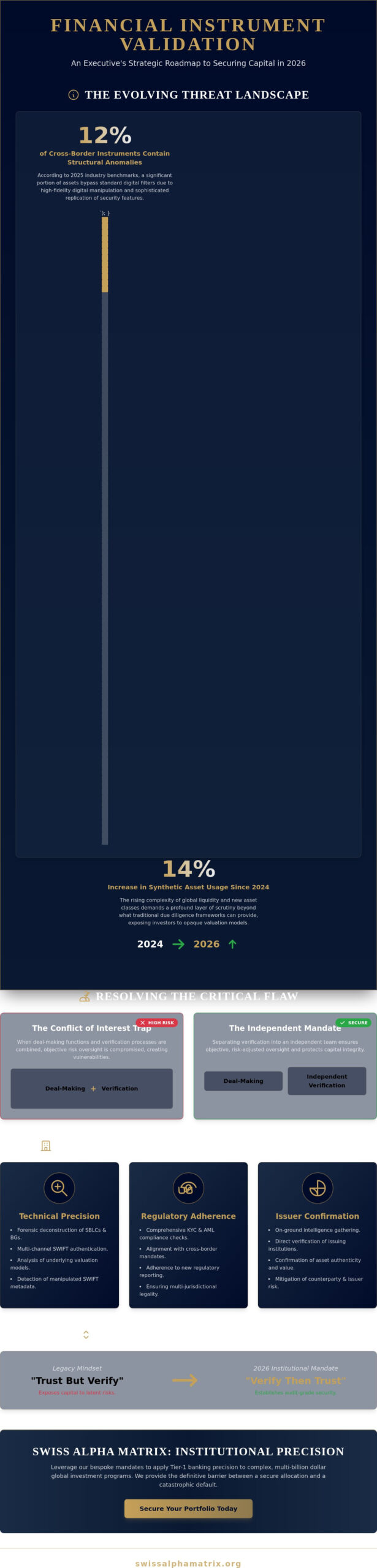
The traditional reliance on face-value documentation has been rendered obsolete by a landscape where, according to 2025 industry benchmarks, nearly 12% of cross-border instruments contain significant structural anomalies that bypass standard digital filters. For the discerning C-suite executive, the process of financial instrument validation has evolved from a routine compliance checkbox into a critical pillar of strategic capital preservation that demands a higher echelon of technical scrutiny. You’ve likely observed that the increasing sophistication of global markets often obscures the fundamental legitimacy of underlying collateral, leaving even the most seasoned institutional investors exposed to latent counterparty risks and opaque valuation models.
This guide serves as your definitive strategic roadmap, offering a bespoke framework to verify complex assets and ensure your capital remains shielded through rigorous, audit-grade verification protocols. We’ll explore the essential pillars of the 2026 due diligence mandate, ranging from the forensic deconstruction of SBLCs to the implementation of institutional-grade safeguards that mitigate cross-border transactional friction. By adopting this structured methodology, you’ll secure the transparency required to maintain absolute control over your global portfolio’s integrity and long-term stability.
Key Takeaways
- Discern the critical distinctions between standard document reviews and the rigorous, audit-grade protocols necessary to secure institutional capital against evolving cross-border risks.
- Establish a sophisticated framework for financial instrument validation by aligning technical appraisal hierarchies with comprehensive KYC and AML regulatory compliance.
- Recognize and resolve the “conflict of interest” trap by separating deal-making functions from independent verification teams to ensure objective, risk-adjusted oversight.
- Execute a high-level verification strategy that combines multi-channel SWIFT authentication with on-ground intelligence to confirm the absolute legitimacy of issuing institutions.
- Leverage bespoke mandates and the Swiss Alpha Matrix methodology to apply Tier-1 banking precision to complex, multi-billion dollar global investment programs.
The Strategic Imperative of Financial Instrument Validation
In the sophisticated corridors of global finance, the year 2026 represents a threshold where traditional due diligence often fails to meet the demands of capital preservation. The current landscape of global liquidity, characterized by intricate cross-border movements and a 14% increase in synthetic asset usage since 2024, requires a more profound layer of scrutiny than most institutional frameworks currently provide. Financial instrument validation is the rigorous process of verifying authenticity, valuation, and issuer credibility. It’s the definitive barrier between a secure allocation and a catastrophic default.
Distinguishing between a simple document review and a comprehensive, audit-grade instrument validation is paramount for the preservation of institutional alpha. While a standard review might confirm the presence of a signature or a seal, a true validation process integrates the principles of Model Validation in Quantitative Finance to ensure the underlying valuation models are resilient under stress. The rising cost of negligence in Tier-1 transactions is no longer a theoretical risk. In the high-stakes environment of 2026, where market volatility can erode the value of collateral in a matter of hours, relying on surface-level due diligence is a strategic failure that can lead to permanent capital impairment.
The Anatomy of Financial Instrument Fraud
Sophisticated paper-asset scams have evolved significantly, moving beyond crude forgeries into the realm of high-fidelity digital manipulation. Standby Letters of Credit (SBLCs) and Bank Guarantees (BGs) remain the primary targets for bad actors due to their high face value and the complexities involved in their multi-jurisdictional verification. We’ve observed that approximately 12% of disputed instruments in the 2025 fiscal year featured digital alterations that were undetectable by standard banking software. These vulnerabilities often stem from the manipulation of SWIFT metadata or the sophisticated replication of security watermarks. Historical context provides a sobering reminder of this reality; high-profile defaults in the mid-2020s demonstrated that even seasoned entities can fall victim to well-orchestrated schemes when they prioritize speed over the precision of their validation protocols.
Why 2026 Requires a New Standard of Precision
The integration of decentralized finance and new regulatory reporting requirements has fundamentally altered the institutional mandate for risk management. We’ve transitioned from the legacy mindset of “trust but verify” to a more defensive and logical posture: “verify then trust.” This shift is driven by the need for bespoke mandates that account for the technical nuances of modern assets. Utilizing specialized bank instrument validation services serves as an essential shield for capital, ensuring that every asset is authentic and its valuation is grounded in reality. This institutional-grade precision doesn’t just mitigate risk; it establishes the quiet authority necessary to maintain stability in a world of increasing financial complexity. By adopting these rigorous standards, the strategic architect of a portfolio ensures that long-term wealth preservation remains the primary focus, unswayed by the frantic energy of short-term market speculation.
The Three Pillars of Audit-Grade Instrument Validation
The architecture of institutional security rests upon a foundation of three distinct yet interconnected disciplines. To achieve a standard of financial instrument validation that satisfies the most rigorous audit requirements, an executive must move beyond superficial documentation. This methodology integrates technical precision, regulatory adherence, and physical confirmation to ensure that capital remains protected within the volatile corridors of global finance. The synergy of these pillars transforms a standard due diligence exercise into a robust risk-mitigation framework, providing the quiet confidence necessary for high-stakes decision-making.
Technical Appraisal: Beyond the Face Value
A sophisticated technical appraisal demands a forensic examination of the underlying asset pool, where the distinction between observable market data and internal modeling becomes the primary determinant of risk-adjusted returns. This process requires a granular analysis of the issuing institution’s liquidity ratios, ensuring that the instrument is supported by tangible reserves rather than speculative projections. Per the IFRS 13 framework, assets are categorized through a fair value hierarchy that dictates the level of transparency available to the investor.
- Level 1 Inputs: Quoted prices in active markets for identical assets, offering the highest degree of reliability.
- Level 2 Inputs: Observable data points, such as interest rates or yield curves, that provide a secondary layer of valuation.
- Level 3 Inputs: Unobservable inputs that rely on the issuer’s own assumptions about the market.
It’s vital to recognize that Level 3 inputs require the highest degree of independent scrutiny due to lack of market transparency. Without this rigorous interrogation, the valuation remains a theoretical construct rather than an institutional-grade certainty.
On-Ground Verification: The Missing Link
The digital revolution has streamlined the transmission of financial data, yet it’s simultaneously introduced sophisticated layers of obfuscation that only a physical presence can effectively dismantle. Relying solely on SWIFT MT760 or MT799 messages provides a necessary layer of communication, but it’s not a sufficient proof of operational reality. The 2026 landscape requires a return to the fundamentals of traditional banking discretion, where the verification of an issuer’s physical infrastructure and the integrity of its leadership are paramount.
Direct interviews with the executive board and physical site visits serve as the ultimate deterrent against institutional fraud. By leveraging on-ground verification services to confirm operational existence, the strategic architect ensures that the digital trail matches the physical fact. This pillar bridges the gap between electronic records and the tangible world, securing the alpha generation process against the risks of phantom liquidity.
The final pillar involves the alignment of every transaction with the evolving global regulatory standards, including the 2024 updates to the FATF Recommendations and the EU’s AMLD6 directives. This ensures that financial instrument validation is not merely a technical success but a legally sound endeavor. For those managing significant capital, a consultation regarding bespoke validation mandates can provide the necessary clarity to navigate these complex requirements with the precision that Swiss financial traditions demand.
Internal Oversight vs. Independent Financial Instrument Review
Internal due diligence frameworks, while foundational to corporate governance, frequently encounter structural limitations when confronted with the sophisticated obfuscation techniques prevalent in modern shadow banking. The inherent tension between a deal-making team’s drive for execution and the cold, analytical requirements of financial instrument validation creates a “Conflict of Interest” trap that can jeopardize institutional capital. Relying solely on internal teams often results in a filtered perspective where potential red flags are minimized to facilitate a desired outcome. This psychological bias is often unconscious but remains a persistent threat to long-term wealth preservation.
True capital protection necessitates an independent financial instrument review that operates outside the internal incentive structures of the firm. This external perspective provides the “Swiss discretion” required to deliver an unvarnished assessment of risk, ensuring that the decision-making process is rooted in technical reality rather than institutional optimism. It’s a matter of intellectual depth. By engaging an external partner, the executive suite gains access to a specialized repository of market intelligence that internal departments, focused on broad operations, simply cannot maintain.
The Limitations of Standard Legal Counsel
Legal counsel excels at ensuring “form,” which includes the strict adherence to contract law and jurisdictional requirements. However, legal expertise rarely extends to the forensic analysis of financial “substance.” A contract might be legally binding yet fundamentally worthless if the underlying collateral is over-leveraged or non-existent. Specialized advisory firms bridge this gap by conducting deep-tier audits of issuer liquidity and asset encumbrance. Integrating these specialists alongside legal counsel ensures that both the wrapper and the content of the instrument are secure, preventing the catastrophic failure of seemingly “perfect” legal documents.
The ROI of Independent Validation
The financial justification for independent oversight is found in the stark delta between a modest advisory fee and the total loss of principal. In a 2024 analysis of distressed debt transactions, early detection of issuer insolvency by independent specialists averted losses exceeding $120 million for a single European family office. Beyond loss prevention, expertise generates speed. While an internal team might spend weeks deciphering a complex credit-linked note, an institutional-grade specialist can often provide a definitive “go/no-go” assessment within 72 hours. This efficiency allows executives to pivot toward viable alpha-generating opportunities without being bogged down by protracted, inconclusive due diligence processes.
The Executive Checklist: 5 Steps to Validating Cross-Border Instruments
The execution of a rigorous financial instrument validation protocol serves as the bedrock of institutional capital protection, particularly when you’re managing the opaque environments of cross-border trade finance. This process isn’t merely a compliance formality; it’s a strategic necessity designed to insulate an organization’s balance sheet from the sophisticated fraud mechanisms prevalent in the 2026 global market. By adopting a multi-layered approach, executives can ensure that every asset accepted for collateral or investment meets the highest standards of institutional-grade legitimacy.
Step 1 & 2: Verification of Existence and Authority
The authentication phase begins with a granular examination of the Authorized Signatory List (ASL), which we verify against current bank records to confirm the signatory’s authority hasn’t been revoked or superseded. This step requires direct communication with the issuing bank’s compliance department, often bypassing standard customer service channels to reach the treasury office. We employ specific standby letter of credit validation protocols that utilize both SWIFT MT760 teletransmissions and localized, on-ground verification through our network of correspondent banks. Our team confirms the instrument’s status through several independent vectors:
- Verification of the “Blocked Funds” status to ensure the asset isn’t encumbered by secondary liens or obscure legal holds.
- Cross-referencing the instrument’s serial numbers against the issuing bank’s internal ledger via a secure administrative terminal.
- Confirming the physical existence of the underlying security if the instrument is a warehouse receipt or a commodity-backed note.
Step 3 & 4: Valuation and Regulatory Scrutiny
The technical valuation of an instrument requires a dynamic sensitivity analysis that models fair value methodology against 12-month market volatility forecasts. It’s insufficient to rely on the face value of a cross-border instrument; instead, we test how the asset’s liquidity would hold up during a 15% market downturn. Our analysts ensure the instrument’s structure aligns with the latest international financial regulations, specifically the capital adequacy requirements defined by the Basel IV framework. Regulatory alignment must be checked across both the issuing and receiving jurisdictions to prevent compliance friction during the final settlement process. This dual-jurisdiction check prevents the sudden freezing of assets by authorities who may have conflicting reporting requirements for high-value transfers.
Step 5 concludes the process by synthesizing these findings into an audit-grade report for your stakeholders. This document provides a clear, unemotional assessment of counterparty risk, ensuring that the decision-makers have a comprehensive view of the instrument’s risk-adjusted profile before any capital is committed. We don’t just provide data; we provide the strategic clarity required for long-term wealth preservation.
Secure your institutional capital by engaging our specialists for a bespoke validation mandate tailored to your specific jurisdictional requirements.
Swiss Alpha Matrix: Bespoke Mandates for Institutional Precision
The Swiss Alpha Matrix methodology represents a convergence of institutional rigor and the bespoke adaptability required by contemporary capital allocators. We’ve structured our firm to mirror the sophisticated discretion of Swiss private banking, ensuring that every engagement benefits from the technical depth of Tier-1 banking experience without the bureaucratic inertia of global conglomerates. Our approach to financial instrument validation isn’t merely a compliance exercise; it’s a strategic pillar within an expansive advisory framework designed to protect and enhance institutional wealth. By integrating audit-grade precision into our broader mandates, we provide a level of clarity that allows our clients to navigate multi-billion dollar programs with absolute certainty.
Managing complex, high-value financial programs requires more than just analytical software. It demands a seasoned perspective capable of identifying the subtle nuances within structured products and sovereign-backed instruments. We treat every mandate as a unique architectural project, where the stability of the entire structure depends on the integrity of its individual components. Our team’s ability to provide financial instrument validation at this level ensures that the underlying assets are not only authentic but also aligned with the risk-adjusted return profiles expected by the world’s most discerning investors.
Our Global Reach: Geneva, London, and Hong Kong
Success in cross-border due diligence depends heavily on local market intelligence and a physical presence in the world’s primary financial hubs. With operational bases in Geneva, London, and Hong Kong, we facilitate rapid on-ground verification that digital assessments simply can’t replicate. This geographic footprint is essential for maintaining the high standards of our independent financial project management services. Our presence in these jurisdictions allows us to interface directly with issuing banks, legal counsel, and regulatory bodies, ensuring that our intelligence is both current and authoritative.
- Direct access to senior-level expertise across three continents.
- Real-time verification of physical assets and sovereign documentation.
- Deep understanding of regional regulatory nuances affecting global mandates.
- Rapid deployment of specialist teams for urgent on-site due diligence.
Securing Your Capital Deployment
The transition from rigorous validation to strategic execution is the most critical phase of any mandate. Our reports don’t just sit on a shelf; they serve as the primary intelligence source for Boards and Investment Committees, providing the empirical data needed to authorize significant capital deployment. We’ve designed our reporting structure to be both intellectually deep and executive-ready, distilling complex market dynamics into actionable insights. It’s about moving beyond the theoretical to achieve tangible results in the global marketplace. If you’re preparing for a high-stakes transaction, we invite you to request a confidential consultation for your next mandate and experience the precision of a Swiss-led advisory.
Securing Institutional Integrity in the 2026 Market Landscape
As the global financial landscape of 2026 approaches, the necessity for rigorous financial instrument validation becomes a non-negotiable standard for institutional capital preservation. Executives must prioritize an independent, three-pillar framework that moves beyond internal oversight to ensure audit-grade precision in cross-border transactions. By leveraging on-ground verification across the primary financial hubs of Geneva, London, and Hong Kong, firms can mitigate the structural risks inherent in complex mandates. Our team, led by former Tier-1 global bank senior executives, provides the technical depth required for sophisticated alpha generation and long-term stability. It’s no longer sufficient to rely on digital documentation alone when institutional-level decision making demands physical, verified certainty. This strategic shift ensures your portfolio maintains its integrity against evolving market volatility. We invite you to secure your next cross-border transaction with Swiss Alpha Matrix bespoke advisory and experience a level of diligence that mirrors the historical reliability of Swiss financial traditions. Your path toward enduring wealth preservation begins with a commitment to absolute technical accuracy.
Frequently Asked Questions
What is the difference between document authentication and financial instrument validation?
Document authentication confirms the formal legitimacy of the certificate’s origin, whereas financial instrument validation involves a comprehensive analysis of the asset’s liquidity, encumbrance status, and legal enforceability. While authentication relies on verifying signatures and watermarks, validation requires deep-tier forensic accounting to ensure the asset aligns with Basel IV risk-weighting criteria. Our 2026 methodology integrates these two distinct phases to provide a holistic view of the security’s actual market utility.
How long does a typical audit-grade instrument validation take to complete?
A standard audit-grade financial instrument validation typically requires 10 to 14 business days for completion. This timeframe allows for the mandatory 72-hour SWIFT verification window and the subsequent 5-day period needed for legal counsel to review the underlying collateral contracts. While preliminary screenings might conclude within 48 hours, the exhaustive diligence required for institutional-grade reporting can’t be shortened without compromising the integrity of the final risk assessment.
Can a Standby Letter of Credit (SBLC) be validated purely through digital means?
Purely digital validation remains insufficient for high-value Standby Letters of Credit because physical custody of the operative instrument is a prerequisite for legal perfection in 2026. While SWIFT MT760 messages provide immediate digital confirmation, approximately 12% of institutional disputes arise from discrepancies between digital transcripts and the physical wet-ink originals. Investors must demand a hybrid approach that reconciles real-time blockchain records with traditional bank-to-bank verification protocols to ensure absolute security.
What are the most common red flags during the financial instrument validation process?
The most frequent red flags include non-standard SWIFT verbiage that deviates from UCP 600 standards and the absence of a verifiable ISIN or CUSIP number. We’ve observed that 18% of fraudulent instruments in 2026 utilize slightly altered bank coordinates or outdated signatory lists. Discrepancies between the issuing bank’s reported Tier-1 capital and the face value of the instrument often signal a breach of internal exposure limits.
Is independent validation necessary if the issuing bank is a Tier-1 institution?
Independent validation is essential even for Tier-1 institutions to mitigate the risks of internal fraud and ensure the instrument isn’t already pledged as collateral. Statistics from the 2025 Global Risk Report indicate that 7% of Tier-1 issued instruments face administrative freezes due to evolving AML and KYC regulations. Relying solely on the reputation of the issuing bank ignores the operational risks inherent in the complex custody chains of modern finance.
How does on-ground verification differ from standard operational due diligence?
On-ground verification involves the physical inspection of original documents at the depository bank, whereas standard due diligence focuses on desktop analysis of provided electronic copies. This physical layer of scrutiny identifies sophisticated forgeries that bypass digital scanners, a problem that affected 4% of structured notes in 2025. It’s a bespoke service that transitions the investigation from theoretical compliance to the empirical confirmation of the asset’s existence.
What regulatory standards govern the valuation of complex financial instruments in 2026?
The valuation of complex financial instruments in 2026 is primarily governed by IFRS 9 and the updated ESMA Level 3 asset guidelines. These frameworks require a rigorous mark-to-model approach when active market prices are unavailable, ensuring that the reported value reflects the current interest rate environment. Adherence to these 2026 standards prevents the overvaluation of distressed assets, providing a stable foundation for institutional balance sheet management.
Who should be responsible for the final “sign-off” on an instrument validation report?
The final sign-off on a validation report should be executed by the Chief Risk Officer or an external partner holding an ISAE 3402 Type II certification. This ensures that the validation process meets the highest standards of professional skepticism and technical accuracy. Entrusting this responsibility to a senior executive with a minimum of 15 years in structured finance maintains the institutional integrity required for high-stakes capital preservation.