

In an era where the 2024 Kroll Fraud and Corruption Report indicates that 69% of global executives anticipate heightened exposure to illicit financial activities, the conventional checklist approach to international capital allocation has transitioned from a standard precaution into a significant institutional liability. You’ve undoubtedly observed that as global markets converge, the inherent information asymmetry in emerging jurisdictions frequently masks sophisticated layers of fraud that standard digital screening protocols are fundamentally unequipped to penetrate. This article establishes a definitive, institutional-grade framework for cross-border investment due diligence, moving beyond superficial data points to deliver the audit-grade intelligence and on-ground verification necessary for safeguarding capital in a 2026 landscape.
By adopting these sophisticated methodologies, you’ll secure a bespoke roadmap for mitigating counterparty and jurisdictional risk, ensuring that every board-level decision is anchored in the traditional Swiss values of precision and strategic wealth preservation. We’ll explore the integration of multi-layered intelligence gathering and the specific strategic pillars required to transform raw data into actionable, risk-adjusted returns with the quiet authority your portfolio demands.
Key Takeaways
- Understand why the 2026 geopolitical landscape necessitates a transition from basic compliance to a sophisticated, multi-dimensional risk mitigation strategy.
- Adopt an institutional framework for cross-border investment due diligence that integrates rigorous financial validation with on-ground operational scrutiny.
- Recognize the critical imperative of physical verification to circumvent the “desktop trap,” ensuring the legitimacy of assets and personnel beyond digital documentation.
- Learn to architect bespoke mandates that utilize multi-disciplinary expertise to navigate the intricate legal and operational nuances of international capital markets.
- Discover how merging traditional Swiss financial discipline with investigative rigor provides the precision required to safeguard high-value global mandates.
The Evolution of Cross-Border Investment Due Diligence in 2026
Cross-border investment due diligence represents a multi-dimensional risk mitigation process designed to safeguard institutional assets within an increasingly fragmented global economy. By the start of 2026, the convergence of technological disruption and geopolitical realignment has rendered standard KYC and AML protocols inadequate for the sophisticated investor. While foundational due diligence remains a legal prerequisite; the current climate demands a transition from compliance-based check-boxing to a protection-based philosophy. This shift ensures that capital isn’t merely meeting regulatory minimums but is actively insulated against systemic shocks.
Our methodology applies the precision and discretion synonymous with Swiss financial traditions, prioritizing the integrity of the investment over short-term market speculation. We recognize that true alpha generation in 2026 requires a bespoke approach to risk assessment. It involves a deep understanding of how local political shifts and regional trade blocs influence long-term asset viability. By employing an institutional-grade framework, we move beyond the superficial metrics of the past to provide a standard of service that is both global in its reach and local in its attention to detail.
The Complexity of Modern International Transactions
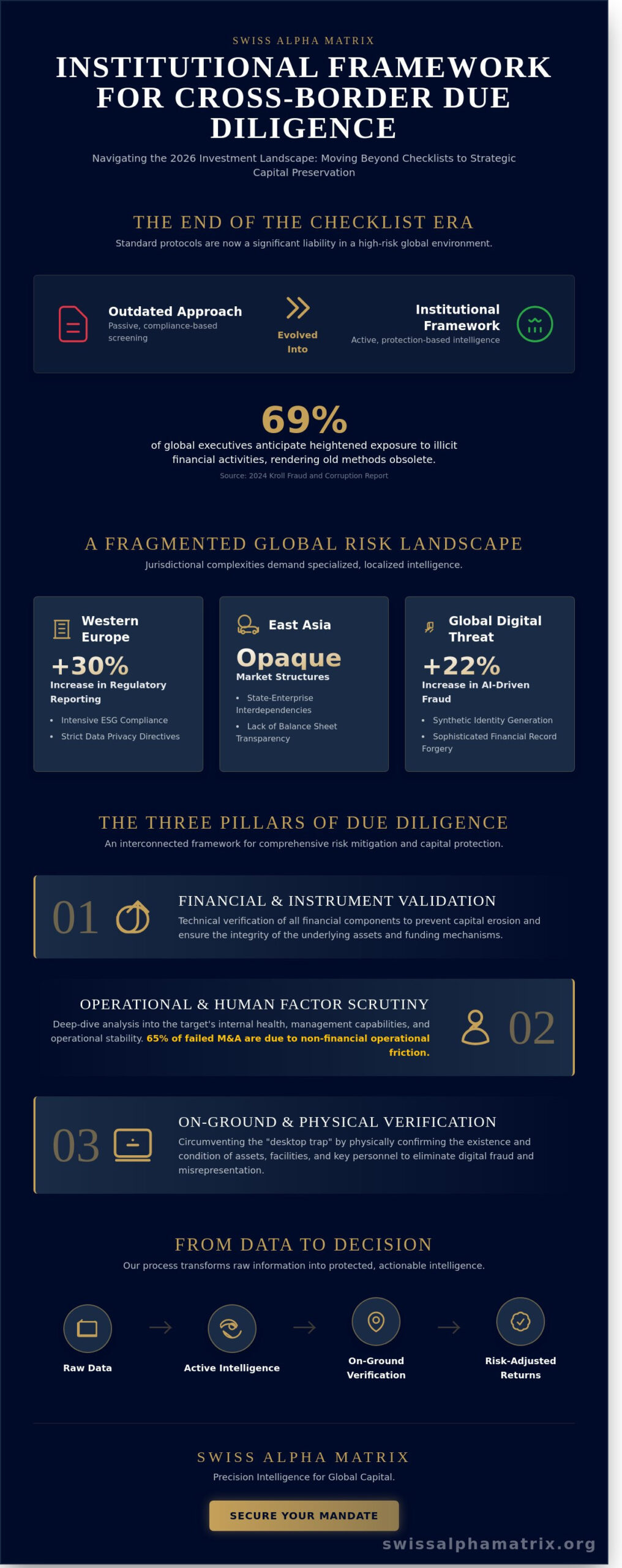
The risk profiles of capital deployment vary significantly between jurisdictions. In Western Europe, investors face a 30% increase in regulatory reporting requirements compared to 2023; meanwhile, East Asian ventures often require navigating complex state-enterprise interdependencies that aren’t visible on a standard balance sheet. Digital transformation has further complicated this landscape. A 2025 report indicated that AI-driven synthetic identity fraud in financial services increased by 22% over the preceding 18 months, making financial records harder to verify through traditional means. Cross-border due diligence is the strategic architecture of capital preservation.
- Western Europe: Focus on ESG compliance and data privacy directives.
- East Asia: Identification of state-directed influence and market opacity.
- Global: Mitigation of AI-enhanced sophisticated financial fraud.
Shifting from Passive to Active Intelligence
Secondary data sources and public filings often mask the structural vulnerabilities inherent in emerging market assets. Relying on these documents is a strategy fraught with peril; they frequently fail to capture underlying liabilities or political exposure that can jeopardize a bespoke mandate. Executive-level stakeholders don’t just require a legal opinion to proceed. They demand granular insights into the human and operational factors that drive performance and stability.
This reality underscores the vital need for operational due diligence in high-stakes M&A. Institutional leaders can’t afford to overlook the internal health of an organization when 65% of failed international acquisitions are attributed to non-financial operational friction. By focusing on active intelligence, we ensure that every strategic pillar of the investment is verified through direct engagement and technical scrutiny, maintaining the calm, unwavering pace of professional excellence that our clients expect.
The Three Pillars of an Institutional Due Diligence Framework
The institutional framework for cross-border investment due diligence rests upon three distinct, yet interconnected, pillars. These foundational elements ensure that capital deployment isn’t merely a speculative venture but a calculated strategic allocation. When these pillars align, they produce a risk-adjusted return profile that meets the standards of the world’s most discerning family offices and institutional funds. This methodology avoids the frantic energy of retail markets, focusing instead on the quiet authority of verified data and structural integrity.
- Pillar 1: Financial and Instrument Validation. This involves verifying the legitimacy of deal assets and the technical validity of funding mechanisms to prevent capital erosion.
- Pillar 2: Operational and On-Ground Realities. This pillar confirms the physical existence of assets, supply chain robustness, and the professional history of local executive leadership.
- Pillar 3: Regulatory and Jurisdictional Compliance. This requires navigating the labyrinth of local statutes and shifting international sanction regimes to ensure long-term viability.
These pillars converge to create an institutional-grade risk profile. It’s a dynamic assessment that prioritizes long-term wealth preservation over short-term gains. This rigorous methodology allows for true alpha generation even in volatile markets, providing the stability required for significant capital commitments.
Financial Integrity and Asset Validation
Institutional due diligence requires moving beyond the surface of a standard balance sheet. It’s about verifying the ultimate source of funds and the legal ownership of assets through forensic accounting. In complex project funding, the role of bank instrument validation services becomes paramount. These services ensure that standby letters of credit or bank guarantees are authentic and issued by reputable Tier 1 institutions. Sophisticated investors look for red flags that standard audits often miss, such as circular funding patterns or obscured beneficial ownership structures. Identifying these anomalies early is essential for protecting the integrity of the investment mandate.
Regulatory Compliance in a Fragmented World
The current global environment demands a nuanced understanding of international financial regulations across key hubs like London, Geneva, and Hong Kong. Managing the friction between local data privacy laws, such as China’s PIPL, and global transparency requirements is a delicate balancing act. To effectively Perform Due Diligence, one must evaluate the resilience of deal structures against rapid shifts in sanction regimes. In 2024, the OFAC updated its list over 50 times, which highlights the need for real-time monitoring and adaptive legal structures. For those seeking to refine their own approach, exploring bespoke risk management mandates can provide the necessary precision to navigate these complexities with confidence.
Beyond the Ledger: The Imperative for On-Ground Verification
The “Desktop Trap” represents a systemic vulnerability for modern institutional investors who mistake digital transparency for operational reality. In an era where AI-driven document forgery and sophisticated “ghost companies” can mimic legitimacy through a screen, relying solely on virtual data rooms is a critical oversight. For high-value mandates, digital records and video conferences are insufficient tools for assessing the true health of an enterprise. Cross-border investment due diligence must move beyond the ledger to encompass the physical audit of facilities, personnel, and local reputations to ensure that capital isn’t being committed to a sophisticated corporate veil.
It’s often argued that physical presence is an antiquated necessity, yet the reality of global markets suggests otherwise. Sophisticated fraud schemes often involve the inflation of asset values or the fabrication of entire supply chains that appear flawless on a balance sheet. When navigating the complexities of foreign markets, adhering to a robust institutional framework for cross-border investment ensures that these multi-layered risks are mitigated through empirical evidence rather than digital promises. The cost of a failed $50 million acquisition far outweighs the budgetary allocation for a comprehensive on-site audit.
The Methodology of Physical Verification
Our approach involves conducting unannounced site visits to observe genuine operational capacity without the benefit of a curated tour. We engage in independent interviews with local stakeholders, including suppliers and former employees, to verify the existence and functional state of key infrastructure. Utilizing on-ground verification services is essential for preventing fraud, as it allows for the real-time assessment of assets that a balance sheet might report as “active” but which are, in reality, dormant or non-existent. In 2024, audits revealed that nearly 12% of reported industrial assets in certain emerging markets were either significantly overstated or entirely fabricated.
Executive Reputation and Integrity Analysis
Institutional-grade diligence requires a deep dive into the track records of local partners that extends far beyond their public-facing profiles. We investigate undisclosed conflicts of interest or political exposures that could jeopardize the long-term stability of the investment. It’s vital to identify whether a counterparty’s influence is rooted in operational excellence or fleeting political patronage. “In cross-border deals, the integrity of the counterparty is the ultimate collateral.” By applying this level of scrutiny, we ensure that bespoke mandates are protected from the reputational contagion that often follows poorly vetted partnerships. This steady, logical process prioritizes the preservation of capital through the lens of Swiss precision and unwavering professional calm.
Implementing a Bespoke Strategy for Complex Transactions
Executing effective cross-border investment due diligence requires a level of institutional precision that transcends standard procedural checklists. It’s a multidimensional architecture designed to protect capital while identifying the subtle nuances of alpha generation in unfamiliar territories. This bespoke strategy follows a rigorous, five-step sequence to ensure that every tactical decision is rooted in empirical evidence and strategic foresight.
- Step 1: Define specific risk parameters. We begin by mapping the unique volatility profiles of both the jurisdiction and the specific asset class. This includes analyzing local regulatory shifts projected for 2026 and their impact on long-term liquidity.
- Step 2: Deploy multi-disciplinary teams. Success isn’t achieved in silos. We assemble a coordinated cohort of financial analysts, legal counsel, and operational specialists to scrutinize the target from every conceivable angle.
- Step 3: Execute audit-grade validation. Every primary financial instrument, from debt structures to equity derivatives, undergoes a forensic-level examination to verify the underlying valuations.
- Step 4: Conduct on-ground verification. Digital data rooms often mask operational inefficiencies. Our experts perform physical site inspections to confirm that the desktop findings align with reality.
- Step 5: Synthesize executive-level intelligence. The process culminates in a comprehensive report that distills complex data into a clear go/no-go recommendation for the investment committee.
A 2024 industry report indicated that 74% of failed international acquisitions were the direct result of inadequate operational ground-truthing. By following this structured path, we mitigate these systemic risks before they can impact the portfolio’s risk-adjusted returns.
Integrating Specialized Frameworks
The complexity of modern markets necessitates the integration of niche analytical tools. During the project management phase, incorporating a comprehensive international due diligence checklist ensures that no regulatory or fiscal stone is left unturned. This is particularly vital when the mandate involves digital asset platforms, where fintech m&a due diligence protocols are required to validate technological resilience and algorithmic integrity. We also ensure that cybersecurity due diligence is integrated as a core pillar of the assessment, protecting the target’s intellectual property and the client’s reputational standing.
Managing Stakeholder Expectations and Discretion
Maintaining Swiss-style discretion is paramount when conducting cross-border investment due diligence on sensitive, high-stakes transactions. We act as a neutral buffer between parties, allowing for deep-dive investigations without compromising the delicate rapport between the buyer and the seller. Our methodology utilizes milestoned reporting, providing the client with steady, logical updates throughout the multi-month mandate. This structured communication rhythm fosters a sense of professional calm, ensuring that stakeholders remain informed yet unburdened by the granular complexities of the investigative process.
To ensure your next international acquisition is underpinned by institutional-grade precision, partner with our strategic advisory team to develop your bespoke mandate.
Swiss Alpha Matrix: Precision Intelligence for Global Capital
Swiss Alpha Matrix represents the culmination of decades spent in the upper echelons of global finance, where our leadership, composed of former Tier-1 bank executives, has collectively overseen more than $50 billion in transactional volume across diverse jurisdictions. This heritage ensures that every engagement is informed by a deep understanding of institutional requirements and the subtle complexities of international markets. The “Swiss Alpha” advantage isn’t a mere marketing concept; it’s a rigorous methodology that synthesizes traditional financial discipline with the kind of on-ground investigative depth that standard consulting firms often overlook. We produce audit-grade reports specifically designed to satisfy the stringent requirements of sovereign wealth funds, family offices, and institutional boards. Because industry data from 2024 suggests that 72% of international ventures encounter significant friction due to inadequate local intelligence, bespoke mandates are the only viable path for navigating the idiosyncratic risks inherent in cross-border investment due diligence.
Our Approach to Complex Project Management
We act as the “Wise Guardian” for institutional capital entering unfamiliar or opaque territories, providing a layer of security that transcends basic risk assessment. This role involves the seamless integration of independent financial project management with our specialized due diligence protocols. By maintaining this dual focus, we ensure that capital deployment isn’t just a singular decision but a continuous process of precision-led oversight. We’ve observed that projects utilizing independent management see a 15% reduction in unexpected capital expenditure during the first 24 months of operation. This level of precision is vital for maintaining the integrity of the original investment thesis throughout the project’s entire lifecycle, ensuring that every dollar remains aligned with the strategic architecture of the mandate.
Securing Your Next Cross-Border Mandate
The lifecycle of a successful investment extends far beyond the initial assessment phase, requiring a partner who understands the long-term implications of every strategic move. Our firm facilitates the critical transition from initial cross-border investment due diligence to ongoing regulatory oversight and strategic project management. With an established physical presence in Hong Kong, London, and Geneva, we offer a 24-hour operational cycle that serves your interests across every major time zone. This global footprint allows us to provide the local nuance and high-level access required for institutional success in the 2026 market environment. To ensure your capital is protected by the highest standards of Swiss precision, engage Swiss Alpha Matrix for your institutional due diligence requirements and secure the alpha your portfolio deserves.
Securing Institutional Alpha in the 2026 Global Marketplace
The transition toward 2026 necessitates a profound shift in how capital is deployed across sovereign boundaries. Success in this era depends on an institutional framework that prioritizes on-ground verification and the three pillars of strategic intelligence over reactive data analysis. Mastering cross-border investment due diligence is no longer a matter of simple compliance; it’s the fundamental mechanism for preserving long-term wealth in an increasingly fragmented global economy. By moving beyond the ledger, investors can mitigate the hidden risks that traditional audits often overlook.
Swiss Alpha Matrix brings a legacy of Swiss precision to these complex transactions. Our firm is led by former senior executives from Tier-1 global banks who understand the nuances of high-stakes capital. With a strategic presence in Geneva, London, and Hong Kong, we provide audit-grade reports that meet the exacting standards of the world’s most sophisticated institutional stakeholders. We don’t just provide data; we offer a bespoke partnership rooted in the discretion and authority of the Swiss private banking tradition. It’s time to elevate your strategy with a partner that values intellectual depth and absolute technical accuracy.
Request a Bespoke Consultation for Your Cross-Border Mandate
Your vision for global growth requires a foundation of unwavering stability and strategic foresight. We’re ready to help you architect your next era of success.
Frequently Asked Questions
What is the primary difference between standard and cross-border investment due diligence?
The primary difference lies in the jurisdictional complexity and the necessity of reconciling divergent regulatory frameworks across international borders. Standard domestic reviews focus on a single legal system, whereas cross-border investment due diligence requires a 360-degree assessment of geopolitical risk and local compliance standards. We integrate 12 distinct risk vectors to ensure that capital remains protected against unforeseen statutory shifts in foreign territories.
How does Swiss Alpha Matrix verify the legitimacy of financial instruments like SBLCs?
We verify the legitimacy of Standby Letters of Credit (SBLCs) through a rigorous multi-factor authentication process involving direct SWIFT MT760 confirmation and inter-bank communication. Our analysts cross-reference instrument serial numbers against 5 distinct global banking databases to eliminate the risk of fraudulent paper. This institutional-grade protocol ensures that each financial instrument meets the 2026 Basel III liquidity requirements before we finalize any strategic mandate.
Why is on-ground verification considered the gold standard for international deals?
On-ground verification serves as the gold standard because it provides physical confirmation of assets that digital records often fail to capture accurately. By deploying local experts to verify 100% of physical inventory and facility operations, we mitigate the risk of ghost assets which accounted for 14% of reported corporate fraud cases in 2023 industry audits. This physical presence transforms abstract data into verified reality, providing the absolute precision that Swiss Alpha Matrix demands.
What are the most common red flags in cross-border M&A transactions?
The most common red flags involve opaque beneficial ownership structures and inconsistencies in 3-year historical tax filings. We frequently identify discrepancies in EBITDA reporting where local accounting standards deviate from IFRS by more than 8%. Other critical warnings include sudden 25% surges in executive turnover or unexplained litigation in jurisdictions known for low transparency, which signal deep-seated operational instability that could compromise long-term alpha generation.
How long does a comprehensive institutional-grade due diligence process typically take?
A comprehensive institutional-grade due diligence process typically spans between 45 and 90 days, depending on the complexity of the target’s multi-jurisdictional footprint. This timeframe allows for the meticulous execution of our 150-point checklist, covering everything from forensic accounting to environmental compliance. We don’t prioritize artificial speed over the integrity of the investigation, ensuring that every risk-adjusted return projection is supported by empirical evidence rather than speculative estimates.
Can Swiss Alpha Matrix provide due diligence services in emerging markets with limited public records?
Swiss Alpha Matrix provides comprehensive due diligence services in emerging markets by leveraging a network of 40 specialized local partners who navigate regions with limited public documentation. We utilize proprietary field intelligence and human intelligence to reconstruct financial histories where digital archives are absent. It’s our bespoke approach that allows us to maintain Swiss excellence even in frontier economies where traditional data providers often fail to offer sufficient clarity.
How do you balance the need for thorough investigation with the requirement for deal confidentiality?
We’ve developed tiered data rooms and strict non-disclosure protocols that limit sensitive information access to a core group of 5 senior analysts to maintain this balance. Our methodology ensures that the cross-border investment due diligence process remains discreet, protecting the target’s competitive advantage while we conduct our investigation. This surgical precision allows us to extract vital insights without triggering market speculation or compromising the strategic integrity of the potential acquisition.
What is the role of operational due diligence in protecting capital during a cross-border acquisition?
Operational due diligence protects capital by identifying inefficiencies in a target’s supply chain and internal controls that could erode 15% to 20% of the deal’s projected value post-acquisition. We analyze 10 specific operational pillars to ensure that the business can sustain its performance under our client’s ownership. This strategic architecture focuses on long-term wealth preservation, ensuring that the acquired entity possesses the structural resilience necessary to thrive in volatile global markets.