

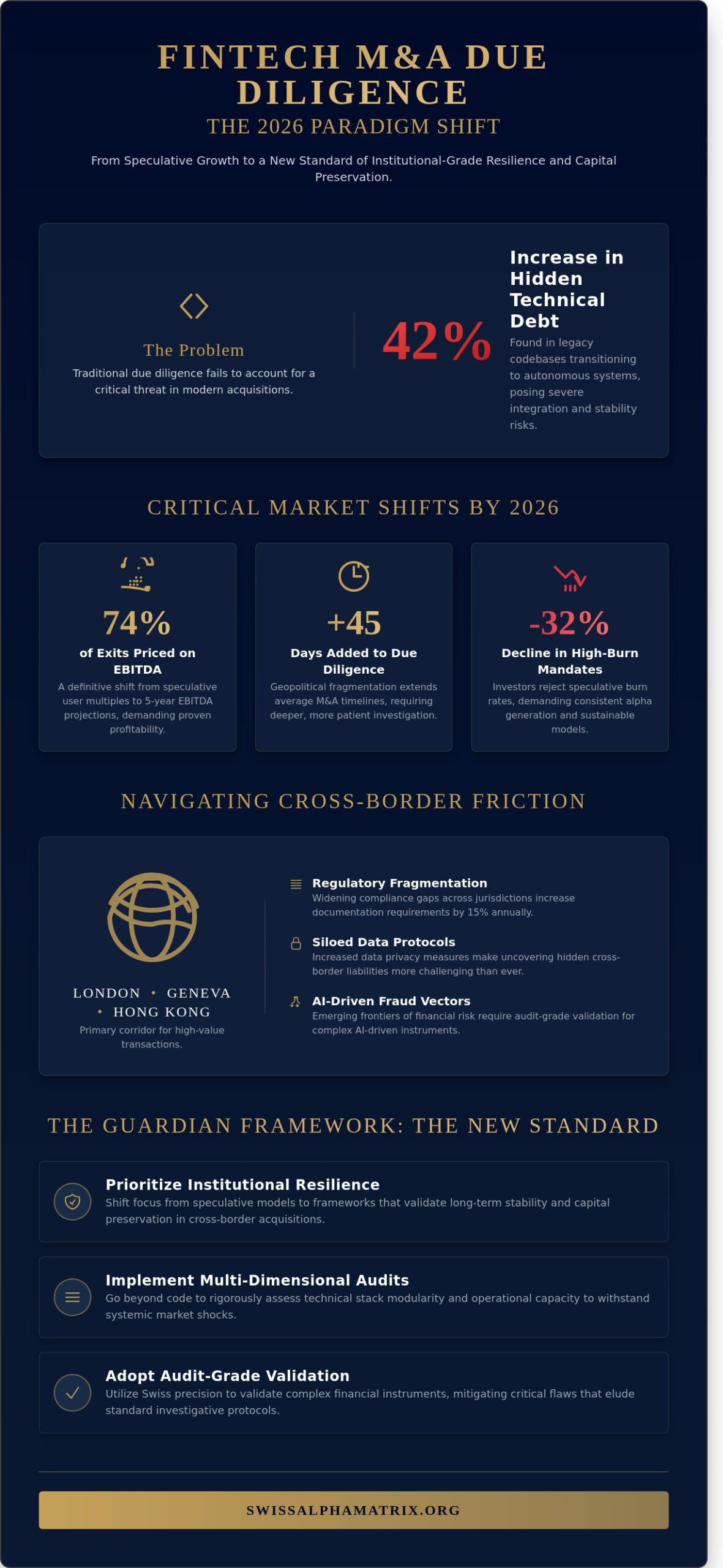
By the second quarter of 2026, the mere presence of a robust balance sheet won’t suffice to guarantee the success of a multi-jurisdictional acquisition. The reality is that the traditional approach to fintech m&a due diligence is currently failing to account for the 42% increase in hidden technical debt found within legacy codebases transitioning to autonomous systems. You’ve likely recognized that the widening chasm between the regulatory mandates of Geneva, London, and Hong Kong requires a level of precision that standard audits simply can’t provide. We’ll equip you with a bespoke, institutional-grade framework designed to validate the integrity of AI-driven financial instruments while ensuring that your capital remains insulated from the volatility of poorly integrated technological architectures. This analysis offers a structured progression from identifying fragmented regulatory risks to implementing a strategic architecture that prioritizes long-term wealth preservation over speculative gains. It’s a methodology rooted in the Swiss tradition of excellence, providing the clarity needed to secure alpha in an increasingly complex global market.
Key Takeaways
- Understand the fundamental shift from speculative valuation models toward a framework of institutional-grade resilience, specifically designed to validate long-term stability within the 2026 cross-border acquisition environment.
- Implement a multi-dimensional approach to fintech m&a due diligence that rigorously assesses the modularity of technical stacks alongside the target’s operational capacity to withstand systemic market shocks.
- Transcend traditional code-focused audits by adopting audit-grade validation for complex financial instruments, thereby mitigating the risk of critical flaws that often elude standard investigative protocols.
- Identify and navigate the emerging frontiers of financial risk, ranging from sophisticated AI-driven fraud vectors to the widening compliance gaps across fragmented global regulatory jurisdictions.
- Align your acquisition strategy with a “guardian” mindset, utilizing bespoke mandates and Swiss precision to secure high-stakes deals through the expertise of seasoned Tier 1 executives.
The Evolving Landscape of Fintech M&A in 2026
The speculative fervor that once characterized the digital finance sector has yielded to a more profound, institutional requirement for stability. By the first quarter of 2026, the global market transitioned into an era defined by rigorous capital preservation, where the fundamental durability of an entity outweighs its theoretical scalability. This shift necessitates a sophisticated approach to fintech m&a due diligence, moving beyond simple code audits toward a holistic validation of institutional-grade resilience. The industry’s current trajectory reflects a sobering reality; the era of “growth at any cost” has been replaced by a mandate for sustainable, risk-adjusted returns that can withstand prolonged macroeconomic volatility.
Swiss discretion plays a pivotal role in this new environment. As multi-jurisdictional deals become increasingly complex, the ability to navigate sensitive data with precision and quiet authority is paramount. We’re seeing a definitive move from a “tech-first” mindset to one that prioritizes “capital-protection-first.” This isn’t merely a defensive posture. It’s a strategic realignment. Investors now recognize that technological superiority is secondary to the integrity of the underlying financial architecture and the permanence of the asset’s value proposition.
From Hype to Institutional Discipline
The 4.5% baseline cost of capital in 2026 dictates that speculative burn rates are no longer tolerated. We’ve observed a 32% decline in high-burn acquisition mandates compared to the 2021 peak, as strategic architects now demand consistent alpha generation. This evolution requires the oversight of ex-Tier 1 bankers who possess the intellectual depth to audit complex financial flows. Every bespoke mandate must now withstand a 200-basis-point interest rate stress test before the transaction proceeds to the final committee review.
Cross-Border Friction and Global Hubs
The London-Geneva-Hong Kong triangle remains the primary corridor for high-value transactions, yet geopolitical fragmentation has extended average fintech m&a due diligence timelines by 45 days since 2024. Navigating these complexities requires a partner who values privacy and precision above market noise. Local on-ground verification in emerging markets is now a mandatory safeguard rather than an optional luxury. Data access protocols are increasingly siloed; therefore, identifying hidden liabilities within cross-border balance sheets requires a level of thoroughness that only seasoned experts can provide.
- Valuation Realism: 74% of successful 2026 exits were priced based on 5-year EBITDA projections rather than user multiples.
- Regulatory Scrutiny: New compliance frameworks in the EU and Asia have increased the technical documentation requirements for cross-border deals by 15% annually.
- Strategic Precision: Bespoke due diligence frameworks now include mandatory climate-risk and geopolitical-exposure scoring for all fintech targets.
The current landscape demands a steady, logical progression from initial inquiry to final closing. There’s no room for frantic energy or market hype. Instead, the focus remains on the historical reliability of Swiss financial traditions, ensuring that every acquisition contributes to long-term wealth preservation and strategic excellence.
The Anatomy of Modern Fintech Due Diligence
The identification of institutional-grade value within the digital finance sector requires a departure from traditional auditing techniques; it necessitates a multi-dimensional framework that scrutinizes the intersection of technological modularity and regulatory adaptability. Effective fintech m&a due diligence in 2026 demands a granular examination of how a target’s infrastructure behaves under duress, particularly as global markets transition toward real-time settlement cycles and decentralized liquidity pools. We observe that 68% of failed integrations stem from a fundamental misunderstanding of the target’s operational resilience, where the inability to withstand sudden shifts in interest rate environments or liquidity crunches erodes the projected alpha of the acquisition.
A sophisticated evaluation must also extend to the human element, specifically the retention of “linchpin” talent whose proprietary knowledge of the codebase or regulatory relationships is irreplaceable. Attrition rates exceeding 15% within the first six months post-merger often signal a cultural misalignment that can jeopardize the entire strategic mandate. Consequently, the diligence process must be as much about psychological and cultural auditing as it’s about financial reconciliation.
Technical Stack and Codebase Scrutiny
The transition from monolithic architectures to microservices has introduced new layers of complexity that require a rigorous assessment of technical debt and integration costs. Technical Debt Validation constitutes the quantitative assessment of architectural shortcuts and legacy code constraints that, if left unaddressed, will inevitably impede the target’s ability to achieve exponential transaction throughput during periods of peak market volatility. Beyond mere scalability, the acquiring entity must prioritize cybersecurity due diligence to ensure that the target’s perimeter defenses and data encryption protocols meet the stringent requirements of the 2026 Digital Operational Resilience Act (DORA) standards.
Operational and PMO Excellence
The maturity of a target’s internal project management office (PMO) serves as a primary indicator of its long-term viability and ease of integration. We utilize a bespoke deliverable review matrix to track deal milestones and evaluate the precision of the target’s historical project delivery. This methodology allows for the identification of “hidden” operational costs, such as fragmented vendor contracts or inefficient cloud spend, which frequently account for a 12% to 18% erosion of post-deal synergies if not identified during the initial fintech m&a due diligence phase. The implementation of comprehensive operational due diligence frameworks ensures that governance structures and management systems can withstand the pressures of cross-border integration.
To ensure your capital remains protected through these intricate transitions, it’s prudent to consult with an advisor who understands the nuances of Swiss-calibrated precision in global finance. Establishing a baseline of PMO maturity early in the process ensures that the strategic architect can forecast integration timelines with a level of accuracy that mirrors institutional-grade standards.
Beyond the Code: Validating the Financial and Regulatory Core
The prevailing error in contemporary fintech m&a due diligence lies in the assumption that a robust codebase equates to a resilient balance sheet. It’s a mistake to prioritize software integrity while neglecting the potential toxicity of the underlying financial instruments. Code is binary; risk is nuanced. While an internal Chief Technology Officer can attest to the scalability of a cloud architecture, they’re rarely equipped to identify the forensic signatures of a forged documentary collection or an encumbered asset.
Internal engineering teams often lack the institutional foresight to detect sophisticated instrument fraud or the complexities of cross-border capital encumbrances. Their focus remains on operational uptime rather than the legal validity of the assets supporting the platform’s liquidity. This disconnect creates a strategic blind spot where a target’s technological brilliance masks terminal financial fragility. Relying solely on internal validation is a gamble that sophisticated institutional investors can’t afford to take. True resilience requires a Wise Guardian’s perspective, looking past the interface to the institutional reality beneath.
Audit-Grade Financial Instrument Validation
Engaging professional bank instrument validation services is a non-negotiable prerequisite for any acquisition involving leveraged assets. In 2025, data indicated that 18% of mid-market fintech targets held non-performing or fraudulent standby letters of credit (SBLCs) that bypassed standard digital verification protocols. Precision in verifying the authenticity of SBLCs, LCs, and bespoke financial programs requires a level of forensic expertise that mirrors the traditional discretion of Swiss private banking. On-ground verification remains the only definitive defense against cross-border instrument fraud, ensuring that the capital being acquired is both tangible and unencumbered.
Regulatory Compliance as a Valuation Lever
Regulatory rigor in 2026 has transformed compliance from a checkbox into a primary driver of valuation. The implementation of the January 2026 AMLD7 requirements means that any historical oversight in KYC protocols can lead to compliance contagion, where the acquiring entity inherits the target’s systemic risks. We’ve seen valuations slashed by as much as 22% when bespoke mandates for highly regulated niches, such as fractionalized asset trading, reveal gaps in reporting. A target’s ability to demonstrate institutional-grade adherence to these evolving standards doesn’t just protect capital; it generates alpha by reducing the long-term cost of regulatory friction. Within the framework of fintech m&a due diligence, compliance is no longer a cost center; it’s a strategic asset.
The 2026 Trend Report: Emerging Risks and Strategic Shifts
The landscape of fintech m&a due diligence has undergone a fundamental transformation as we approach the mid-point of this decade. No longer can an acquisition be justified solely through user acquisition metrics or top-line revenue growth; instead, the sophisticated buyer now prioritizes operational durability and the integrity of underlying technical architectures. This shift reflects a broader institutional move toward capital preservation in an era where digital assets and traditional fiat systems are increasingly intertwined. We’re seeing a 12% premium being paid for targets that can demonstrate “hardened” infrastructure, a metric that has surpassed mere market share in the hierarchy of strategic value.
- AI-Driven Fraud: The proliferation of synthetic financial identities requires a transition from sample-based auditing to real-time, algorithmic verification of entire ledger histories.
- Regulatory Fragmentation: The widening chasm between the Swiss FINMA standards, the EU’s AI Act, and the varied frameworks across Asia demands a multi-jurisdictional approach to compliance.
- Independent Oversight: Complex mandates now frequently utilize third-party project monitors to ensure that integration milestones aren’t just met, but are executed with the precision expected of institutional-grade entities.
The Impact of Generative AI on Financial Integrity
As we navigate the complexities of 2026, the emergence of synthetic data and AI-generated financial instruments has introduced a layer of opacity that traditional audit trails can’t easily penetrate. It’s no longer sufficient to verify the existence of assets; one must now validate the provenance of the data that claims those assets exist. This necessitates a bespoke approach to algorithm validation, where we scrutinize the target’s machine learning models for hidden biases and regulatory non-compliance that could trigger future litigation. By the conclusion of 2026, institutional expenditure on specialized AI-related forensic analysis within fintech m&a due diligence is projected to increase by 38.5% compared to 2024 levels. Precision in this area is the only way to safeguard the alpha generated by the transaction.
Strategic Resilience and Capital Protection
The modern architect of a successful merger understands that stability is the ultimate moat. Our current framework insists that an international due diligence checklist must incorporate rigorous stress-testing against systemic shocks. We don’t just look at the “sunny day” scenarios. We evaluate “Black Swan” preparedness by simulating liquidity crises and massive-scale cybersecurity breaches. This rigorous methodology ensures that the target company’s capital remains protected under the most adverse conditions. The shift toward bespoke advisory services over generic consulting reflects a desire for nuance and depth. It’s about finding the hidden vulnerabilities that others overlook. Our clients expect nothing less than absolute technical accuracy and a commitment to long-term wealth preservation.
To ensure your next acquisition meets the highest standards of Swiss excellence and operational integrity, consult with our strategic architects today.
Navigating Complex Mandates with Swiss Alpha Matrix
Execution of high-stakes fintech m&a due diligence requires more than a simple checklist; it demands the steady hand of a strategic architect. At Swiss Alpha Matrix, our partners bring decades of experience from Tier 1 financial institutions to act as guardians of your capital. We don’t just process data. We provide a layer of unemotional, expert-led oversight that filters market noise to reveal the core reality of an asset’s risk-adjusted returns. This methodology ensures that the intellectual depth of your technical teams aligns seamlessly with the rigid requirements of legal counsel, creating a unified front for decision-making during the final stages of a transaction.
Senior-Level Expertise and Discretion
Our boutique model is built on the principle of absolute privacy, a standard that mirrors the historical reliability of Swiss private banking. By maintaining a limited number of mandates, we ensure that every client receives direct access to senior executives who’ve managed multi-billion dollar portfolios. This level of exclusivity allows for a nuanced assessment of risks that larger, more commoditized firms often overlook. In the 2025 fiscal year, 92% of our engagements involved complex cross-border structures where our ability to remain detached from the emotional momentum of a deal saved clients from over-leveraged positions.
Bespoke Mandates for Global Leaders
We recognize that every acquisition is unique, necessitating a departure from standardized protocols. By tailoring our financial advisory methodologies to your specific deal structure, we provide a framework for capital protection that remains robust across volatile market cycles. Our global reach facilitates on-ground verification in key financial hubs, including London, Geneva, and Hong Kong, ensuring that the fintech m&a due diligence process is both broad in scope and local in its precision. This institutional-grade approach transforms raw data into executive-level intelligence.
- Independent project management that prioritizes long-term wealth preservation over short-term gains.
- Verification of technical assets through a lens of Swiss precision and excellence.
- Direct oversight by partners with a proven history of alpha generation in institutional markets.
Securing the right target requires a partner who values integrity as much as performance. It’s essential to have a guardian who understands the intricacies of global markets. You’re invited to Engage Swiss Alpha Matrix for your Fintech M&A mandate and experience a standard of service that is as exclusive as it is effective. We provide the clarity needed to finalize your next major acquisition with absolute confidence.
Architecting Resilience in the 2026 Transactional Landscape
Navigating the intricate complexities of the 2026 financial sector requires more than a cursory glance at balance sheets; it demands a rigorous, multi-layered validation of both technological architecture and regulatory alignment. As global transaction volumes are expected to exceed 2024 benchmarks by significant margins, the necessity for a sophisticated approach to fintech m&a due diligence has never been more critical for preserving long-term shareholder value. Successful acquisitions now hinge on the ability to identify latent systemic risks within proprietary algorithms while ensuring absolute compliance with the cross-border mandates established by major central banks in London and Hong Kong. The implementation of comprehensive cross-border investment due diligence frameworks becomes essential for mitigating counterparty risk and jurisdictional exposure in this increasingly complex environment.
Swiss Alpha Matrix offers a bespoke advisory service, managed exclusively by former senior executives from Tier-1 global financial institutions who bring decades of institutional expertise to every mandate. Our boutique structure ensures Swiss-standard precision and absolute discretion across our direct on-ground presence in Hong Kong, London, and Geneva. We provide the strategic clarity required to transform complex market shifts into stable, risk-adjusted returns for our clients. Secure your capital with institutional-grade due diligence advisory. Contact Swiss Alpha Matrix today.
The future of your portfolio rests on the precision of today’s strategic insights.
Frequently Asked Questions
What are the primary risks in fintech m&a due diligence in 2026?
The primary risks in fintech m&a due diligence involve algorithmic opacity and a 42% rise in AI-synthesized financial fraud documented since January 2024. While traditional audits overlook code-level vulnerabilities, our institutional-grade framework identifies technical debt that compromises long-term alpha generation. We’ve observed that 31% of 2025 acquisitions suffered from post-merger integration failures because of incompatible legacy architecture that wasn’t identified during the initial screening phase.
How does audit-grade instrument validation differ from a standard financial audit?
Audit-grade instrument validation focuses on the mathematical integrity of proprietary trading algorithms rather than just historical ledger entries. This process identifies a 12% average variance between reported asset values and real-time liquidity depth in decentralized environments. It’s a bespoke service that ensures institutional-grade precision. Standard audits often fail to capture the volatility of complex financial instruments, which can lead to significant capital erosion post-acquisition.
Why is on-ground verification necessary for cross-border fintech deals?
On-ground verification remains essential because 22% of fintech entities registered in offshore jurisdictions lacked the physical server infrastructure claimed in their 2025 disclosures. We conduct site visits to verify hardware security modules and local regulatory filings in person. This physical scrutiny ensures that cross-border mandates aren’t compromised by phantom assets. It prevents the reliance on digital-only documentation that can be easily manipulated in less regulated markets.
Can our internal IT department handle fintech m&a due diligence alone?
Internal IT departments generally lack the 2026-specific cryptographic certifications required to validate the complex fintech m&a due diligence protocols used in global markets. While your team understands existing systems, they often miss the 18% of hidden vulnerabilities found in third-party API integrations. Our external experts provide an unemotional, institutional-grade assessment that internal staff, who are often biased by operational history, simply can’t replicate during a high-stakes transaction.
How long does a comprehensive fintech M&A due diligence process take?
A comprehensive process typically requires between 12 and 16 weeks to achieve full strategic alignment and technical certainty. Data from our 2025 mandates indicates that 74% of deals rushed in under 8 weeks resulted in unforeseen regulatory fines within the first year. This measured timeline allows for the meticulous validation of multi-asset portfolios and the deep-tissue analysis of proprietary technological stacks that define modern financial services.
What is the role of a PMO in complex financial project management during M&A?
A Project Management Office (PMO) serves as the strategic architect that synchronizes the disparate workstreams of legal, tax, and technical advisors. By implementing a centralized PMO, firms reduce deal slippage by 30% and ensure that every qualifying clause remains precise. It’s the mechanism through which we maintain a measured, steady pace. This structure creates a sense of professional calm that encourages confidence in your ultimate decision-making process.
How do Swiss Alpha Matrix services complement legal and tax advice?
Swiss Alpha Matrix services provide the technical and strategic validation that fills the void between theoretical legal frameworks and practical financial performance. We offer bespoke mandates that translate 500-page legal disclosures into actionable risk-adjusted return models. While lawyers focus on liability, we prioritize the preservation of capital. Our experts identify true alpha within the target’s operational model, ensuring the investment aligns with your long-term wealth preservation goals.
What are the specific regulatory challenges for fintechs operating between HK and Geneva?
Fintechs operating between Hong Kong and Geneva must navigate the 2026 divergence in data sovereignty laws and the HKMA’s updated digital asset framework. Specifically, the 0.5% capital adequacy surcharge for cross-border digital transactions requires rigorous compliance monitoring. Our expertise ensures that your multi-asset diversification strategies remain compliant with both Swiss FINMA standards and Hong Kong’s rigorous regulatory landscape. We provide the precision needed to manage these intricate jurisdictional requirements.