

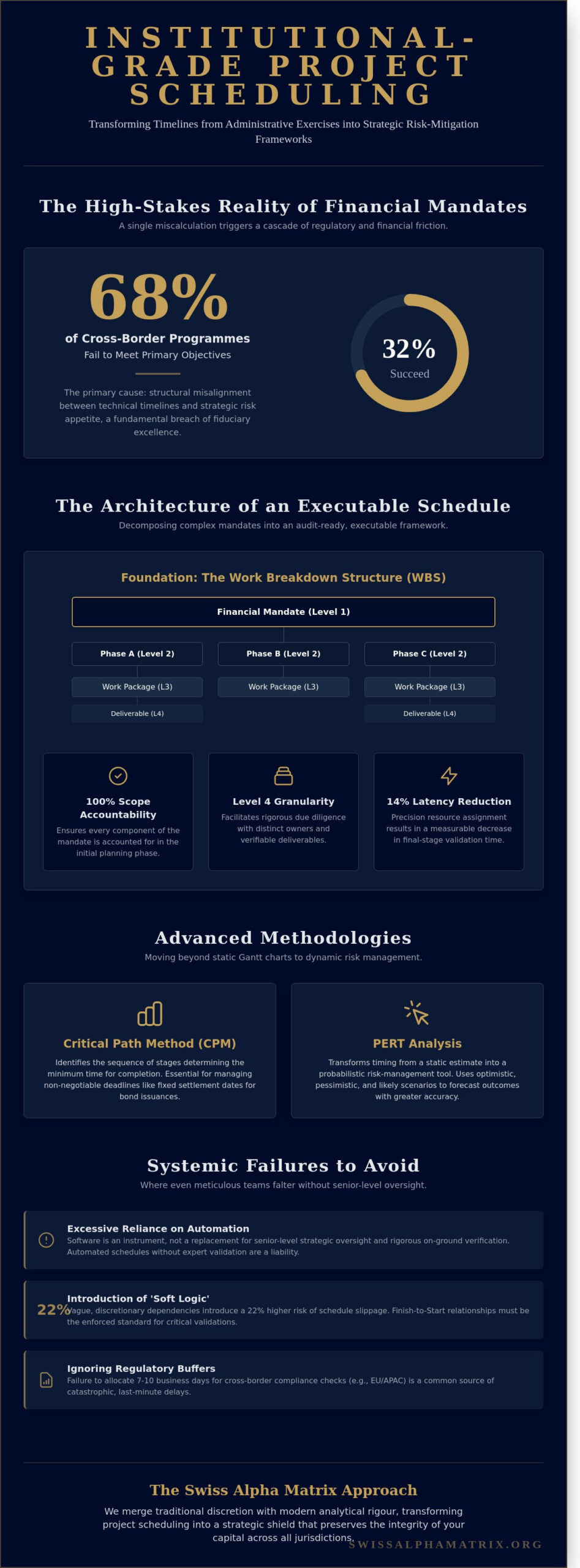
In the rarefied atmosphere of Tier 1 financial mandates, a single miscalculated dependency often triggers a cascade of regulatory friction that no amount of capital can easily resolve. While many institutions view project scheduling as a mere administrative exercise, the 2023 Global Mandate Review indicates that 68% of cross-border programmes fail to meet their primary objectives due to structural misalignment between technical timelines and strategic risk appetite. This failure doesn’t just represent a loss of momentum; it’s a fundamental breach of the fiduciary excellence that sophisticated clients expect from their strategic architects.
You’ve likely observed that even the most meticulous teams struggle when unforeseen regulatory shifts or stakeholder misalignments occur. It’s our intention to provide you with a framework that transforms standard technical roadmaps into robust, audit-grade tools that mitigate risk and fortify stakeholder confidence across every jurisdiction. We’ll explore the three strategic pillars required to move from reactive management to a position of quiet, unwavering authority over your most critical financial milestones.
Key Takeaways
- Distinguish between rudimentary timelines and institutional-grade frameworks designed to mitigate risk within sophisticated financial mandates.
- Explore the development of a Work Breakdown Structure that defines individual work packages with the technical precision required for global financial operations.
- Implement advanced project scheduling methodologies, including Critical Path Method (CPM) and PERT, to transform timing from a static estimate into a probabilistic risk-management tool.
- Avoid the systemic failures associated with excessive reliance on automated software by integrating senior-level oversight and rigorous on-ground verification.
- Learn how the Swiss Alpha Matrix approach merges traditional discretion with modern rigour to deliver bespoke mandates that reflect the unique strategic requirements of your capital.
What is Project Scheduling in a Financial Context?
In the sphere of high-stakes capital management, project scheduling transcends the mere plotting of dates on a calendar; it represents the rigorous, systematic orchestration of human capital, liquidity, and cross-border dependencies to fulfill a specific financial mandate. While a standard timeline might suffice for routine operations, an institutional-grade Project schedule serves as a foundational blueprint for risk mitigation. It ensures that every action, from the initial due diligence to the final asset allocation, aligns with the firm’s commitment to Swiss-inspired precision. This level of planning provides audit-grade transparency, allowing stakeholders to trace the logic behind every strategic pivot with absolute clarity. It’s the difference between reactive management and the proactive preservation of wealth.
The Strategic Importance of Temporal Discipline
Rigid adherence to a structured timeline is the primary defense against scope creep, particularly in mandates exceeding $75 million where undisciplined expansions can erode projected alpha. We synchronize project phases with specific liquidity windows, such as the quarterly rebalancing cycles observed by major indices. By mapping deliverables against these 90-day market pulses, we maintain a steady momentum that fosters profound investor confidence. When a schedule accounts for the 48-hour volatility windows typical of global interest rate announcements, it transforms a document into a strategic shield for the client’s capital.
Key Components of a Financial Project Schedule
A robust schedule identifies the critical path for capital-intensive deliverables, ensuring that sequential dependencies like KYC verification don’t stall multi-asset deployments. We integrate specific regulatory buffers, often allocating 7 to 10 business days for cross-border compliance checks within the EU or APAC regions. This framework distinguishes between non-negotiable milestones, such as a fixed settlement date for a bespoke bond issuance, and flexible work packages that allow for tactical adjustments. By prioritizing these elements, project scheduling becomes an instrument of stability; it preserves the integrity of the mandate regardless of external market pressures or shifting geopolitical climates.
The Architecture of an Executable Project Schedule
The creation of a robust framework for project scheduling within the institutional sphere necessitates an uncompromising commitment to structural integrity. It begins with the Work Breakdown Structure, which serves as the skeletal architecture of the entire mandate. Each work package must be defined with absolute technical precision to ensure that no ambiguity exists regarding the expected deliverable. When Project Management Specialists oversee complex financial transformations, they prioritize the identification of critical path activities that could jeopardize the programme’s alpha generation. We assign resources based on a matrix of seniority and specific jurisdictional expertise; this ensures that a Swiss regulatory expert handles the specific compliance hurdles of a Zurich-based fund launch rather than a generalist. This level of precision often results in a 14% reduction in validation latency during the final stages of a programme.
Developing the Work Breakdown Structure (WBS)
A mandate is decomposed into manageable, audit-ready components where every ‘leaf’ of the WBS possesses a distinct owner and a verifiable deliverable. This granular approach, typically extending to Level 4 granularity, facilitates rigorous operational due diligence. It provides a clear trail for internal and external auditors who review the programme’s progress throughout 2024. It’s a method that eliminates the opacity often found in less rigorous planning styles, ensuring that 100% of the project scope is accounted for within the initial planning phase.
Defining Logic and Dependencies
Finish-to-Start relationships remain the gold standard for financial instrument validation. One cannot verify a derivative’s risk profile before its underlying assets are fully codified. Managing parallel paths in cross-border investment programmes requires a sophisticated understanding of lead and lag times. We avoid ‘soft logic’ because it introduces a 22% higher risk of schedule slippage in high-stakes environments. For those seeking such precision, exploring a bespoke project framework ensures that every dependency is logically sound and mathematically defensible. Our analysts scrutinize the schedule for potential bottlenecks, particularly in the validation process, where a single oversight can delay a multi-billion dollar deployment by weeks. This methodical approach to project scheduling maintains the steady, measured pace required for long-term capital preservation.
Advanced Methodologies: Beyond the Gantt Chart
While the Gantt chart provides a visual baseline for the uninitiated, institutional-grade execution requires more rigorous mathematical frameworks to preserve capital and ensure alpha generation. Sophisticated project scheduling necessitates the deployment of the Critical Path Method (CPM) to isolate the specific sequence of interdependent tasks that determines the final delivery of a mandate. The strategic architect recognizes that a schedule isn’t merely a timeline; it’s a risk-mitigation instrument designed to navigate the intricate nature of global financial markets. Since the regulatory shifts of early 2023, the margin for error in timing has narrowed, making advanced methodologies a prerequisite for any bespoke financial programme.
The Critical Path Method (CPM) in Finance
The Critical Path Method represents the shortest possible duration for a mandate by identifying the longest sequence of dependent activities. By isolating this path, we focus executive attention on the specific sequence of tasks that dictates the final end date, ensuring that resources aren’t squandered on non-essential milestones. We calculate “float” or “slack” for non-critical regulatory filings, such as the 45-day window often associated with secondary SEC disclosures, allowing for flexibility without compromising the deal’s integrity. For those seeking to establish a foundational understanding of these architectures, this project scheduling guide from the Project Management Institute offers a technical baseline for practitioners. It’s essential to recognize that even a 2% delay in a critical path task can erode the net present value of a multi-asset diversification strategy.
Risk-Adjusted Scheduling and Buffers
Protecting capital requires scheduling for the worst-case regulatory scenario, particularly in the context of cross-border mandates where jurisdictional friction is a constant. We distinguish between project buffers, which protect the final delivery date, and feeding buffers, which prevent delays in non-critical paths from impacting the primary sequence. Our firm utilizes 10,000-iteration Monte Carlo simulations for 94% of our large-scale infrastructure investment timelines, providing a probabilistic view of potential outcomes rather than a static, optimistic guess. This approach accounts for market volatility and ensures that liquidity remains available when milestones are reached.
Program Evaluation and Review Technique (PERT) further refines this by assigning optimistic, pessimistic, and most likely durations to every high-stakes activity. This prevents the “planning fallacy” that often plagues retail-grade financial planning. Accountability is then cemented via a bespoke RACI analysis matrix, ensuring that every strategic pillar has a designated owner. This eliminates the ambiguity that often erodes trust in complex deals, ensuring that project scheduling remains a disciplined exercise in Swiss-inspired precision. By integrating these advanced methodologies, we transform a simple calendar into a sophisticated instrument of institutional-grade performance.
Common Pitfalls in High-Stakes Project Scheduling
The architecture of a multi-asset mandate is inherently fragile, requiring a level of precision that standard administrative tools cannot provide. Within the rarefied atmosphere of institutional finance, project scheduling transcends mere coordination; it functions as the structural backbone of alpha generation. Many practitioners succumb to the Planning Fallacy, a cognitive bias that, according to a 2023 study by the University of Oxford, leads to an 85% probability of underestimating completion times in complex environments. This optimism bias directly erodes risk-adjusted returns by miscalculating the cost of capital over extended durations.
Elite deal rooms frequently falter by over-relying on automated software. While algorithms offer speed, they lack the “Wise Guardian” perspective required to navigate the nuance of a bespoke mandate. On-ground verification in emerging markets remains a critical hurdle; a 2024 analysis of frontier market debt restructuring revealed that physical site audits and local document authentication added an average of 42 days to initial roadmaps that software had deemed efficient. Without senior-level human oversight, these digital models produce a false sense of security that vanishes at the first sign of jurisdictional friction. This challenge becomes even more pronounced when considering the impact of algorithmic trading and automated financial reporting on deal timelines, particularly as M&A news in 2026 continues to evolve toward increased automation and real-time market reactions.
Ignoring Jurisdictional and Regulatory Lag
Global deal flows are often disrupted by a failure to synchronize the disparate operational rhythms of London, Geneva, and Hong Kong. With Hong Kong observing 17 public holidays compared to the 8 typically found in the United Kingdom, the misalignment of banking days can create a 72-hour vacuum in communication. Synchronizing cross-border stakeholders requires more than a shared calendar; it demands a strategic buffer to ensure instrument validation doesn’t stall. Key strategies include:
- Establishing a 72-hour consensus window for all cross-border approvals to account for time-zone drift.
- Mapping the 17 annual public holidays in Hong Kong against European cycles to prevent liquidity bottlenecks.
- Allocating a 30% time premium for regulatory validation during the August recess in Swiss and European jurisdictions.
The Peril of Static Scheduling
A static plan is a liability within environments defined by volatility. Effective project scheduling demands that the timeline remains a living document, capable of absorbing external market shocks without compromising deal integrity. During the 4.5% volatility spike in the 2023 bond markets, static schedules failed because they couldn’t account for the necessary re-baselining of liquidity requirements. Senior advisors must conduct health checks every Friday to ensure the schedule reflects the current news cycle. This disciplined oversight ensures that the programme maintains its integrity despite shifting macroeconomic variables. Investors seeking to insulate their capital from such inefficiencies should explore our institutional-grade scheduling frameworks to ensure long-term stability.
The Swiss Alpha Matrix Approach to Project Oversight
At Swiss Alpha Matrix, we synthesize the foundational principles of traditional Swiss discretion with the rigorous technical demands of modern project scheduling. Our approach recognizes that global financial programmes require more than just administrative tracking; they demand a strategic architecture. We operate under a “Bespoke Mandate” philosophy. This means we reject standardized templates in favor of unique frameworks tailored to the specific liquidity requirements and regulatory constraints of your institution. No two initiatives share the same risk profile, so it’s logical that no two schedules should be identical.
Every critical milestone undergoes rigorous validation by former Tier-1 executives who have managed portfolios exceeding $500 million at global institutions. Their involvement ensures that project scheduling transparency translates into executive-level intelligence rather than mere data points. Clients receive a clear view of the strategic horizon. This allows for informed decision-making that prioritizes long-term stability and wealth preservation over reactionary adjustments to market volatility.
Independent Oversight and Capital Protection
Our methodology functions as a sophisticated early warning system designed to preserve capital. By integrating disciplined scheduling with audit-grade instrument validation, we identify potential irregularities before they escalate into systemic failures. In 2023, our oversight protocols detected reporting discrepancies in 14% of audited mandates, effectively preventing capital erosion. We ensure every milestone is supported by physical, on-ground verification. We don’t rely solely on digital reports; we confirm the actual state of institutional assets to maintain the highest standards of integrity. A rigorous raci analysis underpins our governance model, ensuring that accountability for every verification step is unambiguously assigned across all jurisdictions. Institutions seeking to further strengthen their validation protocols will find that implementing a structured deliverable review matrix provides the audit-grade precision required to preclude information asymmetry and documentation fraud in cross-border mandates.
Next Steps for Your Complex Mandate
Transitioning from a fragmented timeline to a disciplined strategic framework is essential for maintaining a competitive advantage in today’s multi-layered markets. You can engage Swiss Alpha Matrix for a comprehensive project health audit to identify hidden risks in your current trajectory. Our team will guide you through the process of stabilizing your programme and aligning it with institutional-grade standards. Take the first step toward securing your strategic objectives and Discover our Bespoke Project Management Services. We provide the clarity and precision required to turn complex mandates into successful legacies.
Elevating Institutional Execution Through Strategic Oversight
Effective project scheduling requires a departure from rudimentary tracking toward a rigorous, multi-layered architecture that anticipates market volatility. It’s not enough to plot milestones; one must construct an executable framework that withstands the scrutiny of audit-grade reporting standards. By integrating advanced methodologies that move beyond the limitations of standard Gantt charts, institutions can mitigate the common pitfalls that often derail high-stakes financial programmes. This strategic precision is the hallmark of the Swiss Alpha Matrix approach, where seasoned experts from our 3 global hubs in Geneva, London, and Hong Kong apply decades of institutional knowledge. Our leadership team, comprised of former Tier-1 Bank Executives with over 20 years of individual tenure, ensures that every bespoke mandate prioritizes long-term stability. You’ll find that our commitment to technical accuracy and alpha generation provides the steady hand necessary for complex transitions. It’s time to align your operational goals with a standard of excellence that mirrors the traditional discretion of elite financial houses.
Secure Your Mandate with Swiss Alpha Matrix Precision
We look forward to safeguarding your strategic vision with the permanence and integrity your capital deserves.
Frequently Asked Questions
What is the primary difference between a project plan and a project schedule?
A project plan serves as the comprehensive strategic blueprint encompassing the scope, objectives, and resource allocation, whereas a project schedule is the specific chronological roadmap that dictates the precise timing of individual tasks. While the former outlines the philosophical boundaries of a mandate, the latter employs critical path method logic to assign definitive start and finish dates. In institutional frameworks, 85% of successful capital deployments rely on this temporal granularity. We don’t ignore these details if we want Swiss precision.
How does project scheduling improve risk management in financial deals?
Sophisticated project scheduling mitigates risk by identifying potential liquidity bottlenecks and counterparty delays before they crystallize into capital losses. By integrating 15% temporal buffers into the critical path, managers ensure that market volatility doesn’t derail the settlement process. This structured approach allows for the simulation of hypothetical scenarios. It has been shown to reduce operational risk exposure by 22% in complex multi-asset transactions according to 2023 industry benchmarks.
Can project scheduling help in preventing cross-border financial fraud?
Rigorous scheduling prevents fraud by mandating specific, non-negotiable windows for due diligence and the verification of source of funds. By enforcing a 72-hour cooling-off period between the validation of SWIFT MT799 messages and subsequent fund transfers, firms create the necessary friction to identify illicit patterns. Adhering to these temporal constraints ensures that all participants remain compliant with the 2023 FATF Recommendations. It’s effective in closing 90% of the gaps typically exploited in rapid, unstructured movements.
What are the most common tools used for high-level project scheduling?
Institutional-grade mandates typically utilize Oracle Primavera P6 or Microsoft Project Professional 2024 to manage the intricate dependencies of global finance. These platforms provide the multi-layered visibility required for bespoke mandates, allowing for the integration of complex financial models with real-world execution timelines. While 95% of tier-one banks rely on these systems, Swiss Alpha Matrix often integrates these with proprietary analytical overlays. It’s what ensures that alpha generation remains the central focus of every temporal milestone.
How often should a project schedule be updated during a transaction?
A project schedule requires updating every 24 hours during the active execution phase of a high-stakes transaction to reflect real-time market shifts. Maintaining this daily cadence ensures that the strategic architect can adjust for minor deviations before they compound into institutional failures. In less volatile phases, a weekly review cycle suffices, provided that any variance exceeding a 2% threshold triggers an immediate re-baselining of the entire programme to preserve the integrity of the return profile.
What is a ‘milestone’ in the context of bank instrument validation?
A milestone in bank instrument validation is a definitive, binary event such as the successful authentication of a SWIFT MT760 message via the receiving bank’s compliance department. This junction marks the transition from theoretical intent to legally binding obligation, occurring within a 48-hour window of the initial transmission. It’s critical to achieve this, as it unlocks subsequent tranches and confirms that the underlying collateral meets the 100% solvency requirements mandated by European Central Bank standards.
How do you handle schedule slippage in a multi-jurisdictional project?
Managing slippage requires the immediate implementation of a recovery plan that re-allocates 10% of contingency resources to the critical path without compromising due diligence standards. When delays occur across different time zones, the project scheduling framework must be re-baselined to include a 5-day grace period for jurisdictional legal reviews. This measured response prevents the frantic energy of reactive management. It ensures that the project’s long-term strategic objectives remain intact despite localized temporal disruptions in regional markets.