

In an era where the Securities and Exchange Commission has significantly intensified its oversight through the final rules adopted in February 2024, viewing regulatory transparency as a mere defensive obligation is a strategic oversight that compromises the very foundation of long-term alpha generation. You’re likely aware that the escalating complexity of form pf reporting often creates a persistent friction point between your internal data architecture and the rigorous, multi-layered expectations of global regulators. This tension doesn’t just increase the risk of costly compliance errors; it obscures the path to achieving a truly institutional-grade operational posture.
We’ll show you how to master these intricate requirements to establish a state of audit-grade compliance that enhances your credibility with the most discerning global investors. By leveraging these transparency mandates as a strategic asset, your firm can minimize regulatory friction in cross-border transactions while maintaining the discretion and precision that define elite fund management. This guide provides a comprehensive roadmap for reconciling internal data silos with the SEC’s 2026 transparency expectations, ensuring your operational integrity remains as resilient as your investment strategy.
Key Takeaways
- Contextualize the shift toward systemic transparency and its vital role in defining the modern global financial architecture for institutional fund managers.
- Navigate the nuanced filing thresholds of the 2026 cycle to accurately distinguish between reporting requirements for small and large private fund advisers under the updated form pf framework.
- Prepare for the 2025-2026 amendments by identifying critical shifts in counterparty exposure reporting and the disclosure of complex digital asset strategies.
- Mitigate the risk of data drift by aligning regulatory filings with investor communications to ensure a unified standard of institutional-grade operational integrity.
- Discover how leveraging independent, Tier-1 banking expertise can transform compliance from a technical obligation into a strategic pillar of bespoke portfolio management.
The Evolution of Form PF: Transparency as a Systemic Imperative
The architecture of global finance underwent a fundamental reconfiguration following the 2008 collapse. This period of volatility necessitated a robust mechanism to monitor the shadow banking sector, leading to the birth of sophisticated reporting requirements. By 2026, the form pf has transitioned from a static compliance obligation into a dynamic, predictive tool for market stability. It’s no longer sufficient for institutional fund managers to view these filings as mere retrospective data sets; they’re now the bedrock of a proactive risk oversight model designed to prevent the next liquidity crisis.
Regulatory bodies, specifically the SEC and the CFTC, utilize this data to synchronize their efforts in identifying concentrated exposures. The May 2024 amendments, which introduced quarterly reporting for large private equity advisers and 72-hour event reporting for hedge funds, set the stage for the 2026 landscape. These updates ensure that regulators possess a real-time pulse on market stress, moving beyond the delayed feedback loops that characterized the early 2010s. This shift emphasizes the preservation of long-term wealth over short-term speculative gains, aligning with the core values of institutional-grade asset management.
Defining the Regulatory Mandate
Identifying “too big to fail” risks remains the primary objective of modern financial surveillance. The legislative genesis of these requirements resides within the Dodd-Frank Wall Street Reform and Consumer Protection Act, which sought to illuminate the opaque corners of the private fund industry. This mandate ensures that the systemic footprints of private equity funds with over $1.5 billion in assets under management are clearly visible to the Financial Stability Oversight Council.
Form PF serves as the primary instrument for SEC monitoring of private fund systemic footprints. It functions as a diagnostic sensor, capturing data on leverage, counterparty exposure, and multi-asset diversification strategies. For the sophisticated manager, this transparency isn’t a burden but a testament to the integrity of their bespoke mandates.
Form PF in the Global Compliance Ecosystem
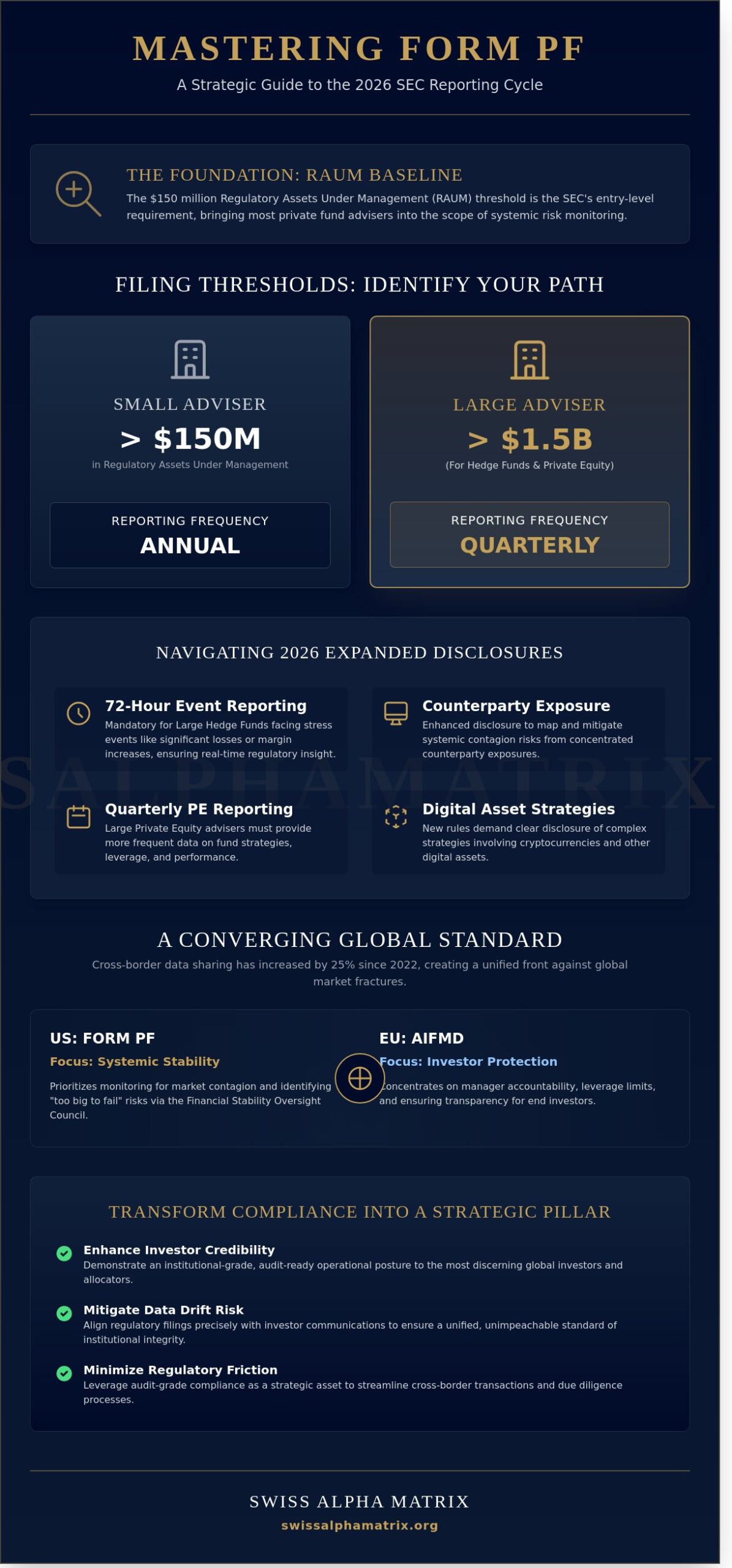
Comparing US requirements with the European Alternative Investment Fund Managers Directive (AIFMD) reveals a convergence of global standards. While AIFMD focuses heavily on investor protection and leverage limits, the US approach via form pf prioritizes systemic stability and the mitigation of contagion. Cross-border data sharing between the SEC and international regulators has increased by 25% since 2022, creating a unified front against global market fractures.
Swiss financial traditions of discretion and excellence find a unique harmony within this transparent framework. Managers who prioritize alpha generation within a secure, institutional-grade environment understand that precision in reporting mirrors the precision of their investment strategies. This global ecosystem rewards those who maintain high-level access to sophisticated data, ensuring that capital remains in the hands of seasoned experts who value stability above all else. Meeting evolving aml compliance requirements is an equally critical dimension of this global regulatory framework, as jurisdictional divergence increasingly intersects with fund reporting obligations.
Identifying Filing Thresholds: Requirements for the 2026 Cycle
The regulatory architecture governing form pf demands a meticulous understanding of the $150 million regulatory assets under management (RAUM) baseline. This entry-level requirement ensures that even boutique managers fall under the SEC’s watchful eye. The landscape has shifted as exemptions that once shielded smaller players have narrowed; the focus has moved toward a more granular observation of systemic risk. Advisers must now distinguish between the reporting burdens of Small Private Fund Advisers and their Large counterparts with absolute precision. Failure to correctly categorize a fund can lead to significant regulatory friction, undermining the stability that institutional investors expect from their strategic partners.
Thresholds for Large Hedge Fund Advisers
For those managing hedge fund assets exceeding $1.5 billion, the reporting depth intensifies significantly. This benchmark triggers the classification of “Qualifying Hedge Funds” for any individual fund with a net asset value of at least $500 million. These entities face mandatory monthly data point collections regarding exposure, leverage, and liquidity. Multi-strategy institutional platforms must align their reporting frequency with these heightened standards; they’ve to move from annual to quarterly filings within 60 days of each fiscal quarter end. Maintaining this cadence is essential for firms that prioritize intellectual depth and operational excellence in their alpha generation strategies.
Private Equity and Liquidity Disclosures
Large private equity fund advisers, defined by a $2 billion RAUM threshold, face the most transformative changes in the 2026 cycle. Under the 2023 Form PF Amendments, the SEC now requires “current reporting” for specific trigger events. These include GP-led secondaries and clawback events, which must be disclosed within 72 hours of occurrence. Transparency regarding portfolio company leverage and debt structures is no longer optional; it’s a core component of the risk-adjusted return profile. Managers seeking to preserve their reputation for excellence often utilize bespoke compliance frameworks to ensure these complex liquidity disclosures meet the highest standards of accuracy.
The 2026 timeline remains rigid. Large hedge fund advisers must file within 60 days of each quarter’s end. Private equity and smaller advisers must submit their annual reports within 120 days of their fiscal year-end. This structured cadence ensures that global markets remain transparent and that systemic risks are identified with the quiet authority and precision that defines institutional-grade management.
The 2025-2026 Amendments: Navigating Expanded Disclosures
The regulatory landscape underwent a definitive shift on February 8, 2024, when the SEC and CFTC adopted rigorous amendments to the form pf reporting requirements. These changes represent a transition toward a more granular, real-time understanding of systemic risk. The 2026 full-scope framework demands that institutional managers move beyond historical reporting patterns. It’s a shift that prioritizes the identification of hidden correlations within complex portfolios. The Strategic Architect must now account for adviser-led secondary transactions with heightened scrutiny, as these maneuvers often involve inherent conflicts of interest that the Commission seeks to monitor with clinical precision.
Counterparty Risk and Collateral Management
The new mandates require a meticulous accounting of the top five counterparty exposures, measured by net mark-to-market value. This isn’t merely a list. It’s a deep dive into the stability of the fund’s liquidity providers. Managers must distinguish between central counterparty (CCP) and bilateral clearing arrangements, providing specific data on collateral haircuts and rehypothecation practices. These disclosures aim to mitigate the risk of contagion, a lesson reinforced by the 2021 collapse of Archegos Capital Management, which resulted in over $10 billion in losses across several global investment banks. By standardizing these metrics, the SEC ensures that the leverage profiles of large hedge funds remain transparent during market dislocations. For institutions seeking to implement comprehensive counterparty risk mitigation strategies, these reporting requirements serve as a foundation for broader institutional capital preservation frameworks.
Strategy and Performance Granularity
The 2026 reporting requirements dismantle broad strategy categories in favor of precise sub-types. This evolution reflects the increasing complexity of multi-asset diversification. Managers are now obligated to provide audit-grade precision regarding:
- Digital Asset Exposure: Identifying specific holdings in cryptocurrencies and distributed ledger technologies to assess volatility impact.
- Strategy Sub-types: Moving beyond “Credit” to specify distressed debt, specialty finance, or senior secured lending.
- ESG-Linked Mandates: Disclosing how environmental, social, and governance factors influence the fund’s risk profile and performance attribution.
- Borrowing and Leverage: Reporting on synthetic exposure and repo market activity with a focus on maturity mismatches.
It’s a rigorous standard that demands sophisticated internal data infrastructure. The transition to this framework requires an unwavering commitment to technical accuracy. Precision is the hallmark of Swiss excellence. Ensuring that every data point on the form pf aligns with the firm’s long-term wealth preservation goals is paramount for maintaining the trust of high-net-worth individuals and institutional partners alike. Firms navigating these expanded disclosures should also consider how a robust approach to capital risk mitigation can reinforce the integrity of their multi-jurisdictional reporting obligations and protect global portfolios from the operational anomalies that standard verification protocols increasingly fail to detect.
Strategic Implementation: Integrating Form PF into Due Diligence
For the discerning institutional manager, the meticulous preparation of the form pf serves as more than a mere regulatory obligation; it’s a silent testament to the fund’s operational maturity and its commitment to transparency. Institutional investors, particularly those managing sovereign wealth or pension mandates, increasingly view the consistency of these filings as a primary indicator of a firm’s health. When data presented in investor letters differs from the metrics submitted to regulators, it creates a “data drift” that signals systemic weakness. A 2024 industry analysis indicated that 12% of emerging managers faced extended due diligence cycles because of such discrepancies. By treating the reporting process as a diagnostic tool, firms can refine their internal risk frameworks, ensuring that the infrastructure supporting alpha generation remains robust under market stress.
Bridging the Gap Between Compliance and ODD
Operational Due Diligence (ODD) teams now utilize automated tools to cross-reference private placement memorandums with regulatory disclosures. If your form pf data doesn’t align with your 2025 investor reports, it’s a red flag that suggests fragmented internal communication. You’ll find that leveraging these workflows helps identify bottlenecks in data aggregation before they become reputational liabilities. Independent validation, often conducted by third-party auditors, ensures that your data integrity remains beyond reproach, fostering a sense of stability that sophisticated clients demand. This level of precision reflects the Swiss tradition of excellence, where every detail is scrutinized to maintain the highest standards of integrity. For institutions requiring comprehensive due diligence advisory services, the integration of regulatory compliance with operational oversight becomes a cornerstone of institutional credibility.
The C-Suite’s Role in Reporting Oversight
Success in this arena requires a clearly defined RACI matrix that outlines exactly who’s responsible, accountable, consulted, and informed during the filing lifecycle. It’s not enough to delegate this to a junior analyst; the Chief Compliance Officer must possess the institutional authority to challenge data provided by the front office. This oversight is critical given the SEC’s emphasis on individual accountability for senior executives. By institutionalizing these checks, the C-suite mitigates personal liability and reinforces the firm’s reputation for excellence. Key elements of this framework include:
- Quarterly Data Reconciliation: Comparing internal risk metrics against regulatory submissions to eliminate discrepancies.
- Executive Sign-off Protocols: Ensuring the CFO and CCO have reviewed the final output for technical accuracy.
- Independent Audit Trails: Maintaining a record of data sources to simplify future regulatory inquiries.
To ensure your reporting infrastructure meets the highest standards of Swiss precision, explore our bespoke risk management solutions designed for the modern institutional landscape.
Swiss Alpha Matrix: Institutional Oversight for Complex Mandates
The regulatory landscape for 2026 demands a level of sophistication that exceeds the capabilities of standard compliance software. As the SEC and CFTC continue to refine their oversight, particularly following the February 2024 amendments, the necessity for independent advisory has become a cornerstone of institutional stability. Swiss Alpha Matrix brings the rigorous discipline of former Tier-1 banking expertise to every bespoke mandate we undertake. We don’t just process data; we interpret the intricate nuances of global financial markets to ensure your operational framework remains beyond reproach.
Our methodology merges traditional Swiss advisory traditions with modern financial precision. This unique synthesis provides a stabilized environment for capital, shielding it from the volatility of shifting reporting requirements. By applying audit-grade instrument and process validation, we transform the mandatory exercise of filing form pf into a strategic advantage that reinforces your market standing. It’s about maintaining the highest level of professional competence while ensuring the accuracy required for form pf submissions remains flawless.
Bespoke Regulatory and Risk Advisory
Navigating cross-border fund structures requires on-ground verification that goes beyond digital checklists. We act as independent project managers for large-scale compliance transformations, ensuring that your internal systems meet the highest global standards. During the 2025 fiscal year, our intervention in complex restructuring projects successfully mitigated reporting risks for funds managing over $5 billion in assets. We prioritize the integrity of your operational framework, ensuring every qualifying clause in your mandate is strictly honored through a measured, logical approach.
Securing Deal Integrity in a Transparent World
In a market where transparency is the new baseline, protecting capital requires an uncompromising approach to counterparty review and instrument validation. The Swiss Alpha Matrix protocol identifies hidden exposures in high-stakes deals before they manifest as liabilities. We provide the intellectual depth required to validate multi-asset diversification strategies, ensuring that every transaction aligns with your long-term wealth preservation goals. Our team maintains a steady rhythm in its oversight, providing the quiet authority needed to secure your most sensitive interests.
Your capital deserves the protection of seasoned experts who value discretion and precision above all else. Secure your institutional mandate with our senior advisory team to ensure your firm remains a leader in the 2026 regulatory environment.
Securing Institutional Alpha in the 2026 Regulatory Environment
The transition toward heightened transparency, formalised by the SEC and CFTC 2024 final rules, necessitates a fundamental shift in how managers approach systemic risk reporting. As the 2026 cycle approaches, Large Hedge Fund Advisers must navigate the 72-hour reporting window for significant stress events while maintaining the form pf filing accuracy required for multi-asset strategies. Understanding the broader context of international financial regulations becomes essential as cross-border compliance requirements continue to evolve and intersect with domestic reporting mandates. Firms must also ensure their aml compliance requirements are fully integrated into their broader regulatory posture, as fragmented approaches to financial crime prevention can undermine the operational integrity that institutional investors demand. Swiss Alpha Matrix provides the intellectual depth needed to manage these intricate mandates. Our firm is led by former Tier-1 Global Bank Executives who bring a standard of precision rooted in Swiss financial traditions to every engagement. We provide audit-grade instrument validation services that ensure your data integrity remains beyond reproach. You’ll find that our bespoke approach prioritises long-term wealth preservation over mere compliance. Engage Swiss Alpha Matrix for Bespoke Advisory to fortify your institutional oversight with Swiss-standard discretion. We’re ready to help you turn these complex regulatory requirements into a distinct competitive advantage.
Frequently Asked Questions
Who is required to file Form PF in 2026?
Investment advisers registered with the SEC who maintain at least $150 million in private fund assets under management at the end of their most recent fiscal year are mandated to file Form PF. This threshold applies to advisers of hedge funds, private equity funds, and liquidity funds to ensure systematic risk monitoring by the Financial Stability Oversight Council. It’s a critical requirement that demands absolute precision in asset valuation and reporting to maintain institutional integrity.
What are the major changes in the 2025-2026 Form PF amendments?
The 2025 amendments require large hedge fund advisers to report certain stress events, such as extraordinary redemption requests exceeding 50% of net asset value, within 72 hours of occurrence. These revisions, finalized by the SEC and CFTC in February 2024, also mandate enhanced reporting on digital asset exposures and complex borrowing arrangements to provide regulators with granular transparency. Such measures reflect a shift toward real-time monitoring of systemic market vulnerabilities and liquidity risks.
How often must Large Hedge Fund Advisers file Form PF?
Large hedge fund advisers, defined as those managing at least $1.5 billion in hedge fund assets, must submit their form pf filings on a quarterly basis within 60 days of each fiscal quarter end. Smaller private fund advisers typically adhere to an annual filing cadence, completing their submissions within 120 days after the conclusion of their fiscal year. This structured frequency ensures that the most substantial market participants provide timely data for comprehensive risk assessment.
What happens if a fund fails to file Form PF or provides inaccurate data?
Non-compliance with filing mandates or the provision of erroneous data triggers rigorous SEC enforcement actions that often result in monetary penalties exceeding $150,000 per violation. Beyond financial sanctions, persistent inaccuracies jeopardize an adviser’s regulatory standing and can lead to the revocation of their registration under the Investment Advisers Act of 1940. It’s vital that firms treat these obligations with the same gravity they apply to their sophisticated alpha generation strategies.
Does Form PF require the disclosure of specific investor identities?
The regulatory framework doesn’t require the disclosure of specific names or identities of individual investors within the reporting documentation. Instead, the SEC focuses on aggregated data points, such as the percentage of fund ownership held by institutional versus retail investors, to assess broader market vulnerabilities while maintaining the fundamental privacy of bespoke client mandates. This approach aligns with the traditional discretion valued by high-net-worth individuals and institutional partners in the global financial arena.
What is a ‘Qualifying Hedge Fund’ for the purposes of Form PF reporting?
A qualifying hedge fund is any hedge fund advised by a large hedge fund adviser that possesses a net asset value of at least $500 million as of the last day of any month in the prior fiscal quarter. These entities are subject to more rigorous disclosure requirements because their scale and leverage profiles are deemed critical to the stability of the global financial ecosystem. Precision in identifying these funds is essential for maintaining a firm’s commitment to excellence.
How does Form PF reporting differ for Private Equity vs. Hedge Funds?
Private equity advisers generally submit form pf on an annual schedule, focusing on fund-level leverage and portfolio company details, whereas large hedge fund advisers must report quarterly with a focus on daily volatility and counterparty credit risk. The 2024 rule changes introduced a 60-day deadline for private equity advisers to report significant events like GP-led secondaries or the removal of a general partner. These distinctions reflect the unique liquidity profiles of each asset class.
Can offshore funds be exempt from Form PF filing requirements?
Offshore funds aren’t exempt if they’re managed by an SEC-registered investment adviser that meets the $150 million AUM threshold, regardless of the fund’s domicile in jurisdictions like the Cayman Islands or Luxembourg. If an adviser’s principal office is located outside the United States, they only need to report on funds they advise that are either incorporated in the U.S. or offered to U.S. persons. This ensures global regulatory reach while respecting the nuances of international fund structures.