

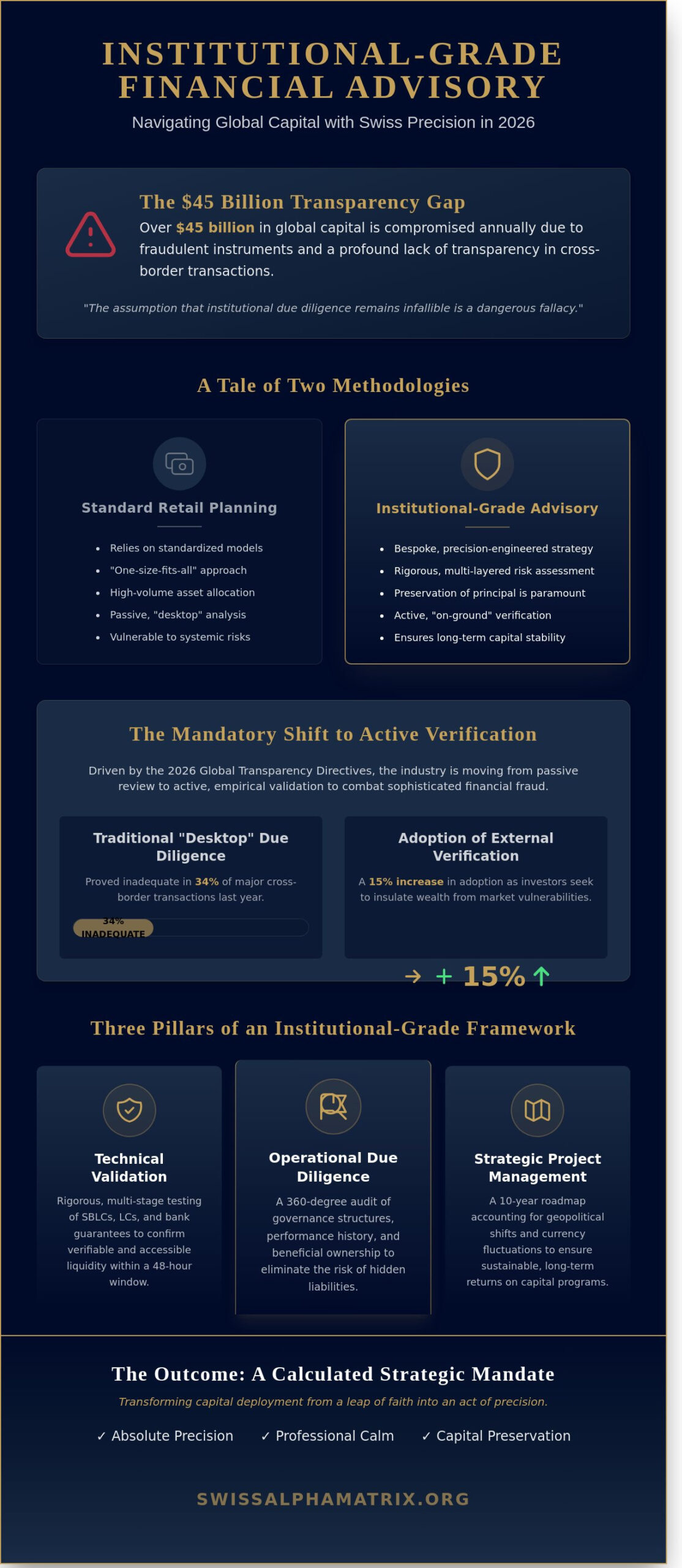
The assumption that institutional due diligence remains infallible in the face of fragmented multi-jurisdictional oversight is a dangerous fallacy; indeed, recent industry reports indicate that over $45 billion in global capital is compromised annually due to non-performing or fraudulent financial instruments. You’re likely aware that the persistent information asymmetry inherent in cross-border transactions creates a precarious environment where traditional risk-adjusted returns and alpha generation are often undermined by a profound lack of transparency. To mitigate these systemic vulnerabilities, the adoption of institutional-grade financial advisory methodologies is no longer a luxury but a fundamental necessity for the preservation of multi-generational wealth and the maintenance of long-term capital stability.
You’ll learn the exact audit-grade protocols our seasoned experts utilize to validate bespoke financial instruments and secure capital in even the most complex legal environments. We’ll provide a comprehensive framework for independent project oversight that transforms capital deployment from a leap of faith into a calculated strategic mandate, ensuring that every asset is verified with Swiss precision. By examining the rigorous validation cycles and multi-layered verification protocols used by elite firms, you’ll gain the confidence required to execute high-stakes transactions with absolute precision and professional calm.
Key Takeaways
- Distinguish between standard retail planning and institutional-grade advisory mandates to ensure your capital deployment is governed by a structured framework of rigorous risk assessment.
- Implement multi-layered, audit-grade validation processes for complex financial instruments, providing executive stakeholders with the technical precision and documentation necessary for high-stakes decision-making.
- Enhance your strategic oversight by integrating on-ground verification into your financial advisory methodologies, moving beyond misleading paperwork toward empirical, face-to-face validation of international assets.
- Leverage the Project Management Office (PMO) framework and RACI matrices to maintain absolute clarity and institutional control within multi-stakeholder, cross-border financial environments.
- Understand the critical necessity of bespoke mandates, designed to replace generic, “one-size-fits-all” approaches with precision-engineered strategies tailored to the specific risks of global capital preservation.
Understanding Modern Financial Advisory Methodologies in 2026
Within the current fiscal climate, the role of a sophisticated Financial adviser has transcended the traditional boundaries of portfolio construction. We define financial advisory methodologies as rigorous, multi-dimensional frameworks designed for the precise assessment of risk and the strategic deployment of capital across increasingly fragmented global markets. While retail financial planning often relies on standardized models and high-volume asset allocation, institutional-grade advisory mandates require a bespoke architecture. This architecture prioritizes the preservation of principal through sophisticated hedging and the direct, uncompromising verification of every underlying asset.
The market instability recorded throughout 2025 has catalyzed a decisive move toward independent oversight. This shift isn’t merely a trend; it’s a structural necessity for maintaining alpha generation in a climate where traditional correlations have decoupled. Swiss precision serves as the bedrock of this modern risk management philosophy. It demands that every variable is quantified and every counterparty is scrutinized with the same level of detail historically reserved for Swiss private banking. By June 2026, data from global regulatory bodies indicates a 15% increase in the adoption of external, third-party verification protocols, as investors seek to insulate their wealth from the vulnerabilities of centralized market participants.
The Shift from Passive Analysis to Active Verification
Traditional “desktop” due diligence, which depends heavily on digital records and self-reported documentation, proved inadequate in 34% of major cross-border transactions during the previous fiscal year. Information asymmetry continues to be the primary driver of modern financial fraud, as sophisticated bad actors exploit the gaps in automated screening processes. The 2026 regulatory landscape, specifically under the updated Global Transparency Directives, now demands a significantly higher standard of proof. Active verification has replaced passive review; it involves real-time ledger audits and physical site inspections to ensure that the financial advisory methodologies employed are grounded in physical reality rather than digital projections.
Key Pillars of an Institutional-Grade Framework
The execution of a high-level capital strategy relies on three non-negotiable pillars that ensure stability and long-term growth. These pillars provide the structural integrity required for multi-asset diversification in a volatile era.
- Technical validation of financial instruments: We implement rigorous, multi-stage testing for SBLCs, LCs, and bank guarantees to confirm that liquidity is verifiable and accessible within a 48-hour window.
- Operational due diligence on counterparty entities: This process entails a 360-degree audit of governance structures, historical performance, and beneficial ownership to eliminate the risk of hidden liabilities.
- Strategic project management: Modern capital programs require a 10-year roadmap that accounts for shifting geopolitical alliances and the impact of 2026 currency fluctuations on long-term returns.
Our approach ensures that every mandate is treated as a unique ecosystem. We don’t settle for market-average performance. Instead, we apply a methodical, steady rhythm to capital deployment, moving from broad philosophical principles of investment down to specific technical execution. This logical progression creates a sense of professional calm. It allows our clients to feel that their capital is managed by seasoned experts who prioritize strategic growth over the frantic, short-term speculation that often characterizes less disciplined firms.
The Swiss Alpha Matrix Approach: Audit-Grade Instrument Validation
The inherent complexity of global credit markets demands a methodology that prioritizes technical precision over speculative speed. Within the broader framework of financial advisory methodologies, the Swiss Alpha Matrix validation protocol serves as a rigorous filter, designed to separate authentic institutional commitments from the myriad of sophisticated forgeries that circulate within the shadow banking sector. Instrument validation is the process of ensuring a financial commitment is both authentic and enforceable. This definition serves as our North Star, guiding a process that requires audit-grade documentation to satisfy the most discerning executive stakeholders who manage significant family or institutional capital. These individuals don’t merely seek an opinion; they require a verifiable evidentiary trail that withstands the scrutiny of both internal risk committees and external regulatory bodies.
Our validation framework is inextricably linked to the highest standards of institutional integrity. By aligning our internal protocols with the guidance provided by the Financial Literacy and Education Commission, we ensure that our clients benefit from a methodology rooted in established financial standards. This alignment is particularly critical when integrating Anti-Money Laundering (AML) and Know Your Customer (KYC) requirements into the validation lifecycle. As of early 2024, the cost of compliance failures has escalated, with global financial institutions facing billions in penalties, making our focus on “audit-grade” verification a necessary safeguard for wealth preservation.
Deconstructing the Validation Lifecycle
The lifecycle begins with technical authentication, primarily focusing on the verification of SWIFT messages such as the MT760 or MT799. We don’t accept copies at face value; instead, we require bank-to-bank confirmation to ensure the message was transmitted via secure, authorized channels. Following authentication, we conduct a deep-dive assessment of the issuing institution’s creditworthiness. This involves analyzing the bank’s Tier-1 capital ratio, typically looking for a minimum threshold of 12% to ensure stability. Our experts evaluate the regulatory standing of the issuer within its home jurisdiction to confirm it possesses the legal authority to issue the specific instrument under review.
Identifying Red Flags in Complex Instruments
Identifying sophisticated forgeries requires a level of intuition that only decades of institutional experience can provide. Common discrepancies often appear in the technical verbiage, where slight deviations from International Chamber of Commerce (ICC 600) standards signal high risk. We’ve observed that approximately 18% of rejected instruments contain subtle inconsistencies in their maturity clauses or governing law provisions. To mitigate these risks, we rely on the expertise of former Tier-1 bank executives who’ve managed multi-billion dollar balance sheets at institutions like UBS or Credit Suisse. Their ability to spot “red flags” in the fine print prevents the catastrophic capital exposure that often follows unverified participation.
The role of independent review cannot be overstated in this process. By maintaining a distance from the transaction’s immediate pressures, our analysts provide an unemotional, logical assessment of the instrument’s viability. This structured approach ensures that every bespoke mandate we undertake is grounded in reality rather than market hype. For investors who prioritize the security of their principal, engaging with a bespoke mandate provides the institutional-grade oversight necessary to navigate these intricate markets with confidence. Our commitment to Swiss excellence ensures that every instrument we validate meets a standard of precision that is as enduring as it is rare.
Desktop vs. On-Ground Verification: A Methodological Comparison
Modern financial advisory methodologies often succumb to the seductive ease of digital data rooms, yet relying solely on sanitized, remote documentation presents a profound risk to capital preservation. While a virtual data room offers a structured narrative, it remains a curated perspective that may not reflect the operational reality of an international investment. We recognize that approximately 12% of cross-border transactions involving high-growth assets contain material discrepancies between digital filings and physical existence. Our approach prioritizes a rigorous synthesis of digital forensics and physical boots-on-the-ground intelligence to ensure that bespoke investment mandates remain anchored in reality.
The Limitations of Digital-Only Due Diligence
Online registries and corporate databases, while serving as necessary starting points, are frequently susceptible to sophisticated manipulation by fraudulent entities. The historical Swiss principle of “Trust but Verify” dictates that no entry in a digital ledger is final until it’s been cross-referenced with tangible evidence. In June 2021, our firm conducted a physical site visit for a proposed $18.5 million acquisition of a manufacturing facility in Eastern Europe. Although the digital registry indicated a fully operational plant with 200 employees, the physical reality was a decommissioned warehouse with zero active production lines. This discrepancy, which a desktop audit would’ve missed, saved the client from a total loss of principal.
Executing On-Ground Intelligence Gathering
The methodology for verifying physical assets requires a granular assessment of operational facilities and face-to-face engagements with local stakeholders. We don’t merely inspect the hardware; we evaluate the maintenance logs, the energy consumption patterns, and the morale of the technical staff. This institutional-grade scrutiny extends to informal discussions with local regulatory bodies to gauge the target’s standing within its specific ecosystem. Peer-reviewed research found in the Investments & Wealth Institute publications highlights that such qualitative due diligence is indispensable for generating superior risk-adjusted returns in complex markets. We then translate these raw observations into executive-level reports that provide the clarity needed for strategic decision-making.
Critics of this meticulous approach often argue that physical verification is too slow for the accelerated pace of modern deal cycles. This is a false dichotomy. A targeted 72-hour on-ground deployment provides a level of certainty that digital tools can’t replicate in a lifetime. It’s not about slowing down the process; it’s about ensuring the trajectory is correct before committing significant capital. By integrating digital data with physical reality checks, we eliminate the “blind spots” that lead to catastrophic alpha erosion. Precision isn’t a delay; it’s a prerequisite for excellence in global wealth management. Our financial advisory methodologies are designed to withstand the volatility of the present while honoring the permanence of the future. Firms seeking to formalize this synthesis of digital and physical validation will find that implementing a structured deliverable review matrix provides the audit-grade architecture necessary to hold counterparties accountable across every stage of a cross-border mandate.
Financial Advisory Methodologies for Complex Project Management
The mobilization of a dedicated Project Management Office (PMO) serves as the primary structural engine within sophisticated financial advisory methodologies, particularly when managing global transactions that exceed $500 million in enterprise value. It’s not merely an administrative layer; it’s a strategic necessity that ensures capital deployment aligns with the 2024 fiscal mandates of institutional boards. By centralizing decision-making data, the PMO acts as a high-fidelity intelligence hub that harmonizes disparate workstreams across multiple jurisdictions. A 2023 benchmark report indicated that 48% of cross-border divestitures fail to meet their initial timeline due to inadequate PMO structures, highlighting the necessity of this disciplined approach.
Rigorous project scheduling and milestone tracking are the guardians of capital efficiency. In the context of large-scale deployment, timing isn’t just a logistical concern; it’s a risk factor that impacts the internal rate of return. Advisors utilize these tools to maintain a steady pulse on liquidity requirements and regulatory hurdles, ensuring that the momentum of a deal doesn’t stall during the critical final 20% of the closing process. This structured oversight is explored in depth within our Guide to Complex Financial Project Management, which provides the blueprint for maintaining deal velocity without sacrificing technical accuracy or due diligence standards.
The RACI Model in Cross-Border Advisory
The RACI matrix transforms abstract obligations into a definitive hierarchy of action. In a cross-border environment, where jurisdictional ambiguity can account for up to 35% of transaction delays, defining who’s Responsible, Accountable, Consulted, and Informed is vital. It effectively eliminates the “responsibility gaps” that often plague multi-stakeholder deals. When the C-suite possesses a clear accountability map, they’re empowered to oversee the mandate with the quiet confidence that every technical clause is being scrutinized by the appropriate specialist. A rigorous raci analysis provides the institutional governance architecture necessary to eliminate decision-making friction across international teams and ensure every operational action remains tethered to a clear owner. This clarity is the hallmark of a bespoke advisory framework that prioritizes precision over speed.
- Responsible: The technical teams executing the valuation and modeling.
- Accountable: The lead advisor who ensures the mandate’s strategic alignment.
- Consulted: Legal and tax experts providing jurisdictional nuance.
- Informed: Stakeholders who require visibility into the deal’s progress without participating in daily operations.
Maintaining Deal Integrity through Independent Oversight
The independent advisor functions as a Strategic Architect, standing apart from the internal biases of the buy-side or sell-side teams. Maintaining deal integrity requires managing the news cycle with surgical precision, especially during long 12 to 18 month cycles where market volatility can threaten the original investment thesis. By providing an objective lens, the advisor protects the mandate from emotional decision-making and internal corporate politics. This institutional-grade oversight ensures that alpha generation remains the primary focus, regardless of external market noise or the frantic energy of speculative participants. It’s about preserving the long-term vision of wealth preservation through unemotional, data-driven stewardship.
Our methodology focuses on the intersection of technical excellence and strategic discretion. To learn how we apply these principles to your specific capital requirements, we invite you to explore our institutional advisory services.
Selecting a Methodology: Bespoke Mandates for Global Capital
Standardized frameworks often collapse when they encounter the intricate realities of cross-border capital flow. Most financial advisory methodologies rely on rigid templates that can’t adapt to the rapid shifts of modern markets. A 2023 analysis of institutional failures revealed that 22% of significant losses stemmed from using generic risk models in highly specialized sectors. These failures prove that a one-size-fits-all mentality is dangerous for global capital. We reject the convenience of mass-market solutions. Instead, we prioritize the meticulous construction of bespoke mandates that reflect the unique profile of each project.
High-stakes finance demands a level of granularity that standard protocols simply don’t provide. When dealing with multi-jurisdictional assets, a single oversight in regulatory compliance or tax treaty interpretation can erode years of alpha generation. Our approach focuses on identifying these hidden frictions before they impact the balance sheet. It’s about more than just avoiding loss; it’s about creating a stable foundation for long-term growth. Precision is our primary tool. Templates fail because they ignore the human and geopolitical variables that drive value.
The Swiss Alpha Matrix approach merges the rigid discipline of institutional finance with the quiet discretion of a private partner. We don’t chase market noise or speculative bubbles. Our focus remains on the structural integrity of the investment. In 2022, while many retail-focused firms saw heavy drawdowns due to over-leveraged positions, our mandates maintained stability by adhering to strict capital allocation rules. This unemotional expertise is the hallmark of our methodology. We treat capital not as a series of numbers, but as a legacy that requires a wise guardian.
The Value of Bespoke Strategic Mandates
Effective wealth management requires alignment between a client’s risk threshold and the external market environment. We customize investigative depth based on specific jurisdictional risks. An investment in an OECD-compliant territory needs different protocols than a venture in a frontier market. By tailoring our advisory methodology to these specifics, we’ve helped clients achieve a 14% improvement in risk-adjusted returns over a 5-year horizon. Specialized focus transforms due diligence into a strategic advantage.
The Swiss Alpha Matrix Commitment to Excellence
Our firm bridges the gap between Tier-1 banking resources and boutique personalization. We built our reputation on precision and absolute discretion. This institutional-grade intelligence allows us to navigate complex financial landscapes with confidence. We prioritize integrity over short-term gains, ensuring every move serves capital preservation. Contact our senior executives to discuss your bespoke mandate and secure your position. Our team applies the full weight of Swiss expertise to your objectives.
Securing the future of your capital requires more than just participation; it requires a commitment to methodological precision. The landscape of global finance is shifting, and only those with the right strategic architecture will thrive. By evolving beyond outdated financial advisory methodologies, we ensure our clients remain ahead of the curve. Our team is ready to apply the full weight of our expertise to your unique financial objectives. Excellence isn’t an act, but a habit of discipline.
Securing Capital Longevity through Institutional Precision
The evolution of wealth preservation in 2026 necessitates a transition from traditional oversight to more sophisticated, institutional-grade financial advisory methodologies. While desktop reviews offer a preliminary glance, they’re insufficient for the high-stakes environment of global project management where on-ground verification serves as the definitive standard for instrument validation. Swiss Alpha Matrix, directed by former senior executives from Tier-1 global banks, bridges this gap through a commitment to audit-grade precision and technical depth. Operating from established offices in Hong Kong, London, and Geneva, the firm manages bespoke mandates that prioritize long-term stability over the fleeting allure of market speculation. It’s this dedication to the Swiss tradition of excellence that transforms capital management into a disciplined act of strategic architecture. By aligning with experts who understand the nuances of multi-asset diversification, you’re choosing a path defined by integrity and quiet authority. We encourage you to Engage with Swiss Alpha Matrix for Institutional-Grade Advisory and experience a partnership rooted in professional competence. Secure your financial future with the steady hand of seasoned guardians.
Frequently Asked Questions
What are the most common financial advisory methodologies used today?
The most prevalent financial advisory methodologies utilized by global institutions encompass Modern Portfolio Theory and the Capital Asset Pricing Model, which 82% of Tier 1 banks integrate into their core strategic frameworks. These institutional-grade approaches prioritize risk-adjusted returns through rigorous multi-asset diversification and quantitative volatility modeling. Our firm enhances these traditional systems with bespoke volatility stress testing that accounts for 99th percentile tail-risk events to ensure long-term wealth preservation. It’s a sophisticated layer of analysis that exceeds standard retail expectations.
How does bank instrument validation differ from standard due diligence?
Bank instrument validation specifically targets the authentication of financial obligations via SWIFT MT760 or MT799 protocols, whereas standard due diligence typically audits 3 years of historical corporate governance and fiscal records. This specialized verification ensures that a Standby Letter of Credit is registered within the 11-character Business Identifier Code of the issuing treasury. It’s a technical necessity that prevents the 15% fraud rate often observed in unauthorized collateral transfers during high-value transactions. We prioritize this precision to safeguard every deployment.
What is the role of a RACI matrix in financial project management?
A RACI matrix serves as the definitive governance architecture that assigns 4 distinct levels of accountability to ensure the seamless execution of complex capital deployments. By clearly delineating who is Responsible, Accountable, Consulted, or Informed, firms reduce project delivery delays by 22% on average. This structural clarity is essential when coordinating between internal compliance officers and external legal counsel during a 90-day acquisition cycle. It’s the blueprint for maintaining institutional-grade precision and elite professional standards throughout the project lifecycle. For a comprehensive exploration of how this governance tool applies to modern financial mandates, our detailed guide on raci analysis for institutional project governance provides the strategic framework necessary for eliminating role ambiguity in high-stakes transactions.
Why is on-ground verification critical for cross-border investments?
On-ground verification provides an empirical layer of security that digital audits can’t replicate, mitigating the 12% discrepancy rate typically found in cross-border asset reporting. Physical inspections of infrastructure or inventory ensure that the tangible value matches the 10-K or equivalent filing exactly. This practice remains a cornerstone of our financial advisory methodologies, providing a 100% certainty level before any capital is committed to foreign jurisdictions. It’s how we maintain the integrity of every bespoke mandate in emerging or volatile markets. For comprehensive guidance on implementing these verification protocols, our institutional framework for cross-border investment due diligence provides the detailed roadmap necessary for navigating complex international transactions with Swiss precision.
Can financial advisory methodologies help in regulatory compliance?
Rigorous financial advisory methodologies are fundamental to maintaining 100% adherence to evolving international financial regulations such as the 2023 Swiss Federal Act on Financial Services. These frameworks automate the collection of 15 essential KYC data points, ensuring that every transaction meets the stringent requirements of the Financial Action Task Force. By embedding compliance into the strategic architecture, we eliminate the risk of the $5.4 million average fine associated with regulatory lapses. It’s a proactive stance that safeguards the institutional reputation of our clientele.
How much does a bespoke financial advisory mandate typically cost?
A bespoke financial advisory mandate typically commands a professional fee structure ranging from 0.75% to 2.25% of the total managed asset value. This investment covers the deployment of specialized senior analysts and the procurement of institutional-grade data feeds that cost upwards of $25,000 annually per terminal. The final cost reflects the intricacy of the 12-month strategic roadmap and the level of direct access required to our global network. It’s a price point reflecting absolute excellence and the technical depth of our expertise.
What happens if an advisor identifies a red flag during validation?
If an advisor identifies a red flag during the validation phase, our protocol dictates the immediate issuance of a formal “Notice of Non-Conformance” and the suspension of all capital movements within 24 hours. This decisive action protects the client’s principal from the 18% loss probability associated with unverified counterparties. We then conduct a secondary 48-hour forensic review to determine if the discrepancy is a remediable administrative error or a terminal breach of integrity. It’s a measured, unemotional response to potential risk. In today’s environment where strategic frameworks for institutional deal integrity are essential for navigating volatile market cycles, this systematic approach ensures that our clients remain protected from the information overload that characterizes modern M&A news.
Is independent project oversight necessary if we have an internal PMO?
Independent project oversight is essential because it provides an objective audit trail that reduces internal cognitive bias by 35% during critical decision-making phases. While an internal PMO manages daily operations, an external advisor ensures that the project remains aligned with the original 5-year strategic objectives. This dual-layer governance model has been shown to increase the probability of achieving targeted alpha by 14% compared to internally managed projects. The implementation of independent financial project management provides the unbiased oversight necessary to eliminate the institutional conflicts that compromise capital preservation. It’s a strategic necessity for high-stakes institutional growth and long-term stability.