

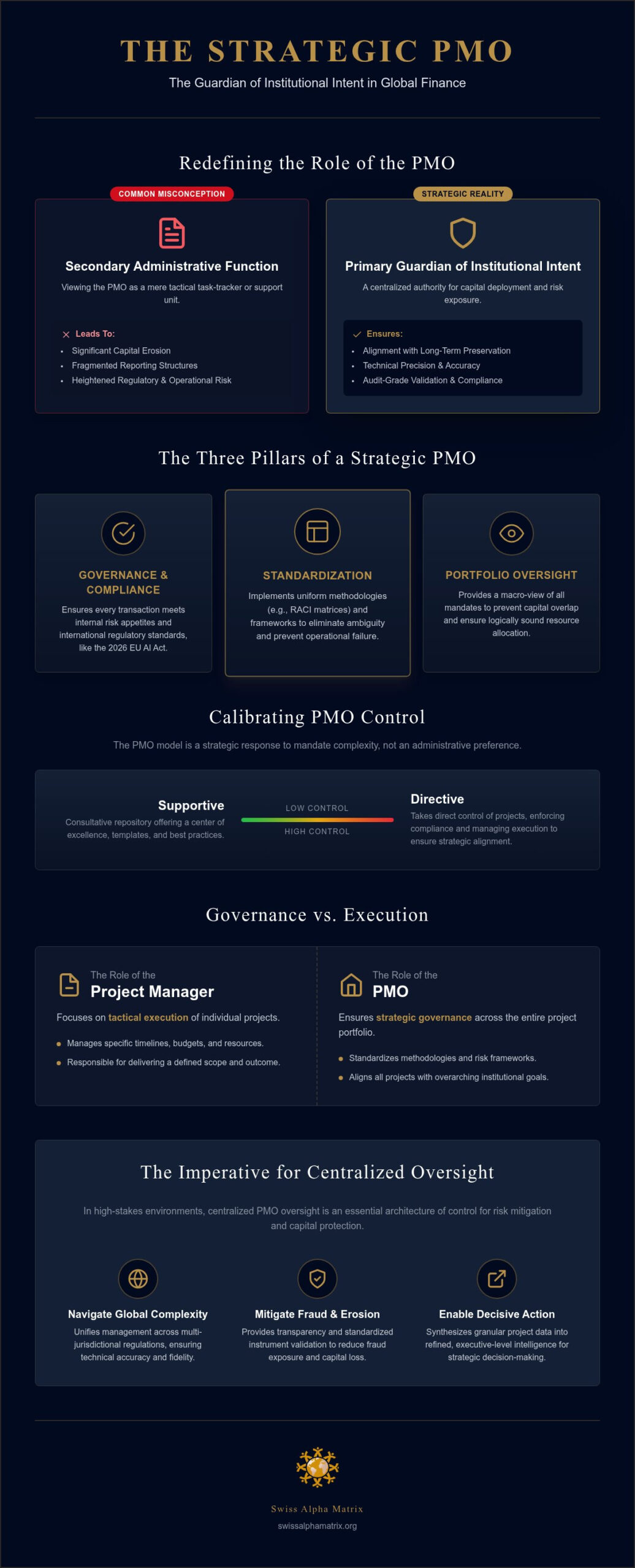
The assumption that a Project Management Office serves as a secondary administrative function is a precarious misconception that often precedes significant capital erosion. In the intricate theater of global finance, where the 2026 implementation of the EU AI Act and the revised Basel III capital rules have intensified the cost of oversight failure, a PMO must be viewed as the primary guardian of institutional intent. You likely recognize the inherent fragility of project governance in financial services when cross-border mandates lack a centralized source of truth or when resource allocation becomes untethered from strategic goals. It’s a common frustration for executives who find their exposure to regulatory and operational risks heightened by fragmented reporting structures and inconsistent risk frameworks.
This exploration reveals how a meticulously structured PMO acts as a master planner to ensure that every deployment of capital remains aligned with long-term preservation and technical precision. We’ll detail the methodologies required to standardize risk management frameworks across complex transactions, providing the transparency necessary to mitigate operational exposure. By the conclusion, you’ll understand why strategic oversight is the essential bridge between high-level institutional mandates and the granular execution required for audit-grade validation. We’ll move from the broad philosophical principles of capital protection down to the specific strategic pillars that define a performance-oriented mindset.
Key Takeaways
- Establish a centralized source of truth to ensure rigorous project governance in financial services across complex, cross-border mandates.
- Distinguish between supportive and directive PMO models to determine the appropriate level of oversight required for audit-grade compliance.
- Differentiate tactical project delivery from strategic governance to ensure all capital deployments remain tethered to institutional objectives.
- Utilize standardized risk management frameworks and instrument validation services to significantly reduce fraud exposure in high-stakes environments.
- Leverage an independent, boutique PMO layer to combine Tier-1 banking expertise with the meticulous precision of Swiss-rooted advisory.
Defining the Project Management Office (PMO) in Institutional Finance
At its most fundamental level, a Project Management Office (PMO) is a centralized functional unit designed to standardize governance processes across an organization’s project portfolio. In the specialized arena of institutional finance, however, this definition expands to encompass a role of profound strategic gravity. It’s the primary source of truth for capital deployment and risk exposure, serving as a protective layer between high-level mandates and the granular realities of execution. This centralized authority ensures that intellectual depth isn’t sacrificed for speed, maintaining a standard of technical accuracy that’s essential for long-term capital preservation.
Rather than merely tracking tactical tasks, a sophisticated PMO ensures that every initiative remains tethered to institutional stability and overarching strategic goals. This shift toward strategic programme alignment is vital for maintaining the high standards of independent financial project management required in today’s increasingly scrutinized markets. Effective project governance in financial services isn’t an administrative burden; it’s a deliberate architecture of control that prevents the drift often seen in decentralized, cross-border operations. It provides the logical structure necessary to navigate the complexities of modern capital markets with quiet authority and precision.
The Core Functions of a Strategic PMO
A strategic PMO operates through three primary pillars of influence to maintain the integrity of a financial portfolio. Governance and compliance form the first pillar, ensuring that every transaction meets both internal risk appetites and international regulatory standards, such as the 2026 EU AI Act requirements. Standardization follows, implementing uniform methodologies like RACI matrices and deliverable review frameworks to eliminate the ambiguity that often leads to operational failure. Finally, portfolio oversight provides a macro-view of all ongoing financial mandates, which is essential to prevent capital overlap and ensure that resource allocation remains logically sound and focused on high-priority institutional objectives.
Why Complex Transactions Mandate Centralized Oversight
Cross-border deals frequently involve multi-jurisdictional regulations that demand a unified management layer to maintain technical accuracy and regulatory fidelity. The intellectual depth required to navigate intricate financial instrument validation is rarely found in isolated project teams, making a centralized authority indispensable for risk mitigation. When project governance in financial services is neglected, the resulting lack of transparency can lead to significant capital erosion and regulatory penalties. The PMO acts as a master planner, synthesizing vast quantities of granular project data into the refined, executive-level intelligence required for decisive institutional action.
Categorizing PMO Structures: From Supportive to Directive Models
Selecting an appropriate structural framework for a Project Management Office is a nuanced exercise in risk calibration. It’s not a matter of administrative preference but a strategic response to the complexity of the financial instruments involved and the specific regulatory environment of the mandate. Within the sphere of project governance in financial services, the efficacy of oversight is directly proportional to how well the PMO model aligns with the institution’s tolerance for operational variance. The decision to implement a specific structure dictates the flow of intelligence and the degree of control exerted over capital-intensive programmes.
The Supportive Model: Knowledge and Methodology
The supportive PMO functions as a consultative repository, offering a center of excellence for firms that already possess capable internal execution teams but require a unified financial advisory methodology. This model prioritizes the preservation of historical data and the dissemination of best practices without exerting direct authority over individual projects. Its value lies in training and the provision of sophisticated templates that inform future investment decisions. For many institutional entities, this approach provides a stable foundation for transactional risk management while allowing for regional autonomy where appropriate, ensuring that historical reliability informs modern strategy.
Controlling and Directive PMOs: Enforcing Precision
When mandates involve high-stakes, cross-border investment programmes, the necessity for audit-grade reporting standards often dictates a more assertive structure. Controlling PMOs require strict compliance with established frameworks, serving as a vital check against the fragmented reporting that often plagues complex financial mandates. In contrast, Directive PMOs assume full control, providing the project managers and managing the entire mandate directly to ensure absolute technical accuracy. These models are particularly effective when navigating the 2026 implementation of the “Basel III Endgame” or the EU AI Act, where non-compliance carries severe institutional penalties and capital repercussions.
By centralizing authority, these directive structures ensure that interests are in the hands of seasoned, unemotional experts who prioritize long-term preservation over short-term expediency. This level of rigor is essential for maintaining the meticulous standards required in international capital markets, where the margin for error is non-existent. For those overseeing multifaceted portfolios, engaging an independent partner like Swiss Alpha Matrix can provide the necessary directive layer to safeguard institutional intent against operational drift. Ultimately, the choice between these models must be a logical progression from the project’s risk profile to the required level of strategic oversight.
PMO vs. Project Manager: Distinguishing Tactical Execution from Strategic Governance
Understanding the distinction between a Project Manager and a Project Management Office is fundamental to the successful preservation of institutional assets. A Project Manager (PM) is inherently tactical, focusing on the meticulous delivery of a single, defined mandate within the rigid parameters of budget and time. In contrast, the Project Management Office (PMO) operates at a strategic level, maintaining the aggregate health and alignment of all mandates within the firm’s portfolio. While the PM manages specific tasks and timelines, the PMO manages the entire environment in which those tasks occur, ensuring that individual efforts don’t deviate from the overarching institutional standard. It’s essential for stakeholders to recognize that while the PM delivers the project, it’s the PMO that protects the capital through rigorous project governance in financial services.
The Scope of Influence: Individual Deals vs. Enterprise Portfolios
Project Managers typically focus on the “Triple Constraint,” which involves the delicate balance of scope, time, and budget for a specific, isolated transaction. The PMO, however, prioritizes strategic integrity, continually evaluating whether a project still serves the institution’s long-term risk appetite as global market conditions fluctuate. By managing inter-project dependencies that a single PM might overlook, the PMO prevents the resource conflicts and capital overlaps that can quietly undermine a portfolio’s aggregate performance. This macro-view is what distinguishes a mature framework for project governance in financial services from a collection of isolated, uncoordinated initiatives that lack a unified direction and a centralized source of truth.
Addressing the Oversight Gap in Cross-Border Investments
Individual PMs, despite their technical proficiency in task management, often lack the executive-level intelligence and high-level access required for multi-national regulatory adherence in complex cross-border investments. The PMO provides a necessary layer of Swiss discretion and specialized expertise, which is essential for on-ground verification and audit-grade instrument validation in jurisdictions where transparency is often limited. Relying solely on individual PMs without the overarching structure of a PMO creates unnecessary exposure in cross-border deals, as deal-level execution frequently fails to account for the intricate web of global compliance requirements and shifting geopolitical risks. This centralized oversight ensures that every transaction is validated against the highest institutional standards, providing a level of security that tactical management alone cannot achieve. It functions as a master planner, ensuring that the technical fidelity of each mandate is maintained throughout its entire lifecycle, from initial deployment to final realization.
The Strategic ROI of a PMO in Capital-Intensive Programmes
In the high-stakes environment of institutional finance, the return on investment for a Project Management Office isn’t found in mere administrative efficiency, but in the rigorous preservation of capital against sophisticated threats. When properly structured, a PMO functions as a master planner, ensuring that the assumption of risk is always a deliberate, well-documented choice rather than a byproduct of oversight gaps. Standardized bank instrument validation services, for instance, provide a critical layer of defense that significantly reduces fraud risk, a value that far outweighs the operational cost of the office itself. This level of project governance in financial services transforms the PMO from a perceived cost center into a strategic engine for institutional stability and long-term growth.
Beyond risk mitigation, the PMO optimizes the deployment of senior-level expertise, ensuring that seasoned professionals are focused on the most critical transactional risks rather than being consumed by tactical minutiae. It provides C-suite stakeholders with verified, audit-grade data, replacing the anecdotal project updates that often mask underlying vulnerabilities in complex mandates. By offering a logical, centralized source of truth, the PMO protects the institution’s most valuable asset: its reputation. Rigorous regulatory compliance advisory ensures that all activities remain within the evolving boundaries of international law, including the 2026 requirements of the EU AI Act and the revised Basel III capital rules.
Risk Mitigation and Audit-Grade Validation
A strategic PMO facilitates deep-dive investigations into financial entities, moving beyond surface-level checks to uncover hidden operational risks. This structure is designed to produce audit-grade reports that can survive the most intense institutional scrutiny, providing a transparent trail of due diligence for every capital deployment. By linking these activities directly to capital risk mitigation strategies, the PMO ensures that every project contributes to the overall safety and soundness of the portfolio. It’s a technical discipline that requires a refusal to oversimplify the intricate dynamics of modern capital markets.
Resource Optimization in Multi-Jurisdictional Mandates
Managing the operational due diligence process across different time zones and legal systems requires a level of coordination that only a centralized PMO can provide. This oversight prevents the siloing of critical risk information, which is a common failure point in cross-border investments where regional teams may operate with varying degrees of transparency. By filtering all project data through a standardized risk-management framework, the PMO ensures that decisions are made with absolute precision and technical accuracy. For firms seeking to elevate their oversight, engaging an independent project management advisory ensures that these frameworks are implemented with the quiet authority and Swiss discretion necessary for complex global mandates.
Orchestrating Precision: The Swiss Alpha Matrix Approach to Independent PMO Services
Swiss Alpha Matrix occupies a distinctive position by providing an independent, boutique Project Management Office layer that’s specifically calibrated for high-stakes investment programmes. Led by former senior executives from Tier-1 global banks, our approach synthesizes the historical reliability of institutional banking with the meticulous strategic oversight required in today’s volatile markets. We recognize that for our clientele, interests must be in the hands of seasoned, unemotional experts who prioritize long-term preservation over the allure of short-term speculation. This commitment to project governance in financial services ensures that every mandate is executed with a level of technical fidelity that matches the gravity of the capital involved.
Merging Financial Discipline with Swiss Discretion
Independence isn’t merely a structural choice; it’s a strategic necessity that allows us to serve as a dedicated partner rather than a simple service provider. This autonomy ensures that our due diligence remains objective, providing the intellectual depth necessary to challenge assumptions and uncover latent risks. We maintain that audit-grade precision must be present in every deliverable, from initial on-ground verification to the final closure of a transaction. Adhering to the complexities of international financial regulations serves as a core pillar of our framework, providing a logical and unwavering pace for compliance in an increasingly fragmented global landscape. Our methodology moves from broad philosophical principles of protection down to the specific strategic pillars of regulatory fidelity.
Beyond Administration: Executive-Level Intelligence
Our PMO doesn’t just track timelines; it validates the underlying integrity of the financial instruments that form the bedrock of your transaction. By providing a master planner perspective for complex capital deployment, we reduce the noise of individual project data into the refined intelligence required for institutional decision-making. This involves a performance-oriented mindset that distinguishes our approach from passive participants in the industry. We provide the high-level access and regional precision needed to secure mandates across multiple jurisdictions, ensuring that every deployment of capital is both broad in reach and meticulous in its attention to detail. It’s a standard of service that reflects a refusal to oversimplify the intricate nature of modern finance. Contact Swiss Alpha Matrix to secure independent oversight for your next mandate.
Establishing a Standard of Strategic Precision
The transition from fragmented project delivery to a unified framework for project governance in financial services is not merely an operational upgrade; it’s a fundamental commitment to capital preservation. By establishing a Project Management Office, institutions ensure that tactical execution remains tethered to long-term strategic intent, providing the transparency required to navigate increasingly complex regulatory environments. You’ve seen how this centralized authority distinguishes deal-level tasks from portfolio-level health, ensuring that every mandate is validated with technical accuracy.
Swiss Alpha Matrix, led by former Tier-1 bank executives, brings global cross-border expertise to your most critical investment programmes. We specialize in audit-grade instrument validation and on-ground verification, providing a boutique layer of independent oversight that mirrors the traditional discretion of private wealth management. It’s time to elevate your methodology beyond simple administration and embrace a performance-oriented mindset rooted in Swiss precision.
Secure Institutional-Grade Oversight for Your Financial Mandates
We look forward to partnering with you to protect your institutional legacy through logical, unwavering strategic pillars.
Frequently Asked Questions
What is the primary purpose of a PMO in financial project management?
The primary purpose is to establish a centralized functional unit that standardizes governance processes to safeguard institutional capital. By acting as the definitive source of truth for risk exposure, it ensures that every deployment remains aligned with the firm’s long-term strategic objectives. This structured approach to project governance in financial services moves beyond simple task tracking to provide the intellectual depth required for capital preservation and institutional stability.
How does a PMO improve the success rate of complex cross-border transactions?
A PMO improves success rates by providing a unified management layer that navigates the multi-jurisdictional complexities inherent in international mandates. It synthesizes granular data from various regions into refined, executive-level intelligence, effectively reducing the operational noise that often leads to capital erosion. This centralized oversight ensures that cross-border deals adhere to a single, high-level standard of technical accuracy and regulatory fidelity across all involved territories.
Can a small firm benefit from an external or independent PMO?
Small firms frequently benefit from independent PMO services by gaining access to Tier-1 banking expertise without the prohibitive cost of maintaining an internal department. Engaging an external, boutique partner allows these entities to implement sophisticated project governance in financial services on a mandate-by-mandate basis. This model provides the necessary “master planner” perspective, ensuring that even smaller portfolios are managed with the same level of Swiss precision and institutional rigor as global banks.
What is the difference between a PMO and a Project Manager in a bank?
The distinction lies in the scope of authority, where a Project Manager focuses on tactical delivery while the PMO prioritizes strategic integrity across the entire portfolio. While the PM manages the constraints of a single deal, the PMO manages the environment and risk frameworks that govern all institutional activities. This structural separation ensures that tactical progress doesn’t come at the expense of the firm’s broader risk appetite or long-term capital protection goals.
What are the key KPIs for a successful financial PMO?
Success is measured through institutional KPIs such as the accuracy of audit-grade instrument validation, the rate of regulatory compliance adherence, and the variance in capital allocation against strategic targets. Unlike standard project metrics, financial PMO KPIs focus on risk mitigation efficacy and the precision of executive-level reporting. These metrics provide a logical, data-driven foundation for assessing how effectively the governance framework protects the institution’s assets and reputation during complex transactional cycles.
How does a PMO assist with regulatory compliance and AML requirements?
A PMO assists by integrating complex requirements, such as the 2026 EU AI Act and Basel III capital rules, into the project’s foundational risk management framework. It provides the necessary human oversight and cybersecurity protocols required for high-risk financial systems, ensuring that AML checks and on-ground verifications are technically accurate. This centralized compliance advisory reduces the exposure to significant penalties, which can reach up to 7% of worldwide turnover for certain regulatory breaches.
What tools do institutional PMOs use for instrument validation?
Institutional PMOs utilize audit-grade instrument validation frameworks and on-ground verification protocols to ensure the technical fidelity of every financial asset. These tools often involve proprietary risk assessment matrices and direct communication channels with global banking institutions to confirm the authenticity of bank instruments. By employing these meticulous validation standards, the PMO provides a protective layer of due diligence that identifies potential fraud before capital is committed to a transaction.
Is a PMO necessary for a single, large-scale investment project?
A PMO is often essential for single mandates when the scale of capital deployment or the complexity of the jurisdiction introduces significant operational risk. In such instances, a Directive PMO model provides the specialized expertise and executive-level intelligence required to safeguard institutional intent. This focused oversight ensures that the technical accuracy of the project is maintained throughout its lifecycle, providing a level of security that standard project management alone cannot offer.