

True capital preservation in the institutional sphere is not merely a reflection of an investor’s psychological appetite for volatility; it is, more accurately, a forensic validation of the transaction’s underlying architecture. While the recent postponement of the FinCEN Anti-Money Laundering rule to January 1, 2028, provides a superficial reprieve, the mandate for 2026 remains clear: sophisticated firms must utilize this window to formalize a documented investment risk assessment framework that transcends basic compliance. You likely recognize that as cross-border deployments grow increasingly intricate, traditional due diligence often fails to isolate the sophisticated mechanisms of multi-jurisdictional fraud or the subtle operational fragilities inherent in complex financial instruments.
This article provides the blueprint to master a sophisticated, institutional-grade architecture designed to protect capital against counterparty and operational risks. By adopting a methodology rooted in audit-grade validation and on-ground verification, you’ll achieve the precision necessary for defensible capital deployment decisions in an era of heightened regulatory scrutiny. We will examine the strategic pillars of this methodology, moving from broad philosophical principles of preservation to the meticulous strategic pillars required for regional excellence and long-term stability.
Key Takeaways
- Distinguish between mere market volatility and the structural risks inherent in cross-border deployments by adopting a multi-layered system for identifying and mitigating exposure.
- Understand why a robust investment risk assessment framework must prioritize forensic counterparty validation and operational due diligence over standard credit scoring and retail-level risk profiles.
- Identify the “discrepancy gap” where traditional risk questionnaires fail to account for the complex transactional realities of institutional-grade capital movements.
- Learn the necessity of independent financial project management and on-ground verification to validate physical assets and ensure the integrity of multi-jurisdictional deals.
- Master the implementation of audit-grade instrument validation and regulatory compliance strategies that leverage Swiss discretion and Tier-1 banking expertise for long-term preservation.
Defining the Modern Investment Risk Assessment Framework
The institutional professional understands that an effective investment risk assessment framework is not a static document, but rather a multi-layered architecture designed to withstand the pressures of cross-border capital deployment. While retail-focused strategies often prioritize market volatility, which is merely the fluctuation of price over time, the sophisticated investor recognizes that true danger resides in structural risk. This form of risk involves the potential for a complete failure of the transaction’s architecture, whether through counterparty insolvency or fraudulent documentation. A robust financial risk management framework must therefore prioritize the forensic identification and quantification of these deep-seated exposures before capital is ever committed.
The Shift from Subjective Tolerance to Objective Validation
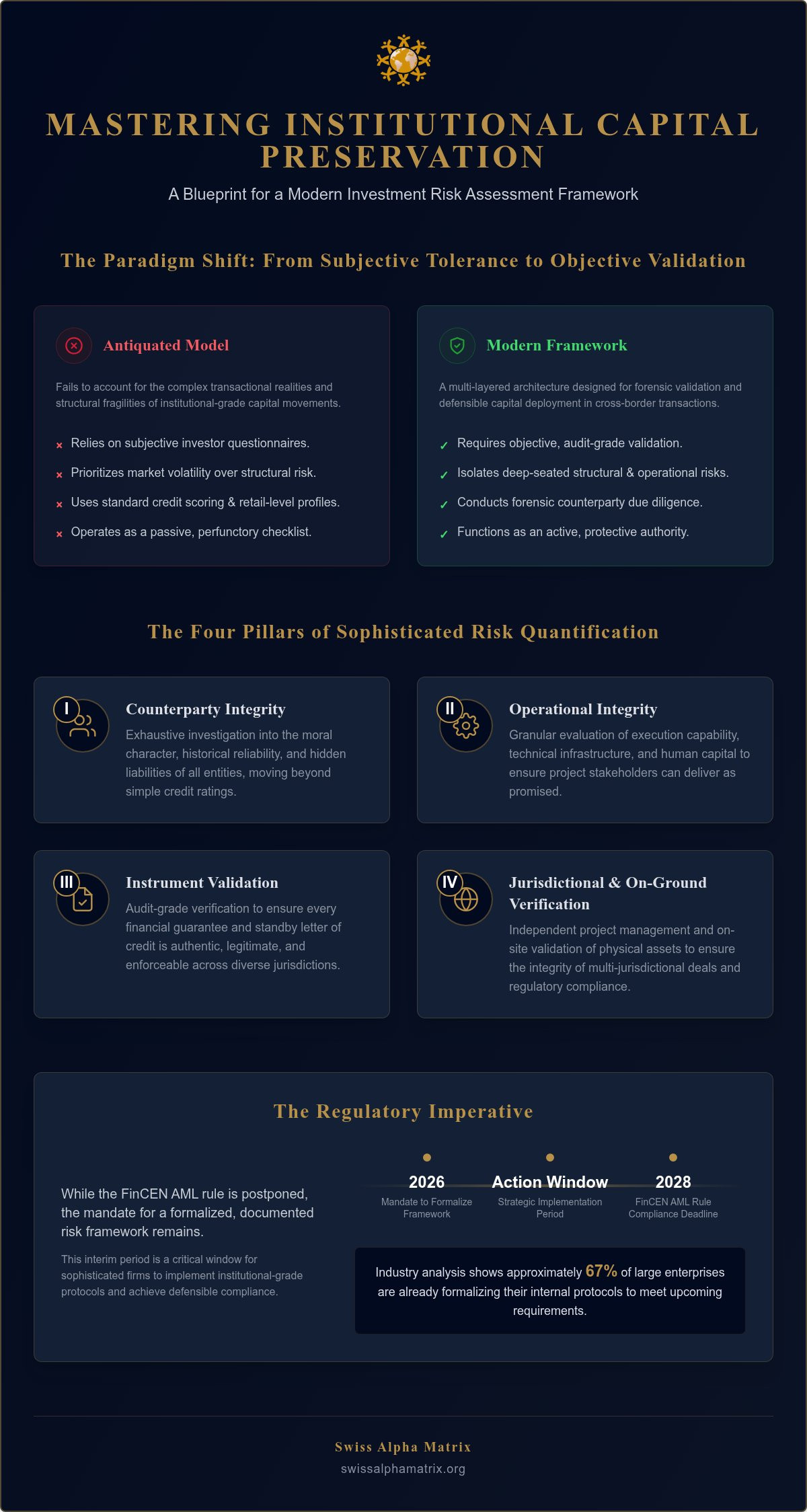
The industry is moving away from the antiquated model of subjective risk tolerance, which relies on investor questionnaires to gauge emotional comfort. In complex transactions, emotional comfort is irrelevant; what matters is the objective validation of the deal’s components. This necessitates the integration of bank instrument validation services to ensure that every financial guarantee and standby letter of credit is not only authentic but also enforceable across diverse jurisdictions. When dealing with multi-million dollar deployments, a framework that lacks on-ground verification and audit-grade validation is essentially a house built on sand.
Regulatory Foundations of Risk Frameworks in 2026
As we progress through 2026, the regulatory landscape demands a higher standard of documented precision. Although the FinCEN AML rule for investment advisers has seen its compliance deadline moved to January 1, 2028, the interim period is not a time for complacency. Large enterprises, which currently account for approximately 67% of the risk management market, according to recent industry analysis, are already formalizing their internal protocols to meet the upcoming requirement for documented risk assessments. A modern investment risk assessment framework must be dynamic, reflecting real-time shifts in geopolitical stability and counterparty health, rather than relying on a perfunctory annual review that fails to capture the velocity of today’s global markets. This evolution from a passive checklist to an active, protective authority ensures that capital preservation remains the primary objective in an increasingly volatile world.
The Four Pillars of Sophisticated Risk Quantification
To construct a truly defensible investment risk assessment framework, one must move beyond the surface-level metrics that satisfy basic compliance. The architecture of institutional safety rests upon four distinct yet interconnected pillars, each requiring a forensic level of scrutiny that standard advisory firms often fail to provide. This methodical approach shifts the focus from a perfunctory checklist to a comprehensive validation of the deal’s structural integrity.
Pillar I & II: Counterparty and Operational Integrity
Counterparty risk, when viewed through an institutional lens, requires an exhaustive investigation into the moral character and historical reliability of all involved entities. It’s not enough to rely on credit ratings; one must conduct deep-dive due diligence into institutional integrity to identify hidden liabilities or opaque ownership structures. This level of rigor aligns with the expectations for a sophisticated institutional risk-management framework, where the focus shifts from passive observation to active verification of the entities managing the capital.
Operational risk assessment involves a granular evaluation of the execution capability of project stakeholders. It asks whether the counterparty possesses the technical infrastructure and human capital necessary to fulfill the specific requirements of the mandate. In many cross-border scenarios, the gap between a counterparty’s stated capacity and their actual operational reality can be vast. Bridging this gap requires on-ground verification, ensuring that the stakeholders aren’t just paper entities but viable partners capable of managing complex mandates under pressure.
Pillar III & IV: Jurisdictional and Instrument-Specific Risks
The third pillar addresses jurisdictional risk, which has become increasingly volatile as global standards evolve. Navigating the dense landscape of international financial regulations is essential for protecting capital from unforeseen regulatory shifts or local legal challenges. A failure to account for regional legal nuances can render even the most promising deal unenforceable, leading to significant capital exposure in unfriendly legal environments.
Finally, the integrity of the financial instrument itself must be validated with clinical precision. Whether the transaction utilizes Standby Letters of Credit (SBLCs) or complex guarantee structures, audit-grade validation is mandatory to confirm that the underlying vehicles are authentic and properly collateralized. By meticulously examining these four pillars, an expert master planner can isolate vulnerabilities before they manifest as losses. For those seeking to fortify their internal protocols, implementing professional risk management frameworks provides the necessary layer of elite protection. This methodical approach transforms a speculative venture into a logically sound, institutional-grade deployment.
Beyond Behavioral Profiling: Why Questionnaires Fail Complex Transactions
Traditional wealth management often relies on behavioral finance models that attempt to quantify an investor’s emotional response to market fluctuations. While these models have some utility in retail portfolio allocation, they’re fundamentally ill-equipped to serve as a primary investment risk assessment framework for institutional-grade deployments. A questionnaire, regardless of its length or academic backing, cannot detect the forensic markers of a fraudulent bank instrument, nor can it evaluate the operational readiness of a counterparty in a foreign jurisdiction. It prioritizes the investor’s feelings over the objective integrity of the deal’s architecture, creating a false sense of security that evaporates when structural risks manifest.
The Limitations of Behavioral Finance in High-Stakes Mandates
The primary failure of the “risk quiz” methodology is the inherent discrepancy gap between stated risk preference and transactional reality. An investor might declare a high tolerance for volatility based on past market performance, yet this subjective self-assessment provides no protection against the structural failure of a cross-border project. In the high-stakes environment of 2026, where global transactions often involve complex layers of intermediaries and opaque regulatory environments, relying on behavioral profiling is a dangerous oversimplification. It treats risk as a psychological trait rather than a forensic variable that must be isolated and quantified through rigorous investigation.
In contrast to retail environments where market risk is the dominant concern, institutional mandates are frequently threatened by operational and counterparty failures. These threats don’t correlate with an investor’s appetite for volatility. A counterparty’s lack of execution capability or a jurisdictional shift in compliance standards will impact capital regardless of how “aggressive” or “conservative” the investor claims to be. Therefore, a framework that doesn’t account for these structural realities is not a risk management tool; it’s merely a compliance formality that leaves capital exposed to sophisticated fraud and operational negligence.
Moving Toward Forensic Financial Discipline
Transitioning from subjective profiles to objective safety requires a commitment to forensic financial discipline. This means prioritizing audit-grade evidence over personal narratives or unverified assertions provided by deal-makers. A sophisticated framework demands that every claim made by a stakeholder is backed by verifiable data and on-ground confirmation. This is where cross-border investment due diligence becomes the essential counter-measure. By replacing the retail-level quiz with a rigorous verification process, institutional entities can isolate the specific operational and jurisdictional risks that questionnaires simply ignore. Ultimately, the goal is to build a defensible position rooted in logic and verified fact, ensuring that capital preservation is never left to the vagaries of human emotion.
Implementing a Cross-Border Risk Mitigation Strategy
Transitioning from the theoretical understanding of structural risk to the practical application of a protective architecture requires a departure from passive observation. The first critical step in a sophisticated investment risk assessment framework is the establishment of independent oversight, entirely separate from the deal-making team. Transactional teams are naturally incentivized by the closure of a mandate, which can inadvertently lead to the glazing over of subtle red flags. By positioning an independent master planner as the final gatekeeper, an institution ensures that the evaluation remains unemotional, objective, and aligned with the long-term preservation of capital.
The Criticality of On-Ground Verification
While digital due diligence provides a necessary baseline, it’s insufficient for complex cross-border deployments where digital footprints are easily forged. A truly robust strategy demands on-ground verification of physical assets and institutional presence. This forensic step involves seasoned experts physically visiting the counterparty’s facilities, verifying the existence of stated collateral, and confirming the operational reality of the stakeholders. It’s the difference between reviewing a bank’s website and validating the actual authority of the signatories within the branch. This level of precision is the only way to close the gap between a paper-based proposal and a logically sound transaction.
Once the physical reality is confirmed, the process moves into the execution of a multi-layered financial advisory methodology. This phase integrates jurisdictional intelligence with technical instrument validation, ensuring that the legal and financial vehicles are perfectly aligned with the mandate’s requirements. For executive stakeholders who require absolute certainty before deployment, engaging in professional Audit-Grade Instrument Validation is a mandatory component of this methodology, providing a defensible record of the transaction’s integrity.
Maintaining Institutional Discipline Through PMO Oversight
The final pillar of implementation is the transition from initial assessment to continuous monitoring through a dedicated Project Management Office (PMO). Institutional discipline isn’t a one-time event; it’s a steady, unwavering pace of oversight that persists throughout the lifecycle of the capital deployment. The PMO serves as a protective authority, tracking performance metrics and operational milestones in real-time. If the transaction’s architecture begins to deviate from the established risk framework, the PMO provides the early warning system necessary to trigger mitigation protocols. This measured and logical approach ensures that the initial due diligence isn’t wasted, but rather serves as the foundation for a dynamic, ongoing defense of the institution’s interests.
Swiss Alpha Matrix: Institutional Discipline in Risk Framework Execution
Swiss Alpha Matrix operates at the intersection of traditional values and modern forensic rigor, serving as the definitive master planner for entities navigating the complexities of global capital deployment. By integrating a comprehensive investment risk assessment framework with the technical precision of former Tier-1 banking executives, the firm provides a standard of oversight that transcends the capabilities of conventional advisory services. This approach isn’t merely about identifying potential pitfalls; it’s about the clinical execution of protective strategies that ensure capital remains insulated from the structural fragilities of international markets.
Expertise Rooted in Tier-1 Global Banking
The firm’s leadership consists of seasoned professionals who have managed mandates at the highest levels of global finance. This background informs a methodology that prioritizes audit-grade intelligence, providing C-suite and executive stakeholders with the clarity required for high-stakes decision-making. Unlike generic risk tools, the reports generated by Swiss Alpha Matrix are designed for those who demand technical accuracy and intellectual depth. Every operational due diligence report and instrument validation is conducted with the same level of scrutiny found in the world’s leading financial institutions, ensuring that the findings are both defensible and actionable.
The Swiss Standard of Precision and Discretion
Central to the firm’s identity is an unwavering commitment to Swiss discretion, a principle that mirrors the traditional values of high-end private wealth management. This cultural foundation is coupled with a performance-oriented mindset that distinguishes active, expert participation from passive observation. The transition from risk assessment to capital protection is achieved through independent financial project management, a service that provides an essential layer of separation between the deal-making process and the oversight of the transaction’s architecture. This independence is vital for maintaining the integrity of the investment risk assessment framework, as it removes the inherent biases that can occur when the same team is responsible for both execution and validation.
Ultimately, Swiss Alpha Matrix delivers a standard of service that is both broad in its jurisdictional reach and meticulous in its attention to detail. By merging on-ground verification services with regulatory compliance advisory, the firm ensures that every component of a cross-border deployment is validated against the highest international standards. This logical and measured approach leads to a sense of professional calm, allowing institutional entities to deploy capital with the confidence that their interests are protected by masters of the industry. The result is a hyper-personalized strategy that prioritizes long-term preservation and strategic growth over the short-term speculation that often characterizes less disciplined approaches.
Fortifying the Architecture of Global Capital Deployment
The evolution of international finance toward the 2028 compliance horizon necessitates a transition from passive risk tolerance to an active, objective investment risk assessment framework. As we’ve established, the structural integrity of any cross-border transaction relies on the clinical validation of its four primary pillars: counterparty, operational, jurisdictional, and instrument-specific risks. Moving beyond the superficiality of retail-level questionnaires allows institutional entities to close the discrepancy gap between stated intent and transactional reality, ensuring that every deployment is rooted in forensic certainty. By prioritizing on-ground verification and independent oversight, you establish a defensible architecture of logic and verified fact that protects capital from sophisticated fraud.
Swiss Alpha Matrix serves as the master planner in this intricate landscape, merging the traditional discretion of Swiss excellence with the rigorous technical standards of former Tier-1 global bank executives. Our commitment to audit-grade reporting and meticulous project oversight provides the elite access necessary to navigate multi-jurisdictional deals with unwavering confidence. It’s essential to align your strategy with a standard of precision that prioritizes long-term preservation and regional excellence. Secure your capital through institutional-grade precision with Swiss Alpha Matrix. Your path toward professional calm and logical capital deployment starts with a dedicated partner who values technical accuracy above all else.
Frequently Asked Questions
What is the primary difference between risk tolerance and a risk assessment framework?
Risk tolerance represents a subjective measure of an investor’s psychological comfort with market volatility, whereas an investment risk assessment framework is an objective, forensic architecture designed to identify structural vulnerabilities. While tolerance focuses on the emotional capacity to endure price fluctuations, the framework prioritizes the clinical validation of transactional components. It’s a shift from internal sentiment to external verification, providing a logical basis for capital preservation in complex environments.
How do institutional risk frameworks address counterparty fraud in 2026?
Institutional protocols address counterparty fraud by moving beyond superficial credit ratings toward deep-dive investigations into institutional integrity and moral character. In the complex environment of 2026, this involves mapping opaque ownership structures and verifying the historical reliability of all involved entities. Such rigor ensures that potential vulnerabilities are isolated before capital is committed to the mandate, shifting the focus from passive observation to active, forensic verification.
Why is on-ground verification essential for cross-border investment risk assessment?
On-ground verification is essential because digital footprints and paper-based documentation are increasingly susceptible to sophisticated forgery in cross-border contexts. Physical site visits by seasoned experts confirm the actual existence of stated collateral and the operational capacity of stakeholders. This forensic step closes the gap between a digital proposal and the physical reality of the transaction’s architecture, ensuring that interests aren’t left to the mercy of unverified claims.
What role does a RACI matrix play in a risk management framework?
Within a sophisticated risk management framework, a RACI matrix serves to establish absolute clarity regarding accountability and responsibility across multi-jurisdictional teams. It ensures that every critical task, from instrument validation to regulatory reporting, has a designated owner and a clear line of communication. This structure prevents the operational drift that often leads to oversight failures in high-stakes mandates, maintaining a steady, unwavering pace of execution.
Can a standard internal audit replace a specialized risk assessment framework?
A standard internal audit typically focuses on retrospective compliance with existing internal policies, which lacks the forensic depth required for complex, cross-border capital deployments. A specialized investment risk assessment framework is proactive, utilizing audit-grade intelligence to validate the structural integrity of a deal before execution. It provides a level of specialized oversight that general internal functions aren’t equipped to deliver, ensuring that every claim is backed by verifiable data.
How do global regulatory changes in 2026 impact investment risk assessment?
Regulatory shifts in 2026, including the formalization of documented risk assessments under the Bank Secrecy Act framework, demand a higher standard of technical precision from investment entities. While certain compliance deadlines have been extended to 2028, the current mandate is to utilize this period for the implementation of robust, defensible protocols. This trend reflects a global movement toward mandatory, documented verification of products, services, customers, and specific geographies.
What are the hallmarks of audit-grade financial instrument validation?
Audit-grade financial instrument validation is characterized by a clinical examination of the vehicle’s technical accuracy, jurisdictional alignment, and the verified authority of the signatories. It involves confirming that guarantees, such as Standby Letters of Credit, are not only authentic but also properly collateralized and enforceable within the specific legal environment of the deal. This level of scrutiny provides executive stakeholders with a defensible record of the transaction’s structural safety and integrity.