

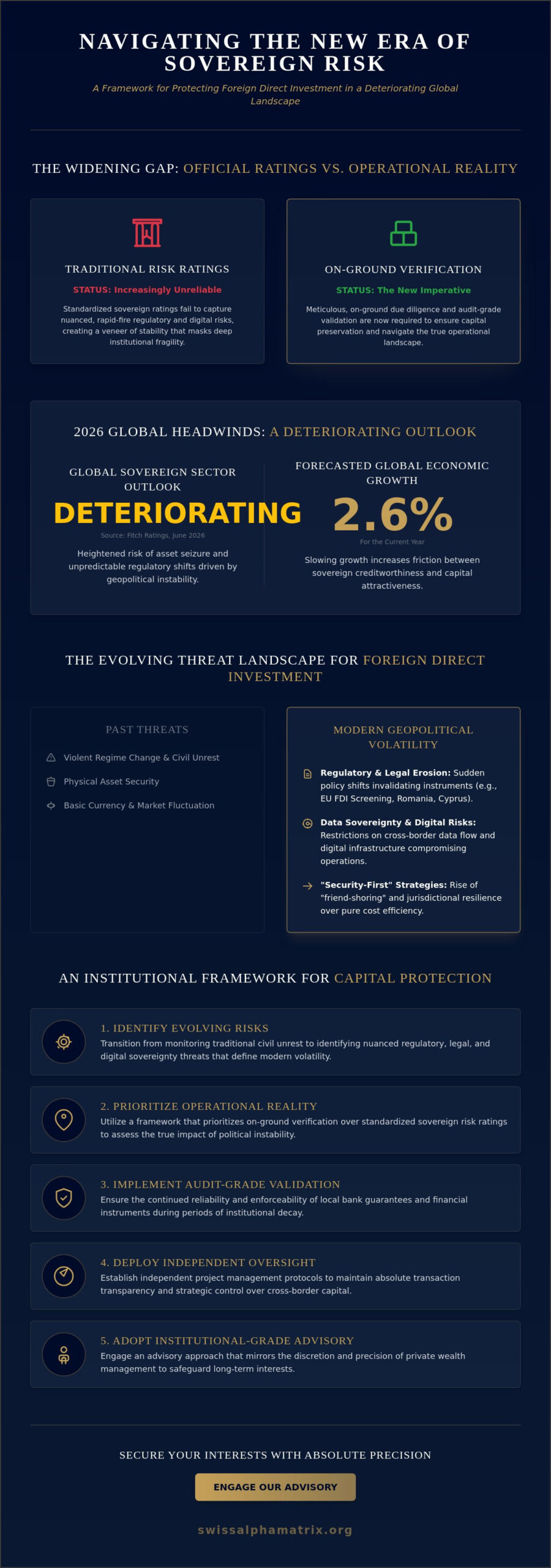
The traditional reliance on standardized sovereign risk ratings has become a precarious liability for the modern institutional investor. With Fitch Ratings recently downgrading the global sovereign sector outlook to “deteriorating” as of June 2026, the political instability impact on foreign direct investment has moved beyond theoretical risk into a tangible era of operational decay. You’ve likely recognized that the widening gap between official reporting and the reality of local regulatory shifts leaves cross-border capital increasingly vulnerable to asset seizure or the sudden invalidation of bank instruments. It’s a landscape where the veneer of stability often masks deep-seated institutional fragility.
We understand that in this climate, your primary objective isn’t merely the pursuit of yield, but the meticulous preservation of capital through absolute precision. This analysis provides an executive-level framework for securing interests via audit-grade validation and sophisticated on-ground verification methodologies. We’ll explore the institutional strategies required to navigate the stringent new EU FDI Screening Regulations adopted this month, while establishing a structured approach to maintaining operational integrity despite the heightened volatility of the current global sovereign environment.
Key Takeaways
- Identify the transition from traditional civil unrest to the nuanced regulatory and digital sovereignty risks that now define modern geopolitical volatility.
- Evaluate the political instability impact on foreign direct investment by utilizing a framework that prioritizes on-ground operational reality over standardized sovereign risk ratings.
- Implement audit-grade instrument validation to ensure the continued reliability of local bank guarantees and financial instruments during periods of institutional decay.
- Deploy independent project management protocols to maintain absolute transaction transparency and strategic control over complex cross-border capital deployments.
- Adopt an institutional-grade advisory approach that mirrors the discretion of private wealth management to safeguard long-term interests in a deteriorating global sovereign landscape.
The Evolving Landscape of Political Instability and FDI in 2026
The concept of stability, once a static metric in sovereign risk assessments, has evolved into a fluid and highly complex dynamic. In 2026, the political instability impact on foreign direct investment is no longer characterized solely by the threat of violent regime change; instead, it is defined by the subtle, yet profound, erosion of the legal and regulatory frameworks that underpin cross-border capital. As global economic growth slows to a forecasted 2.6% this year, the relationship between sovereign creditworthiness and capital attractiveness has become increasingly fraught. To navigate these complexities, sophisticated entities must first understand the core tenets of What is Foreign Direct Investment, specifically how it serves as a long-term commitment that is uniquely vulnerable to the shifting sands of local governance and institutional decay.
Modern Dimensions of Geopolitical Volatility
The current year has seen a marked acceleration in “Security-First” investment strategies, where the priority has shifted from cost efficiency to jurisdictional resilience. This is evidenced by the new EU Foreign Direct Investment Screening Regulation adopted on June 8, 2026, which mandates national screening mechanisms across all member states to safeguard sensitive sectors. Such sudden policy shifts, while intended to protect national interests, create significant hurdles for long-term capital projects by introducing layers of administrative complexity that can delay or derail deployment. We’ve observed similar pivots in Romania, which raised its mandatory notification threshold to EUR 5 million in March 2026, and Cyprus, which implemented a rigorous new screening framework in April. These regulatory layers, combined with increasingly stringent data sovereignty laws and the influence of regional trade blocs, represent a new frontier of volatility that requires meticulous, on-ground verification to ensure compliance and capital safety.
The Investor’s Entry State: Risk vs. Opportunity
For the institutional investor, the psychological landscape of 2026 is one of calculated caution. The June 2026 downgrade of the global sovereign sector outlook by Fitch Ratings, largely attributed to the repercussions of the US-Iran war, has heightened the perceived risk of asset seizure and regulatory shifts. While emerging markets continue to offer high-growth potential, the fear of capital flight and the unpredictability of local bank instruments often outweigh the allure of high returns. True safe havens are becoming a rarity in our multipolar world, forcing a realignment of supply chains toward “friend-shoring” jurisdictions where strategic interests align. Consequently, C-suite decision-making now demands a methodology that goes beyond desktop due diligence, seeking instead a framework that guarantees operational reality despite the deteriorating sovereign outlook. This shift necessitates a move toward audit-grade validation of all local financial instruments to maintain liquidity and confidence.
To effectively manage these risks, investors are increasingly turning to the following strategic pillars:
- Audit-Grade Instrument Validation: Ensuring that local bank guarantees and letters of credit remain enforceable despite sovereign shifts.
- Regulatory Compliance Advisory: Navigating the rapid harmonization of FDI screening across the European Union and other major trade blocs.
- Operational Due Diligence: Verifying that the physical and digital infrastructure on the ground matches the data provided in institutional reports.
Quantifying the Erosion: How Instability Compromises Financial Instrument Validity
The political instability impact on foreign direct investment extends far beyond the physical security of assets, often manifesting as a silent erosion of the contractual certainty that underpins international finance. In the current climate, characterized by the June 2026 “deteriorating” outlook for the global sovereign sector, the assumption that a local bank guarantee remains a static obligation is a dangerous oversimplification. When a host nation faces fiscal distress or geopolitical friction, the reliability of its financial institutions often mirrors the volatility of its leadership. This correlation is explored in depth within the Analysis of Political Risks on FDI, which highlights how sovereign interference can pivot from subtle regulatory shifts to the direct freezing of cross-border liquidity. For the sophisticated investor, understanding this erosion requires a transition from traditional credit analysis to a more rigorous model of political risk integration.
The Vulnerability of SBLCs and Letters of Credit
Standby Letters of Credit (SBLCs) and other international guarantees are only as robust as the jurisdictional environment that hosts the issuing bank. During periods of heightened unrest, such as the regional shocks witnessed in early 2026, local bank insolvency can occur with startling speed, rendering once-prestigious instruments effectively worthless. Currency fluctuations and the sudden imposition of capital controls further complicate the liquidity of these instruments, as governments move to trap foreign currency within their borders to stabilize failing domestic markets. It’s no longer sufficient to verify a bank’s balance sheet; one must also verify the bank’s ability to fulfill its obligations under a regime that may prioritize national survival over private contract law. This is where specialized bank instrument validation services become indispensable, providing an audit-grade layer of protection that accounts for the specific political pressures acting upon a financial counterparty.
Counterparty Risk in Unstable Jurisdictions
Identifying red flags in local financial partners during a government transition requires a master planner’s perspective on regional precision. A partner who appears solvent today may become a liability tomorrow if their political alignment falls out of favor with a new administration. We’ve seen that the most resilient transaction structures often utilize secondary and tertiary bank relationships in neutral jurisdictions to ensure transaction integrity. Counterparty risk represents the precarious intersection where a partner’s financial solvency meets their continued alignment with a shifting political regime. To mitigate these risks, we recommend a tiered approach to Audit-Grade Instrument Validation, ensuring that every link in the financial chain is verified against the reality of the ground-level political environment.
The demand for such precision is reflected in the 33% increase in political risk insurance demand reported by Howden in 2025, as entities seek to cushion their portfolios against the unpredictability of sovereign behavior. This trend underscores a broader shift toward institutional-grade oversight, where the validity of a financial instrument is treated as a dynamic variable rather than a fixed certainty.
The Discrepancy Between Institutional Data and Operational Reality
The reliance on secondary data, while historically considered a standard of care, represents a significant vulnerability when the political instability impact on foreign direct investment accelerates beyond the reporting cycles of major financial institutions. Desktop due diligence, which often depends on digitized records and annual sovereign ratings, fails to account for the localized operational decay that precedes a full-scale institutional crisis. At Swiss Alpha Matrix, we define the “Due Diligence Gap” as the critical discrepancy between official sovereign data and the actual conditions on the ground; it’s a space where asset seizure risks and regulatory shifts are often obscured by a veneer of bureaucratic normalcy. In a year defined by the repercussions of the US-Iran conflict and shifting EU screening mandates, the speed at which operational reality deviates from institutional data requires a more agile and intrusive form of oversight.
The Limitations of Secondary Data
Risk indices, including those issued by major global rating agencies, naturally suffer from a temporal lag, reflecting past performance rather than immediate geopolitical shifts. In 2026, local censorship and the sophisticated manipulation of economic data can mask deteriorating conditions, leading investors into a false sense of security based on outdated metrics. Successfully mastering cross-border investment due diligence requires a pivot toward primary sources and raw, unverified data that hasn’t been filtered through the lens of state-controlled reporting agencies. Relying on secondary data in high-stakes environments is no longer a matter of thoroughness; it’s a matter of institutional negligence that overlooks the nuances of regional precision.
The Necessity of On-Ground Verification
Audit-Grade on-ground verification serves as a fundamental tool for executive-level intelligence, providing a level of precision that secondary data cannot match. Physical site visits, when conducted with the traditional discretion associated with Swiss financial standards, allow for the verification of tangible project milestones and the assessment of local stakeholder sentiment. These interactions reveal the true state of project health, identifying potential red flags, such as local regulatory friction or supply chain disruptions, long before they manifest in a formal credit downgrade. Independent project management (PMO) protocols ensure that transaction transparency is maintained, providing a protective layer of authority that safeguards cross-border capital from the unpredictable shifts of a host nation’s political landscape. This meticulous attention to detail distinguishes a performance-oriented mindset from the passive participation of those who rely solely on institutional data.
Strategic Risk Mitigation Frameworks for Cross-Border Capital Protection
To move beyond the passive observation of jurisdictional decay, institutional investors must adopt a tiered risk management framework that prioritizes the structural integrity of every deployment. This systematic approach ensures that the political instability impact on foreign direct investment is neutralized through layers of proactive oversight rather than reactive crisis management. By establishing clear thresholds for capital exposure and utilizing a rigorous RACI matrix, we clarify stakeholder accountability in environments where local governance may be compromised. Such a framework doesn’t merely acknowledge risk; it actively manages it by tethering transaction progress to the strictest international financial regulations, ensuring that every movement of capital remains within a verifiable, compliant corridor.
Operational Due Diligence as a Defensive Shield
In the context of 2026’s multipolar volatility, operational due diligence functions as the primary barrier against capital misallocation by verifying that local partners possess the technical and ethical capacity to perform under pressure. This process begins with an exhaustive audit of the counterparty’s historical adherence to regulatory standards, followed by a real-time assessment of their current operational resilience. By integrating regulatory compliance advisory directly into the daily project management workflow, we ensure that shifts in local law or international sanctions are identified and mitigated before they can impact the project’s bottom line. The goal is to create a transparent environment where data is not merely accepted but rigorously interrogated against the reality of the ground-level environment.
Independent Project Oversight and Milestone Validation
The distinction between “paper milestones” and “verified deliverables” is often the difference between capital preservation and total loss in high-stakes cross-border deals. Standard reporting from local contractors can be influenced by political pressure or institutional bias, necessitating the deployment of independent financial project management to provide an unbiased perspective. This master planner approach utilizes audit-grade reporting to provide boards and institutional stakeholders with the granular detail required for informed decision-making. We focus on the following pillars to ensure transaction transparency:
- Physical Verification of Assets: Ensuring that the infrastructure described in reports exists in the physical world and meets the specified standards.
- Stakeholder Alignment Audits: Verifying that local partners remain committed to the project’s objectives despite external political shifts.
- Fiduciary Oversight: Maintaining a steady, logical flow of funds that is strictly tied to the successful completion of verified project phases.
This disciplined methodology creates a sense of professional calm, allowing investors to maintain their strategic focus even as global sovereign outlooks deteriorate. To secure your next international deployment with the precision of a dedicated partner, explore our comprehensive Risk Management Frameworks today.
Navigating Volatility with Institutional-Grade Advisory and Oversight
Addressing the political instability impact on foreign direct investment requires more than just a set of protocols; it demands a fusion of historical wisdom and contemporary technical precision. While standardized risk metrics offer a foundational view, they often lack the granular insight necessary to protect capital during the rapid institutional decay witnessed in early 2026. At Swiss Alpha Matrix, we bridge the gap between abstract risk assessments and operational certainty by merging Tier-1 banking expertise with the traditional discretion of Swiss financial stewardship. This transition from passive risk monitoring to active project management ensures that your interests aren’t merely observed but are meticulously validated against the reality of the ground-level environment.
The Value of Senior Executive Intelligence
Our team, comprised of former senior executives with decades of transactional experience, provides a master planner perspective that is essential for anticipating political risk patterns before they manifest in global indices. This partner-led advisory model ensures that complex, multi-layered financial programs benefit from a level of intellectual depth that avoids the oversimplifications of traditional consulting. By establishing a risk management framework that prioritizes long-term capital preservation over short-term speculation, we provide the stability required to navigate a global sovereign sector currently facing a deteriorating outlook. It’s this commitment to moral character and high-level standards that allows us to identify the subtle red flags that secondary data often overlooks.
Your Partner in Cross-Border Execution
Positioning ourselves as a boutique entity, we value privacy and exclusivity above all else, acting as a dedicated partner rather than a mere service provider. Our methodology, rooted in regional excellence and meticulous attention to detail, ensures that every deployment is governed by technical accuracy and institutional rigor. We understand that in a multipolar world, the implicit promise of high-level access and hyper-personalized strategy is what distinguishes a performance-oriented mindset from passive participation. By tethering modern strategies to concepts of regional precision, we secure the future of your international deployments with an unwavering focus on excellence. We invite you to engage Swiss Alpha Matrix for institutional-grade project oversight and due diligence to ensure your interests remain in the hands of seasoned, unemotional experts.
Securing Institutional Longevity in a Multipolar Era
The shifting geopolitical landscape of 2026 demands a departure from the complacency of traditional risk management. We’ve explored how the political instability impact on foreign direct investment manifests through subtle regulatory erosions and the hidden decay of local bank instruments; this reality necessitates a transition to audit-grade validation. By bridging the discrepancy between lagging institutional data and ground-level operational reality, sophisticated entities can establish a defensive shield that prioritizes long-term capital preservation over speculative growth.
Maintaining transaction transparency requires the steady, logical oversight of a partner who understands the intricate intersection of sovereign shifts and financial solvency. Managed by former Tier-1 global bank executives, our team specializes in audit-grade instrument validation and on-ground verification, offering a global reach tempered by Swiss levels of discretion and precision. We invite you to secure your international capital with Swiss Alpha Matrix advisory and ensure your deployments are governed by institutional-grade rigor. With a finessed framework in place, you’ll find that even the most complex global shocks can be navigated with professional calm and strategic confidence.
Frequently Asked Questions
How does political instability directly affect the validity of a Standby Letter of Credit (SBLC)?
Political instability compromises the validity of an SBLC by triggering sovereign interference, such as the imposition of capital controls or the sudden insolvency of local financial institutions. In high-risk jurisdictions, the legal enforceability of these instruments often deteriorates alongside the host nation’s fiscal stability. This reality necessitates audit-grade validation to confirm that the guarantee remains a liquid asset rather than a stranded liability during a regime transition.
What is the difference between sovereign risk and political risk in FDI?
Sovereign risk pertains specifically to a government’s ability or willingness to meet its debt obligations, whereas political risk encompasses a broader spectrum of jurisdictional shifts, including regulatory volatility and asset seizure. Both factors are critical components of the political instability impact on foreign direct investment. While a nation may remain technically solvent, its shifting policy landscape can still render private investments unviable through sudden legislative reversals.
Why is on-ground verification more reliable than a standard due diligence report?
On-ground verification provides real-time, primary evidence of operational reality that standard reports, which often rely on lagging secondary data, consistently fail to capture. Physical inspections and local stakeholder interviews reveal the true state of project milestones and site infrastructure. This intrusive level of oversight bypasses the data manipulation or censorship that frequently masks institutional decay in volatile regions, ensuring that executive decisions are based on fact.
Can political risk insurance (PRI) fully protect an investment from government interference?
Political risk insurance serves as a critical financial cushion, but it doesn’t provide absolute operational protection or prevent the underlying decay of a project’s strategic value. While PRI covers specific events like expropriation or currency inconvertibility, it often involves complex claim processes and high premiums. True capital preservation requires merging insurance with active, on-ground project management to mitigate risks before they escalate into insured losses.
How often should a risk management framework be updated in a volatile jurisdiction?
A risk management framework must be treated as a dynamic instrument, requiring reassessment at every significant project milestone or whenever a shift in local governance occurs. In the current global environment, characterized by rapid regulatory changes such as the new EU FDI screening mandates, a quarterly review is often the minimum standard. This ensures that the strategic architecture of the deployment remains aligned with the evolving jurisdictional reality on the ground.
What role does the RACI matrix play in managing international financial projects?
The RACI matrix clarifies stakeholder accountability by defining who is Responsible, Accountable, Consulted, and Informed across every phase of a complex deployment. In volatile environments, where local reporting lines can become obscured by institutional shifts, this matrix provides a necessary layer of transaction transparency. It prevents the dilution of responsibility and ensures that fiduciaries maintain precise control over cross-border capital movements through defined authority structures.
How does Swiss Alpha Matrix verify the solvency of a local counterparty during unrest?
We utilize audit-grade instrument validation and intrusive operational due diligence to verify a counterparty’s financial health beyond their published balance sheets. This involves analyzing their secondary banking relationships in neutral jurisdictions and conducting on-site audits of their technical capacity. Our team applies a master planner’s perspective to identify subtle fiscal red flags that standard credit ratings often overlook during periods of heightened political instability impact on foreign direct investment.
Is it possible to maintain regulatory compliance when local laws are in flux?
Maintaining compliance is possible through the implementation of a rigorous regulatory compliance advisory that monitors local shifts in real-time against international standards. By tethering all operations to the most stringent global financial regulations, investors can insulate their projects from the unpredictability of local legislative pivots. This structured approach ensures that the project remains a compliant entity, regardless of the host nation’s internal political volatility or administrative shifts.