

What if the SWIFT MT760 currently residing in your transaction folder, despite its technical appearance of legitimacy, lacks the underlying institutional standing required for actual enforcement within a distressed scenario? You likely recognize that a standard bank guarantee validation process often falls short when it’s confronted with the intricate nuances of varying jurisdictions or the opaque internal policies of distant issuing banks. In an era where global M&A values reached USD 2.8 trillion in the first half of 2026, the reliance on cross-border financial instruments has reached unprecedented levels, yet the sophistication of fraudulent activity has evolved with equal precision.
It’s understandable that many institutional leaders feel a sense of unease when deploying capital against instruments issued by banks where they lack direct, high-level access. This guide serves as a comprehensive roadmap for navigating these complexities through an audit-grade validation framework that prioritizes absolute certainty over mere compliance. We’ll explore the transition from simple documentary checks to a more robust methodology, incorporating on-ground verification and the stable application of UCP 600 and ISP98 standards, to provide your stakeholders with the definitive documentation and strategic calm they require.
Key Takeaways
- Understand why a sophisticated bank guarantee validation process is the essential threshold for mitigating cross-border risk and ensuring the practical enforceability of financial instruments.
- Navigate the 2026 landscape of ICC standards, confirming that UCP 600 and ISP98 remain the foundational rules for institutional validation despite the broader digital transition.
- Identify the critical limitations of standard correspondent bank verification and why independent, audit-grade oversight is required to protect capital in unfamiliar jurisdictions.
- Master a multi-stage protocol that analyzes an issuing institution’s actual liquidity and on-ground standing rather than relying solely on automated technical messages.
- Discover how applying Tier-1 banking discipline to independent advisory mandates provides the necessary intellectual depth to challenge and verify complex standby instruments.
The Strategic Imperative of the Bank Guarantee Validation Process
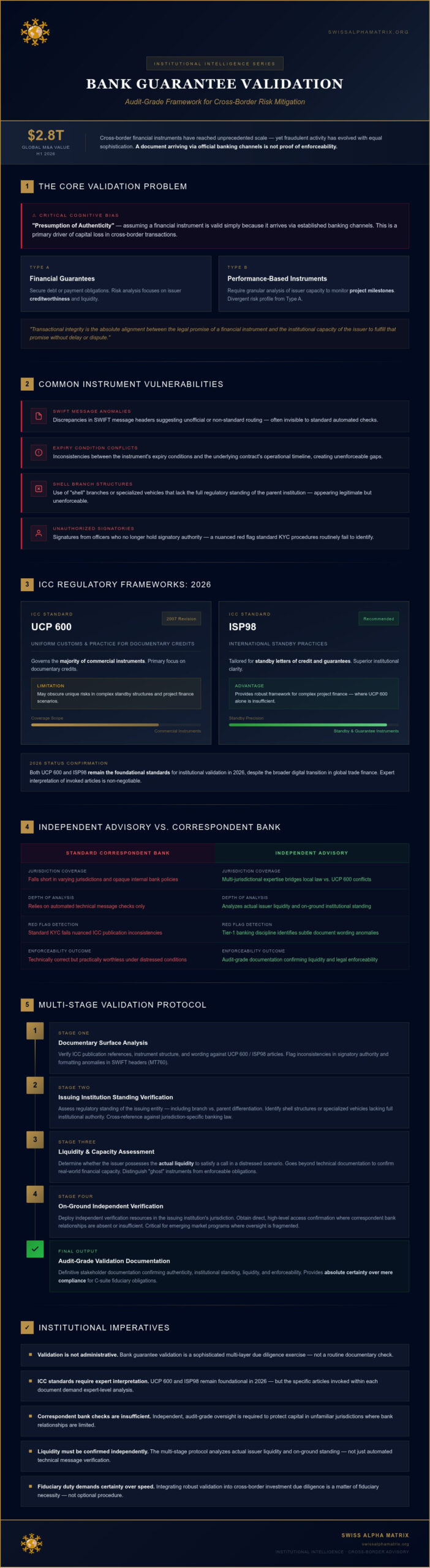
The bank guarantee validation process represents far more than a routine administrative check; it’s a sophisticated, multi-layered due diligence exercise designed to confirm the institutional standing and operational intent of the issuing entity. In high-stakes international mandates, a bank guarantee serves as the bedrock of security, yet many participants operate under a dangerous “presumption of authenticity” that assumes a document is valid simply because it arrives via established banking channels. This cognitive bias is a primary driver of capital loss, as it ignores the possibility of “ghost” instruments or institutions that lack the actual liquidity to satisfy a call. True validation requires distinguishing between purely financial guarantees, which secure debt or payment, and performance-based instruments, which demand a more granular analysis of the issuer’s capacity to monitor the underlying project’s milestones. This distinction is critical because the risk profiles of these instruments diverge significantly, requiring tailored verification protocols that address both the creditworthiness of the bank and the technical precision of the document’s wording.
Vulnerabilities in Cross-Border Financial Instruments
Sophisticated financial fraud has evolved significantly, particularly within emerging market programs where oversight may be fragmented. Standard KYC procedures often fail to identify nuanced red flags, such as subtle inconsistencies in ICC publication references or signatures from officers who no longer hold signatory authority. If the validation is inadequate, the legal enforceability of the underlying contract is immediately compromised, leaving the beneficiary with a technically correct but practically worthless piece of paper. This risk is exacerbated in jurisdictions where local banking laws might conflict with international standards like UCP 600, creating a gap that only rigorous, independent verification can bridge. Common vulnerabilities often include:
- Discrepancies in SWIFT message headers that suggest unofficial or non-standard routing.
- Inconsistencies between the instrument’s expiry conditions and the underlying contract’s operational timeline.
- The use of “shell” branches or specialized vehicles that lack the full regulatory standing of the parent institution.
Strategic Impact on Capital Deployment Decisions
For the C-suite, integrating a robust bank guarantee validation process into the broader cross-border investment due diligence framework is a matter of fiduciary necessity. It ensures that stakeholders are protected by instruments that aren’t only authentic but also liquid and enforceable under stress. This level of oversight reflects a commitment to long-term preservation over speculative speed, positioning the firm as a disciplined participant in the global market. Transactional integrity is the absolute alignment between the legal promise of a financial instrument and the institutional capacity of the issuer to fulfill that promise without delay or dispute.
Regulatory Frameworks: Navigating UCP 600 and ISP98 Standards
The efficacy of any bank guarantee validation process rests upon the meticulous alignment of the instrument with established International Chamber of Commerce (ICC) standards. While these rules provide a standardized lexicon for global trade, their application requires an expert interpretation of the specific articles invoked within the document’s text. The foundational role of the Uniform Customs and Practice for Documentary Credits (UCP 600), specifically the 2007 revision, continues to govern the majority of commercial instruments, yet its focus on documentary credits can sometimes obscure the unique risks inherent in standby structures. Conversely, the International Standby Practices (ISP98) offer a more robust framework tailored for standby letters of credit and guarantees, providing institutional clarity that UCP 600 may lack in complex project finance scenarios. It’s this technical nuance that determines whether a security remains enforceable or becomes a point of contention during a call.
Identifying non-standard clauses is a critical component of validation, as even a minor deviation from ICC-sanctioned language can inadvertently waive protection or introduce jurisdictional ambiguities. The choice of law and jurisdictional clauses are particularly significant; they dictate which legal system interprets the instrument if a dispute arises, potentially overriding the ICC rules themselves. Without a seasoned eye to scrutinize these technicalities, an entity might find its security compromised by a local regulation that contradicts the expected international standard. Professional validation ensures that these legal tethers are secure before capital is committed.
UCP 600 vs. ISP98: Selecting the Appropriate Framework
Sophisticated practitioners often favor ISP98 for complex project finance because it addresses the operational realities of standby instruments more precisely than rules designed for commercial letters of credit. For instance, the Trade Finance Guide highlights how these frameworks provide the predictability necessary for cross-border transactions. Key articles within UCP 600, such as Article 14 regarding the standard for examination of documents, remain relevant, yet they may not account for the automatic extension or “evergreen” clauses frequently found in modern performance guarantees. Selecting the wrong framework can lead to significant pitfalls, particularly when attempting to validate the enforceability of a call under distressed conditions.
Ensuring Regulatory Clarity in 2026
As of July 2026, the ICC Banking Commission has confirmed that there will be no revision to UCP 600 or ISP98, focusing instead on digital transition and education. This stability means that the bank guarantee validation process must remain anchored in the 2007 and 1998 publications respectively, ensuring that every instrument explicitly subjects itself to these specific revisions. Understanding how evolving international financial regulations influence the validation of issuing bank liquidity is paramount for maintaining transactional security. If you’re managing high-value mandates, establishing a dedicated risk management framework ensures that your regulatory compliance is never left to chance.
Independent Advisory vs. Conventional Correspondent Bank Verification
While correspondent banking networks serve as the traditional conduit for international financial communication, they often lack the critical distance required for truly unbiased scrutiny. When an advising bank undertakes the bank guarantee validation process for an instrument issued by a long-standing correspondent partner, a subtle but pervasive conflict of interest can emerge. This institutional proximity often leads to a cursory review that prioritizes relationship maintenance over the rigorous, unemotional risk assessment that high-net-worth stakeholders require. Consequently, sophisticated investors are increasingly opting for an independent “second pair of eyes” to oversee these mandates, ensuring that the validation remains entirely insulated from the commercial pressures and reciprocal obligations of the global correspondent network.
This independent approach is not merely a redundant layer of oversight; it’s a strategic necessity in an environment where the mere presence of a technical message does not equate to the presence of liquid assets. By integrating this scrutiny into a broader framework of independent financial project management, firms can maintain long-term oversight that extends far beyond the initial issuance. This ensures that the instrument remains valid and the issuer remains solvent throughout the entire lifecycle of the project, providing a level of security that standard banking protocols simply aren’t designed to offer.
The SWIFT MT760 Authentication Gap
It’s a common misconception within the industry that a verified SWIFT MT760 message provides a definitive seal of authenticity and enforceability. In technical terms, authentication merely confirms that the message originated from the stated source and has not been altered in transit; it does not, however, validate the underlying substance of the promise or the current solvency of the issuing branch. Even institutions with seemingly “clean” KYC and AML profiles can harbor significant operational risks that technical messages fail to capture. A deep-dive due diligence exercise must look beyond the digital screen to analyze the specific mandate context and the issuing bank’s actual capacity to satisfy a demand, particularly when dealing with non-standardized or complex performance-based instruments.
The Imperative of On-Ground Verification
In unfamiliar or emerging jurisdictions, documentary evidence is rarely sufficient to guarantee transactional integrity. The “ghost bank” phenomenon, where entities present a facade of institutional legitimacy through sophisticated digital footprints and rented office space, requires a physical counter-measure. On-ground verification involves confirming the operational capacity and physical presence of the issuing branches, utilizing local intelligence to assess their real-world standing among regional regulators and peers. This granular level of oversight is a hallmark of a professional bank guarantee validation process, where the goal is to provide stakeholders with absolute certainty regarding the counterparty’s physical existence and their actual ability to perform under stress. This proactive stance distinguishes a performance-oriented mindset from the passive acceptance of standard, often inadequate, banking communications.
The Multi-Stage Protocol for Bank Guarantee Validation
While the receipt of a financial instrument often signals the commencement of a transaction, for the prudent beneficiary, it marks the beginning of a rigorous, five-stage bank guarantee validation process. This protocol is designed to transition from a baseline “presumption of authenticity” toward an audit-grade certainty that the instrument is both legitimate and enforceable. Unlike the standard administrative checks performed by many advising banks, this multi-layered approach scrutinizes the intersection of technical wording, institutional liquidity, and jurisdictional stability. It’s a structured methodology that ensures the promise of payment is backed by the issuer’s actual capacity to perform under stress.
- Step 1: Institutional Standing Analysis. This phase moves beyond the superficial comfort of credit ratings to evaluate the issuer’s actual liquidity reserves and settlement capabilities within specific currency corridors.
- Step 2: Technical Document Review. A meticulous examination ensures that every clause aligns with both the underlying project requirements and the specific ICC rules, such as UCP 600 or ISP98, cited in the text.
- Step 3: SWIFT Message Scrutiny. This involves verifying the technical sequence and authenticity of MT760 communications, ensuring that the message was routed through authorized channels without unauthorized deviations.
- Step 4: Operational Clause Audit. Experts identify “soft” clauses or ambiguous trigger conditions that could provide the issuer with a technical loophole to delay or deny a legitimate call.
- Step 5: Final Risk Assessment. The process concludes with the issuance of an independent, executive-level opinion on the instrument’s overall enforceability and risk profile.
Scrutinizing Operative Clauses and Trigger Conditions
The presence of “poison pills” within an instrument’s text is a frequent cause of capital loss in international trade. These are often disguised as “non-documentary” conditions, requirements for third-party certifications that are practically impossible to obtain, or achievement-based triggers that lack objective verification methods. A professional validation ensures that “demand” requirements are achievable and that the beneficiary’s right to draw is not compromised by operational hurdles. For those overseeing high-value mandates, engaging in professional Audit-Grade Instrument Validation ensures that every stage of this protocol is executed with institutional precision.
Verifying the Issuing Institution’s Global Standing
Evaluating an issuer’s global standing requires an analysis of their Tier-1 correspondent relationships and their ability to settle obligations through major clearing systems. Jurisdictional risk must also be factored in, particularly the potential for local banking moratoria or regulatory shifts that could impede the outward transfer of funds. Institutional standing is the aggregate of an entity’s regulatory compliance, verified liquidity reserves, and its proven capacity to settle international obligations through established Tier-1 channels. Without this high-level standing, even a technically perfect document lacks the necessary weight to serve as a reliable security.
Institutional Oversight: The Swiss Alpha Matrix Methodology
The Swiss Alpha Matrix methodology represents the culmination of decades spent within the upper echelons of global finance, applying Tier-1 banking discipline to the independent advisory space. This framework is not merely a technical checklist; it is a profound commitment to intellectual depth and the refusal to oversimplify the complex dynamics of international trade. By merging specialized bank instrument validation services with executive-level intelligence, we provide a layer of protection that standard bank KYC procedures simply cannot replicate. This approach is rooted in the traditional discretion of Swiss private wealth management, ensuring that sensitive cross-border capital deployment is handled with technical precision and a sense of quiet authority. The ultimate goal of our bank guarantee validation process is to move stakeholders from a position of transactional uncertainty to one of audit-grade precision, where every risk is accounted for and every instrument is verified for its actual standing.
Securing Capital Deployment with Quiet Authority
Our senior-led team, comprised of former executives from Tier-1 global banks, provides the expert oversight necessary during complex negotiations where the technicalities of a guarantee are often used as leverage. We ensure that every instrument under review strictly adheres to the financial advisory methodologies required for genuine capital protection. In recent mandates, this meticulous document and issuer scrutiny has repeatedly prevented exposure to programs where the issuing institutions, despite their outward appearances of legitimacy, lacked the verified liquidity to fulfill their obligations under stress. This level of protective authority is essential for navigating unfamiliar jurisdictions where the “presumption of authenticity” remains a primary driver of financial loss.
Strategic Partnership Beyond the Validation Report
Validation shouldn’t be viewed as a static event that concludes once a report is issued. Instead, we view our role as a dedicated partner, providing ongoing monitoring of instrument validity throughout the entire project lifecycle to ensure continued compliance with the underlying contract. We manage the delicate interface between legal counsel, issuing banks, and executive stakeholders, ensuring that communication remains steady and highly logical even when technical disputes arise. This standard of service is both broad in reach and meticulous in its attention to detail, reflecting a commitment to regional excellence and the long-term preservation of capital. It’s a persona that values privacy and exclusivity above all else, positioning our firm as the “independent eyes” for the C-suite.
Contact Swiss Alpha Matrix for a confidential consultation on your bank guarantee validation needs.
Elevating Transactional Security through Institutional Oversight
Transitioning from a state of transactional vulnerability to a position of strategic certainty requires more than a cursory reliance on standard banking communications. It’s essential to recognize that the presence of a technical message often obscures the underlying operational risks and liquidity constraints of the issuing entity. A robust bank guarantee validation process must therefore integrate meticulous technical review with an unyielding analysis of institutional standing and jurisdictional stability. By aligning every instrument with the precise requirements of UCP 600 or ISP98, while simultaneously conducting on-ground verification, institutional leaders ensure their capital deployment is protected by a promise that is both authentic and enforceable under stress.
This level of meticulous oversight is the defining characteristic of Swiss Alpha Matrix, where our framework is steered by former Tier-1 global banking executives who bring a standard of regional excellence to every mandate. Our global on-ground verification capabilities and uncompromising Swiss standards of precision provide the independent eyes necessary to verify complex financial instruments in unfamiliar markets. Secure your next transaction with Audit-Grade Instrument Validation from Swiss Alpha Matrix. We invite you to experience a partnership rooted in historical reliability and the relentless pursuit of transactional integrity.
Frequently Asked Questions
What is the primary difference between bank guarantee validation and a standard bank check?
The primary difference lies in the depth of scrutiny; a standard bank check focuses on the technical authentication of a message, whereas a comprehensive bank guarantee validation process analyzes the issuing entity’s actual liquidity and operational standing. While a bank might confirm that a SWIFT message is authentic, it won’t typically verify the issuer’s on-ground capacity to satisfy a call in a distressed jurisdiction or examine the instrument for subtle “poison pill” clauses.
How long does a comprehensive bank guarantee validation process typically take?
A comprehensive validation typically requires five to ten business days to complete, although the timeline varies based on the complexity of the instrument and the accessibility of the issuing jurisdiction. This period allows for the technical document review, institutional standing analysis, and any necessary on-ground verification required to produce an audit-grade report for stakeholders who prioritize strategic calm over speculative speed.
Can a guarantee be validated if it is issued by a non-SWIFT participating bank?
Yes, a guarantee from a non-SWIFT participating bank can be validated, though it requires a significantly more intensive protocol involving direct institutional contact and on-ground verification. In these instances, the absence of standardized digital authentication makes physical due diligence and the assessment of local regulatory standing the primary methods for ensuring transactional integrity and confirming the issuer’s physical existence.
What are the most common red flags discovered during the validation process?
Common red flags include the presence of non-documentary conditions, inconsistent references to ICC publications, and signatures from officers whose current authority cannot be independently verified through official channels. We also frequently identify “soft” clauses that allow the issuer to delay payment through achievement-based triggers that lack objective verification, effectively rendering the instrument unenforceable despite its technical appearance of legitimacy.
Is UCP 600 or ISP98 better for protecting a beneficiary in a cross-border deal?
ISP98 is generally superior for protecting a beneficiary in standby or guarantee scenarios because it was specifically designed to address the operational realities of these instruments. While UCP 600 remains the foundational standard for commercial letters of credit, it often lacks the technical nuance required to manage the unique risks and automatic extension clauses frequently found in complex project finance and performance-based security.
What happens if a bank guarantee is found to be fraudulent after capital has been deployed?
If fraud is discovered after capital has been deployed, the beneficiary often faces protracted legal challenges in unfamiliar jurisdictions where the likelihood of recovery is statistically low and the costs are prohibitive. This reality underscores why a proactive bank guarantee validation process is the only reliable method for protecting interests; once funds are released against a fraudulent instrument, the institutional damage is often irreversible regardless of legal standing.
Why should an independent advisory firm be used instead of a corporate bank for validation?
Independent advisory firms offer an unbiased perspective that corporate banks, often constrained by their own correspondent relationships and reciprocal obligations, cannot provide. By acting as the “independent eyes” for the C-suite, a specialized firm led by former Tier-1 executives prioritizes capital protection over the maintenance of inter-bank relationships, delivering a level of scrutiny that is both technically deeper and operationally broader than standard bank protocols.
Does the validation process include an assessment of the issuing bank’s creditworthiness?
The validation process includes a rigorous assessment of the issuing bank’s creditworthiness, though it prioritizes actual liquidity reserves and settlement capabilities over mere credit ratings. We analyze the bank’s Tier-1 correspondent network and its proven capacity to settle international obligations through major clearing systems, ensuring that the institution possesses the practical means to fulfill the promise of the instrument without delay.