

Trust is built before a proposal is made. Effective techniques for stakeholder negotiation begin with mapping who holds influence and interest, clarifying each party’s underlying motivations, and listening carefully before proposing trade-offs. The approach should reflect the stakes, the decision-makers involved, and the priorities that matter most to each party.
It’s easy to see negotiation as a contest between competing positions. In complex projects, however, durable agreements depend on understanding what those positions are meant to protect. A considered process makes room for shared interests while keeping constraints, risks, and commitments explicit.
This article explains how to map stakeholders, prepare and communicate attentively, and distinguish stated demands from underlying priorities. It also compares practical techniques by complexity, resources, and likely use, so you can choose an approach that fits the negotiation instead of relying on a single formula.
Key Takeaways
- Map stakeholders by influence, interest, and authority to identify who needs close involvement and where alliances may support a workable agreement.
- Use purposeful engagement, careful listening, and documented commitments to build trust while keeping decisions and responsibilities clear.
- Look beyond stated positions to understand the priorities and incentives shaping each stakeholder’s response.
- Choose a negotiation approach that fits the issue’s complexity, available resources, and desired outcome rather than relying on one method for every situation.
1. What Is Stakeholder Mapping and How Can It Help Guide Negotiations?
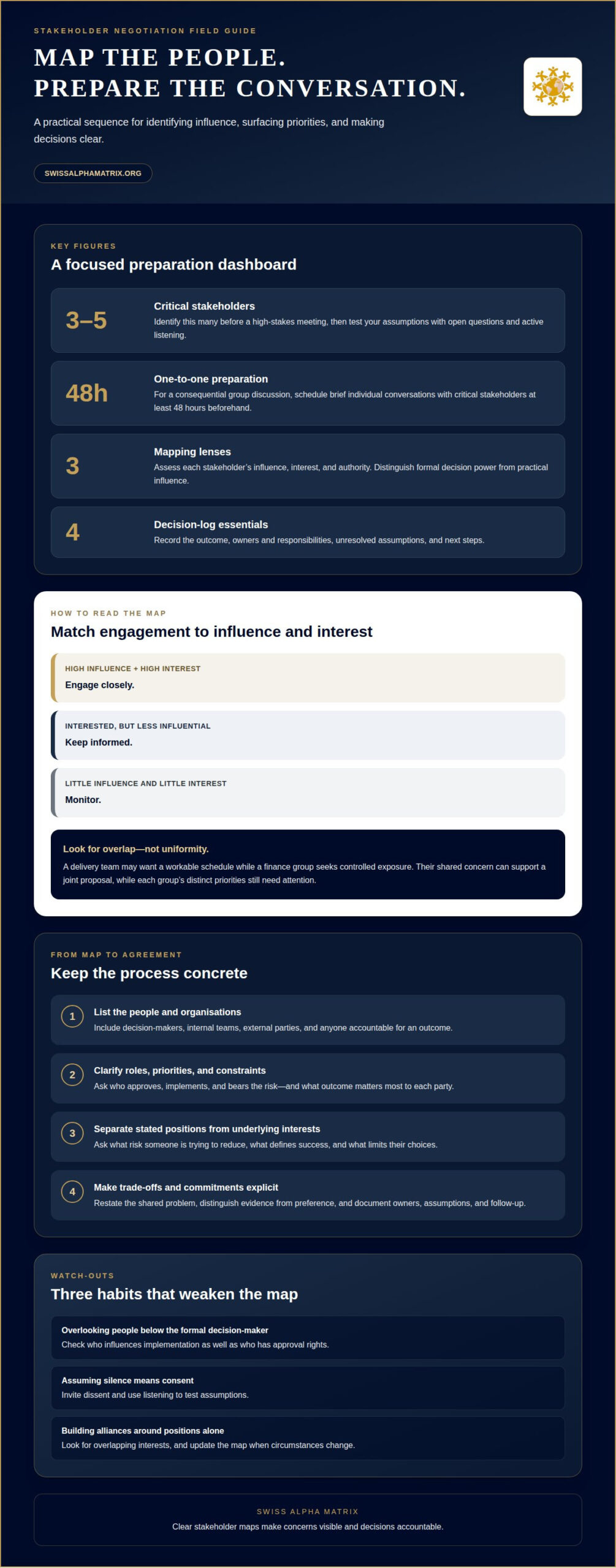
Stakeholder mapping identifies the people and organisations with an interest in a project’s success. Start by listing decision-makers, internal teams, external parties, and anyone accountable for an outcome. Then assess their influence and interest. A project manager can use a spreadsheet to record each stakeholder’s role, priorities, authority, concerns, and preferred way to engage. This makes it easier to distinguish formal decision-making power from practical influence.
Build the map around focused questions: Who approves the decision? Who implements it? Who bears the risk if it fails? What outcome matters most to each party? Which constraints shape their position? Before a high-stakes meeting, identify three to five critical stakeholders. Use open questions and active listening to test assumptions, rather than treating an initial position as the full account of someone’s interest.
Mapping can also reveal potential coalitions without confusing agreement with uniformity. Look for stakeholders with overlapping interests, such as a delivery team seeking a workable schedule and a finance group seeking controlled exposure. Their shared concern may support a joint proposal, while their distinct priorities still need attention. Engage closely with stakeholders who have high influence and interest, keep interested but less influential parties informed, and monitor those with little of either. Trust grows when people see their concerns recorded and understand how decisions will be made.
Record agreements in a decision log that states the outcome, each owner’s responsibilities, unresolved assumptions, and next steps. Note who will act and when follow-up will happen, then circulate the record so participants can resolve ambiguity promptly.
Common mistakes include overlooking people below the formal decision-maker, assuming silence means consent, and building alliances around positions rather than interests. Reduce these risks by checking authority, inviting dissent, and updating the map when circumstances change.
2. Negotiation’s role in stakeholder engagement
Negotiation turns engagement from information-sharing into a process for resolving competing priorities. A project manager can use it to clarify each stakeholder’s position, identify what can change, and agree on a decision path. For example, if a team requests an earlier delivery date, discuss the effects on scope, workload, risk, and quality. This makes trade-offs visible instead of letting a difficult request become a personal disagreement.
Prepare engagement tactics around the decision required, each participant’s authority, and the influence they hold. For a consequential group discussion, schedule brief one-to-one meetings with critical stakeholders at least 48 hours beforehand. These conversations can surface objections, test assumptions, and help participants arrive ready to address the substance. They also create a direct connection before the political dynamics of a larger meeting take hold.
Choose a format that fits the situation. An informal discussion may resolve a narrow operational issue, while a formal meeting can help when several groups need to agree on responsibilities or constraints. In either setting, listen carefully as stakeholders explain their cases. Then restate the shared problem, distinguish evidence from preference, and invite proposals that address more than one interest. A good outcome need not meet every initial demand, but it should make the rationale and consequences clear.
Structure each meeting around a defined outcome, not an arbitrary duration. If a stakeholder refuses to consider trade-offs, explain the effects on risk, workload, or confidence in delivery, then ask which constraint could change. If no agreement emerges, record the unresolved point and identify who has authority to decide it. Follow-up should capture commitments and next steps, moving the discussion forward through accountable action rather than repetition. These practices make negotiation a leadership tool that preserves working relationships and grounds project decisions in evidence.
3. Stakeholder motivations, incentives, and priorities
Stakeholders often state a preferred outcome, while their underlying interests explain why it matters. Effective techniques for stakeholder negotiation start by asking what risk they are trying to reduce, what result defines success, and what constraint limits their choices. A technology leader requesting a new feature may be protecting reliability, while an operations lead may prioritise implementation capacity. Understanding the distinction can reveal ways to create value without treating every request as fixed.
To identify interests, priorities, and decision-making authority, compare each stakeholder’s stated goals with their responsibilities, approval rights, and influence over implementation. Hold individual conversations, ask targeted questions, and record each party’s priorities in order. Confirm who recommends, approves, funds, and executes the action, since those roles may belong to different people.
Prioritisation can take account of legitimacy, power, and urgency. A stakeholder with formal authority and an immediate concern may need direct engagement; a highly interested contributor without approval rights may still offer valuable operational insight. Distinguish urgency from importance, then revisit the ranking when project conditions change. This keeps meetings focused on decision-makers without excluding people whose expertise affects delivery.
Trade priorities against project constraints rather than bargaining over isolated demands. If a stakeholder requests a feature, clarify what could change in scope, time, budget, or quality. For example, adding functionality may require deferring another deliverable or accepting a different schedule. Ask what work could stop if new work begins. An illustrative weighted decision model can assign 30% to cost, while making the remaining criteria explicit to participants.
Among useful techniques for stakeholder negotiation, incentive-aware proposals link each adjustment to a defined benefit or constraint. A team may value predictable workloads, while leaders prioritise strategic alignment and users need dependable performance. Record the agreed priority, its owner, and the next action so the discussion leads to accountable progress and supports a durable working relationship.
4. Comparing techniques by complexity, resources, outcomes, and use cases
Effective techniques combine preparation, attentive listening, evidence, trade-offs, and documented commitments. Their value depends on the context: a routine scheduling decision needs less structure than a cross-functional investment decision involving competing risks. Match the method to the number of interests, the decision’s consequences, and the authority needed to approve it.
For a contained disagreement, start with a focused discussion. Each party states its concern, tests assumptions, and proposes a practical adjustment. This requires little coordination and works when decision-makers can resolve the issue directly. If a delivery team needs a schedule change, for example, compare the proposed date with workload and quality implications before agreeing.
For competing proposals, use an evidence-led comparison. Define shared criteria, assess each option consistently, and make trade-offs visible. An illustrative weighted framework assigns 40% to strategic fit and 30% to technical feasibility. This can clarify alignment when stakeholders disagree over proposals, but it requires credible inputs and agreement on evaluation criteria before scoring begins.
When several groups have different priorities or approval rights, a structured negotiation may be more suitable. Prepare a shared agenda, identify unresolved issues, and involve the relevant decision-makers in sequence. This takes more coordination, but can produce a clearer outcome by linking each commitment to an owner, constraint, and next action. A considered strategy also separates firm requirements from negotiable preferences, reducing the risk of false agreement.
Use the least complex method that can address the decision’s real dependencies; escalate structure when evidence, authority, or cross-team alignment demands it. For projects with interdependent workstreams, explore Complex Project Management to support coordinated decisions and delivery planning.
Swiss Alpha Matrix
Swiss Alpha Matrix supports stakeholders in complex financial and investment programmes where sound negotiation depends on reliable information, clear responsibilities, and coordinated execution. Its services include Operational Due Diligence, Audit-Grade Instrument Validation, On-Ground Verification Services, and Complex Project Management. These services help decision-makers assess issues and coordinate next steps across a project.
Turn to Swiss Alpha Matrix when negotiations involve cross-border arrangements, significant operational dependencies, or a need for structured verification and project oversight. Its work can support stakeholder discussions by grounding decisions in due diligence and clarifying how commitments fit within a complex programme.
For a measured discussion of your project’s requirements, contact Swiss Alpha Matrix.
Carry Negotiation into the Next Decision
The value of techniques for stakeholder negotiation depends not only on reaching agreement, but on whether the resulting decision can be carried forward clearly. Treat each negotiation as part of a broader governance process: preserve the reasoning behind material choices, keep commitments aligned with the project’s direction, and revisit assumptions when circumstances change. This discipline helps stakeholders maintain constructive working relationships without treating every new issue as a return to the beginning.
For complex programmes, independent support can help bring structure to decisions where verification, coordination, and execution intersect. Swiss Alpha Matrix works with stakeholders on complex project management and related advisory needs, bringing a disciplined perspective to demanding financial and investment programmes. If your next decision calls for that kind of support, contact Swiss Alpha Matrix to discuss the matter. A thoughtful next step can make collaboration more deliberate and give the project a sounder basis for progress.
Frequently Asked Questions
How Do You Build Trust Before You Ask for Anything?
Build trust by making your reasoning clear before requesting a concession. Explain the decision context, acknowledge what remains uncertain, and show how the request supports a shared objective. For example, before asking a team to change its delivery sequence, clarify the dependency driving the request and invite them to correct your understanding. Following through on a modest commitment also demonstrates reliability before higher-stakes discussions.
How Do You Handle Difficult Stakeholders and High-Tension Conversations?
Lower the temperature by slowing the exchange and focusing on one decision at a time. If a stakeholder challenges a proposal sharply, acknowledge the specific concern without accepting an unsupported conclusion. Ask what evidence would change their assessment, then address that point directly. If the discussion becomes unproductive, agree to pause and return with a defined issue, relevant information, and a clear purpose for the decision.
How Do You Prepare for Negotiation Before the Conversation Starts?
Prepare by defining your preferred outcome, acceptable limits, and best alternative if no agreement is reached. Gather the evidence behind your position, identify assumptions that could be challenged, and consider the other party’s likely opening proposal. For example, a project lead seeking a scope change can decide which deliverables are essential and which could move, then enter the discussion with practical options instead of a single demand.
How Should You Negotiate with Sponsors, Teams, and Vendors?
Adapt the discussion to each party’s role. With a sponsor, frame choices around strategic objectives, exposure, and the decision that needs approval. With an internal team, examine capacity, dependencies, and delivery consequences. With a vendor, clarify the agreed output, any proposed change, and its operational implications. In each conversation, keep the facts consistent while tailoring the emphasis to the party’s responsibilities.
What Are the Core Principles of Project Negotiation?
Use candour, evidence, proportionality, and clear authority as guiding principles. A project negotiation should distinguish verifiable constraints from preferences, avoid implying approval where none exists, and make the consequences of each option understandable. For example, if a proposed change affects a key dependency, explain the operational impact before discussing concessions. A sound process preserves the integrity of the decision, even when the parties disagree.
What Communication Tools Strengthen Negotiation Outcomes?
A shared issue log can track open questions, owners, and the evidence needed to resolve each point. A decision matrix helps compare options against agreed criteria, while a concise agenda keeps discussion focused on the required outcome. After a verbal agreement, summarise the decision in plain language and ask participants to correct any misunderstanding. These tools create a shared record without replacing sound judgment or direct conversation.