

The modern executive understands that securing board approval for a nine-figure capital expenditure isn’t an exercise in persuasive storytelling, but rather the inevitable conclusion of a validation process so rigorous that dissent becomes a fiduciary risk. In a 2026 fiscal environment defined by a $610 billion surge in AI infrastructure and the permanence of 100% bonus depreciation under the One Big Beautiful Bill Act, the margin for error in your capital expenditure due diligence process has effectively vanished. You likely recognize that internal skepticism regarding ROI projections is often a byproduct of legitimate concerns over cross-border regulatory nuances or the lack of independent, audit-grade validation for high-value bank instruments.
This article promises to equip you with the sophisticated methodologies necessary to transform complex CapEx proposals into validated, board-ready investment mandates. We’ll explore a strategic framework designed to align your objectives with institutional risk standards. By shifting the focus from subjective projections to precise, unemotional data and meticulously verified operational intelligence, you’ll ensure your next major initiative secures unanimous approval while minimizing both personal and corporate exposure in high-stakes deals.
Key Takeaways
- Transition from consensus-based buy-in to hard fiduciary alignment by addressing the institutional skepticism that characterizes the 2026 capital landscape.
- Implement an independent capital expenditure due diligence process to neutralize confirmation bias and provide the board with an unemotional, data-driven foundation for decision-making.
- Utilize audit-grade validation and on-ground verification services to ensure that complex financial instruments and operational assumptions meet the highest institutional standards.
- Align your strategic proposals with evolving international financial regulations through a multi-phase framework that prioritizes capital protection and risk mitigation.
- Leverage specialized oversight from seasoned experts to transform speculative projections into validated mandates that satisfy the most rigorous corporate governance requirements.
The Architecture of Executive Skepticism in Large Capital Expenditures
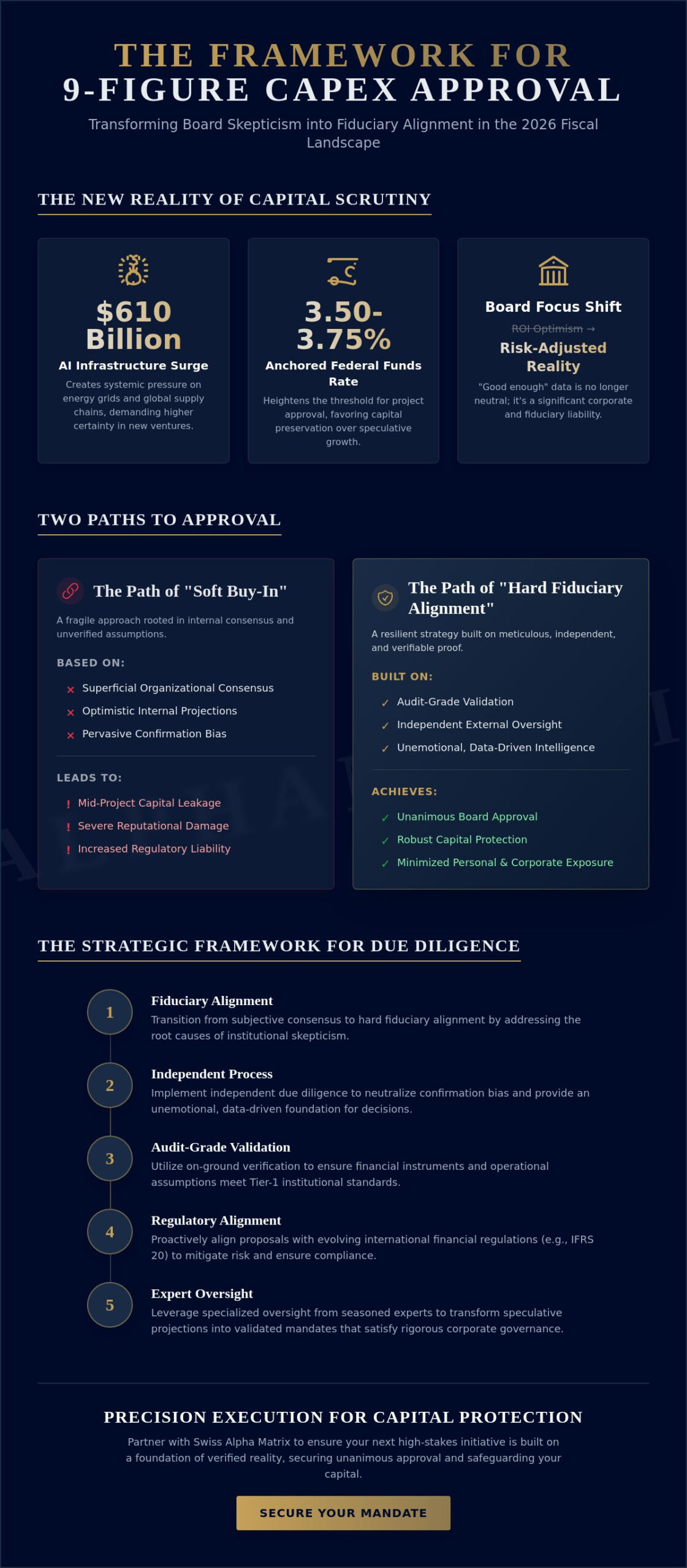
In the fiscal climate of mid-2026, where the federal funds rate remains anchored between 3.50% and 3.75%, the threshold for approving a capital expenditure has reached unprecedented heights of scrutiny. Boards of directors no longer view massive capital deployments through the lens of mere growth; instead, they operate within a framework of defensive preservation and long-term stability. This heightened risk aversion is a rational response to the $610 billion being deployed by hyperscalers for AI infrastructure, a scale of investment that creates systemic pressure on energy grids and global supply chains. Within this environment, a standard capital expenditure due diligence process often fails because it addresses technical feasibility while ignoring the psychological architecture of executive skepticism. This skepticism arises from three primary friction points: acute data asymmetry between project sponsors and the board, intensifying geopolitical volatility in cross-border acquisitions, and the pervasive influence of internal confirmation bias.
To overcome this hesitation, leadership must distinguish between soft buy-in, which relies on superficial organizational consensus, and hard buy-in, which is rooted in absolute fiduciary alignment. While the former may allow a project to commence, only the latter provides the institutional protection required when navigating high-value mandates. Strategic Precision, defined by the meticulous validation of every underlying assumption, serves as the only effective antidote to the inertia of a cautious board.
The Cost of Soft Buy-In
Soft buy-in represents a significant threat to corporate stability. It occurs when stakeholders agree to a proposal based on perceived alignment rather than rigorous, audit-grade proof. When a project proceeds on the back of unvalidated assumptions, the result is almost inevitably mid-project capital leakage and severe reputational damage for the executive sponsors. Maintaining deal integrity requires the integration of independent financial project management. By utilizing external oversight, an organization can ensure that the project’s foundation is built on verified reality rather than the optimistic projections of internal teams who may be too close to the initiative to remain objective.
Fiduciary Duty and the Burden of Proof
For the modern board, “good enough” data is no longer a neutral state; it’s a regulatory liability. The psychological shift from ROI optimism to a focus on Risk-Adjusted Reality has fundamentally altered the capital expenditure due diligence process. Directors now demand a burden of proof that rivals institutional audit standards, particularly as they navigate the new IFRS 20 standards regarding regulatory assets and liabilities. Bridging the gap between an ambitious corporate vision and successful execution requires senior-level expertise that understands the intricate nuances of global banking and institutional risk frameworks. This level of precision ensures that interests are protected by seasoned experts who prioritize strategic growth over short-term speculation.
Establishing the Foundation: Audit-Grade Validation and Operational Due Diligence
True capital protection begins long before a proposal reaches the board, requiring a transition from traditional administrative checks to what we define as Audit-Grade Validation. This rigorous process involves verifying financial instruments and project assumptions to the exact standards of Tier-1 global institutions, ensuring that every figure is backed by verifiable, institutional-grade evidence. Unlike standard due diligence, which often relies on self-reported data or superficial market analysis, a sophisticated capital expenditure due diligence process employs the deep-dive methodologies used by former senior banking executives. These experts don’t just review spreadsheets; they interrogate the underlying capital structures and counterparty risks that internal teams might lack the specialized perspective to see. By positioning this validation as a pre-approval phase, you effectively transform the final board vote into a calm formality of governance rather than a high-stakes debate on risk.
Verifying the Invaluable: Bank Instrument Validation
Securing high-value CapEx often involves complex financial arrangements, including Standby Letters of Credit (SBLCs) or Documentary Letters of Credit (LCs). Utilizing specialized bank instrument validation services is essential to ensure these instruments are authentic, enforceable, and issued by institutions with the necessary liquidity profiles to support the mandate. Verifying these instruments before any capital deployment occurs protects the organization from fraudulent actors and structural failures in the funding pipeline. Instrument validation serves as a non-negotiable safeguard for cross-border transactions where local banking customs may diverge from global standards. For those seeking to accurately estimate and model capex spending, the integrity of the underlying financial instruments remains the most critical variable in the entire risk equation.
Operational Due Diligence: Beyond the Balance Sheet
Financial modeling alone cannot account for the physical realities of an investment, particularly in emerging or international markets. On-ground verification serves as the ultimate reality check, ensuring that the physical assets, infrastructure, and operational capacities described in a proposal actually exist in the stated condition. Rigorous cross-border investment due diligence frequently uncovers hidden liabilities, such as undisclosed regulatory encumbrances or operational bottlenecks, that internal teams might overlook due to a lack of specialized transactional experience. These red flags are often invisible to those without a history of managing complex, large-scale projects in diverse jurisdictions. By partnering with a firm that provides on-ground verification services, project sponsors can provide the board with an unassailable level of operational certainty that internal projections simply cannot match.
Independent Oversight vs. Internal Projections: Mitigating Confirmation Bias
A frequent objection raised during the initial stages of a high-value mandate is the belief that a robust internal finance department is sufficient to manage the capital expenditure due diligence process. While internal teams possess deep institutional knowledge, they’re often burdened by an inherent paradox: the very individuals responsible for advocating for a project’s strategic necessity are also tasked with its objective validation. This structural conflict of interest creates a fertile ground for confirmation bias, where data points are subtly filtered to support the project sponsor’s desired outcome. Independent oversight, characterized by a sense of quiet authority and technical detachment, provides a dignified second opinion that reassures skeptical board members that the investment is sound.
Utilizing an external partner ensures that the verification process remains insulated from internal corporate politics. This is particularly vital in transactions requiring absolute confidentiality. The tradition of Swiss discretion, combined with a commitment to regional precision, ensures that sensitive deal details remain protected while providing the board with the unemotional data they require. This approach doesn’t just validate the numbers; it validates the integrity of the decision-making process itself. It feels less like a hurdle and more like a protective layer for the organization’s long-term interests.
The Internal Team Paradox
The limitation of internal teams often lies in the lack of a Tier-1 bank lens, which is essential for interrogating the sophisticated financial instruments that underpin modern CapEx deployments. Project sponsors are, by definition, advocates for their vision, which makes it difficult for them to maintain the necessary critical distance. To maintain deal integrity, it’s essential to employ institutional-grade financial advisory methodologies that are entirely detached from the internal hierarchy. This detachment allows for a forensic examination of risk that internal departments, however skilled, are rarely positioned to perform without bias or pressure from above.
The Value of Independent Precision
Engaging a third-party expert acts as an insurance policy for the project sponsor’s professional reputation. When a proposal is backed by independent validation, the sponsor is no longer solely responsible for the veracity of the data; the burden of proof is shared with an objective authority. This external verification frequently leads to more favorable financing terms from lenders, as it signals a commitment to transparency and risk mitigation. As noted in the principles of Due Diligence in Project Finance, a structured and independent review is the cornerstone of capital protection in any large-scale infrastructure or equipment acquisition. While some industry professionals report that independent oversight can reduce the probability of capital misallocation by identifying structural flaws early, the true value lies in the absolute certainty it provides to those with fiduciary responsibility. This rigorous capital expenditure due diligence process ensures that every dollar deployed is an investment in growth rather than a gamble on unverified projections.
A Strategic Framework for Securing Board-Level Buy-In for Complex Projects
Securing a mandate for significant capital deployment requires a sequence of actions that move beyond internal consensus toward an unassailable institutional proof. This framework is designed to ensure that by the time a proposal reaches the formal board meeting, every potential objection has been neutralized through technical validation. The process is structured into five distinct phases that prioritize capital protection and fiduciary alignment over speculative growth projections.
- Phase 1: Pre-Validation – Engage independent experts to audit the core assumptions of the CapEx proposal, identifying any structural weaknesses or optimism bias before they’re exposed by the board.
- Phase 2: Risk Framework Alignment – Map the project against current international financial regulations to ensure the deployment remains compliant with the evolving standards of 2026.
- Phase 3: The Independent Report – Produce an audit-grade assessment that explicitly addresses counterparty risk and instrument validity, providing a technical anchor for the capital expenditure due diligence process.
- Phase 4: Stakeholder De-Risking – Socialize the validated data with key gateholders and skeptical directors individually, allowing for a quiet resolution of concerns in a dignified setting.
- Phase 5: The Fiduciary Presentation – Position the initiative as a validated deployment of capital into a secure asset class rather than a traditional corporate spend.
Mapping to Global Compliance Standards
In a 2026 regulatory environment, characterized by the implementation of IFRS 20 regarding regulatory assets and liabilities, standard due diligence is no longer sufficient for high-stakes projects. A proposal must survive a rigorous stress test against current geopolitical volatility and the sustained federal funds rate of 3.50% to 3.75%. Senior-level regulatory compliance advisory ensures that the project doesn’t merely meet minimum legal requirements but aligns with the sophisticated risk frameworks expected by Tier-1 financial institutions. This meticulous attention to detail transforms a project from a potential liability into a verified strategic asset.
The Art of the Fiduciary Presentation
The final presentation to the board should be characterized by a shift in vocabulary, moving away from speculative ROI and toward the language of capital preservation. By utilizing institutional terminology and precise performance metrics, the project sponsor demonstrates a performance-oriented mindset that distinguishes themselves from passive participants. Executive Intelligence is the essential catalyst required to navigate high-stakes board dynamics, allowing the sponsor to lead the room through a logical progression toward inevitable approval. When the capital expenditure due diligence process is presented as a completed, audit-grade verification, the board’s decision becomes an exercise in prudent governance rather than a debate on unverified vision.
Precision Execution: Partnering with Swiss Alpha Matrix for Capital Protection
The successful navigation of a high-value investment mandate requires more than a standard checklist; it demands a partner capable of providing the audit-grade intelligence that internal finance departments, by their very nature as generalists, cannot access. Swiss Alpha Matrix serves as this specialized extension of your executive team, offering a level of technical interrogation that transforms the capital expenditure due diligence process into an unassailable shield for your professional reputation. By engaging a firm led exclusively by former senior executives from Tier-1 global banks, you ensure that your proposal is viewed through the same lens as the world’s most sophisticated institutional lenders. This level of oversight is particularly critical for cross-border mandates where the complexity of local regulatory environments and the opacity of foreign financial instruments can create catastrophic blind spots for the uninitiated.
Tailoring a buy-in strategy for these intricate deals involves a meticulous alignment of your corporate objectives with the rigorous standards of global capital protection. It isn’t enough to simply present a project; one must present a project that has been stress-tested against the sustained federal funds rate of 3.50% to 3.75% and the specific requirements of IFRS 20. This commitment to precision ensures that your capital deployment is not merely a tactical move, but a protected strategic advancement. When interests are managed by experts who prioritize long-term preservation over short-term speculation, the result is a professional calm that encourages board confidence and institutional trust.
The Boutique Advantage: Exclusivity and Discretion
Institutional clients increasingly favor the personalized oversight of a boutique firm over the standardized, high-volume models of large aggregators. This preference is rooted in the need for hyper-personalization and a standard of service that is meticulous in its attention to detail. In jurisdictions where paper records are often insufficient or unreliable, our on-ground verification services provide the physical reality check necessary to validate asset existence and operational capacity. This approach offers high-level access and a level of discretion that mirrors the traditional values of private wealth management. It’s a performance-oriented mindset that ensures every nuance of a cross-border transaction is scrutinized by seasoned hands, providing a standard of excellence that distinguishes our partners from passive market participants.
Next Steps: Securing Your Next Major Mandate
Engaging Swiss Alpha Matrix begins with a preliminary project review, a process designed to identify the specific risk vectors of your proposed capital deployment. This initial assessment serves as the foundation for a comprehensive risk management framework, transitioning seamlessly from initial capital expenditure due diligence process into long-term complex project management. Our role is to act as a master planner, ensuring that from the moment of board approval to the final execution of the project, your interests remain in the hands of protective authorities. To ensure your next major initiative is backed by the technical depth and regional precision required for success in 2026, we invite you to consult with our senior advisors at Swiss Alpha Matrix. Secure the professional stability your mandate deserves through a partnership rooted in historical reliability and institutional excellence.
Advancing Toward Institutional Certainty
The transition from a speculative proposal to a board-ready mandate requires a fundamental shift in how risk is quantified and communicated. By embracing a more rigorous capital expenditure due diligence process, you move beyond the limitations of internal bias and align your objectives with the sophisticated standards of global finance. This methodology replaces the burden of executive skepticism with the calm of verified data, ensuring that every deployment of capital is both strategic and secure. It’s about transforming a high-stakes request into an inevitable fiduciary conclusion.
Ensuring your next major initiative withstands the scrutiny of 2026 requires the technical depth of a protective authority. Swiss Alpha Matrix, managed by former Tier-1 global bank senior executives, provides the audit-grade financial instrument validation and regional precision necessary to protect your corporate reputation. Through a unique combination of global reach and Swiss discretion, we ensure your interests are in the hands of seasoned experts who prioritize long-term stability. Secure your capital deployment with executive-level intelligence at Swiss Alpha Matrix and proceed with the confidence that only meticulous validation can provide.
Frequently Asked Questions
What is the difference between standard due diligence and audit-grade instrument validation?
Audit-grade instrument validation involves a technical interrogation of financial assets to institutional standards, whereas standard due diligence typically focuses on basic administrative compliance. This sophisticated level of scrutiny ensures that bank instruments, such as standby letters of credit, are both authentic and enforceable within global banking corridors. It provides a board with the technical certainty required to authorize significant capital movement without the risk of structural failure.
How does independent project oversight differ from internal PMO functions?
Independent project oversight provides a neutral, fiduciary-focused perspective that remains distinct from the operational execution goals of an internal Project Management Office. While a PMO focuses on timelines and resource allocation, an independent partner ensures the project remains aligned with the broader risk management framework. This technical detachment is essential for maintaining deal integrity and protecting the project sponsor’s professional reputation from internal politics.
Why is on-ground verification necessary for securing CapEx buy-in in cross-border deals?
On-ground verification serves as the ultimate reality check in jurisdictions where paper records are often insufficient or opaque. It ensures that the physical infrastructure and operational assets described in a proposal actually exist in their stated condition. This physical interrogation is a vital component of the capital expenditure due diligence process, as it uncovers hidden liabilities that remote analysis simply cannot detect.
Can Swiss Alpha Matrix assist with regulatory compliance during the buy-in process?
We provide specialized regulatory compliance advisory to ensure that complex proposals align with evolving international standards such as IFRS 20. By mapping a project against current financial regulations and geopolitical volatility, we help executives navigate the intricate requirements of high-stakes board approvals. This advisory ensures that the mandate doesn’t merely meet legal minimums but satisfies the most rigorous institutional expectations.
How do former Tier-1 banking executives improve the probability of board approval?
Former Tier-1 banking executives bring a unique institutional lens that allows them to speak the board’s native language regarding risk and capital preservation. Their history of managing multi-billion dollar mandates provides immediate credibility, transforming a speculative request into a validated investment mandate. This elite perspective ensures that every data point is interrogated with the same skepticism a board member would apply during a formal review.
What are the most common red flags that cause a board to reject a CapEx proposal?
Boards frequently reject proposals due to data asymmetry, unvalidated financial instruments, or the lack of an independent second opinion. When a proposal relies solely on internal projections without external validation, it creates a perceived fiduciary risk for directors. Identifying these red flags early through a structured capital expenditure due diligence process prevents reputational damage and ensures a smoother path to unanimous approval based on verified data.
Is independent advisory cost-effective for smaller capital expenditures?
Independent advisory serves as a sophisticated insurance policy that protects against the high cost of capital misallocation, regardless of the project’s relative size. For smaller yet complex expenditures, the cost of a structural failure often far exceeds the investment in professional oversight. We provide the same level of meticulous attention to detail and technical precision to ensure that every deployment is strategically sound and protected from avoidable risk.
How does Swiss Alpha Matrix maintain discretion during sensitive cross-border investigations?
We maintain absolute discretion through a boutique service model that prioritizes privacy and exclusive access over high-volume visibility. Our methodology is rooted in the traditional values of Swiss private wealth management, ensuring that sensitive transaction details remain protected during complex investigations. This quiet authority allows us to conduct thorough on-ground verifications without attracting unnecessary attention to the client’s strategic intentions or internal deliberations.