

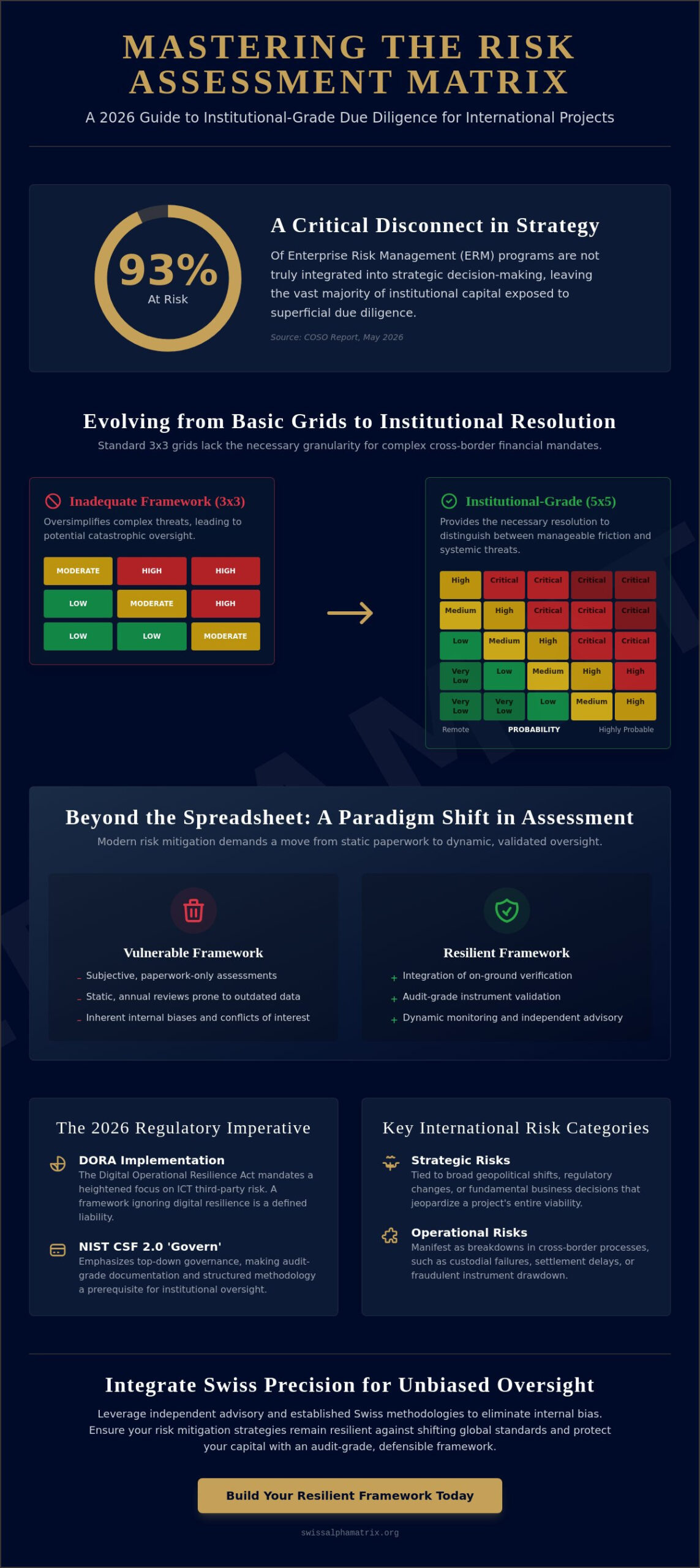
According to a May 2026 COSO report, a mere 7% of Enterprise Risk Management programs are truly integrated into strategic decision-making; this leaves the vast majority of institutional capital exposed to superficial due diligence that fails to account for on-ground realities. It’s a sentiment shared by many sophisticated leaders who find themselves overwhelmed by high volumes of qualitative data that lack a clear prioritization framework for capital allocation. You likely recognize that a standard risk assessment matrix for international projects often functions as a liability rather than a shield if it’s not anchored by audit-grade instrument validation and technical precision.
This article serves as a definitive guide to mastering the sophisticated architecture of risk matrices, ensuring your cross-border investments maintain regulatory resilience against the shifting landscape of 2026. We’ll examine how to align internal models with the latest ISO 31000:2018 principles and May 2026 COSO supplemental guidance to create a defensible, audit-grade risk map. By the conclusion, you’ll possess the clarity needed to transform your risk appetite into a structured methodology for strategic growth and long-term preservation.
Key Takeaways
- Master the sophisticated architecture of a risk assessment matrix for international projects to effectively visualize the intersection of probability and severity within complex cross-border financial mandates.
- Adopt a granular 5×5 Probability-Impact Grid to ensure the level of technical accuracy required for institutional-grade due diligence and long-term capital preservation.
- Move beyond the inherent vulnerabilities of subjective, paperwork-only assessments by integrating on-ground verification and audit-grade instrument validation into your oversight framework.
- Calibrate the International Project Risk Assessment (IPRA) framework to account for jurisdictional nuances, distinguishing the unique regulatory and political landscapes of diverse global financial hubs.
- Leverage independent advisory and established Swiss methodologies to eliminate internal bias, ensuring your risk mitigation strategies remain resilient against 2026 global standards like DORA.
The Architecture of Risk: Defining the Matrix for Global Capital Deployment
In the sphere of high-stakes cross-border mandates, the Risk Matrix evolves from a mere administrative tool into a sophisticated instrument of institutional defense. At its core, the risk assessment matrix for international projects is a visual methodology that plots the probability of an adverse event against the severity of its consequence, specifically tailored for complex financial mandates. Unlike generic project management grids that focus on logistical delays, an institutional framework must prioritize the integrity of financial instruments. For instance, in transactions involving Standby Letters of Credit (SBLCs) or Documentary Letters of Credit (LCs), the risk of fraudulent drawdown or non-performance represents a catastrophic threat to principal preservation that standard matrices often overlook.
The regulatory environment of May 2026, characterized by the full implementation of the Digital Operational Resilience Act (DORA) and the refinement of NIST CSF 2.0 ‘Govern’ functions, mandates a transition from static, annual reviews toward dynamic monitoring. This shift ensures that the matrix isn’t just a snapshot in time but a living record of capital vulnerability. By aligning the matrix with these global standards, entities can provide the technical accuracy required to distinguish between a minor operational friction and a systemic failure in custodial procedures, catering to a sophisticated audience that values nuance and professional competence. This architecture serves as a protective authority, ensuring that modern strategies are tethered to concepts of regional excellence and precision.
Strategic vs. Operational Risk in International Mandates
Differentiating between strategic and operational hazards is paramount for determining capital reserve requirements in foreign jurisdictions. Strategic risks are frequently tied to broader geopolitical shifts or fundamental business decisions that, if flawed, jeopardize the entire project’s viability. Conversely, operational risks manifest as breakdowns in cross-border internal processes, such as custodial failures or settlement delays in emerging markets. A robust risk assessment matrix for international projects allows the master planner to categorize these threats with precision, ensuring that interests are in the hands of seasoned experts who prioritize long-term preservation over short-term speculation.
The 2026 Regulatory Landscape for Risk Reporting
The full implementation of DORA has fundamentally altered the ‘Impact’ axis for financial entities, requiring a heightened focus on ICT third-party risk within the standard project matrix. In 2026, a risk framework that ignores the digital operational resilience of overseas partners is considered a liability by executive stakeholders and regulators alike. Maintaining audit-grade documentation is no longer optional; it is a prerequisite for regulatory compliance and institutional oversight. By integrating these modern requirements into the architecture of risk, the matrix serves as a structured argument for the methodology, providing the quiet authority and professional calm necessary to encourage confidence among high-net-worth individuals and institutional entities.
Constructing the Probability-Impact Grid: A Multi-Dimensional Financial Approach
The structural integrity of a risk assessment matrix for international projects depends entirely on its granularity. While a 3×3 grid might suffice for internal administrative tasks, institutional mandates require a 5×5 configuration to provide the resolution necessary for complex capital protection. This expanded architecture allows for a more nuanced multinational risk analysis, distinguishing between manageable friction and systemic threats. On the horizontal X-axis, likelihood levels are defined from ‘Remote’ to ‘Highly Probable,’ while the vertical Y-axis measures severity from ‘Negligible’ to ‘Catastrophic Capital Loss.’ The resulting heat map dictates the intensity of oversight. Risks in the upper right quadrant demand immediate intervention and capital allocation, whereas those in the lower left may only require passive monitoring through quarterly reviews.
Implementing this grid requires a shift in perspective. Standard project management often prioritizes schedule adherence, yet in the context of high-value finance, the primary concern is the preservation of principal and the mitigation of basis point erosion. When the matrix indicates a ‘High’ or ‘Critical’ risk level, it signals that the project’s viability is tethered to external variables beyond the control of the primary stakeholders. This is where a robust operational due diligence framework becomes indispensable to validate the assumptions underlying each score.
Quantifying Financial Severity in Cross-Border Deals
In international finance, severity isn’t measured in days lost but in the degradation of the internal rate of return (IRR). A ‘Major’ impact on the Y-axis might represent a scenario where currency volatility or transfer risks threaten the liquidity of a Standby Letter of Credit (SBLC). Institutional experts must set thresholds where ‘Catastrophic’ reflects a 10% or greater exposure of the total principal. This precision prevents the ‘paperwork-only’ trap, ensuring that capital reserve requirements are calculated based on actual financial vulnerability rather than vague qualitative descriptors.
Determining Probability in Volatile Jurisdictions
Assigning probability in frontier markets is notoriously difficult because these environments rarely follow a ‘Normal Distribution’ pattern. Instead of relying solely on historical transactional data, sophisticated models incorporate forward-looking geopolitical intelligence. This includes leveraging the World Bank’s Worldwide Governance Indicators, which were last updated on March 18, 2026, to assess political stability and regulatory quality. By adjusting probability scores based on real-time counterparty creditworthiness and regional precision, the matrix remains a reliable guide for strategic execution in an increasingly fragmented global landscape.
Beyond the Spreadsheet: Addressing the Critical Flaws of Qualitative Assessment
The inherent vulnerability of any risk assessment matrix for international projects lies not in its visual design, but in the integrity of the data that informs its coordinates. While the 5×5 grid discussed previously provides a necessary structure, it remains susceptible to the ‘Garbage In, Garbage Out’ phenomenon, where subjective bias or incomplete information leads to a fundamental miscalculation of capital risk. For the institutional investor, a matrix populated by optimistic internal projections rather than verified external realities creates a dangerous illusion of safety. This paperwork-only approach often satisfies internal compliance checklists while leaving the actual principal exposed to unmitigated on-ground hazards. To make these qualitative grids truly defensible for high-level audits, the underlying inputs must transition from anecdotal evidence to validated, technical data points.
Sophisticated entities recognize that a defensible risk map requires a refusal to oversimplify complex dynamics. Relying solely on digital documentation or contractual warranties in foreign jurisdictions is a strategy rooted in speculation rather than preservation. When a matrix identifies a risk as ‘Low Probability,’ that designation is only as reliable as the verification process behind it. Without a rigorous methodology to challenge and validate the assumptions of the X and Y axes, the matrix becomes a liability that can obscure emerging threats until they reach a point of catastrophic failure. True institutional resilience demands that every cell in the grid is anchored by a standard of evidence that meets the scrutiny of seasoned, unemotional experts.
The Limitation of Paper-Based Validation
In the context of international finance, fraudulent financial instruments like Standby Letters of Credit (SBLCs) or Documentary Letters of Credit (LCs) are specifically designed to bypass standard, desk-based risk grids. These sophisticated forgeries often appear impeccable on paper, leading analysts to assign a ‘Low’ impact score to custodial risks. The role of bank instrument validation services is critical here; they provide the technical verification necessary to confirm the matrix’s ‘Impact’ axis represents a real, enforceable asset. Historical data suggests that many ‘Low Probability’ events in frontier markets occur simply because the counterparties were never properly vetted beyond their provided documentation.
Integrating On-Ground Verification into the Framework
Moving from a desk-based to a site-based assessment is the only way to ensure a risk assessment matrix for international projects reflects reality rather than contractual promises. On-ground verification involves the physical inspection of assets and the confirmation of operational existence within foreign jurisdictions, removing the veil of distance that often masks incompetence or malfeasance. By embedding these site-based findings into the risk management framework, an organization can calibrate its matrix with regional precision. This meticulous attention to detail distinguishes a performance-oriented mindset from passive participants who remain tethered to their spreadsheets while their capital is at risk abroad.
Implementing the International Project Risk Assessment (IPRA) Framework
The transition from theoretical modeling to operational execution requires a disciplined implementation of the International Project Risk Assessment (IPRA) framework. This methodology moves beyond the static grids of the past, opting instead for a dynamic architecture that mirrors the complexity of global capital deployment. To begin, practitioners must identify international-specific risk elements across legal, political, and financial dimensions. Following this identification, the risk assessment matrix for international projects must be calibrated for the specific jurisdiction in question. A matrix configured for the stability of Switzerland will fundamentally differ from one designed for the dynamic regulatory environment of Hong Kong; political stability and regulatory quality require frequent recalibration based on the latest World Bank data to ensure technical accuracy.
The third step involves conducting a deep-dive cross-border investment due diligence to populate the grid with technical data rather than anecdotal evidence. Once the grid is populated, the ‘Risk Response’ is executed according to matrix prioritization, ensuring that capital is allocated where the threat to principal is most acute. Finally, a continuous monitoring loop must be established to capture high-velocity risks, such as shifts in the 3-month EURIBOR, which stood at 2.204% in late May 2026, or sudden changes in Basel IV implementation timelines. For organizations seeking to secure their mandates with this level of technical precision, our risk management frameworks offer a defensible path to institutional resilience.
Identifying International-Specific Risk Elements
Sovereign risk serves as a primary pillar in this identification process, as sudden regulatory shifts can invalidate previously secured protections. Beyond the purely legal, cultural and linguistic barriers often introduce friction in complex project management, leading to misinterpretations of contractual obligations. Logistical risks, particularly in frontier markets with underdeveloped infrastructure, must also be quantified. These elements are not mere hazards; they are variables that directly influence the ‘Impact’ axis of the institutional matrix, requiring a standard of service that is meticulous in its attention to detail.
Tracking Risks from Inception to Operation
Maintaining a living risk register is essential for feeding the matrix in real-time. This register distinguishes between project milestones vs deliverables, ensuring that risk tracking remains aligned with strategic objectives rather than just tactical completions. As the project evolves, any significant shift in matrix coordinates must be reported to the Board and executive stakeholders with audit-grade documentation. This transparency fosters a culture of accountability and ensures that the master planner remains in control of the project’s long-term trajectory, prioritizing stability over short-term speculation.
Institutional Oversight: Integrating Swiss Precision into Risk Mitigation
The final pillar in securing a risk assessment matrix for international projects is the introduction of independent oversight to eliminate the inherent biases of internal stakeholders. Despite their competence, internal teams often fall prey to institutional inertia or “deal fever,” which can lead to the underestimation of catastrophic tail risks. By engaging an external protective authority, organizations ensure that their risk scoring is subjected to a rigorous, unemotional critique. This process utilizes institutional-grade financial advisory methodologies to validate every coordinate on the grid, transforming a theoretical exercise into a defensible shield for institutional capital. It’s about moving beyond the spreadsheet to ensure that the logic of the matrix remains steady under the scrutiny of an audit.
Swiss Alpha Matrix provides this level of audit-grade oversight, offering a standard of service that mirrors the traditional discretion of high-end private wealth management. Our role extends beyond the initial plotting of hazards; we facilitate the transition from risk ‘assessment’ to active risk ‘management’ through mandate-specific engagements. This involves the application of regional excellence and precision to verify that the safeguards promised on paper are operational in reality. For entities navigating the fragmented regulatory landscape of 2026, where Basel IV implementation deadlines diverge across the EU and the UK, having a master planner to oversee these intricacies isn’t just a preference. It’s a prerequisite for long-term preservation and strategic growth.
Audit-Grade Validation as a Risk Response
Specialized due diligence serves as the primary mechanism for moving risks from ‘High’ to ‘Mitigated.’ By leveraging the expertise of professionals with backgrounds in Tier-1 banking, we subject financial instruments to a level of scrutiny that standard project managers simply cannot provide. This instrument analysis ensures that the ‘Impact’ axis of your matrix is based on executive-level intelligence rather than hearsay. When every matrix point is backed by technical validation, the organization can deploy capital with the confidence that its interests are in the hands of seasoned experts who prioritize stability over short-term speculation.
Retainer-Based Strategic Oversight
Maintaining compliance with international financial regulations across all project phases requires continuous access to senior experts. Through retainer-based oversight, we provide the steady, logical guidance necessary to navigate transactional risk mitigation in real-time. This includes monitoring the latest World Bank Worldwide Governance Indicators, which were last updated on March 18, 2026, to adjust for shifting political risks. Our approach ensures that project management remains unemotional and expert-led, providing an implicit promise of exclusivity and a standard of service that is both broad in reach and meticulous in its attention to detail.
Securing the Future of Global Capital Deployment
The pursuit of regional excellence in cross-border finance demands a departure from the superficiality of static documentation. We’ve explored how a technically calibrated risk assessment matrix for international projects serves as the foundation for institutional capital protection, provided it’s anchored by audit-grade validation rather than qualitative speculation. By integrating the IPRA framework and prioritizing on-ground verification, sophisticated entities can navigate the complexities of 2026 regulatory shifts with absolute precision. This methodology ensures that every strategic pillar is reinforced by technical accuracy, protecting the integrity of the principal against the inherent volatility of global mandates.
True resilience is achieved when interests are placed in the hands of seasoned experts who prioritize long-term preservation over short-term speculation. Secure your international capital with Swiss Alpha Matrix’s independent oversight and leverage a standard of service defined by former Tier-1 global bank executives. Our commitment to audit-grade instrument validation and on-ground verification in global jurisdictions provides the quiet authority required to execute complex projects with confidence. We invite you to embrace a methodology that values nuance, thoroughness, and the meticulous attention to detail that your capital deserves.
Frequently Asked Questions
What is the primary difference between a 3×3 and a 5×5 risk assessment matrix for international projects?
The primary difference lies in the granularity of resolution, as a 5×5 configuration provides twenty-five distinct risk profiles compared to the nine offered by a 3×3 grid. For institutional mandates, this increased resolution is essential to distinguish between manageable operational friction and systemic threats to principal. A 5×5 risk assessment matrix for international projects allows for a more nuanced calibration of technical data, ensuring that capital allocation remains aligned with precise risk appetites and strategic growth objectives.
How often should an international project risk matrix be updated in 2026?
In the regulatory environment of 2026, an international project risk matrix should be updated through a continuous monitoring loop rather than on a static, annual basis. High-velocity risks, such as fluctuations in the 3-month EURIBOR, which stood at 2.204% in late May 2026, or shifts in Basel IV implementation timelines, necessitate real-time data integration. Monthly reviews are often the minimum standard for complex mandates to ensure that the framework reflects current geopolitical and financial realities and maintains technical accuracy.
Can a risk assessment matrix be used for financial instrument validation?
A risk matrix does not validate financial instruments directly, but it relies on audit-grade instrument validation to accurately define its “Impact” axis. Without verifying the authenticity of SBLCs or LCs, the severity score remains speculative and potentially catastrophic. Integrating specialized validation services ensures that the coordinates on the grid are backed by technical evidence, moving the process from a qualitative exercise to a defensible institutional shield that prioritizes long-term preservation over short-term speculation.
What are the most common ‘red flags’ that move a risk to the ‘Catastrophic’ quadrant?
Risks move to the ‘Catastrophic’ quadrant when they involve unverified counterparties, fraudulent financial instruments, or sovereign shifts that threaten 10% or more of the total principal. Other red flags include a lack of on-ground operational existence in foreign jurisdictions or a failure to align with the Digital Operational Resilience Act (DORA). These indicators signify that the threat is no longer a localized delay but a systemic risk to the long-term preservation of capital, requiring immediate intervention and expert-led project management.
How does DORA compliance affect the way financial firms use risk matrices?
DORA compliance forces financial firms to integrate ICT third-party risk and operational resilience directly into the ‘Impact’ axis of their risk grids. This shift mandates that firms move beyond simple financial metrics to account for the technical integrity of their cross-border custodial procedures. By aligning a risk assessment matrix for international projects with DORA standards, entities ensure their frameworks are resilient enough to withstand the scrutiny of 2026 regulatory audits and maintain a standard of service that is both broad in reach and meticulous in detail.
Is a qualitative risk matrix sufficient for multi-jurisdictional M&A deals?
A purely qualitative risk matrix is insufficient for multi-jurisdictional M&A deals because it lacks the technical precision required to validate complex cross-border assets. These transactions demand on-ground verification and audit-grade due diligence to ensure the matrix reflects reality rather than contractual promises. Relying on subjective scoring without technical evidence in an M&A context often leads to significant capital loss and unrecognized basis point erosion, undermining the stability and trust expected by high-net-worth individuals and institutional entities.
What is the IPRA framework and how does it differ from standard PMP risk tools?
The International Project Risk Assessment (IPRA) framework differs from standard PMP tools by focusing specifically on the unique hazards of cross-border capital deployment, such as sovereign risk and linguistic barriers. While PMP tools often prioritize schedule and task completion, the IPRA methodology emphasizes the protection of principal and strategic alignment in volatile jurisdictions. It provides a more sophisticated architecture for master planners who must manage the intricate dynamics of international financial mandates, incorporating perception-based data like the World Bank’s Worldwide Governance Indicators last updated on March 18, 2026.